
Orion (ORN)
Orion is up against the odds. Its poor sales growth shows demand is soft and its negative returns on capital suggest it destroyed value.― StockStory Analyst Team


1. News


2. Summary
Why We Think Orion Will Underperform
Established in 1994, Orion (NYSE:ORN) provides construction services for marine infrastructure and industrial projects.
- Earnings per share have contracted by 3.8% annually over the last five years, a headwind for returns as stock prices often echo long-term EPS performance
- Gross margin of 9.5% reflects its high production costs
- Responsiveness to unforeseen market trends is restricted due to its substandard operating margin profitability
Orion’s quality doesn’t meet our hurdle. We’re on the lookout for more interesting opportunities.
Why There Are Better Opportunities Than Orion







Orion is trading at $12.21 per share, or 48.6x forward P/E. The current multiple is quite expensive, especially for the tepid revenue growth.
We prefer to invest in similarly-priced but higher-quality companies with superior earnings growth.
3. Orion (ORN) Research Report: Q3 CY2025 Update
Marine infrastructure company Orion (NYSE:ORN) met Wall Street’s revenue expectations in Q3 CY2025, but sales were flat year on year at $225.1 million. The company’s full-year revenue guidance of $842.5 million at the midpoint came in 1.6% above analysts’ estimates. Its non-GAAP profit of $0.09 per share was 50% above analysts’ consensus estimates.
Orion (ORN) Q3 CY2025 Highlights:
- Revenue: $225.1 million vs analyst estimates of $225.3 million (flat year on year, in line)
- Adjusted EPS: $0.09 vs analyst estimates of $0.06 (3c beat)
- Adjusted EBITDA: $13.13 million vs analyst estimates of $13.19 million (5.8% margin, in line)
- The company lifted its revenue guidance for the full year to $842.5 million at the midpoint from $825 million, a 2.1% increase
- Management raised its full-year Adjusted EPS guidance to $0.20 at the midpoint, a 42.9% increase
- EBITDA guidance for the full year is $45 million at the midpoint, above analyst estimates of $44.37 million
- Operating Margin: 2.4%, in line with the same quarter last year
- Free Cash Flow was -$2.08 million, down from $33.31 million in the same quarter last year
- Backlog: $679 million at quarter end, down 1.7% year on year
- Market Capitalization: $346.1 million
Company Overview
Established in 1994, Orion (NYSE:ORN) provides construction services for marine infrastructure and industrial projects.
Over the years, Orion has expanded its scope from marine construction project management through strategic acquisitions and the buildout of its equipment fleet. Today, Orion offers specialty construction and engineering services across various sectors including infrastructure, industrial, and building.
Orion provides a broad range of construction services, especially in marine environments. These include the building and rehabilitation of marine transportation facilities like ports and marinas, installation and maintenance of marine pipelines, and construction of bridges and causeways. Its projects are crucial for enhancing marine and transportation infrastructure, ensuring the longevity and functionality of these essential facilities.
The company’s revenue streams are diversified across several construction and engineering services, with a business model that emphasizes long-term customer relationships and recurring revenue through maintenance dredging and other ongoing service contracts. Orion markets its services through a blend of direct sales efforts by its seasoned professionals and competitive bidding processes.
4. Construction and Maintenance Services
Construction and maintenance services companies not only boast technical know-how in specialized areas but also may hold special licenses and permits. Those who work in more regulated areas can enjoy more predictable revenue streams - for example, fire escapes need to be inspected every five years. More recently, services to address energy efficiency and labor availability are also creating incremental demand. But like the broader industrials sector, construction and maintenance services companies are at the whim of economic cycles as external factors like interest rates can greatly impact the new construction that drives incremental demand for these companies’ offerings.
Competitors in the marine construction and engineering sector include Great Lakes Dredge & Dock (NASDAQ:GLDD), Sterling Construction (NASDAQ:STRL), while a prominent private competitor is Weeks Marine
5. Revenue Growth
A company’s long-term sales performance can indicate its overall quality. Any business can put up a good quarter or two, but many enduring ones grow for years. Unfortunately, Orion’s 2.5% annualized revenue growth over the last five years was sluggish. This was below our standards and is a poor baseline for our analysis.
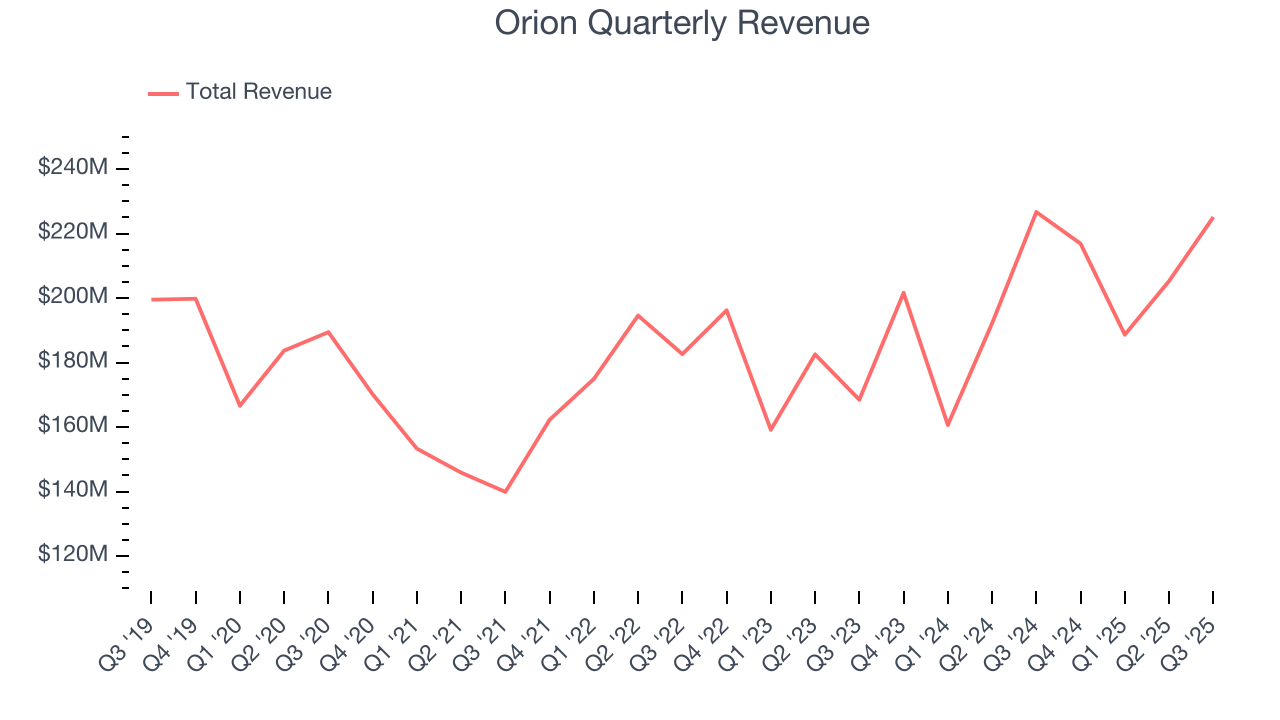
We at StockStory place the most emphasis on long-term growth, but within industrials, a half-decade historical view may miss cycles, industry trends, or a company capitalizing on catalysts such as a new contract win or a successful product line. Orion’s annualized revenue growth of 8.8% over the last two years is above its five-year trend, suggesting some bright spots. 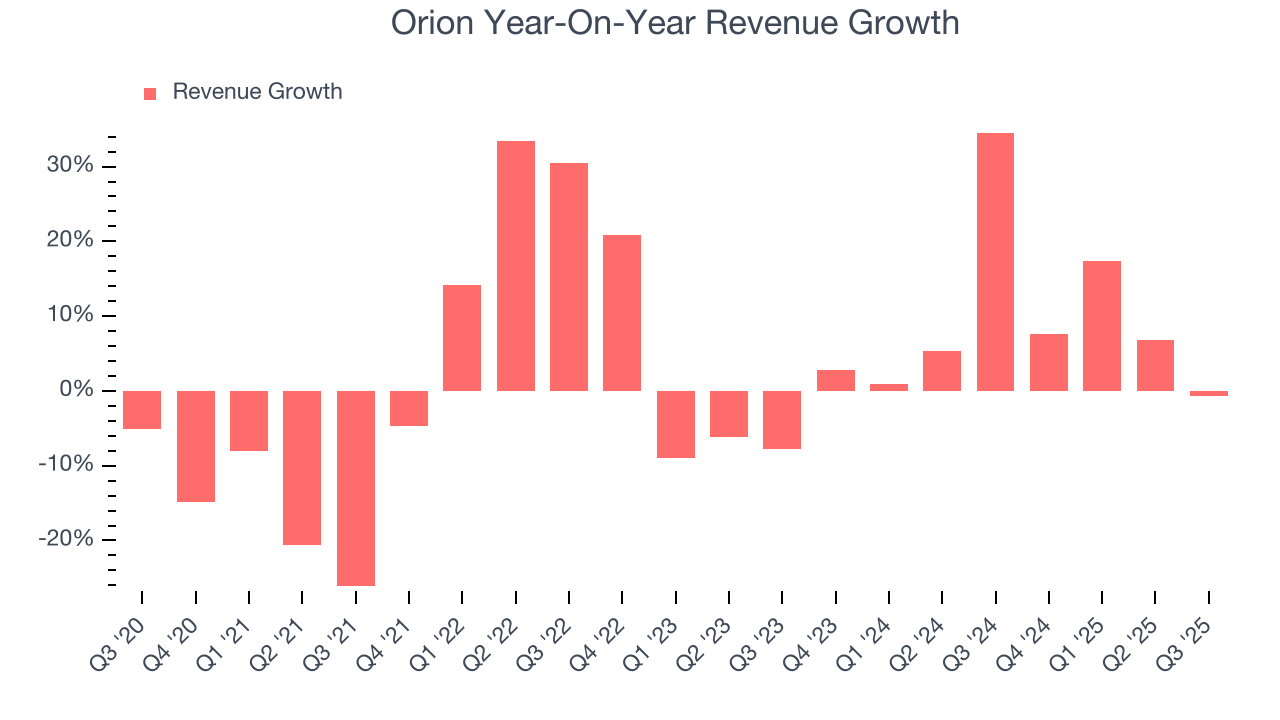
Orion also reports its backlog, or the value of its outstanding orders that have not yet been executed or delivered. Orion’s backlog reached $679 million in the latest quarter and averaged 1.7% year-on-year declines over the last two years. Because this number is lower than its revenue growth, we can see the company fulfilled orders at a faster rate than it added new orders to the backlog. This implies Orion was operating efficiently but raises questions about the health of its sales pipeline. 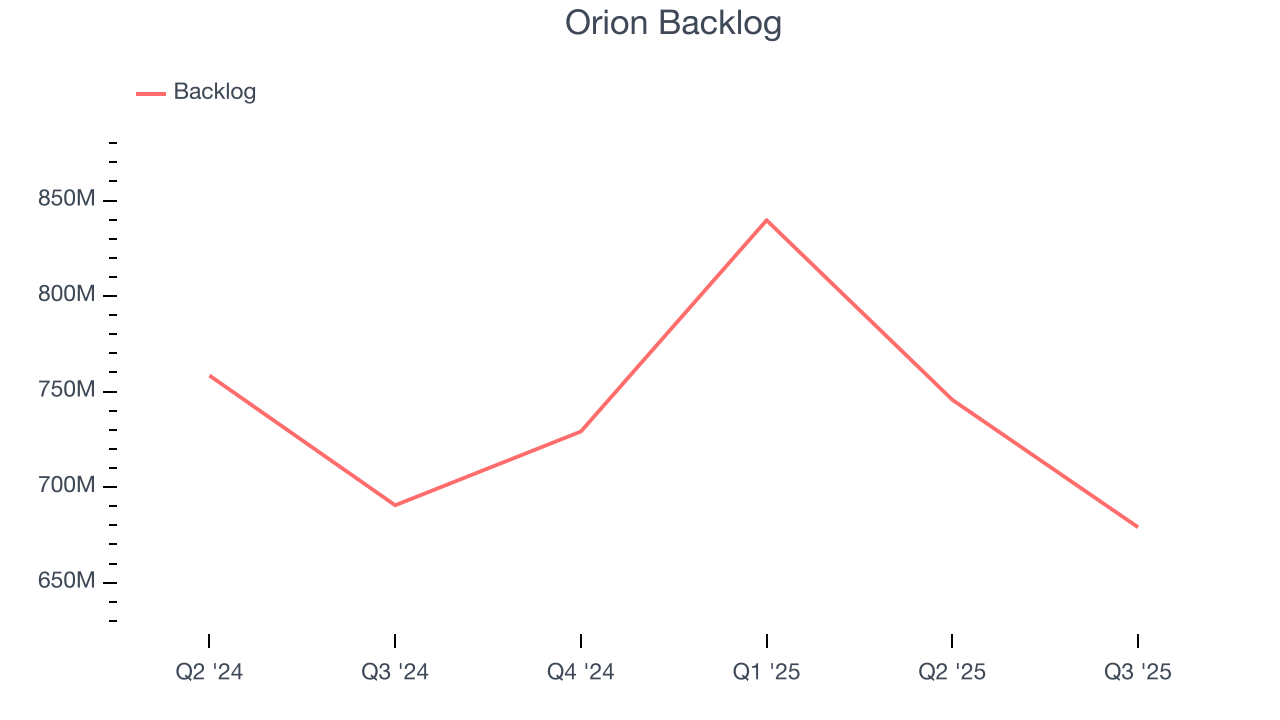
This quarter, Orion’s $225.1 million of revenue was flat year on year and in line with Wall Street’s estimates.
Looking ahead, sell-side analysts expect revenue to grow 2.7% over the next 12 months, a deceleration versus the last two years. This projection doesn't excite us and indicates its products and services will face some demand challenges.
6. Gross Margin & Pricing Power
Orion has bad unit economics for an industrials business, signaling it operates in a competitive market. As you can see below, it averaged a 9.5% gross margin over the last five years. That means Orion paid its suppliers a lot of money ($90.55 for every $100 in revenue) to run its business. 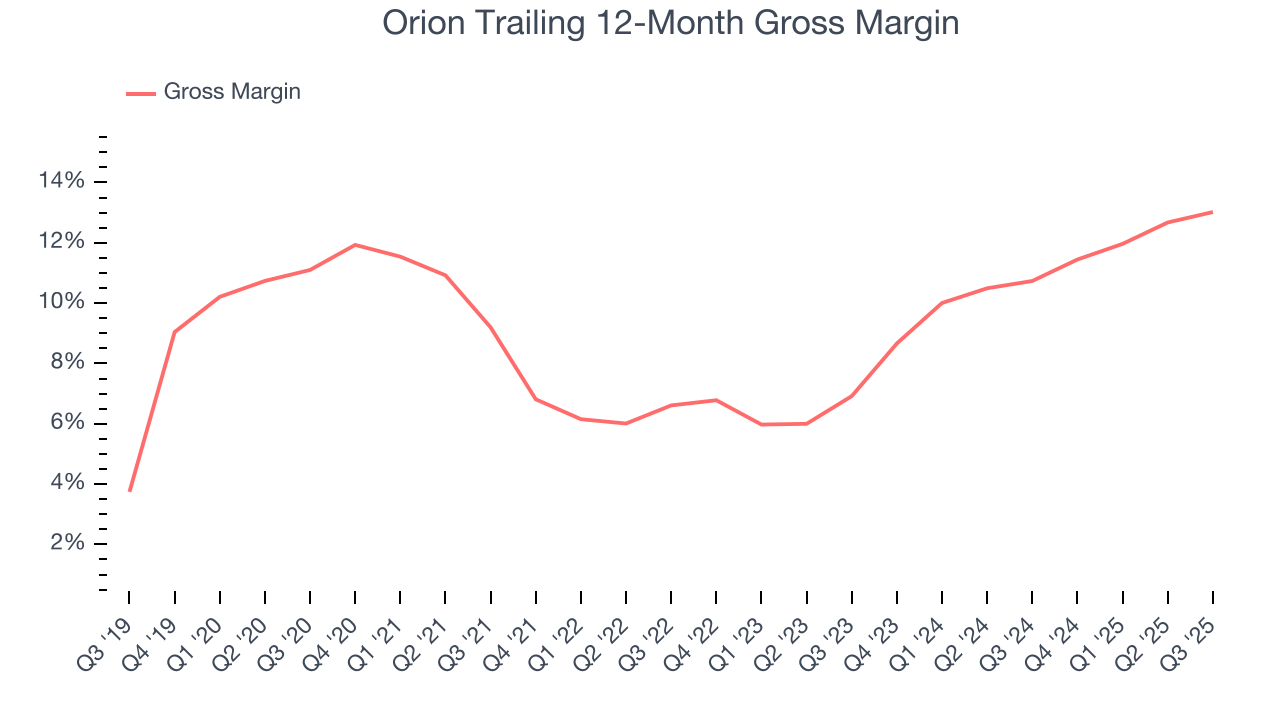
In Q3, Orion produced a 13.2% gross profit margin, marking a 1.3 percentage point increase from 11.9% in the same quarter last year. Orion’s full-year margin has also been trending up over the past 12 months, increasing by 2.3 percentage points. If this move continues, it could suggest better unit economics due to some combination of stable to improving pricing power and input costs (such as raw materials).
7. Operating Margin
Orion was roughly breakeven when averaging the last five years of quarterly operating profits, one of the worst outcomes in the industrials sector. This result isn’t too surprising given its low gross margin as a starting point.
On the plus side, Orion’s operating margin rose by 3.3 percentage points over the last five years, as its sales growth gave it operating leverage.
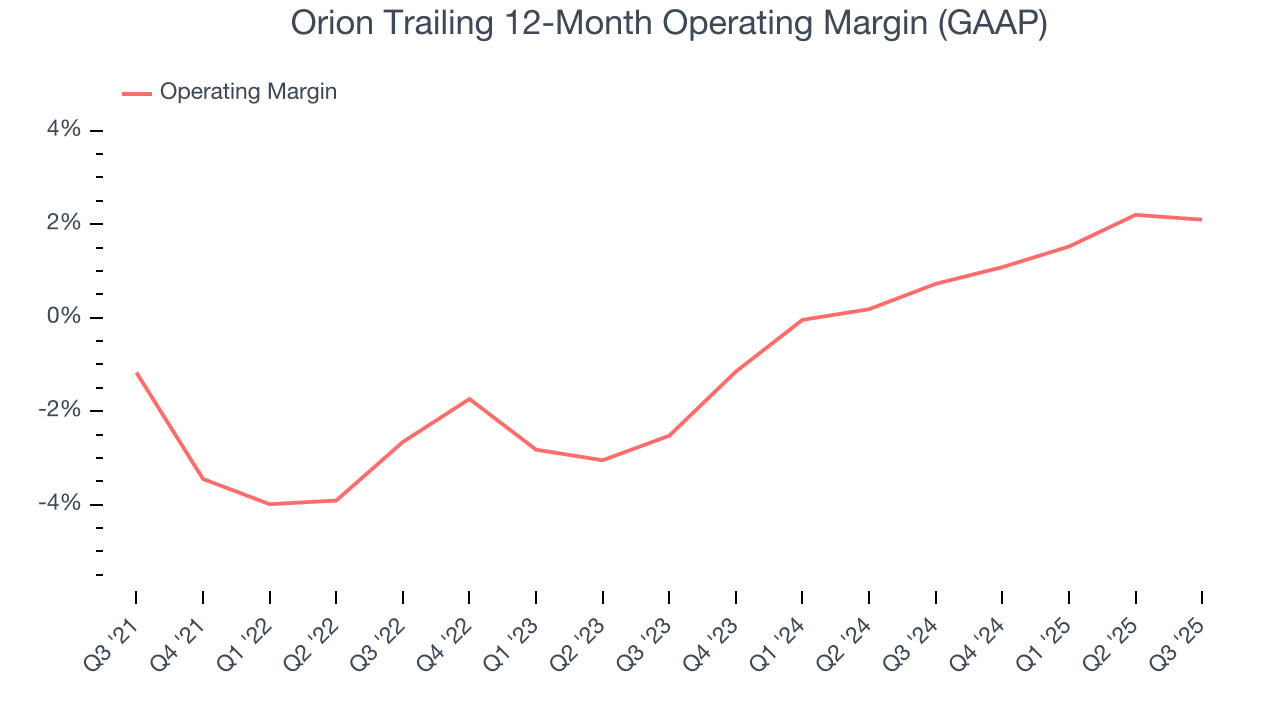
This quarter, Orion generated an operating margin profit margin of 2.4%, in line with the same quarter last year. This indicates the company’s cost structure has recently been stable.
8. Earnings Per Share
Revenue trends explain a company’s historical growth, but the long-term change in earnings per share (EPS) points to the profitability of that growth – for example, a company could inflate its sales through excessive spending on advertising and promotions.
Sadly for Orion, its EPS declined by 3.8% annually over the last five years while its revenue grew by 2.5%. However, its operating margin actually improved during this time, telling us that non-fundamental factors such as interest expenses and taxes affected its ultimate earnings.
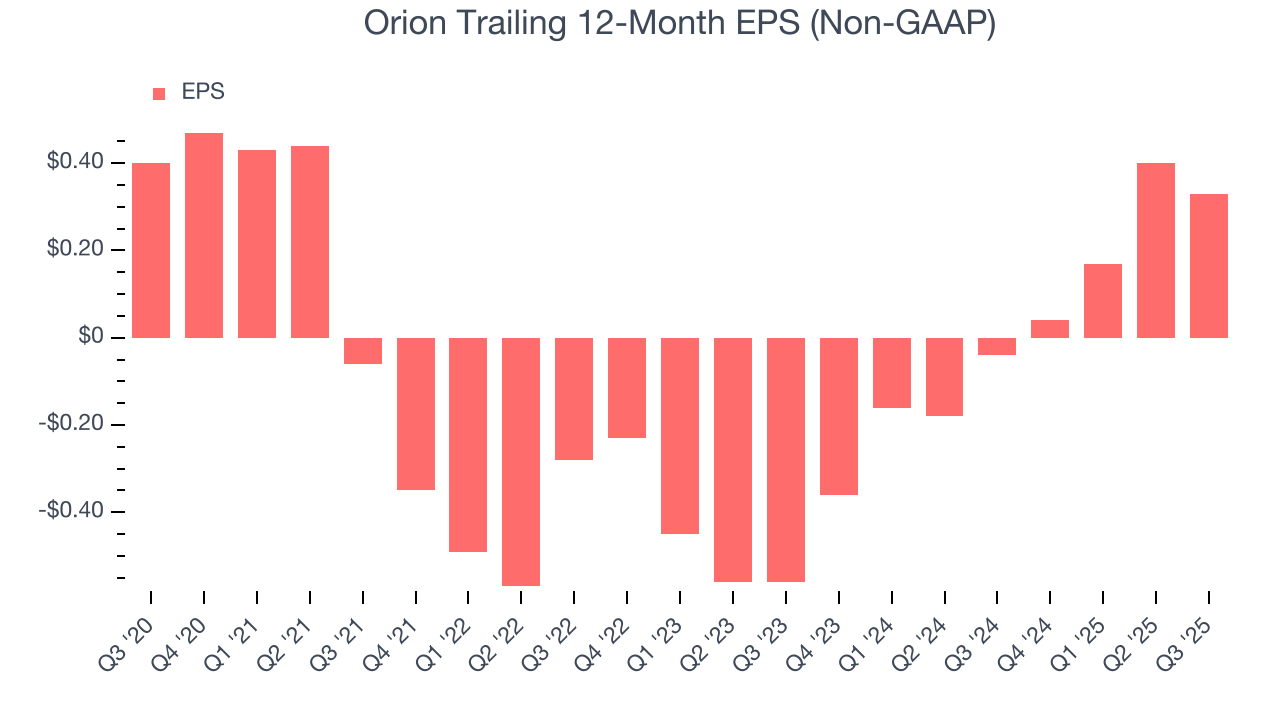
Diving into the nuances of Orion’s earnings can give us a better understanding of its performance. A five-year view shows Orion has diluted its shareholders, growing its share count by 31%. This dilution overshadowed its increased operational efficiency and has led to lower per share earnings. Taxes and interest expenses can also affect EPS but don’t tell us as much about a company’s fundamentals. 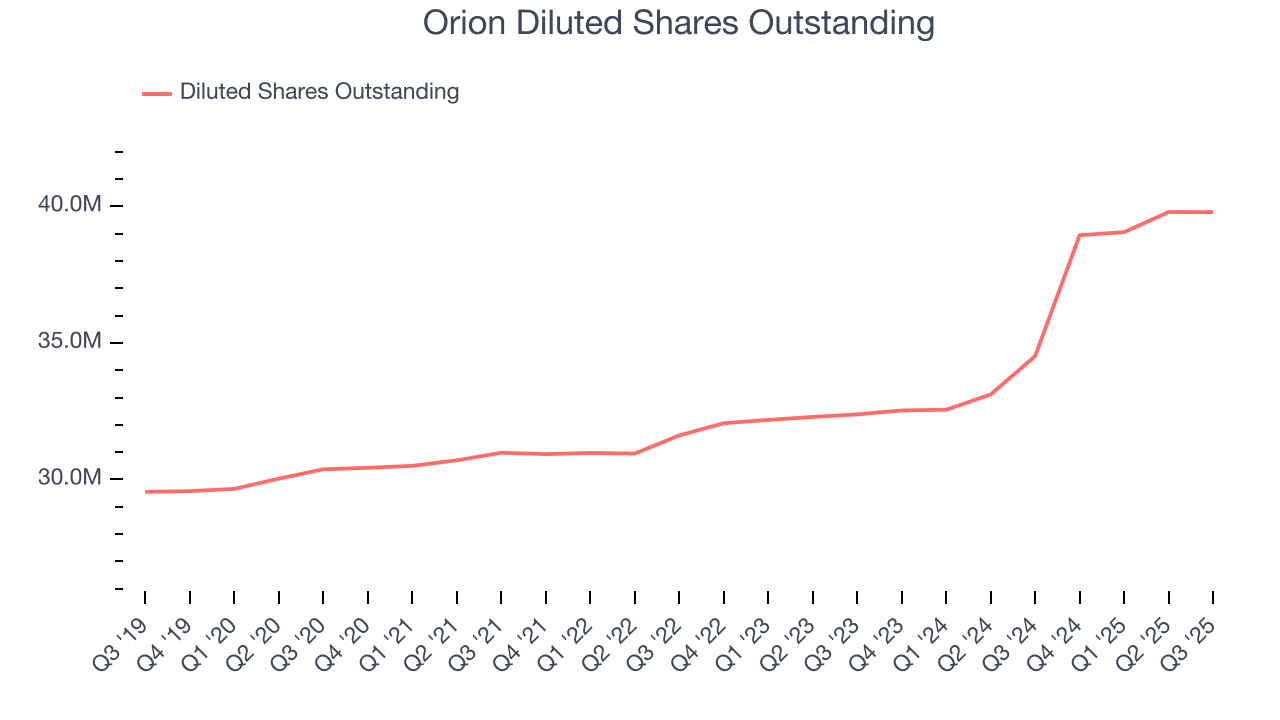
Like with revenue, we analyze EPS over a more recent period because it can provide insight into an emerging theme or development for the business.
For Orion, its two-year annual EPS growth of 60.9% was higher than its five-year trend. This acceleration made it one of the faster-growing industrials companies in recent history.
In Q3, Orion reported adjusted EPS of $0.09, down from $0.16 in the same quarter last year. Despite falling year on year, this print easily cleared analysts’ estimates. Over the next 12 months, Wall Street expects Orion’s full-year EPS of $0.33 to shrink by 31.3%.
9. Cash Is King
Free cash flow isn't a prominently featured metric in company financials and earnings releases, but we think it's telling because it accounts for all operating and capital expenses, making it tough to manipulate. Cash is king.
While Orion’s free cash flow broke even this quarter, the broader story hasn’t been so clean. Orion’s demanding reinvestments have drained its resources over the last five years, putting it in a pinch and limiting its ability to return capital to investors. Its free cash flow margin averaged negative 1.1%, meaning it lit $1.09 of cash on fire for every $100 in revenue.
Taking a step back, we can see that Orion’s margin dropped by 1.3 percentage points during that time. Almost any movement in the wrong direction is undesirable because it is already burning cash. If the trend continues, it could signal it’s becoming a more capital-intensive business.
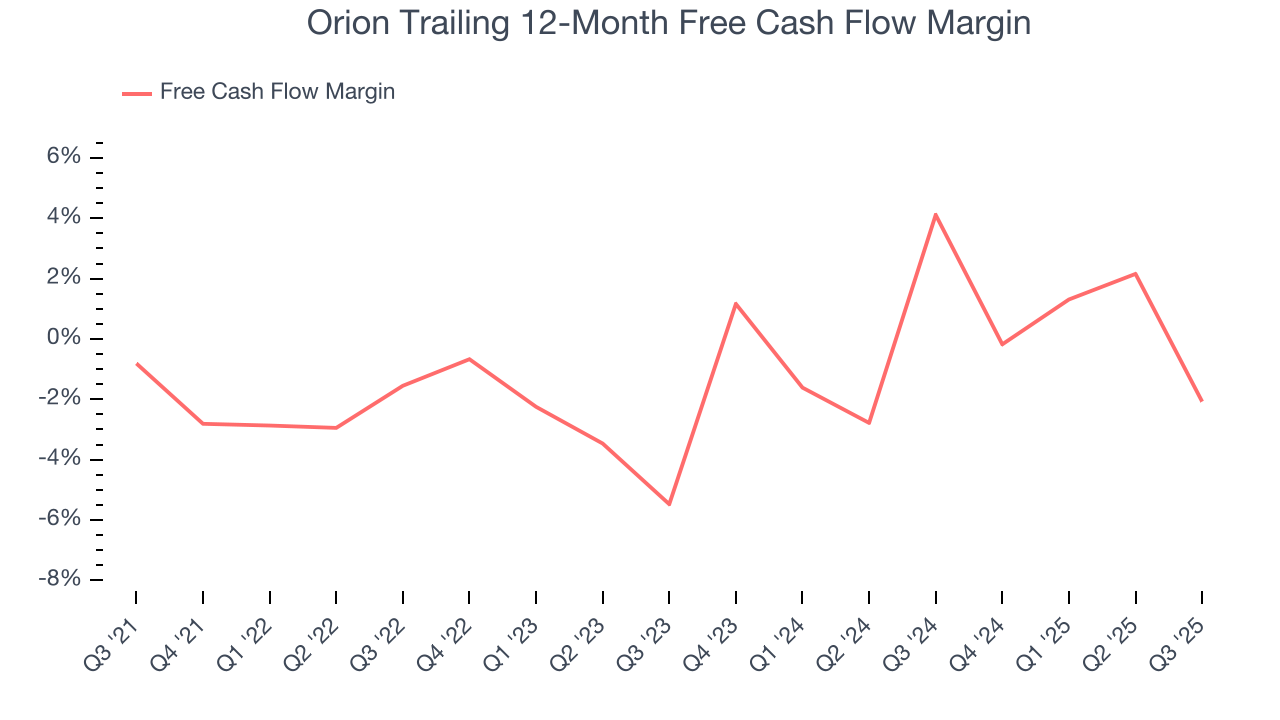
Orion broke even from a free cash flow perspective in Q3. The company’s cash profitability regressed as it was 15.6 percentage points lower than in the same quarter last year, suggesting its historical struggles have dragged on.
10. Return on Invested Capital (ROIC)
EPS and free cash flow tell us whether a company was profitable while growing its revenue. But was it capital-efficient? A company’s ROIC explains this by showing how much operating profit it makes compared to the money it has raised (debt and equity).
Orion’s five-year average ROIC was negative 3.1%, meaning management lost money while trying to expand the business. Its returns were among the worst in the industrials sector.
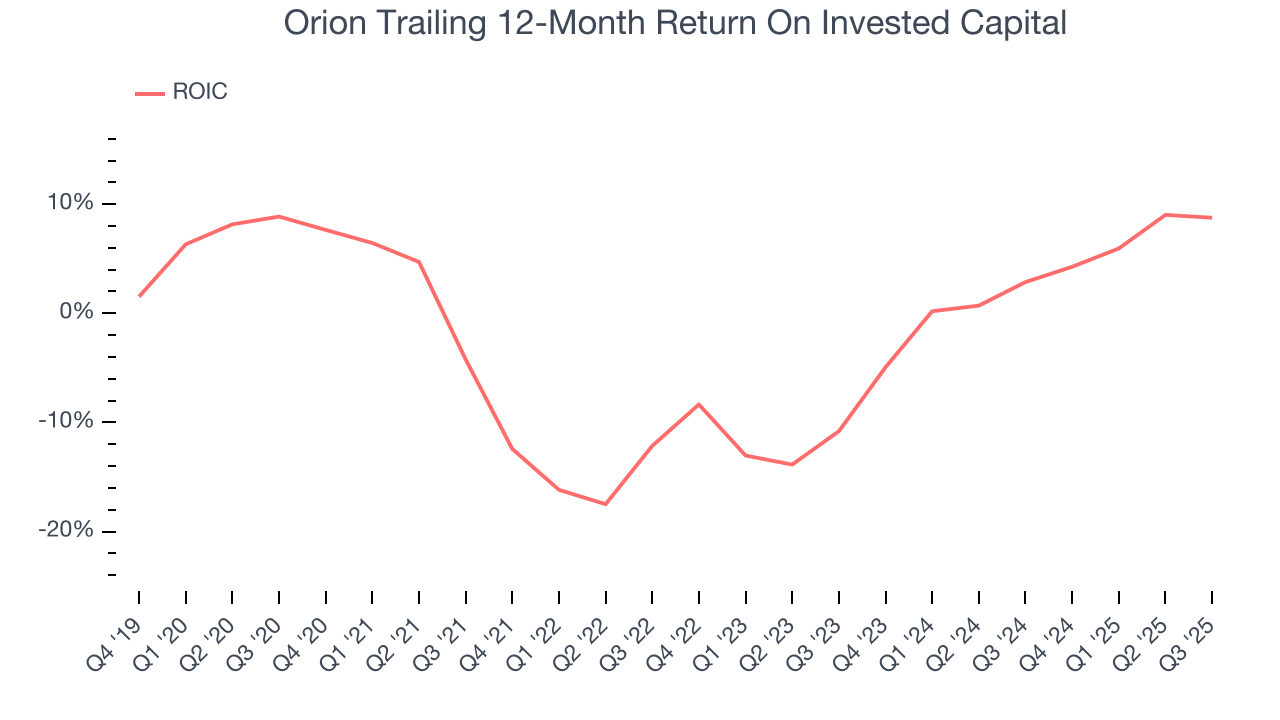
We like to invest in businesses with high returns, but the trend in a company’s ROIC is what often surprises the market and moves the stock price. Over the last few years, Orion’s ROIC has increased. This is a good sign, but we recognize its lack of profitable growth during the COVID era was the primary reason for the change.
11. Balance Sheet Assessment
Orion reported $4.92 million of cash and $65.49 million of debt on its balance sheet in the most recent quarter. As investors in high-quality companies, we primarily focus on two things: 1) that a company’s debt level isn’t too high and 2) that its interest payments are not excessively burdening the business.
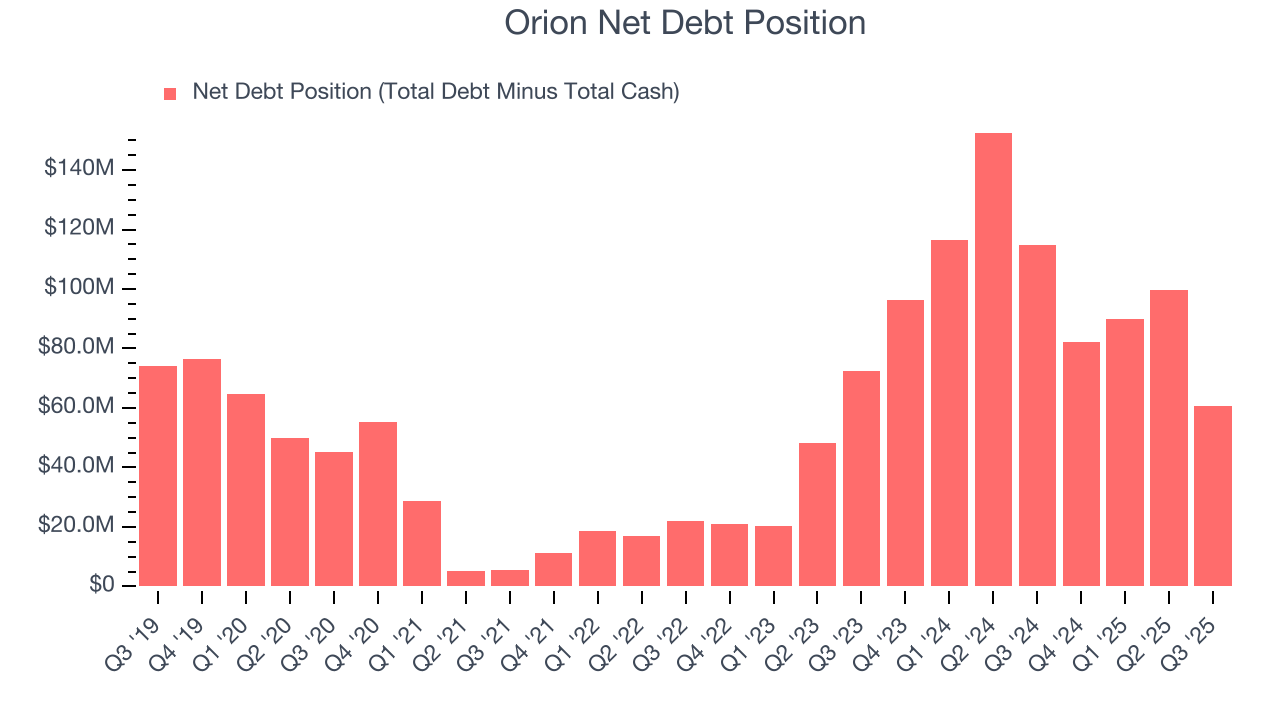
With $49.35 million of EBITDA over the last 12 months, we view Orion’s 1.2× net-debt-to-EBITDA ratio as safe. We also see its $5.88 million of annual interest expenses as appropriate. The company’s profits give it plenty of breathing room, allowing it to continue investing in growth initiatives.
12. Key Takeaways from Orion’s Q3 Results
It was good to see Orion beat analysts’ EPS expectations this quarter. We were also glad its full-year revenue guidance exceeded Wall Street’s estimates. Overall, we think this was still a solid quarter with some key areas of upside. The stock traded up 2.8% to $8.89 immediately after reporting.
13. Is Now The Time To Buy Orion?
Updated: January 24, 2026 at 10:32 PM EST
The latest quarterly earnings matters, sure, but we actually think longer-term fundamentals and valuation matter more. Investors should consider all these pieces before deciding whether or not to invest in Orion.
We cheer for all companies making their customers lives easier, but in the case of Orion, we’ll be cheering from the sidelines. To kick things off, its revenue growth was weak over the last five years, and analysts don’t see anything changing over the next 12 months. And while its rising returns show management's prior bets are at least better than before, the downside is its relatively low ROIC suggests management has struggled to find compelling investment opportunities. On top of that, its projected EPS for the next year is lacking.
Orion’s P/E ratio based on the next 12 months is 48.6x. This valuation tells us a lot of optimism is priced in - we think there are better stocks to buy right now.
Wall Street analysts have a consensus one-year price target of $13.13 on the company (compared to the current share price of $12.21).