UiPath (PATH)
We’re skeptical of UiPath. It’s recently struggled to grow its revenue, a worrying sign for investors seeking high-quality stocks.― StockStory Analyst Team


1. News
2. Summary
Why We Think UiPath Will Underperform
Starting with robotic process automation (RPA) and evolving into a comprehensive automation powerhouse, UiPath (NYSE:PATH) provides an AI-powered business automation platform that enables organizations to create software robots that mimic human actions to streamline repetitive tasks and processes.
- Products, pricing, or go-to-market strategy may need some adjustments as its 7.4% average billings growth over the last year was weak
- Estimated sales growth of 9.1% for the next 12 months implies demand will slow from its two-year trend
- On the plus side, its software is difficult to replicate at scale and leads to a top-tier gross margin of 83.2%
UiPath is skating on thin ice. We believe there are better businesses elsewhere.
Why There Are Better Opportunities Than UiPath





UiPath’s stock price of $11.20 implies a valuation ratio of 3.8x forward price-to-sales. This certainly seems like a cheap stock, but we think there are valid reasons why it trades this way.
It’s better to pay up for high-quality businesses with higher long-term earnings potential rather than to buy lower-quality stocks because they appear cheap. These challenged businesses often don’t re-rate, a phenomenon known as a “value trap”.
3. UiPath (PATH) Research Report: Q4 CY2025 Update
Automation software company UiPath (NYSE:PATH) reported revenue ahead of Wall Street’s expectations in Q4 CY2025, with sales up 13.6% year on year to $481.1 million. Guidance for next quarter’s revenue was better than expected at $397.5 million at the midpoint, 0.7% above analysts’ estimates. Its non-GAAP profit of $0.30 per share was 17.8% above analysts’ consensus estimates.
UiPath (PATH) Q4 CY2025 Highlights:
- Revenue: $481.1 million vs analyst estimates of $464.8 million (13.6% year-on-year growth, 3.5% beat)
- Adjusted EPS: $0.30 vs analyst estimates of $0.25 (17.8% beat)
- Adjusted Operating Income: $150.1 million vs analyst estimates of $139.8 million (31.2% margin, 7.3% beat)
- Revenue Guidance for Q1 CY2026 is $397.5 million at the midpoint, roughly in line with what analysts were expecting
- Operating Margin: 16.7%, up from 7.9% in the same quarter last year
- Free Cash Flow Margin: 37.3%, up from 6.1% in the previous quarter
- Annual Recurring Revenue: $1.85 billion vs analyst estimates of $1.85 billion (11.2% year-on-year growth, in line)
- Market Capitalization: $6.20 billion
Company Overview
Starting with robotic process automation (RPA) and evolving into a comprehensive automation powerhouse, UiPath (NYSE:PATH) provides an AI-powered business automation platform that enables organizations to create software robots that mimic human actions to streamline repetitive tasks and processes.
UiPath's platform works by allowing users to build digital workers that can replicate human interactions with software applications - from logging into systems and extracting information from documents to updating databases and processing forms. These automations can be created through an intuitive drag-and-drop interface that requires minimal coding knowledge, democratizing automation capabilities across organizations regardless of technical expertise.
The company's technology integrates artificial intelligence, machine learning, and natural language processing to handle increasingly complex scenarios. For example, a financial services company might use UiPath to automate invoice processing by having software robots extract data from incoming documents, validate information against multiple systems, and initiate payment workflows - all with minimal human intervention.
UiPath generates revenue through software licensing and subscription models. Its customer base spans organizations of all sizes across industries, though it maintains a strategic focus on enterprise clients, particularly among the Forbes Global 2000. The company sells both directly and through channel partnerships with systems integrators who help implement the technology.
The platform can be deployed on-premises, in the cloud, or in hybrid environments. For customers seeking faster implementation, UiPath offers Automation Cloud, a SaaS version that requires no additional infrastructure setup.
4. Automation Software
The whole purpose of software is to automate tasks to increase productivity. Today, innovative new software techniques, often involving AI and machine learning, are finally allowing automation that has graduated from simple one- or two-step workflows to more complex processes integral to enterprises. The result is surging demand for modern automation software.
UiPath competes with automation and workflow software providers including Automation Anywhere, Blue Prism (now part of SS&C Technologies), Microsoft Power Automate (NASDAQ: MSFT), ServiceNow (NYSE: NOW), and IBM (NYSE: IBM), along with broader business process management platforms.
5. Revenue Growth
A company’s long-term sales performance can indicate its overall quality. Even a bad business can shine for one or two quarters, but a top-tier one grows for years. Thankfully, UiPath’s 21.5% annualized revenue growth over the last five years was decent. Its growth was slightly above the average software company and shows its offerings resonate with customers.
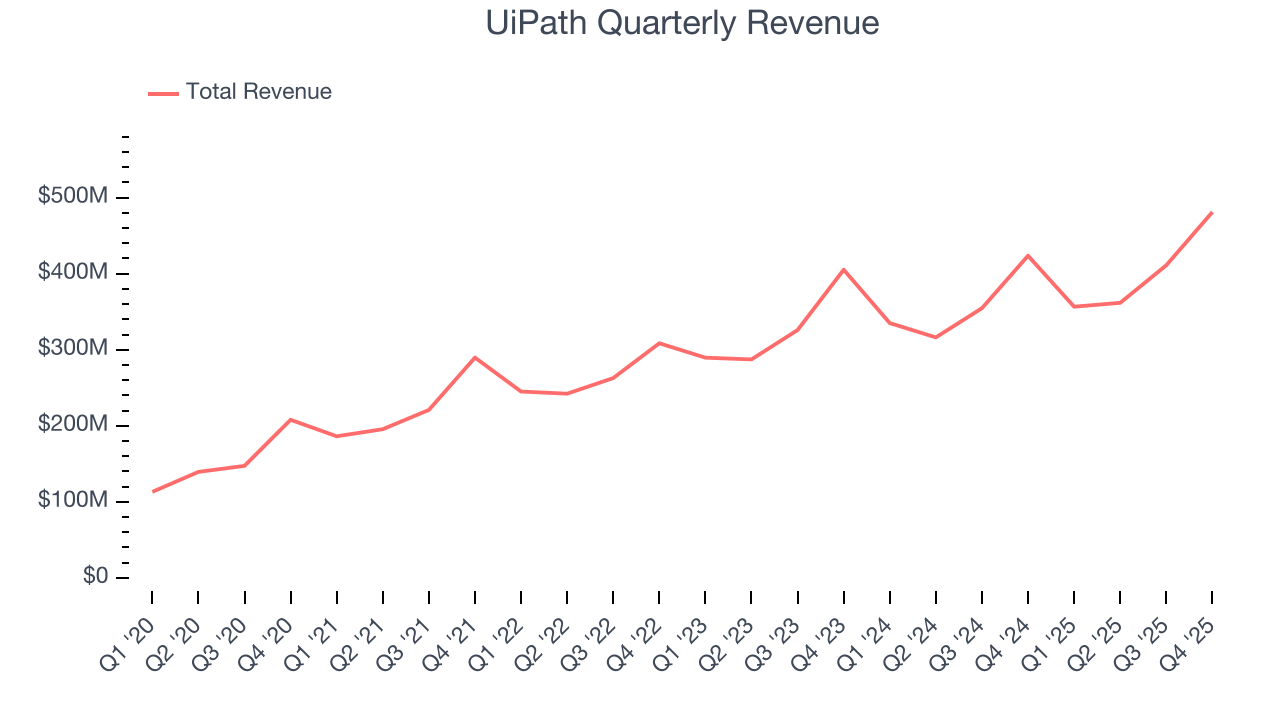
We at StockStory place the most emphasis on long-term growth, but within software, a half-decade historical view may miss recent innovations or disruptive industry trends. UiPath’s recent performance shows its demand has slowed as its annualized revenue growth of 11% over the last two years was below its five-year trend. We’re wary when companies in the sector see decelerations in revenue growth, as it could signal changing consumer tastes aided by low switching costs. 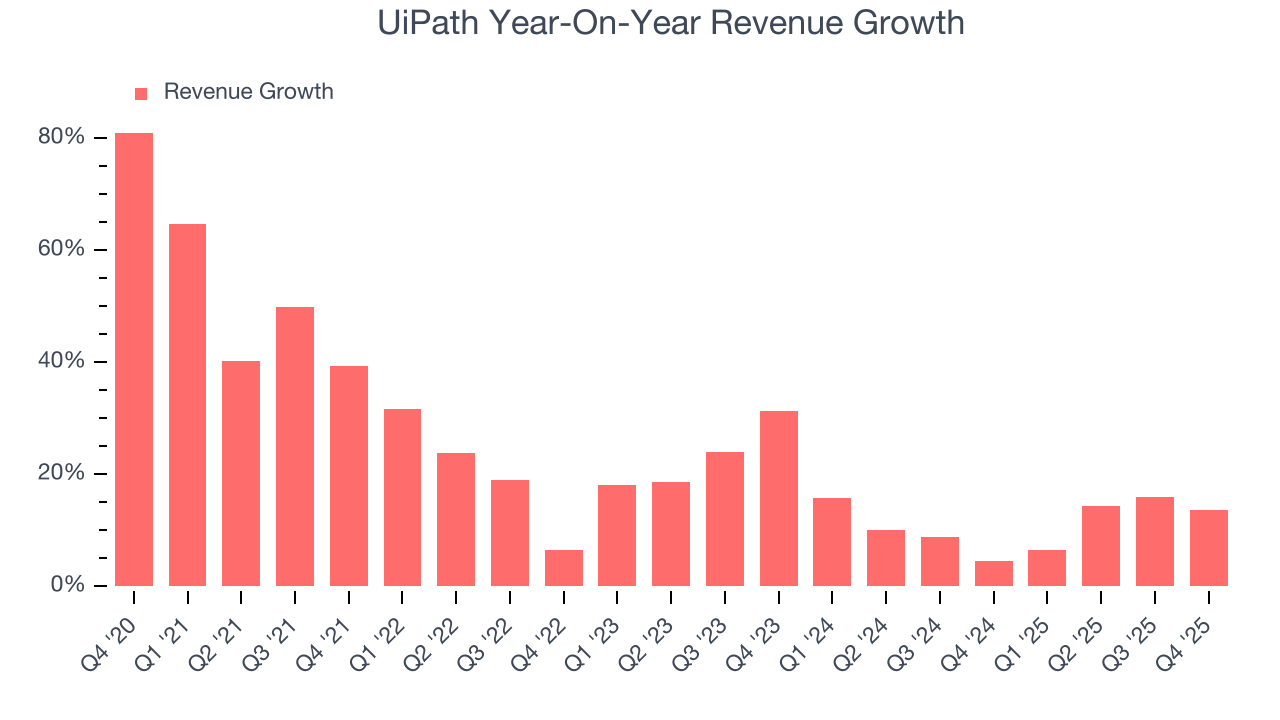
This quarter, UiPath reported year-on-year revenue growth of 13.6%, and its $481.1 million of revenue exceeded Wall Street’s estimates by 3.5%. Company management is currently guiding for a 11.5% year-on-year increase in sales next quarter.
Looking further ahead, sell-side analysts expect revenue to grow 8% over the next 12 months, a slight deceleration versus the last two years. This projection doesn't excite us and indicates its products and services will face some demand challenges.
6. Annual Recurring Revenue
While reported revenue for a software company can include low-margin items like implementation fees, annual recurring revenue (ARR) is a sum of the next 12 months of contracted revenue purely from software subscriptions, or the high-margin, predictable revenue streams that make SaaS businesses so valuable.
UiPath’s ARR came in at $1.85 billion in Q4, and over the last four quarters, its growth was underwhelming as it averaged 11.4% year-on-year increases. This performance mirrored its total sales and suggests that increasing competition is causing challenges in securing longer-term commitments. 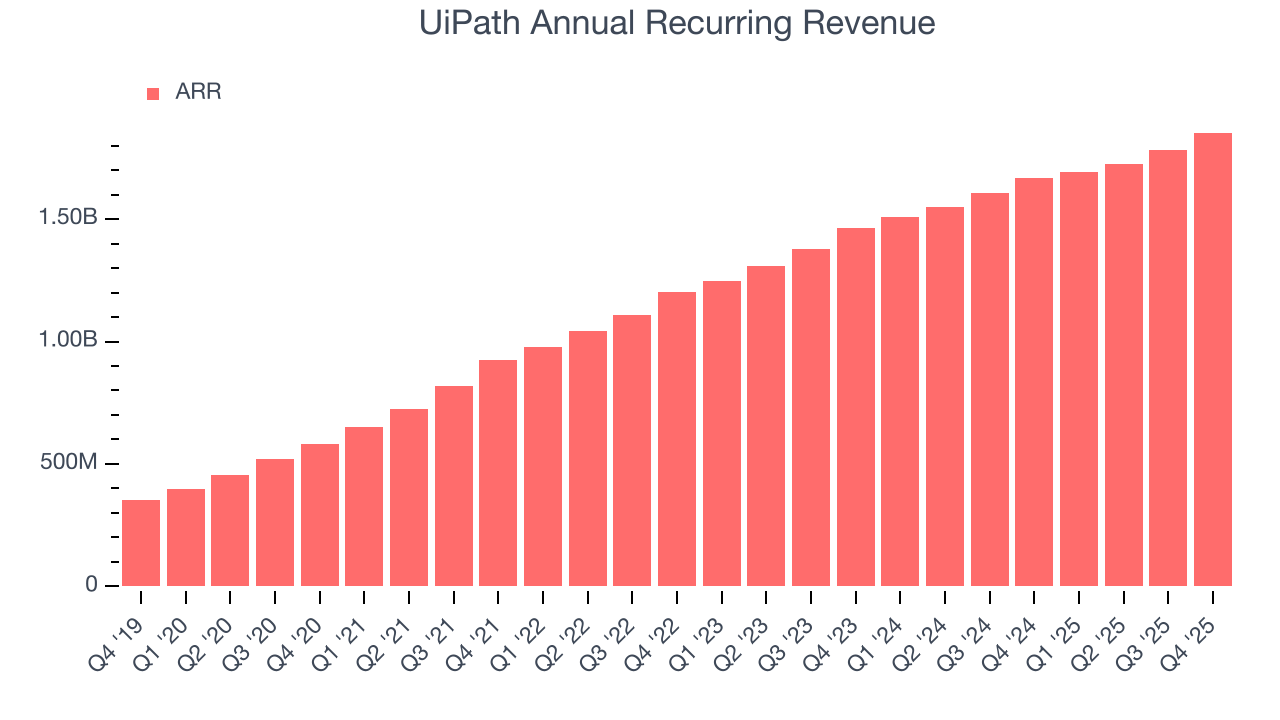
7. Customer Acquisition Efficiency
The customer acquisition cost (CAC) payback period measures the months a company needs to recoup the money spent on acquiring a new customer. This metric helps assess how quickly a business can break even on its sales and marketing investments.
UiPath is quite efficient at acquiring new customers, and its CAC payback period checked in at 31 months this quarter. The company’s rapid recovery of its customer acquisition costs means it can attempt to spur growth by increasing its sales and marketing investments.
8. Gross Margin & Pricing Power
For software companies like UiPath, gross profit tells us how much money remains after paying for the base cost of products and services (typically servers, licenses, and certain personnel). These costs are usually low as a percentage of revenue, explaining why software is more lucrative than other sectors.
UiPath’s gross margin is one of the highest in the software sector, an output of its asset-lite business model and strong pricing power. It also enables the company to fund large investments in new products and sales during periods of rapid growth to achieve outsized profits at scale. As you can see below, it averaged an elite 83.2% gross margin over the last year. That means UiPath only paid its providers $16.77 for every $100 in revenue.
The market not only cares about gross margin levels but also how they change over time because expansion creates firepower for profitability and free cash generation. UiPath has seen gross margins decline by 1.9 percentage points over the last 2 year, which is poor compared to software peers.
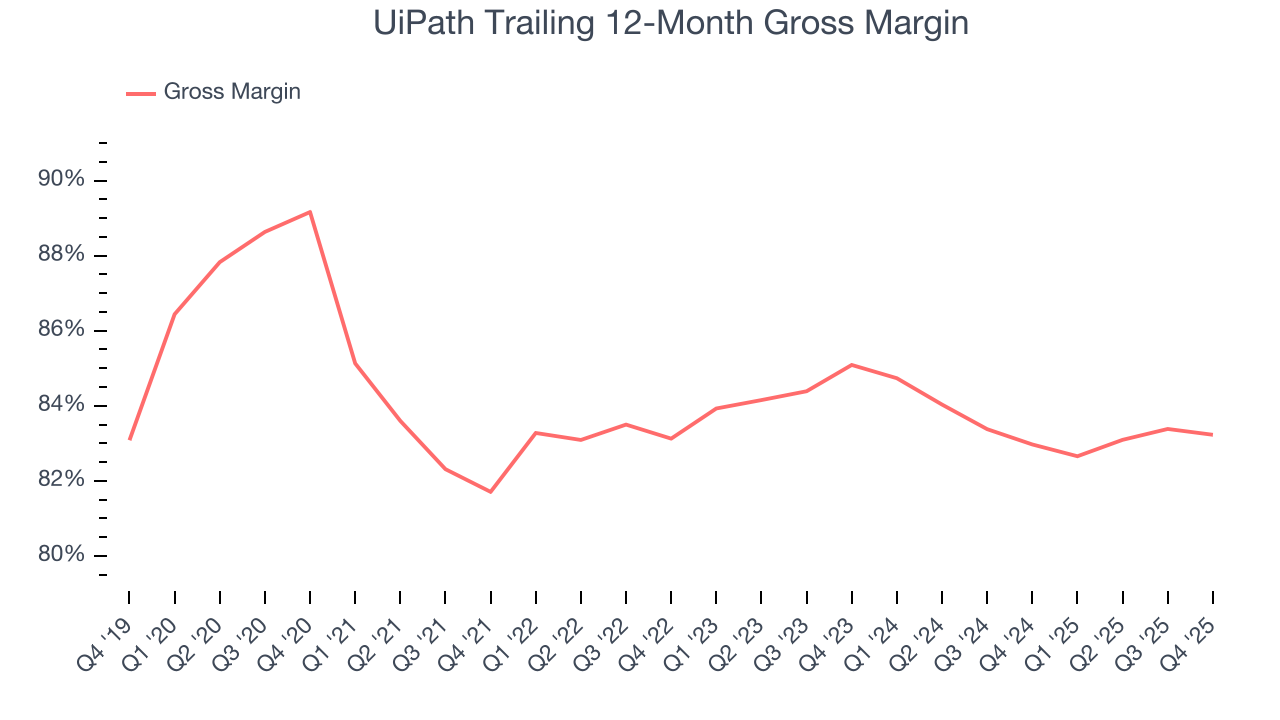
UiPath produced a 84.6% gross profit margin in Q4, in line with the same quarter last year. Zooming out, the company’s full-year margin has remained steady over the past 12 months, suggesting its input costs have been stable and it isn’t under pressure to lower prices.
9. Operating Margin
UiPath has done a decent job managing its cost base over the last year. The company has produced an average operating margin of 3.5%, higher than the broader software sector.
Analyzing the trend in its profitability, UiPath’s operating margin rose by 14.9 percentage points over the last two years, as its sales growth gave it operating leverage.
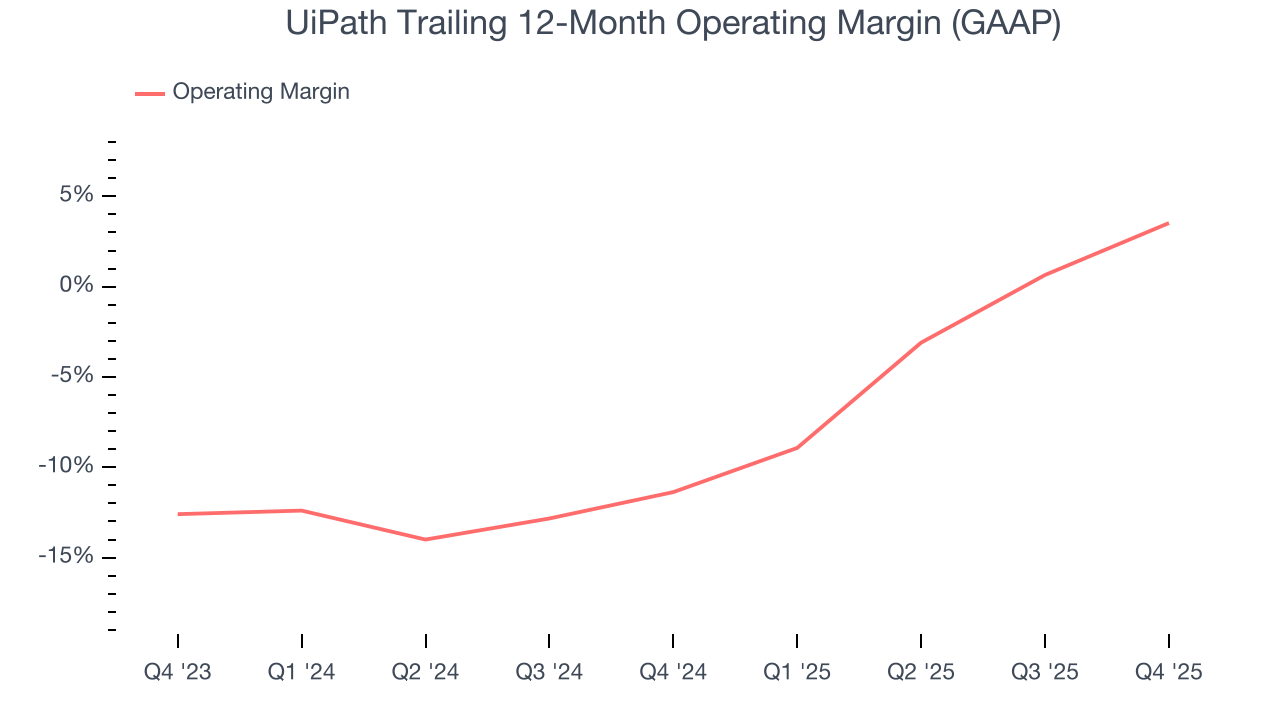
This quarter, UiPath generated an operating margin profit margin of 16.7%, up 8.8 percentage points year on year. The increase was solid, and because its operating margin rose more than its gross margin, we can infer it was more efficient with expenses such as marketing, R&D, and administrative overhead.
10. Cash Is King
Although earnings are undoubtedly valuable for assessing company performance, we believe cash is king because you can’t use accounting profits to pay the bills.
UiPath has shown impressive cash profitability, driven by its attractive business model and cost-effective customer acquisition strategy that give it the option to invest in new products and services rather than sales and marketing. The company’s free cash flow margin averaged 21.9% over the last year, better than the broader software sector.
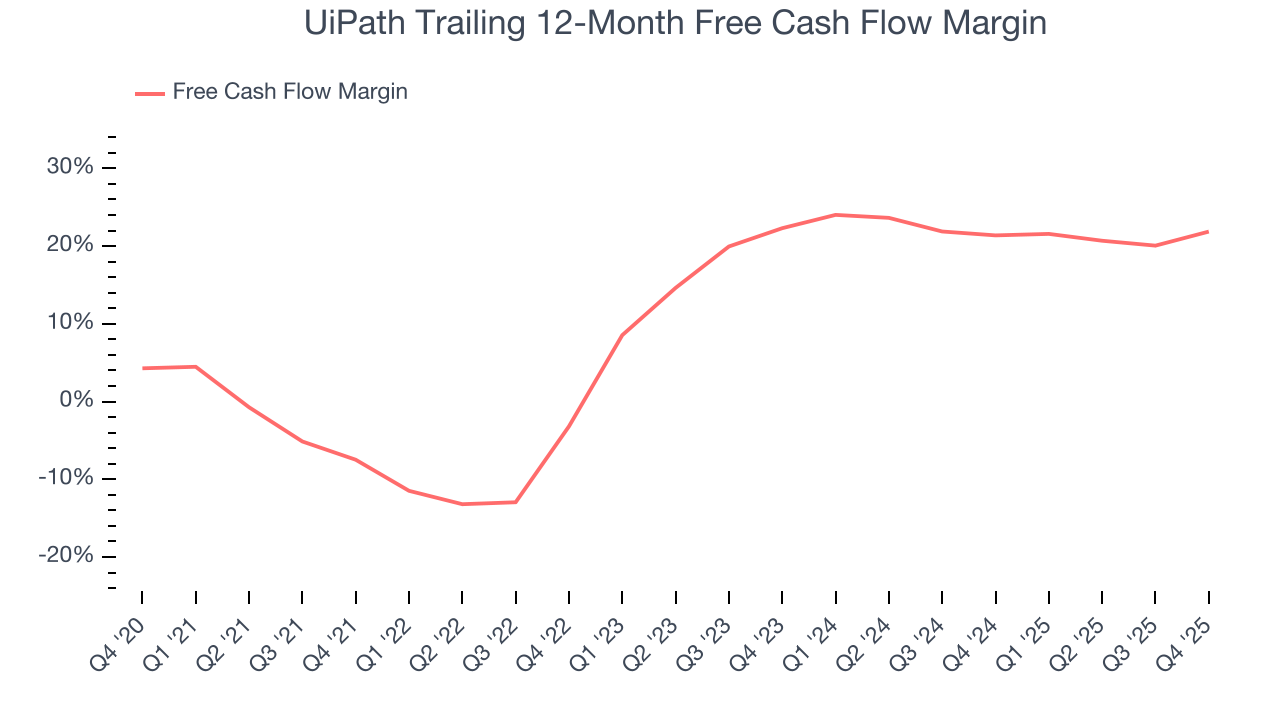
UiPath’s free cash flow clocked in at $179.3 million in Q4, equivalent to a 37.3% margin. This result was good as its margin was 4.5 percentage points higher than in the same quarter last year, but we wouldn’t read too much into the short term because investment needs can be seasonal, leading to temporary swings. Long-term trends carry greater meaning.
Over the next year, analysts predict UiPath’s cash conversion will improve. Their consensus estimates imply its free cash flow margin of 21.9% for the last 12 months will increase to 26.7%, giving it more flexibility for investments, share buybacks, and dividends.
11. Balance Sheet Assessment
One of the best ways to mitigate bankruptcy risk is to hold more cash than debt.
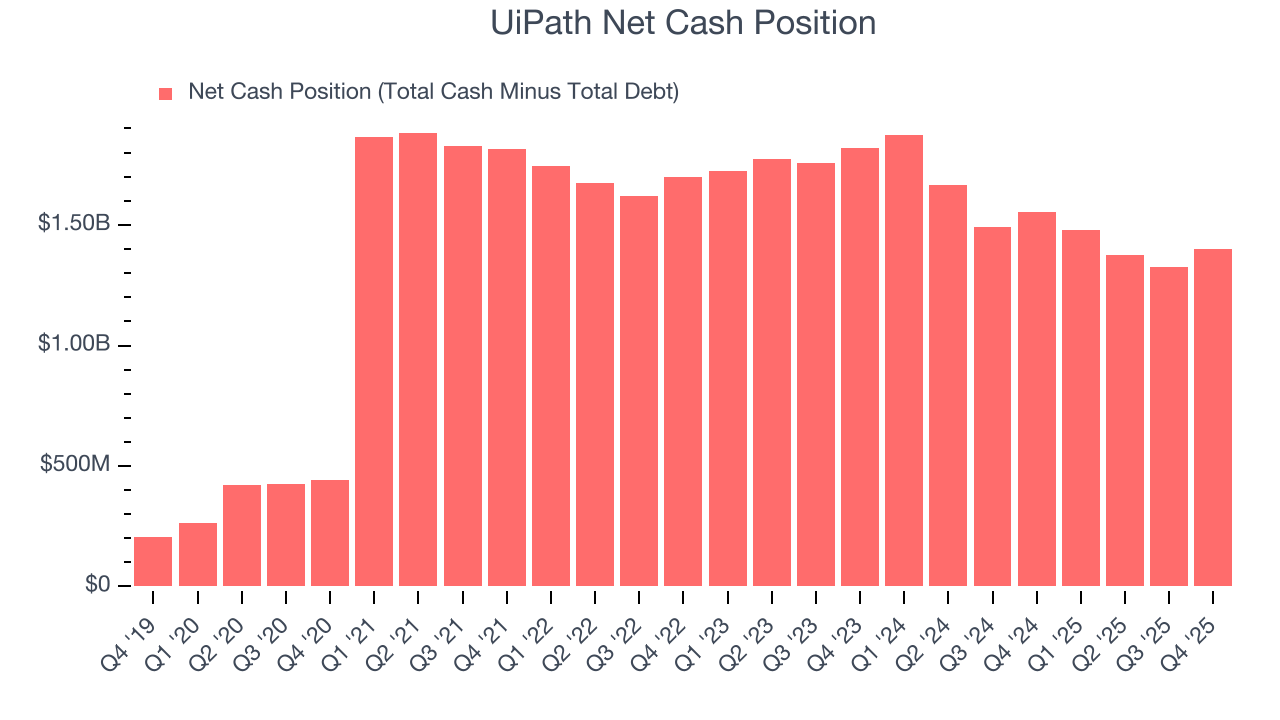
UiPath is a profitable, well-capitalized company with $1.47 billion of cash and $70.94 million of debt on its balance sheet. This $1.40 billion net cash position is 21.2% of its market cap and gives it the freedom to borrow money, return capital to shareholders, or invest in growth initiatives. Leverage is not an issue here.
12. Key Takeaways from UiPath’s Q4 Results
It was encouraging to see UiPath beat analysts’ revenue expectations this quarter. We were also glad its full-year revenue guidance slightly exceeded Wall Street’s estimates. On the other hand, its revenue guidance for next year suggests a significant slowdown in demand. Overall, this print had some key positives. Investors were likely hoping for more, and shares traded down 1.7% to $12.22 immediately following the results.
13. Is Now The Time To Buy UiPath?
Updated: March 12, 2026 at 10:14 PM EDT
When considering an investment in UiPath, investors should account for its valuation and business qualities as well as what’s happened in the latest quarter.
UiPath’s business quality ultimately falls short of our standards. Although its revenue growth was solid over the last five years, it’s expected to deteriorate over the next 12 months and its ARR has disappointed and shows the company is having difficulty retaining customers and their spending.
UiPath’s price-to-sales ratio based on the next 12 months is 3.8x. While this valuation is reasonable, we don’t really see a big opportunity at the moment. We're fairly confident there are better investments elsewhere.
Wall Street analysts have a consensus one-year price target of $13.99 on the company (compared to the current share price of $11.20).
Although the price target is bullish, readers should exercise caution because analysts tend to be overly optimistic. The firms they work for, often big banks, have relationships with companies that extend into fundraising, M&A advisory, and other rewarding business lines. As a result, they typically hesitate to say bad things for fear they will lose out. We at StockStory do not suffer from such conflicts of interest, so we’ll always tell it like it is.