
Taylor Morrison Home (TMHC)
We’re wary of Taylor Morrison Home. Its weak sales growth and declining returns on capital show its demand and profits are shrinking.― StockStory Analyst Team


1. News




2. Summary
Why We Think Taylor Morrison Home Will Underperform
Named “America’s Most Trusted Home Builder” in 2019, Taylor Morrison Home (NYSE:TMHC) builds single family homes and communities across the United States.
- Estimated sales decline of 17.2% for the next 12 months implies a challenging demand environment
- Backlog has dropped by 33.6% on average over the past two years, suggesting it’s losing orders as competition picks up
- A positive is that its incremental sales significantly boosted profitability as its annual earnings per share growth of 20.1% over the last five years outstripped its revenue performance
Taylor Morrison Home’s quality is lacking. We see more lucrative opportunities elsewhere.
Why There Are Better Opportunities Than Taylor Morrison Home








Taylor Morrison Home is trading at $57.67 per share, or 11.3x forward P/E. This multiple is lower than most industrials companies, but for good reason.
It’s better to pay up for high-quality businesses with higher long-term earnings potential rather than to buy lower-quality stocks because they appear cheap. These challenged businesses often don’t re-rate, a phenomenon known as a “value trap”.
3. Taylor Morrison Home (TMHC) Research Report: Q4 CY2025 Update
Homebuilder Taylor Morrison Home (NYSE:TMHC) beat Wall Street’s revenue expectations in Q4 CY2025, but sales fell by 10.9% year on year to $2.1 billion. Its non-GAAP profit of $1.91 per share was 10% above analysts’ consensus estimates.
Taylor Morrison Home (TMHC) Q4 CY2025 Highlights:
- Revenue: $2.1 billion vs analyst estimates of $1.96 billion (10.9% year-on-year decline, 7.2% beat)
- Adjusted EPS: $1.91 vs analyst estimates of $1.74 (10% beat)
- Adjusted EBITDA: $293.2 million vs analyst estimates of $248.9 million (14% margin, 17.8% beat)
- Operating Margin: 10.9%, down from 15.3% in the same quarter last year
- Backlog: $1.86 billion at quarter end, down 41.8% year on year
- Market Capitalization: $6.49 billion
Company Overview
Named “America’s Most Trusted Home Builder” in 2019, Taylor Morrison Home (NYSE:TMHC) builds single family homes and communities across the United States.
Taylor Morrison is a prominent homebuilder and real estate developer in the United States, specializing in creating lifestyle communities in high-growth markets. The company focuses on designing and constructing single-family detached and attached homes under its Taylor Morrison and Darling Homes brands, primarily catering to move-up buyers in desirable locations.
The company's strategy is built on four key pillars: pursuing prime locations, developing distinctive communities, maintaining cost efficiency, and balancing price with sales pace. Taylor Morrison is committed to delivering high-quality, sustainable homes that enhance customers' lives and create vibrant neighborhoods.
In addition to homebuilding, Taylor Morrison offers complementary financial services through its mortgage subsidiary, Taylor Morrison Home Funding, and title insurance services via Inspired Title. These offerings enhance the customer experience and provide additional revenue streams.
4. Home Builders
Traditionally, homebuilders have built competitive advantages with economies of scale that lead to advantaged purchasing and brand recognition among consumers. Aesthetic trends have always been important in the space, but more recently, energy efficiency and conservation are driving innovation. However, these companies are still at the whim of the macro, specifically interest rates that heavily impact new and existing home sales. In fact, homebuilders are one of the most cyclical subsectors within industrials.
Competitors of Taylor Morrsion include DR Horton (NYSE:DHI), Lennar (NYSE:LEN), and PulteGroupe (NYSE:PHM).
5. Revenue Growth
A company’s long-term sales performance can indicate its overall quality. Any business can experience short-term success, but top-performing ones enjoy sustained growth for years. Unfortunately, Taylor Morrison Home’s 5.8% annualized revenue growth over the last five years was tepid. This fell short of our benchmark for the industrials sector and is a poor baseline for our analysis.
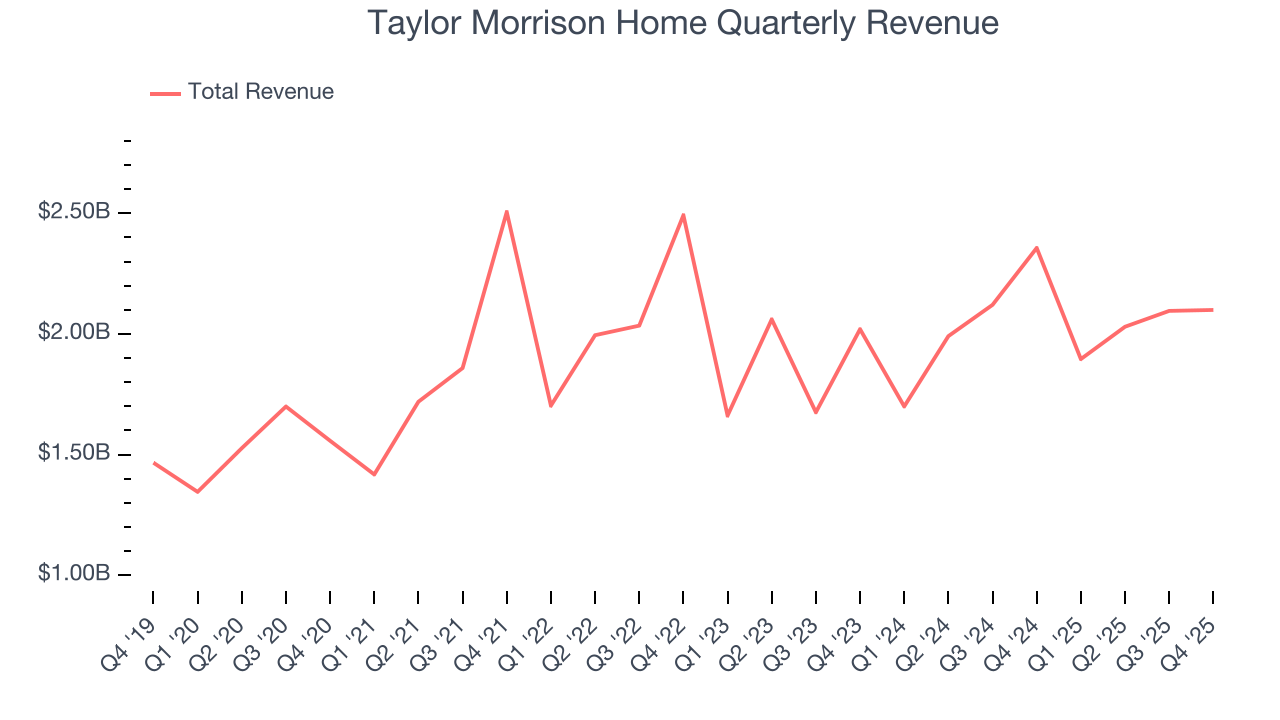
Long-term growth is the most important, but within industrials, a half-decade historical view may miss new industry trends or demand cycles. Taylor Morrison Home’s recent performance shows its demand has slowed as its annualized revenue growth of 4.6% over the last two years was below its five-year trend. 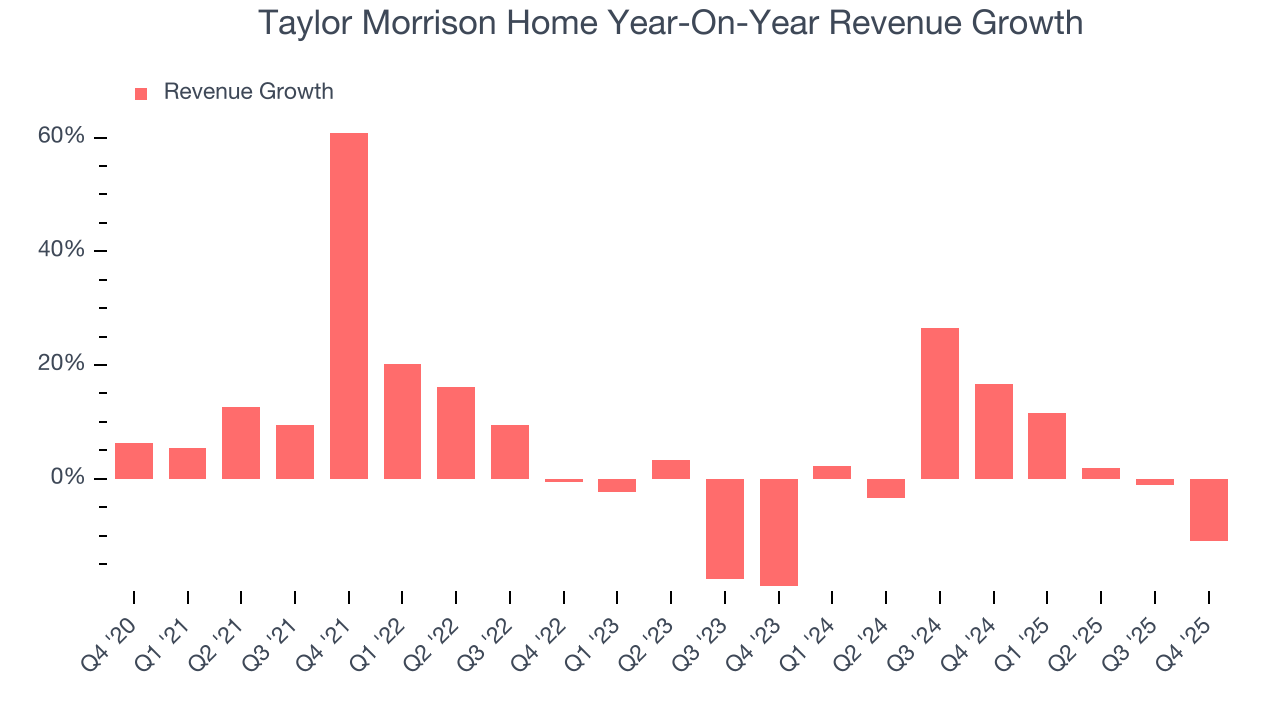
We can better understand the company’s revenue dynamics by analyzing its backlog, or the value of its outstanding orders that have not yet been executed or delivered. Taylor Morrison Home’s backlog reached $1.86 billion in the latest quarter and averaged 18.5% year-on-year declines over the last two years. Because this number is lower than its revenue growth, we can see the company hasn’t secured enough new orders to maintain its growth rate in the future. 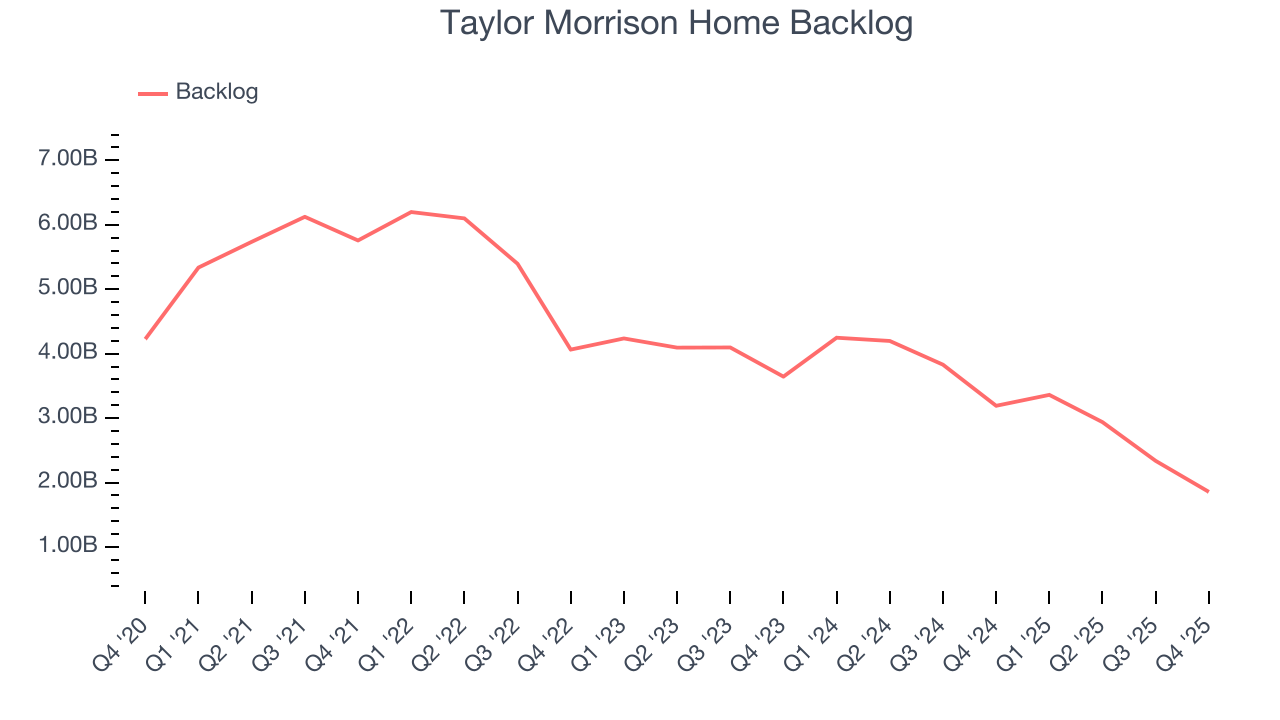
This quarter, Taylor Morrison Home’s revenue fell by 10.9% year on year to $2.1 billion but beat Wall Street’s estimates by 7.2%.
Looking ahead, sell-side analysts expect revenue to decline by 12.6% over the next 12 months, a deceleration versus the last two years. This projection is underwhelming and implies its products and services will see some demand headwinds.
6. Gross Margin & Pricing Power
Taylor Morrison Home has bad unit economics for an industrials company, giving it less room to reinvest and develop new offerings. As you can see below, it averaged a 23.8% gross margin over the last five years. That means Taylor Morrison Home paid its suppliers a lot of money ($76.19 for every $100 in revenue) to run its business. 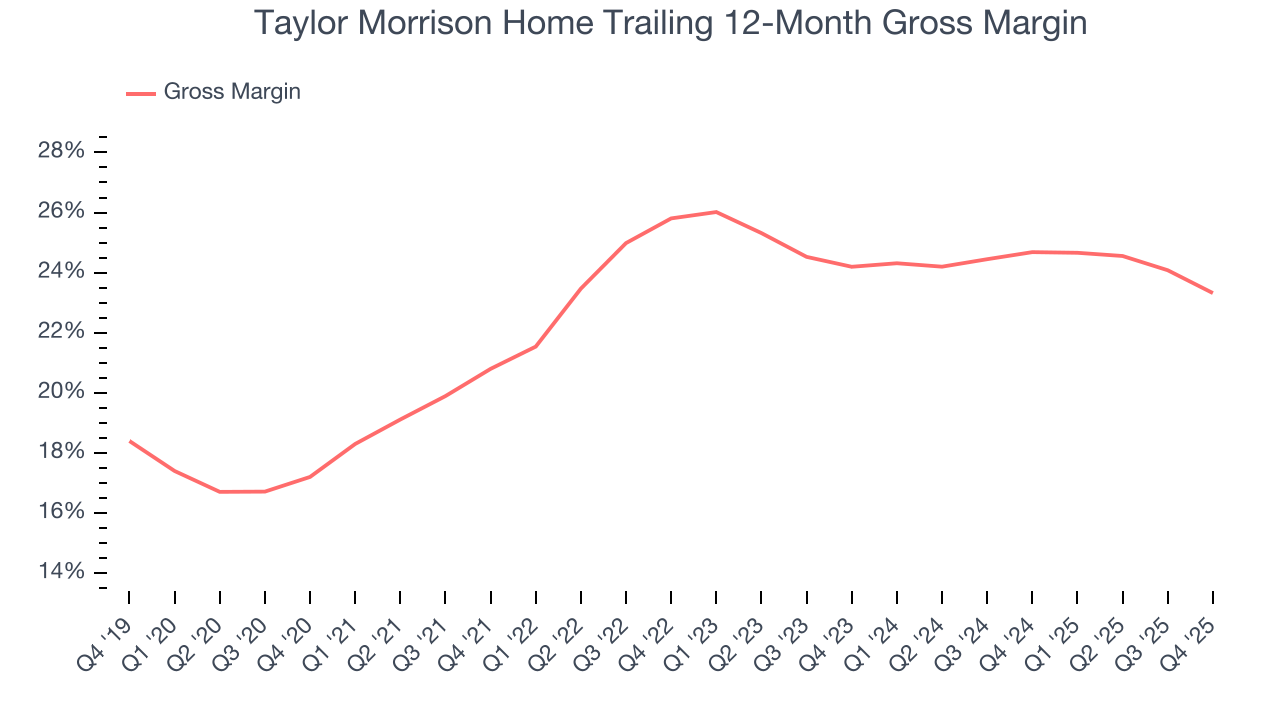
This quarter, Taylor Morrison Home’s gross profit margin was 22%, marking a 2.8 percentage point decrease from 24.9% in the same quarter last year. Taylor Morrison Home’s full-year margin has also been trending down over the past 12 months, decreasing by 1.4 percentage points. If this move continues, it could suggest a more competitive environment with some pressure to lower prices and higher input costs (such as raw materials and manufacturing expenses).
7. Operating Margin
Taylor Morrison Home has been an efficient company over the last five years. It was one of the more profitable businesses in the industrials sector, boasting an average operating margin of 14.5%. This result was particularly impressive because of its low gross margin, which is mostly a factor of what it sells and takes huge shifts to move meaningfully. Companies have more control over their operating margins, and it’s a show of well-managed operations if they’re high when gross margins are low.
Looking at the trend in its profitability, Taylor Morrison Home’s operating margin rose by 1.7 percentage points over the last five years, as its sales growth gave it operating leverage. Its expansion was impressive, especially when considering most Home Builders peers saw their margins plummet.
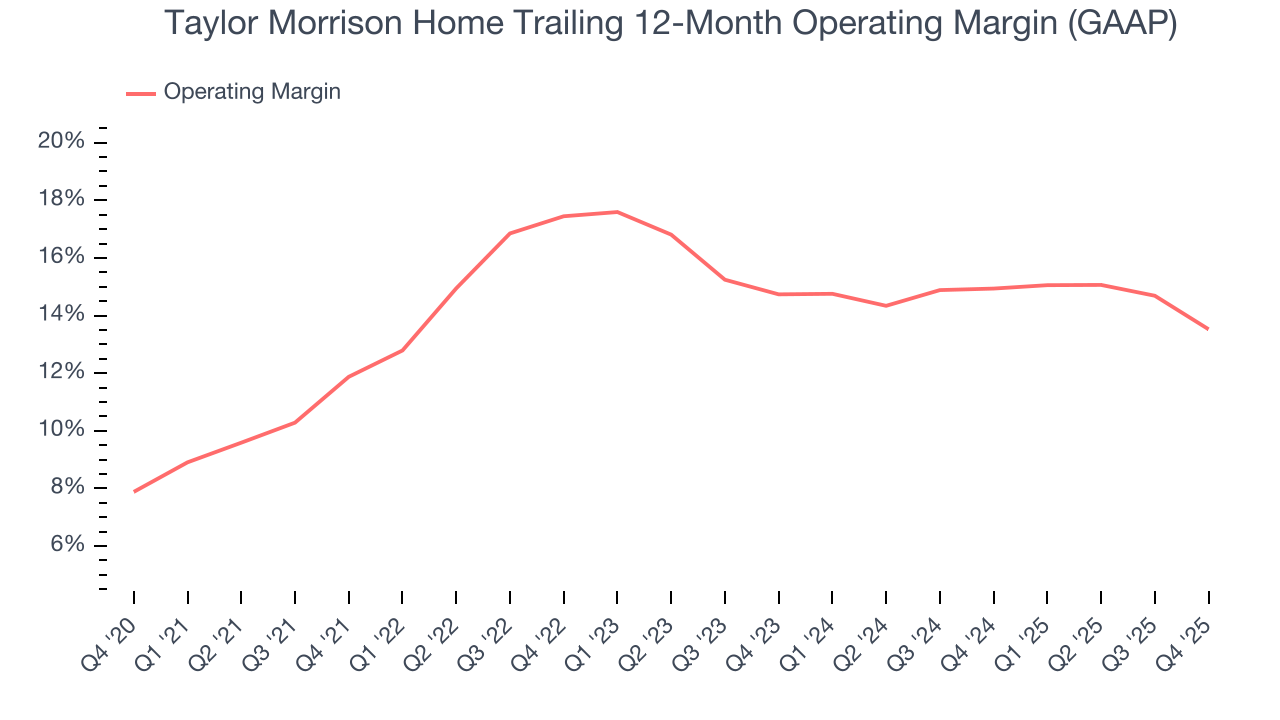
This quarter, Taylor Morrison Home generated an operating margin profit margin of 10.9%, down 4.4 percentage points year on year. Since Taylor Morrison Home’s operating margin decreased more than its gross margin, we can assume it was less efficient because expenses such as marketing, R&D, and administrative overhead increased.
8. Earnings Per Share
Revenue trends explain a company’s historical growth, but the long-term change in earnings per share (EPS) points to the profitability of that growth – for example, a company could inflate its sales through excessive spending on advertising and promotions.
Taylor Morrison Home’s EPS grew at an astounding 20.1% compounded annual growth rate over the last five years, higher than its 5.8% annualized revenue growth. This tells us the company became more profitable on a per-share basis as it expanded.
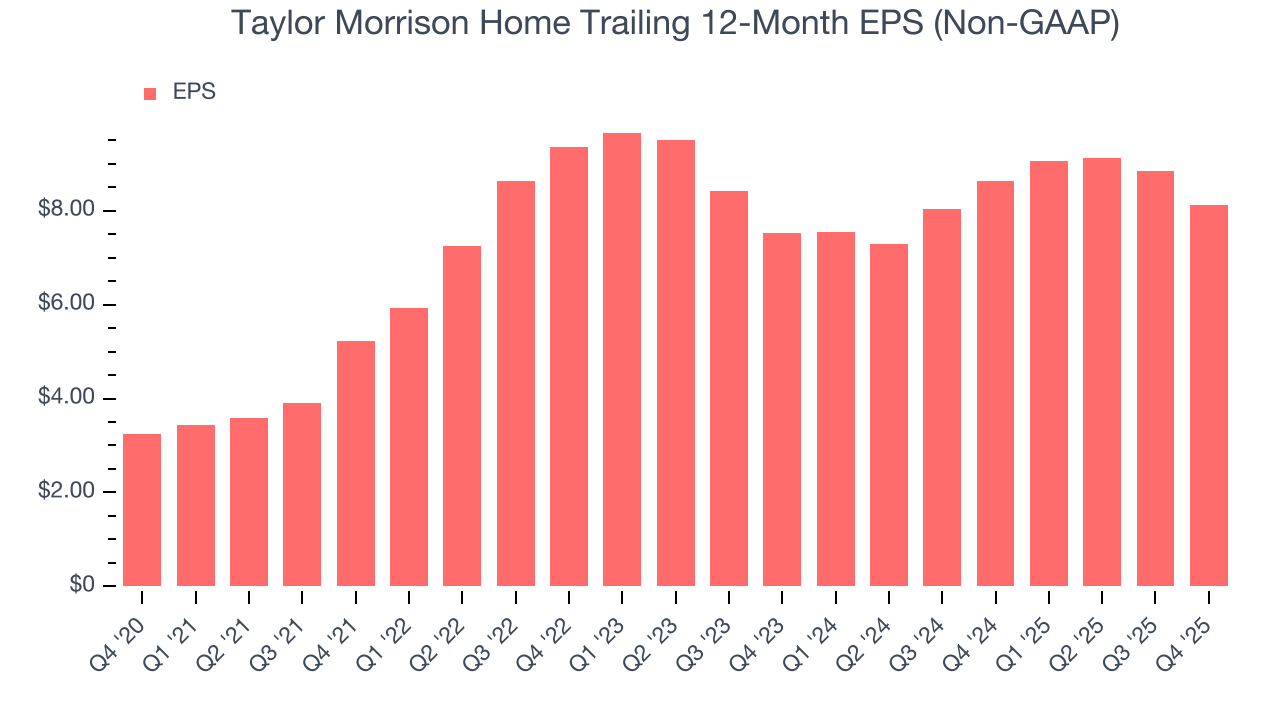
Diving into Taylor Morrison Home’s quality of earnings can give us a better understanding of its performance. As we mentioned earlier, Taylor Morrison Home’s operating margin declined this quarter but expanded by 1.7 percentage points over the last five years. Its share count also shrank by 25.3%, and these factors together are positive signs for shareholders because improving profitability and share buybacks turbocharge EPS growth relative to revenue growth. 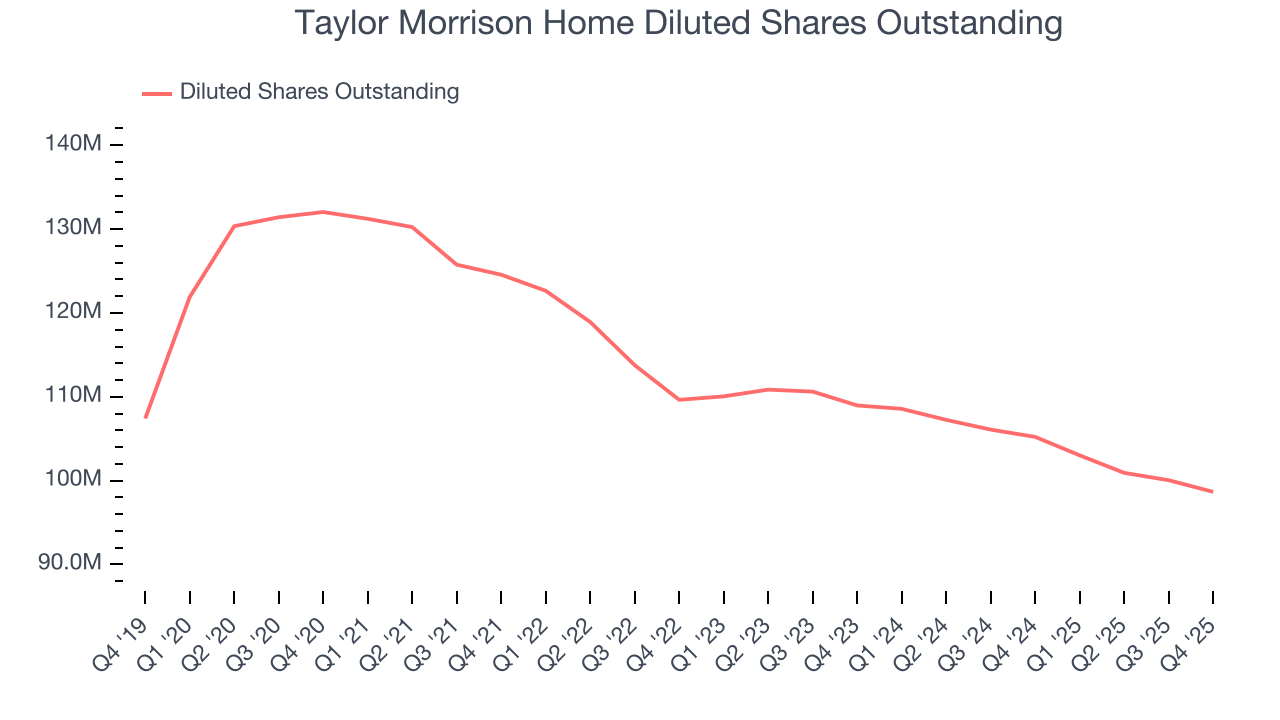
Like with revenue, we analyze EPS over a more recent period because it can provide insight into an emerging theme or development for the business.
For Taylor Morrison Home, its two-year annual EPS growth of 3.8% was lower than its five-year trend. We hope its growth can accelerate in the future.
In Q4, Taylor Morrison Home reported adjusted EPS of $1.91, down from $2.64 in the same quarter last year. Despite falling year on year, this print beat analysts’ estimates by 10%. Over the next 12 months, Wall Street expects Taylor Morrison Home’s full-year EPS of $8.12 to shrink by 22%.
9. Cash Is King
Free cash flow isn't a prominently featured metric in company financials and earnings releases, but we think it's telling because it accounts for all operating and capital expenses, making it tough to manipulate. Cash is king.
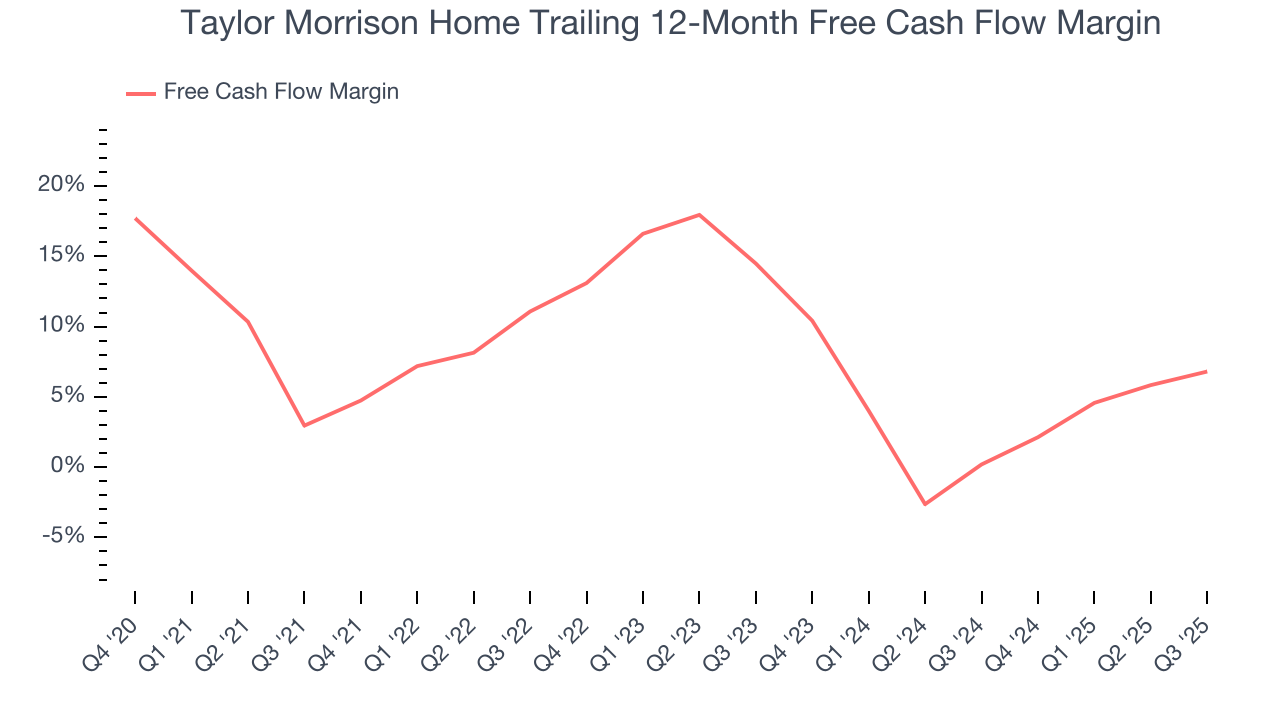
Taylor Morrison Home has shown decent cash profitability, giving it some flexibility to reinvest or return capital to investors. The company’s free cash flow margin averaged 6.8% over the last five years, slightly better than the broader industrials sector.
Taking a step back, we can see that Taylor Morrison Home’s margin expanded by 4.7 percentage points during that time. This shows the company is heading in the right direction, and we can see it became a less capital-intensive business because its free cash flow profitability rose more than its operating profitability.
10. Return on Invested Capital (ROIC)
EPS and free cash flow tell us whether a company was profitable while growing its revenue. But was it capital-efficient? Enter ROIC, a metric showing how much operating profit a company generates relative to the money it has raised (debt and equity).
Although Taylor Morrison Home hasn’t been the highest-quality company lately, it historically found a few growth initiatives that worked. Its five-year average ROIC was 12.9%, higher than most industrials businesses.
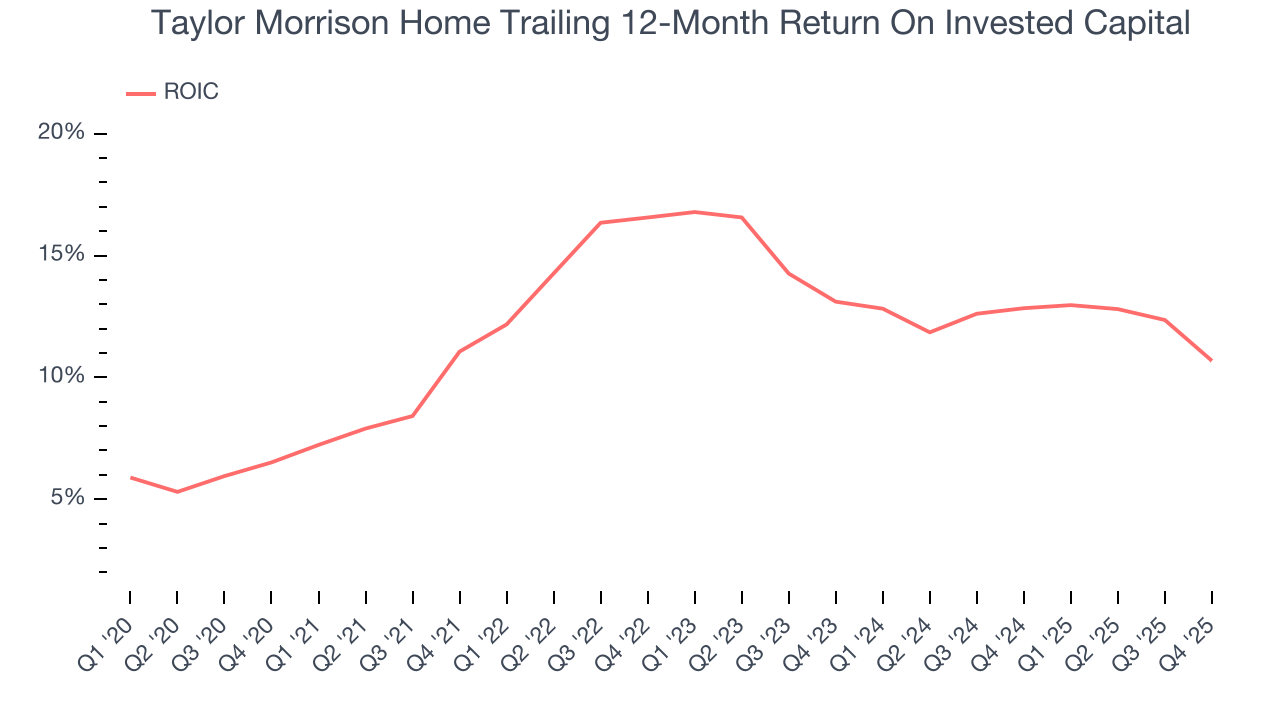
We like to invest in businesses with high returns, but the trend in a company’s ROIC is what often surprises the market and moves the stock price. Over the last few years, Taylor Morrison Home’s ROIC averaged 2 percentage point decreases each year. We like what management has done in the past, but its declining returns are perhaps a symptom of fewer profitable growth opportunities.
11. Balance Sheet Assessment
Taylor Morrison Home reported $851.2 million of cash and $2.36 billion of debt on its balance sheet in the most recent quarter. As investors in high-quality companies, we primarily focus on two things: 1) that a company’s debt level isn’t too high and 2) that its interest payments are not excessively burdening the business.
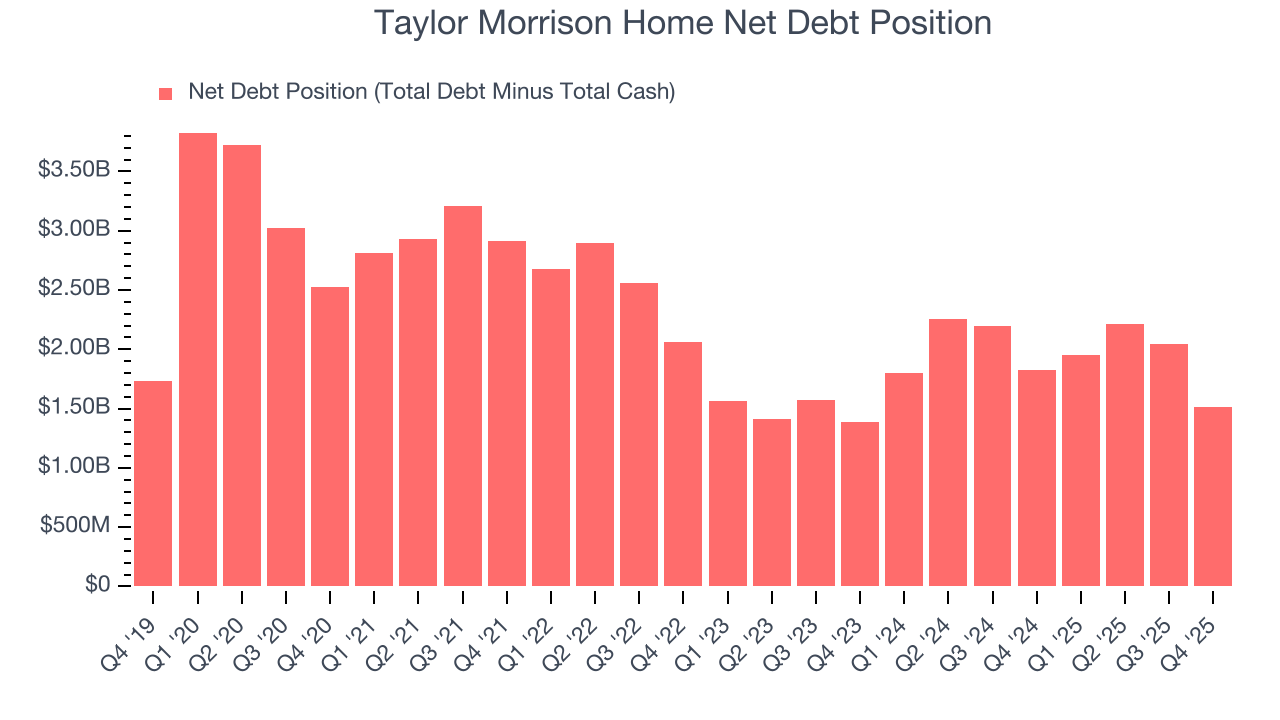
With $1.19 billion of EBITDA over the last 12 months, we view Taylor Morrison Home’s 1.3× net-debt-to-EBITDA ratio as safe. We also see its $23.18 million of annual interest expenses as appropriate. The company’s profits give it plenty of breathing room, allowing it to continue investing in growth initiatives.
12. Key Takeaways from Taylor Morrison Home’s Q4 Results
We were impressed by how significantly Taylor Morrison Home blew past analysts’ EBITDA expectations this quarter. We were also excited its revenue outperformed Wall Street’s estimates by a wide margin. Zooming out, we think this quarter featured some important positives. The stock remained flat at $66.41 immediately following the results.
13. Is Now The Time To Buy Taylor Morrison Home?
Updated: March 23, 2026 at 12:09 AM EDT
A common mistake we notice when investors are deciding whether to buy a stock or not is that they simply look at the latest earnings results. Business quality and valuation matter more, so we urge you to understand these dynamics as well.
Taylor Morrison Home isn’t a terrible business, but it doesn’t pass our bar. To begin with, its revenue growth was uninspiring over the last five years, and analysts expect its demand to deteriorate over the next 12 months. While its astounding EPS growth over the last five years shows its profits are trickling down to shareholders, the downside is its projected EPS for the next year is lacking. On top of that, its backlog declined.
Taylor Morrison Home’s P/E ratio based on the next 12 months is 11.3x. While this valuation is reasonable, we don’t really see a big opportunity at the moment. We're pretty confident there are superior stocks to buy right now.
Wall Street analysts have a consensus one-year price target of $74.89 on the company (compared to the current share price of $57.67).
Although the price target is bullish, readers should exercise caution because analysts tend to be overly optimistic. The firms they work for, often big banks, have relationships with companies that extend into fundraising, M&A advisory, and other rewarding business lines. As a result, they typically hesitate to say bad things for fear they will lose out. We at StockStory do not suffer from such conflicts of interest, so we’ll always tell it like it is.