
Yum China (YUMC)
We aren’t fans of Yum China. Its weak sales growth and declining returns on capital show its demand and profits are shrinking.― StockStory Analyst Team


1. News


2. Summary
Why Yum China Is Not Exciting
One of China’s largest restaurant companies, Yum China (NYSE:YUMC) is an independent entity spun off from Yum! Brands in 2016.
- Weak same-store sales trends over the past two years suggest there may be few opportunities in its core markets to open new restaurants
- Gross margin of 20.1% is below its competitors, leaving less money for marketing and promotions
- A consolation is that its ROIC punches in at 26.1%, illustrating management’s expertise in identifying profitable investments
Yum China’s quality doesn’t meet our bar. Better businesses are for sale in the market.
Why There Are Better Opportunities Than Yum China



Yum China’s stock price of $50.55 implies a valuation ratio of 17.9x forward P/E. Yes, this valuation multiple is lower than that of other restaurant peers, but we’ll remind you that you often get what you pay for.
It’s better to pay up for high-quality businesses with higher long-term earnings potential rather than to buy lower-quality stocks because they appear cheap. These challenged businesses often don’t re-rate, a phenomenon known as a “value trap”.
3. Yum China (YUMC) Research Report: Q4 CY2025 Update
Fast-food company Yum China (NYSE:YUMC) reported Q4 CY2025 results beating Wall Street’s revenue expectations, with sales up 8.8% year on year to $2.82 billion. Its non-GAAP profit of $0.40 per share was 9.2% above analysts’ consensus estimates.
Yum China (YUMC) Q4 CY2025 Highlights:
- Revenue: $2.82 billion vs analyst estimates of $2.72 billion (8.8% year-on-year growth, 3.9% beat)
- Adjusted EPS: $0.40 vs analyst estimates of $0.37 (9.2% beat)
- Adjusted EBITDA: $318 million vs analyst estimates of $304.9 million (11.3% margin, 4.3% beat)
- Operating Margin: 6.6%, in line with the same quarter last year
- Free Cash Flow was -$116 million compared to -$15 million in the same quarter last year
- Locations: 18,101 at quarter end, up from 16,395 in the same quarter last year
- Same-Store Sales rose 3% year on year (-1% in the same quarter last year)
- Market Capitalization: $17.89 billion
Company Overview
One of China’s largest restaurant companies, Yum China (NYSE:YUMC) is an independent entity spun off from Yum! Brands in 2016.
It was strategically separated from its parent company to focus on the Chinese restaurant market, which has vast potential and different dynamics than the United States. Today, the company mainly operates KFC (fried chicken), Pizza Hut (pizza), and Taco Bell (Mexican) fast-food chains in China.
Yum China has carved itself a niche in the country as the predominant destination for traditional American flavors with an Asian twist. Its success can be attributed to localization, and through its deep understanding of Chinese consumers, has revamped its menu items to include innovative dishes such as KFC’s fried chicken meal, which comes with rice, soup, and mushroom salad, Pizza Hut’s jumbo bacon-wrapped shrimp basil pesto pizza and escargot, and Taco Bell’s beef bulgogi and kimchi burrito.
Additionally, unlike its United States counterparts, Yum China’s fast-food locations are perceived as premium dining options due to their cleanliness, price point, and inclusion of technology like self-service digital kiosks. Generally, its stores’ layouts are similar to those in the United States with a counter where customers can place orders and seating areas with a mix of booths and tables. Some of its locations, however, also offer table service, which is unheard of in typical fast-food joints.
4. Traditional Fast Food
Traditional fast-food restaurants are renowned for their speed and convenience, boasting menus filled with familiar and budget-friendly items. Their reputations for on-the-go consumption make them favored destinations for individuals and families needing a quick meal. This class of restaurants, however, is fighting the perception that their meals are unhealthy and made with inferior ingredients, a battle that's especially relevant today given the consumers increasing focus on health and wellness.
American competitors include Burger King (owned by Restaurant Brands, NYSE:QSR), McDonald’s (NYSE:MCD), and Starbucks (NASDAQ:SBUX) while Chinese competitors comprise of Dicos, Home Original Chicken, and Real Kungfu.
5. Revenue Growth
Examining a company’s long-term performance can provide clues about its quality. Any business can put up a good quarter or two, but the best consistently grow over the long haul.
With $11.8 billion in revenue over the past 12 months, Yum China is one of the most widely recognized restaurant chains and benefits from customer loyalty, a luxury many don’t have. Its scale also gives it negotiating leverage with suppliers, enabling it to source its ingredients at a lower cost. However, its scale is a double-edged sword because there are only a finite of number places to build restaurants, making it harder to find incremental growth. To accelerate system-wide sales, Yum China likely needs to optimize its pricing or lean into new chains and international expansion.
As you can see below, Yum China’s sales grew at a tepid 5.1% compounded annual growth rate over the last six years.
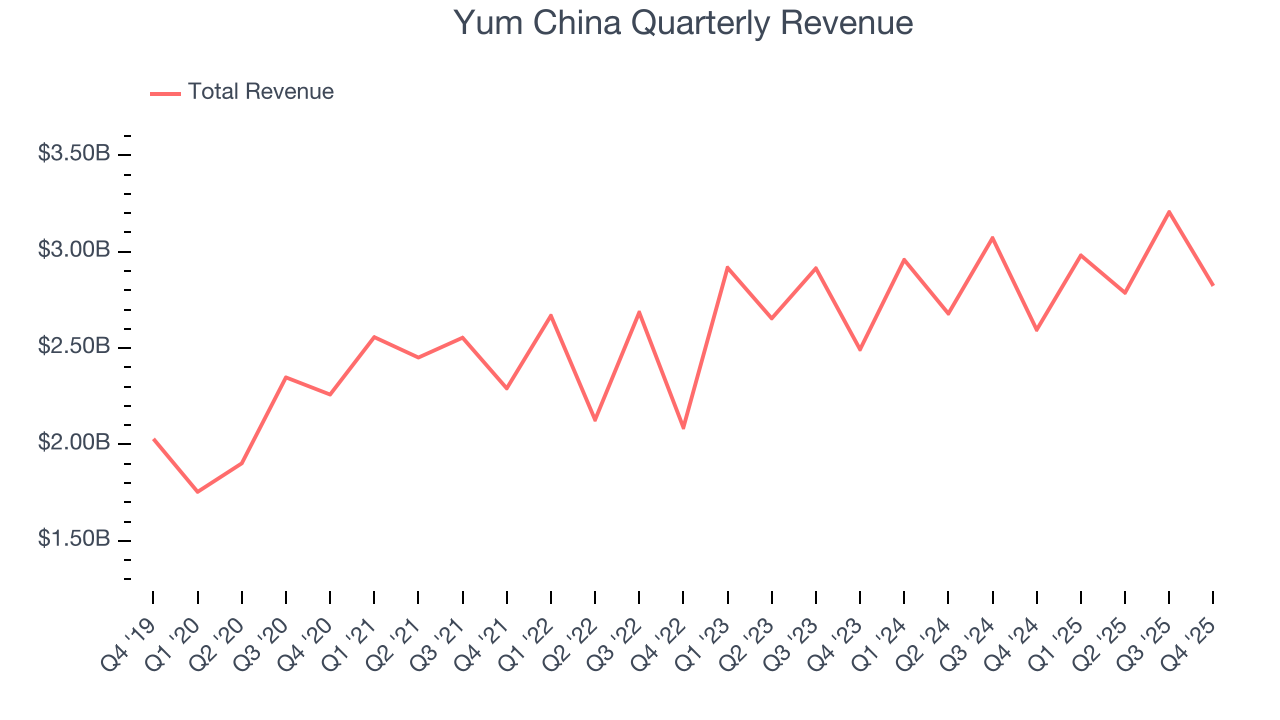
This quarter, Yum China reported year-on-year revenue growth of 8.8%, and its $2.82 billion of revenue exceeded Wall Street’s estimates by 3.9%.
Looking ahead, sell-side analysts expect revenue to grow 5.6% over the next 12 months, similar to its six-year rate. This projection is underwhelming and suggests its newer menu offerings will not catalyze better top-line performance yet.
6. Restaurant Performance
Number of Restaurants
The number of dining locations a restaurant chain operates is a critical driver of how quickly company-level sales can grow.
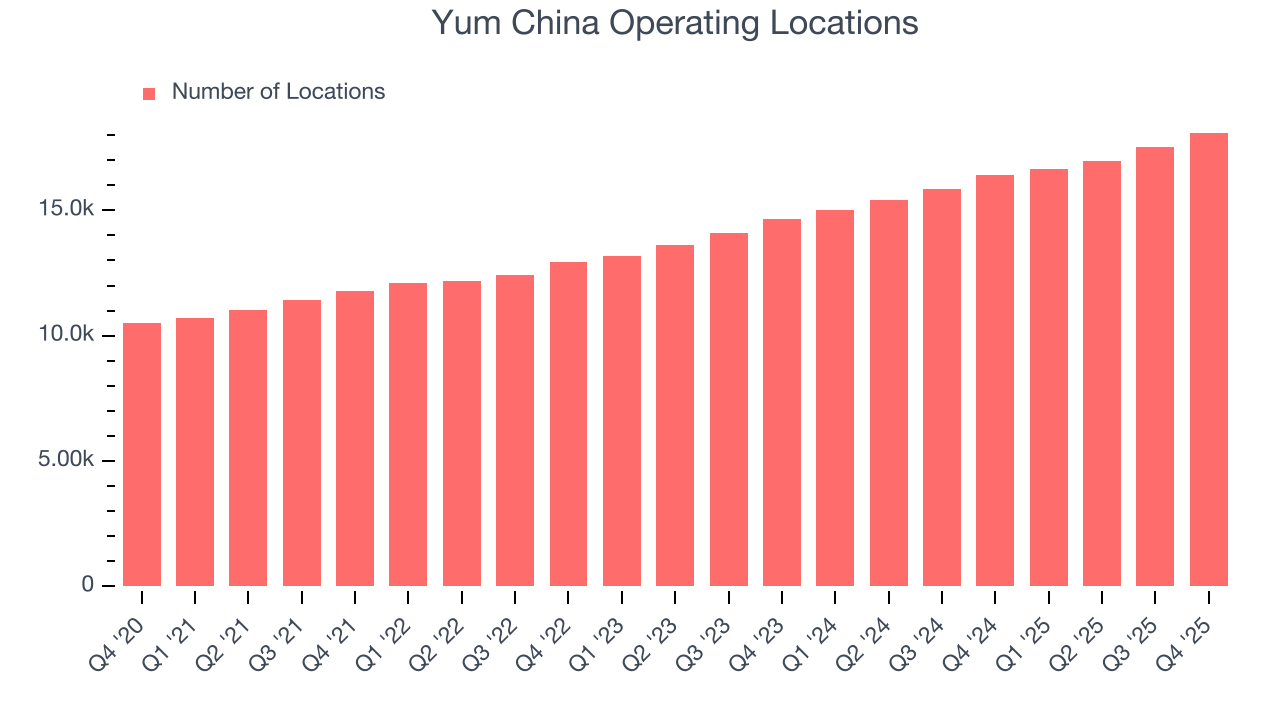
Yum China sported 18,101 locations in the latest quarter. Over the last two years, it has opened new restaurants at a rapid clip by averaging 11.7% annual growth, among the fastest in the restaurant sector.
When a chain opens new restaurants, it usually means it’s investing for growth because there’s healthy demand for its meals and there are markets where its concepts have few or no locations.
Same-Store Sales
A company's restaurant base only paints one part of the picture. When demand is high, it makes sense to open more. But when demand is low, it’s prudent to close some locations and use the money in other ways. Same-store sales provides a deeper understanding of this issue because it measures organic growth at restaurants open for at least a year.
Yum China’s demand within its existing dining locations has barely increased over the last two years as its same-store sales were flat. Yum China should consider improving its foot traffic and efficiency before expanding its restaurant base.
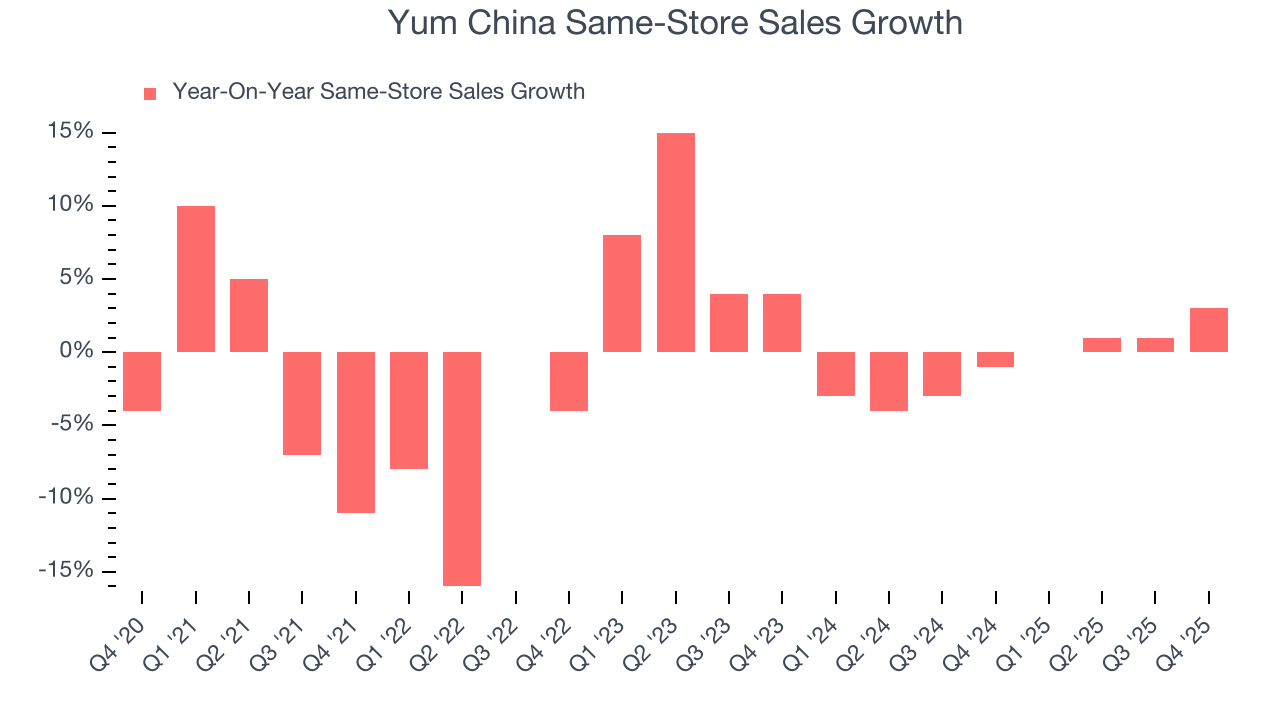
In the latest quarter, Yum China’s same-store sales rose 3% year on year. This growth was a well-appreciated turnaround from its historical levels, showing the business is regaining momentum.
7. Gross Margin & Pricing Power
Yum China has bad unit economics for a restaurant company, signaling it operates in a competitive market and has little room for error if demand unexpectedly falls. As you can see below, it averaged a 19.1% gross margin over the last two years. Said differently, Yum China had to pay a chunky $80.86 to its suppliers for every $100 in revenue. 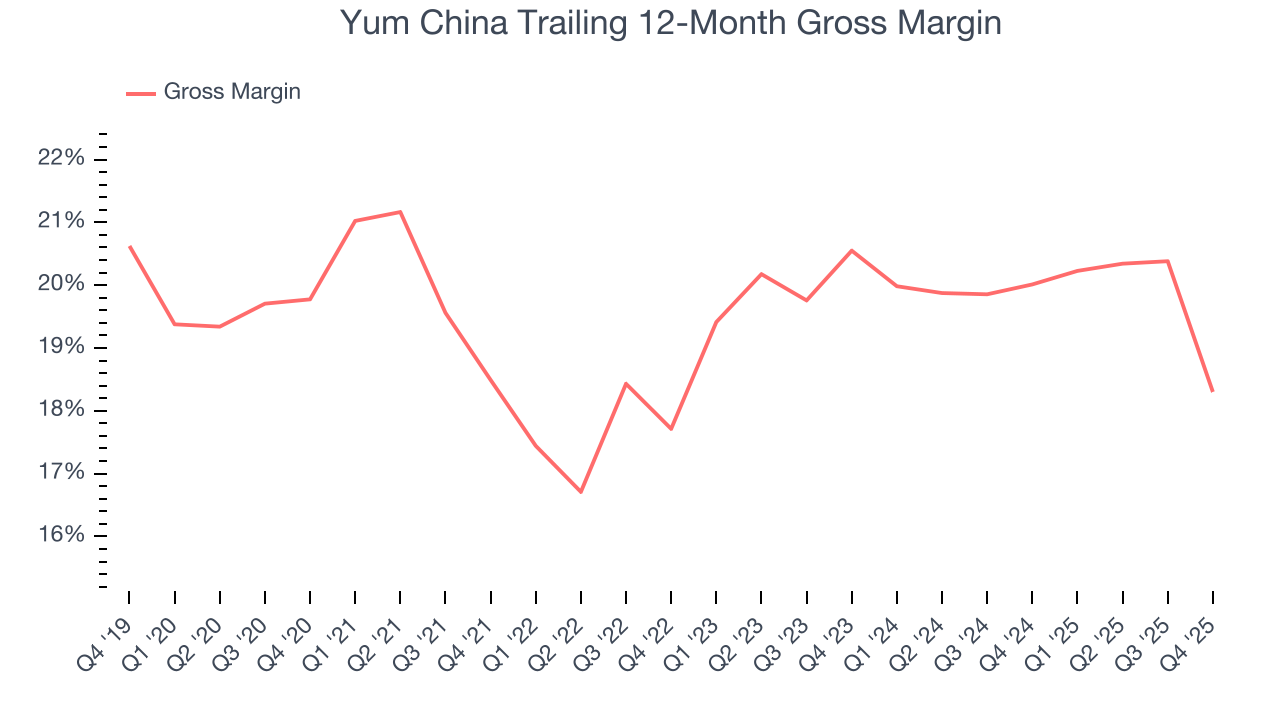
This quarter, Yum China’s gross profit margin was 18.7%, marking a 9.3 percentage point decrease from 28.1% in the same quarter last year. Yum China’s full-year margin has also been trending down over the past 12 months, decreasing by 1.7 percentage points. If this move continues, it could suggest a more competitive environment with some pressure to lower prices and higher input costs (such as ingredients and transportation expenses).
8. Operating Margin
Operating margin is a key profitability metric because it accounts for all expenses keeping the business in motion, including food costs, wages, rent, advertising, and other administrative costs.
Yum China’s operating margin might fluctuated slightly over the last 12 months but has generally stayed the same, averaging 10.6% over the last two years. This profitability was higher than the broader restaurant sector, showing it did a decent job managing its expenses.
Analyzing the trend in its profitability, Yum China’s operating margin might fluctuated slightly but has generally stayed the same over the last year. This raises questions about the company’s expense base because its revenue growth should have given it leverage on its fixed costs, resulting in better economies of scale and profitability.
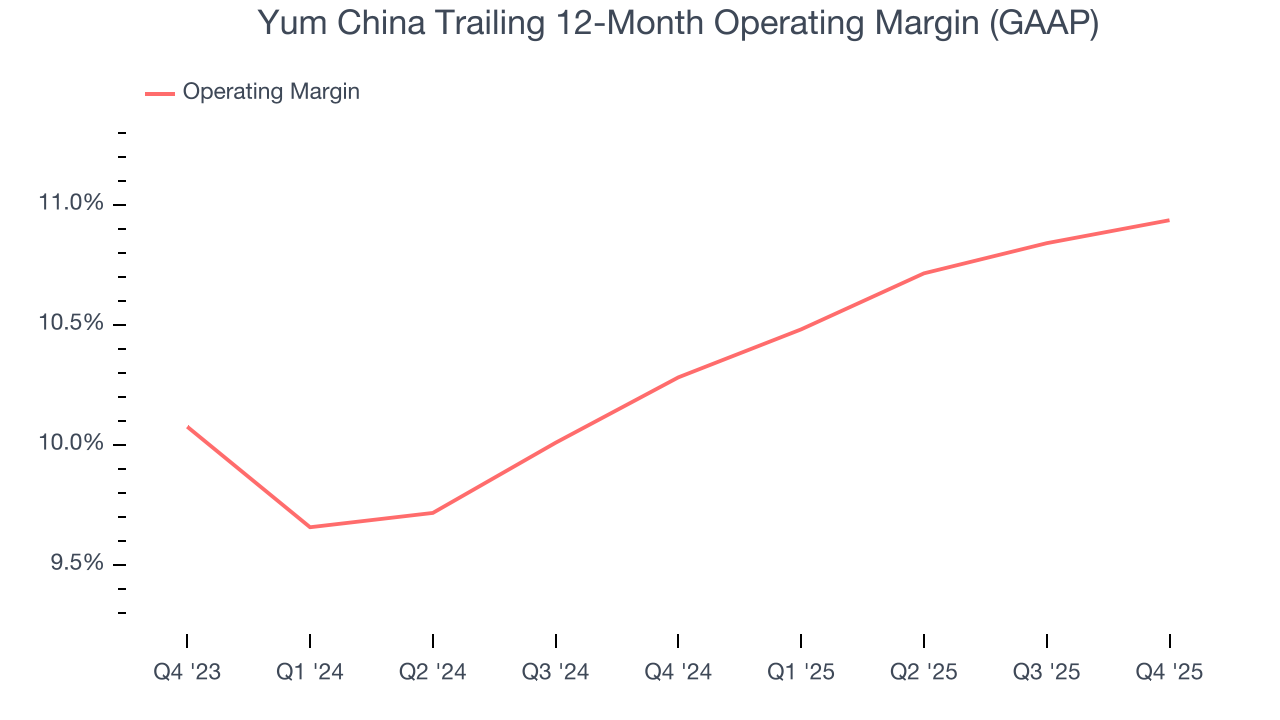
In Q4, Yum China generated an operating margin profit margin of 6.6%, in line with the same quarter last year. This indicates the company’s cost structure has recently been stable.
9. Earnings Per Share
We track the long-term change in earnings per share (EPS) for the same reason as long-term revenue growth. Compared to revenue, however, EPS highlights whether a company’s growth is profitable.
Yum China’s unimpressive 4.9% annual EPS growth over the last six years aligns with its revenue performance. On the bright side, this tells us its incremental sales were profitable.
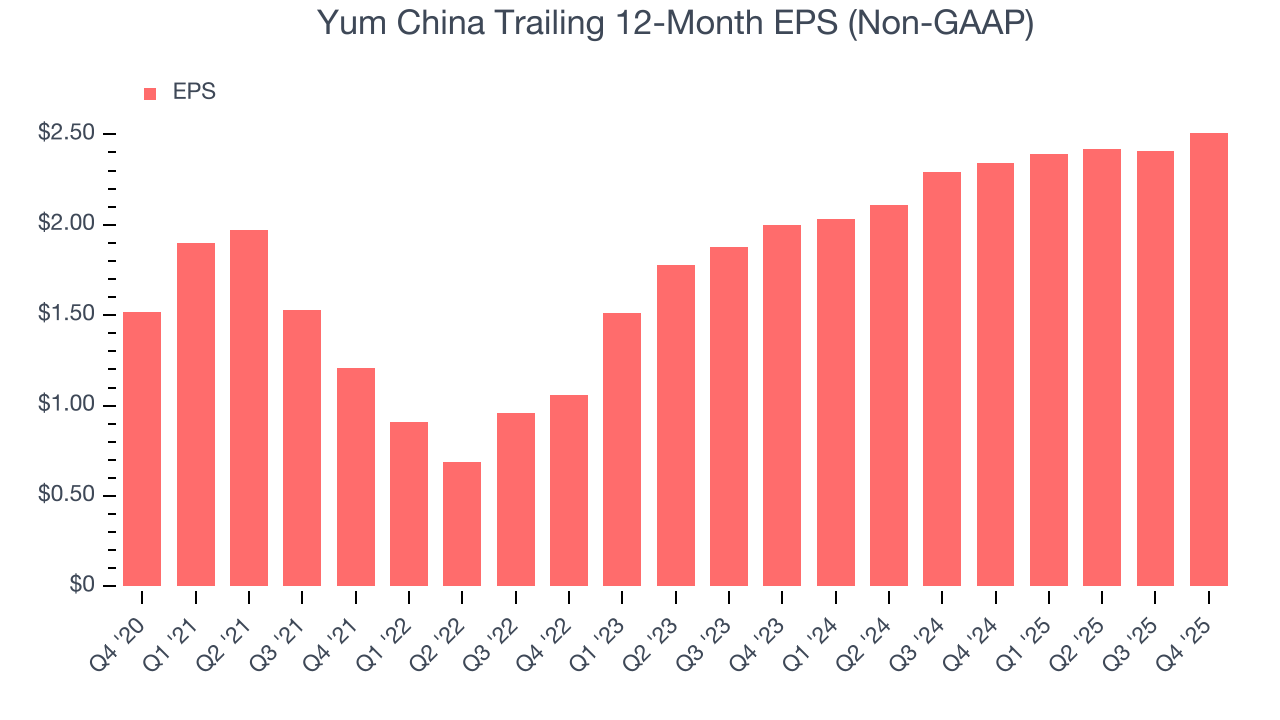
In Q4, Yum China reported adjusted EPS of $0.40, up from $0.30 in the same quarter last year. This print beat analysts’ estimates by 9.2%. Over the next 12 months, Wall Street expects Yum China’s full-year EPS of $2.51 to grow 14.6%.
10. Cash Is King
Free cash flow isn't a prominently featured metric in company financials and earnings releases, but we think it's telling because it accounts for all operating and capital expenses, making it tough to manipulate. Cash is king.
Yum China has shown impressive cash profitability, giving it the option to reinvest or return capital to investors. The company’s free cash flow margin averaged 6.7% over the last two years, better than the broader restaurant sector.
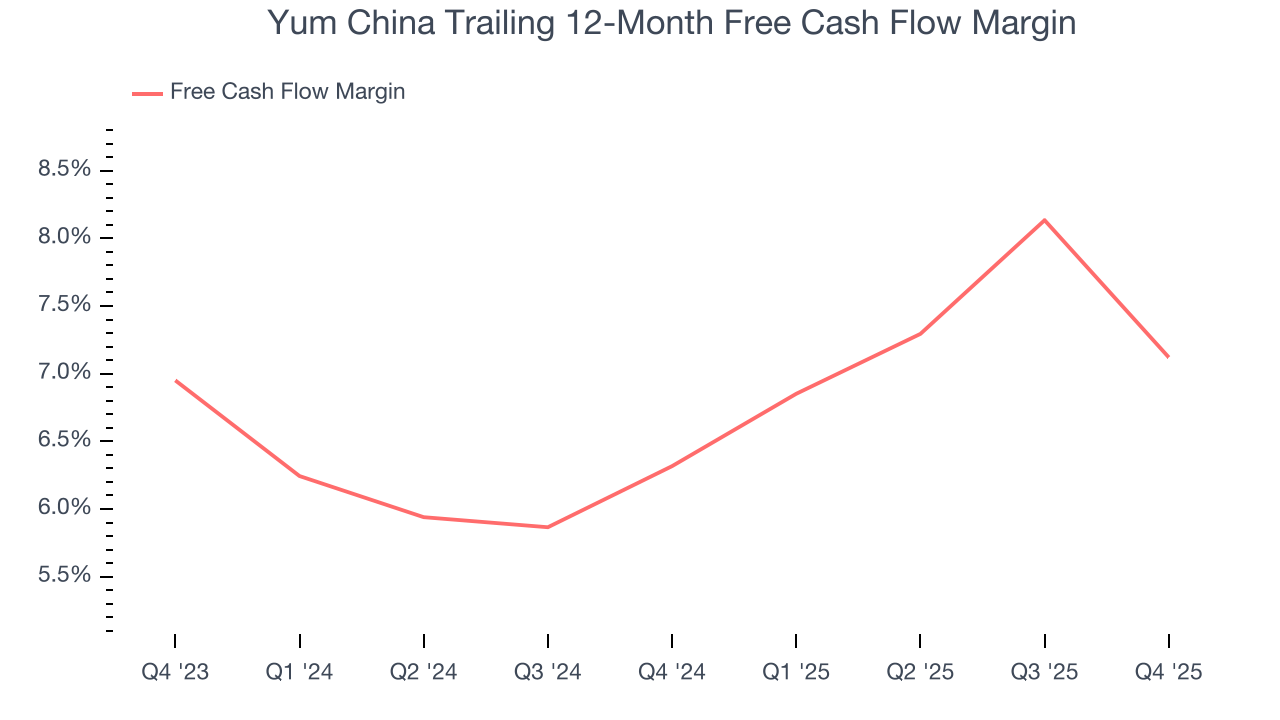
Yum China burned through $116 million of cash in Q4, equivalent to a negative 4.1% margin. The company’s cash burn increased from $15 million of lost cash in the same quarter last year. These numbers deviate from its longer-term margin, indicating it is a seasonal business.
11. Return on Invested Capital (ROIC)
EPS and free cash flow tell us whether a company was profitable while growing its revenue. But was it capital-efficient? A company’s ROIC explains this by showing how much operating profit it makes compared to the money it has raised (debt and equity).
Although Yum China hasn’t been the highest-quality company lately, it found a few growth initiatives in the past that worked out wonderfully. Its five-year average ROIC was 26.3%, splendid for a restaurant business.
12. Balance Sheet Assessment
Yum China reported $1.38 billion of cash and $1.90 billion of debt on its balance sheet in the most recent quarter. As investors in high-quality companies, we primarily focus on two things: 1) that a company’s debt level isn’t too high and 2) that its interest payments are not excessively burdening the business.
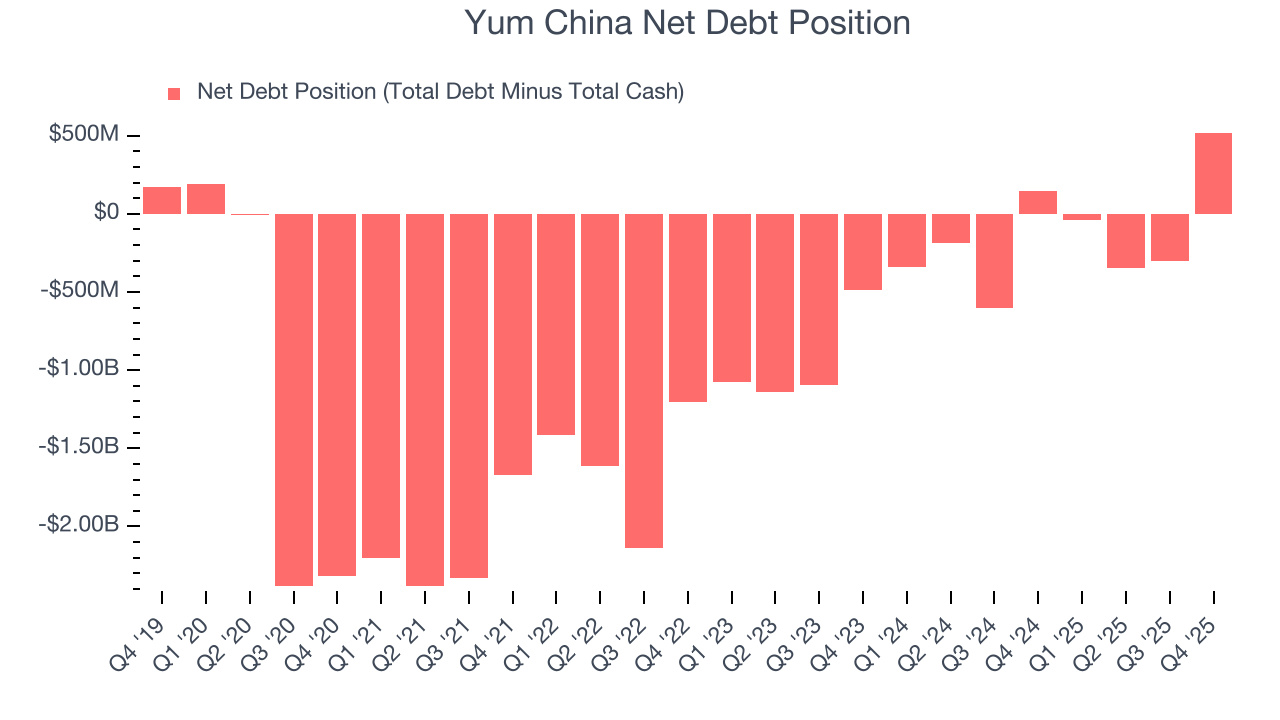
With $1.78 billion of EBITDA over the last 12 months, we view Yum China’s 0.3× net-debt-to-EBITDA ratio as safe. We also see its $95 million of annual interest expenses as appropriate. The company’s profits give it plenty of breathing room, allowing it to continue investing in growth initiatives.
13. Key Takeaways from Yum China’s Q4 Results
We were impressed by how significantly Yum China blew past analysts’ revenue expectations this quarter. We were also excited its same-store sales outperformed Wall Street’s estimates by a wide margin. Zooming out, we think this quarter featured some important positives. The stock traded up 4.9% to $53.23 immediately after reporting.
14. Is Now The Time To Buy Yum China?
Updated: February 4, 2026 at 5:30 AM EST
The latest quarterly earnings matters, sure, but we actually think longer-term fundamentals and valuation matter more. Investors should consider all these pieces before deciding whether or not to invest in Yum China.
Yum China isn’t a terrible business, but it isn’t one of our picks. First off, its revenue growth was a little slower over the last six years, and analysts don’t see anything changing over the next 12 months. And while its new restaurant openings have increased its brand equity, the downside is its poor same-store sales performance has been a headwind. On top of that, its gross margins make it more challenging to reach positive operating profits compared to other restaurant businesses.
Yum China’s P/E ratio based on the next 12 months is 17.6x. While this valuation is fair, the upside isn’t great compared to the potential downside. We're fairly confident there are better investments elsewhere.
Wall Street analysts have a consensus one-year price target of $58.29 on the company (compared to the current share price of $53.23).