
Bumble (BMBL)
We’re cautious of Bumble. Its sluggish sales growth shows demand is soft, a worrisome sign for investors in high-quality stocks.― StockStory Analyst Team


1. News


2. Summary
Why Bumble Is Not Exciting
Started by the co-founder of Tinder, Whitney Wolfe Herd, Bumble (NASDAQ:BMBL) is a leading dating app built with women at the center.
- Projected sales decline of 11.1% for the next 12 months points to a tough demand environment ahead
- Demand has fallen off a cliff over the last two years as its average revenue per buyer fell by 26.5% annually while it struggled to expand its customer base
- A consolation is that its successful business model is illustrated by its impressive EBITDA margin, and its profits increased over the last few years as it scaled
Bumble’s quality is insufficient. We’re redirecting our focus to better businesses.
Why There Are Better Opportunities Than Bumble






Bumble is trading at $3.42 per share, or 3.1x forward EV/EBITDA. This is a cheap valuation multiple, but for good reason. You get what you pay for.
We’d rather pay up for companies with elite fundamentals than get a bargain on weak ones. Cheap stocks can be value traps, and as their performance deteriorates, they will stay cheap or get even cheaper.
3. Bumble (BMBL) Research Report: Q4 CY2025 Update
Online dating app Bumble (NASDAQ:BMBL) announced better-than-expected revenue in Q4 CY2025, but sales fell by 5.1% year on year to $248.2 million. On top of that, next quarter’s revenue guidance ($244 million at the midpoint) was surprisingly good and 15.9% above what analysts were expecting. Its GAAP loss of $2.45 per share was significantly below analysts’ consensus estimates.
Bumble (BMBL) Q4 CY2025 Highlights:
- Revenue: $248.2 million vs analyst estimates of $221.5 million (5.1% year-on-year decline, 12% beat)
- EPS (GAAP): -$2.45 vs analyst estimates of $0.22 (significant miss)
- Adjusted EBITDA: $94.59 million vs analyst estimates of $63.77 million (38.1% margin, 48.3% beat)
- Revenue Guidance for Q1 CY2026 is $244 million at the midpoint, above analyst estimates of $210.6 million
- EBITDA guidance for Q1 CY2026 is $81.5 million at the midpoint, above analyst estimates of $56.76 million
- Operating Margin: -136%, down from 14.1% in the same quarter last year
- Free Cash Flow Margin: 27.3%, down from 30% in the previous quarter
- Paying Users: 3.78 million, down 401,600 year on year
- Market Capitalization: $316.8 million
Company Overview
Started by the co-founder of Tinder, Whitney Wolfe Herd, Bumble (NASDAQ:BMBL) is a leading dating app built with women at the center.
Online dating apps have disrupted the more traditional ways that people meet romantic partners, by greatly expanding the pool of potential dating partners, allowing people to more readily find those with shared common interests. Today, approximately 40% of couples now meet Online in the U.S., up from 20% in the early-2000s.
Bumble operates two dating apps – Bumble and Badoo. The Badoo app, founded by Andrey Andreev and launched in 2006, differentiates itself by its mantra of “Date Honestly” which is meant to be a mix of both dating app and social discovery app, where one can meet friends with similar interests. It is the market leader in Europe and Latin America.
Bumble launched in 2014, with the innovation of giving women the authority to make the first move under the premise that women would feel more confident and empowered, resulting in higher engagement than on other dating apps. As a result, within North America, Bumble has more female users for every male user than any other dating app, an indication of how well the product resonates with its users. Along the lines of being women-centric, Bumble was one of the first major dating apps to launch automated photo verification (ensuring matches are real people), develop in-app video chat, use machine learning to blur lewd images, and ban obscene images, all with the intention of improving the comfort level of meeting in person. Bumble has also added other mental health resources like a crisis support line, suicide prevention lifeline, and stress management tutorials, all of which bolster its reputation of being a safer, kinder, and more accountable dating app experience. The app itself is simple and works similarly to Tinder, profiles of potential matches are displayed to users, who can "swipe left" to reject a candidate or "swipe right" to indicate interest.
4. Consumer Subscription
Consumers today expect goods and services to be hyper-personalized and on demand. Whether it be what music they listen to, what movie they watch, or even finding a date, online consumer businesses are expected to delight their customers with simple user interfaces that magically fulfill demand. Subscription models have further increased usage and stickiness of many online consumer services.
Bumble (NASDAQ:BMBL)’s online dating peers include direct rivals Match Group (NASDAQ:MTCH) and Spark Networks (NYSE:LOV), along with social networks like Snapchat (NYSE:SNAP) and Meta Platforms (NASDAQ:FB).
5. Revenue Growth
A company’s long-term performance is an indicator of its overall quality. Even a bad business can shine for one or two quarters, but a top-tier one grows for years. Over the last three years, Bumble grew its sales at a sluggish 3.1% compounded annual growth rate. This was below our standard for the consumer internet sector and is a tough starting point for our analysis.
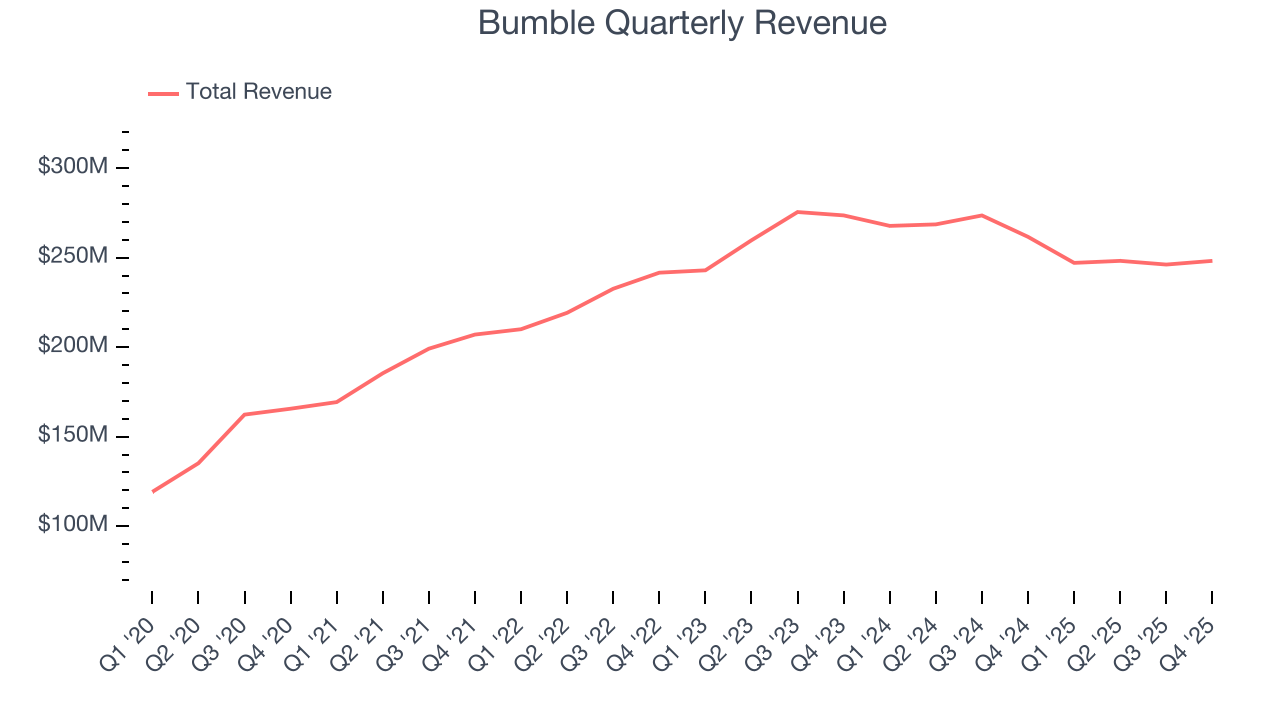
This quarter, Bumble’s revenue fell by 5.1% year on year to $248.2 million but beat Wall Street’s estimates by 12%. Company management is currently guiding for a 1.3% year-on-year decline in sales next quarter.
Looking further ahead, sell-side analysts expect revenue to decline by 13.8% over the next 12 months, a deceleration versus the last three years. This projection doesn't excite us and indicates its products and services will see some demand headwinds.
6. Paying Users
Buyer Growth
As a subscription-based app, Bumble generates revenue growth by expanding both its subscriber base and the amount each subscriber spends over time.
Over the last two years, Bumble’s paying users, a key performance metric for the company, increased by 1.5% annually to 3.78 million in the latest quarter. This growth rate is one of the lowest in the consumer internet sector. If Bumble wants to accelerate growth, it likely needs to engage users more effectively with its existing offerings or innovate with new products. 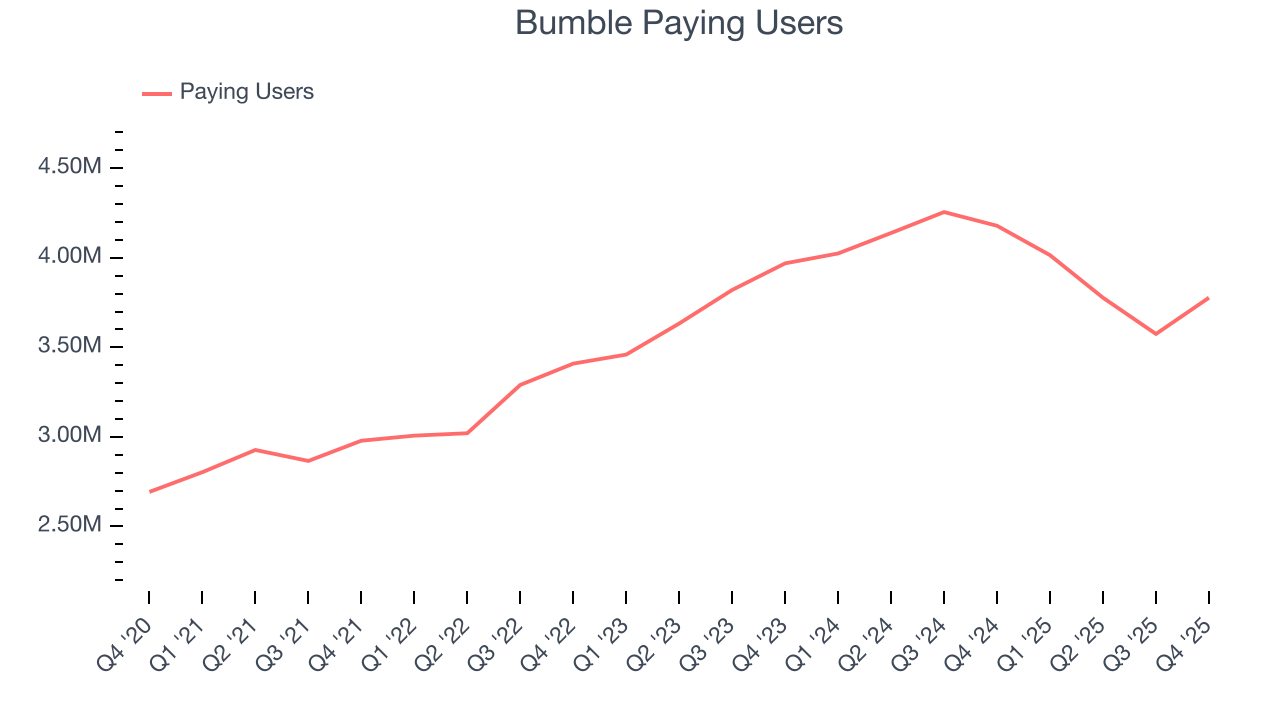
Unfortunately, Bumble’s paying users decreased by 401,600 in Q4, a 9.6% drop since last year. The quarterly print was lower than its two-year result, suggesting its new initiatives aren’t moving the needle for buyers yet.
Revenue Per Buyer
Average revenue per buyer (ARPB) is a critical metric to track because it measures how much the average buyer spends. ARPB is also a key indicator of how valuable its buyers are (and can be over time).
Bumble’s ARPB fell over the last two years, averaging 26.5% annual declines. This isn’t great when combined with its weaker paying users performance. If Bumble tries boosting ARPB by taking a more aggressive approach to monetization, it’s unclear whether buyer growth would be sustainable. 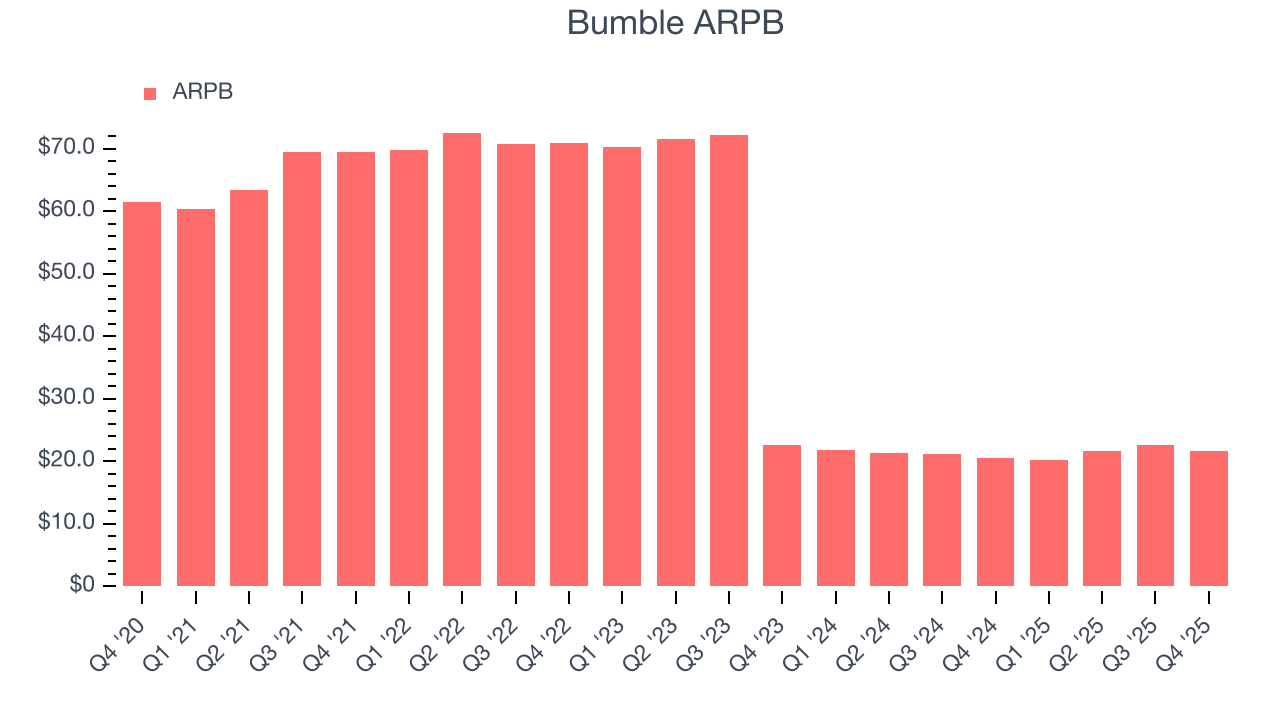
This quarter, Bumble’s ARPB clocked in at $21.69. It grew by 5.4% year on year, faster than its paying users.
7. Gross Margin & Pricing Power
For internet subscription businesses like Bumble, gross profit tells us how much money the company gets to keep after covering the base cost of its products and services, which typically include customer service, data center and infrastructure expenses, royalties, and other content-related costs if the company’s offerings include features such as video or music.
Bumble has robust unit economics, an output of its asset-lite business model and pricing power. Its margin is better than the broader consumer internet industry and enables the company to fund large investments in new products and marketing during periods of rapid growth to achieve higher profits in the future. As you can see below, it averaged an excellent 70.5% gross margin over the last two years. That means Bumble only paid its providers $29.51 for every $100 in revenue. 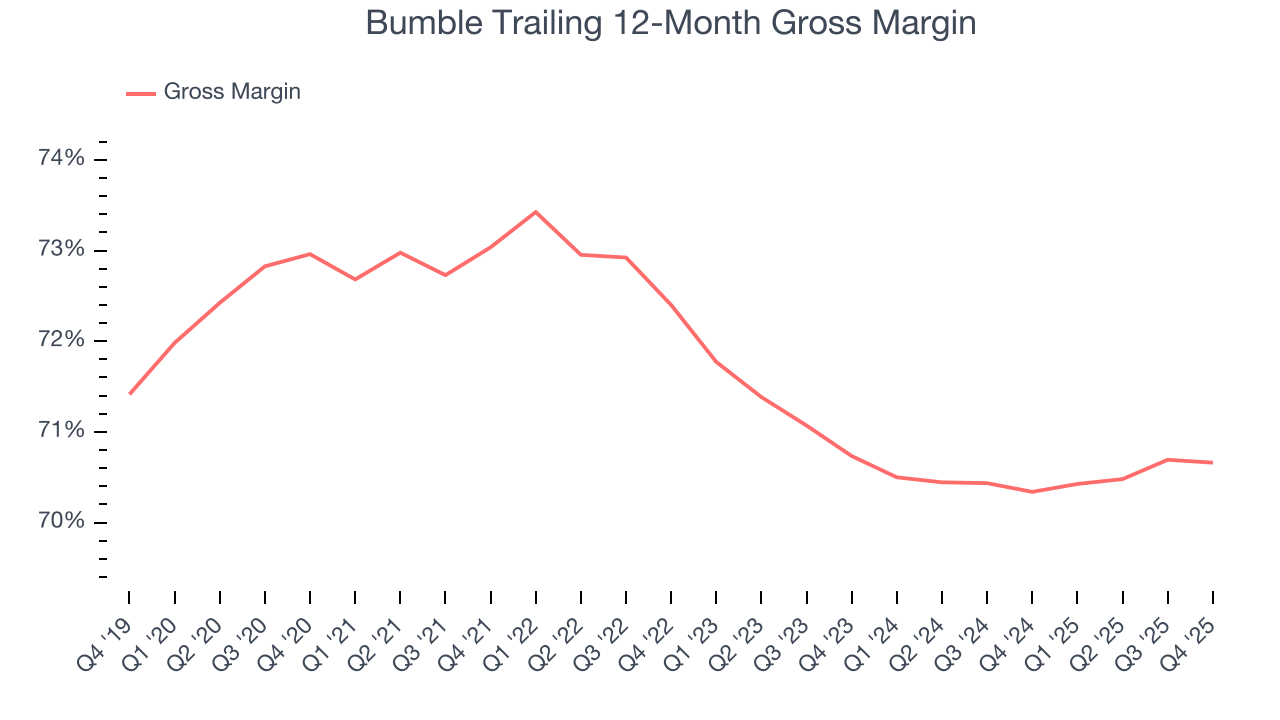
Bumble produced a 70.1% gross profit margin in Q4, in line with the same quarter last year. Zooming out, the company’s full-year margin has remained steady over the past 12 months, suggesting its input costs have been stable and it isn’t under pressure to lower prices.
8. User Acquisition Efficiency
Consumer internet businesses like Bumble grow from a combination of product virality, paid advertisement, and incentives (unlike enterprise software products, which are often sold by dedicated sales teams).
Bumble is very efficient at acquiring new users, spending only 22.1% of its gross profit on sales and marketing expenses over the last year. This efficiency indicates that it has a highly differentiated product offering and strong brand reputation, giving Bumble the freedom to invest its resources into new growth initiatives while maintaining optionality. 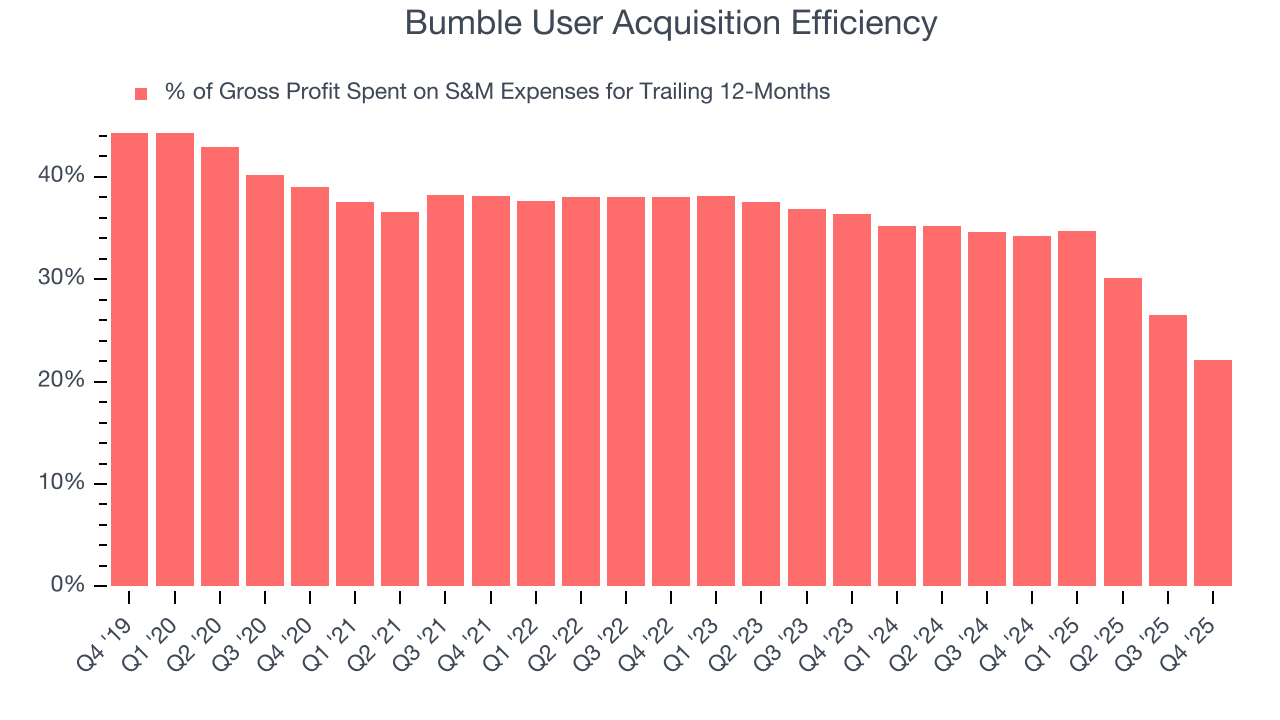
9. EBITDA
Investors regularly analyze operating income to understand a company’s profitability. Similarly, EBITDA is a common profitability metric for consumer internet companies because it excludes various one-time or non-cash expenses, offering a better perspective of the business’s profit potential.
Bumble has been a well-oiled machine over the last two years. It demonstrated elite profitability for a consumer internet business, boasting an average EBITDA margin of 31.1%. This result isn’t surprising as its high gross margin gives it a favorable starting point.
Analyzing the trend in its profitability, Bumble’s EBITDA margin rose by 8.9 percentage points over the last few years, as its sales growth gave it operating leverage.
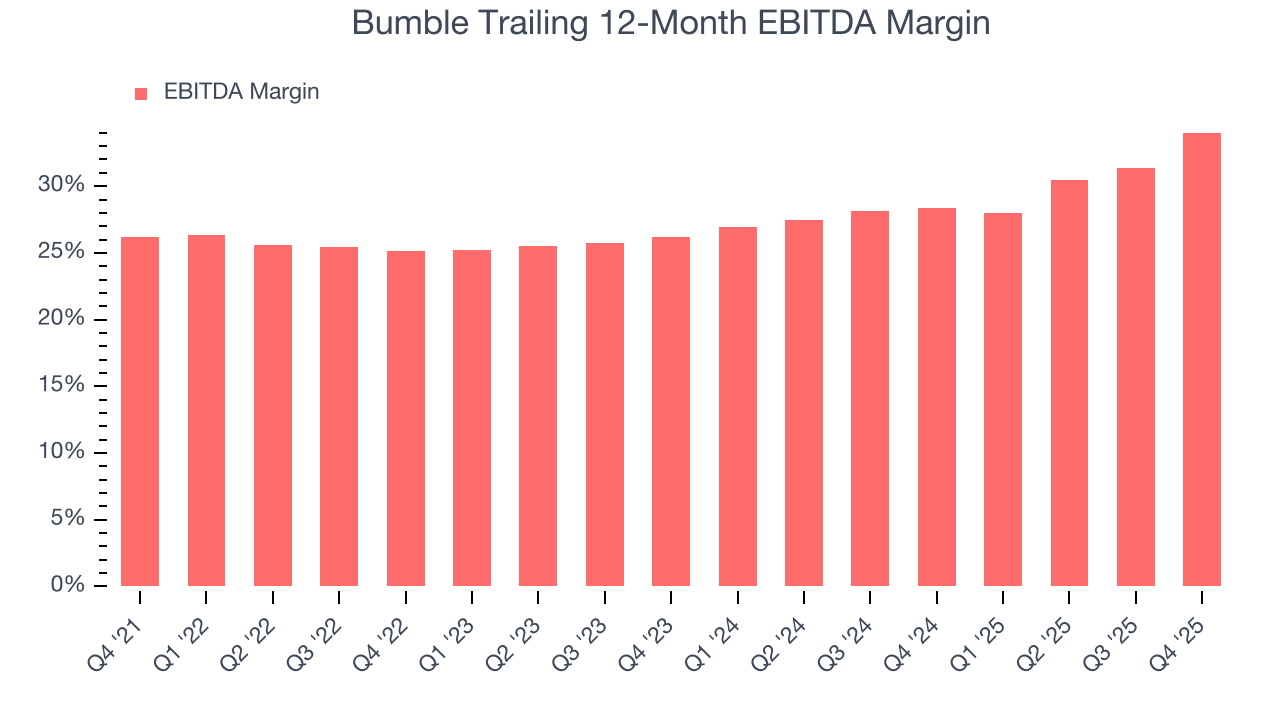
In Q4, Bumble generated an EBITDA margin profit margin of 38.1%, up 10.4 percentage points year on year. The increase was solid, and because its EBITDA margin rose more than its gross margin, we can infer it was more efficient with expenses such as marketing, R&D, and administrative overhead.
10. Earnings Per Share
We track the long-term change in earnings per share (EPS) for the same reason as long-term revenue growth. Compared to revenue, however, EPS highlights whether a company’s growth is profitable.
Bumble’s earnings losses deepened over the last three years as its EPS dropped 117% annually. We tend to steer our readers away from companies with falling EPS, where diminishing earnings could imply changing secular trends and preferences. If the tide turns unexpectedly, Bumble’s low margin of safety could leave its stock price susceptible to large downswings.
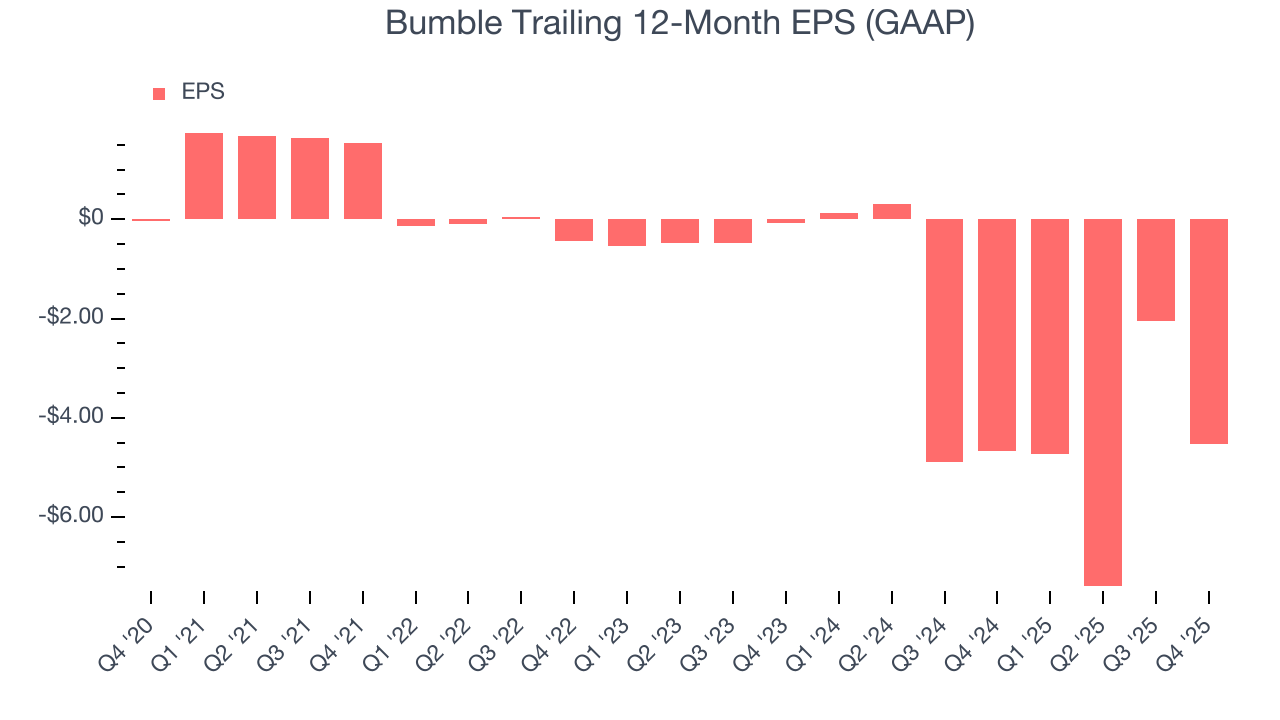
In Q4, Bumble reported EPS of negative $2.45, down from $0.03 in the same quarter last year. This print missed analysts’ estimates. Over the next 12 months, Wall Street is optimistic. Analysts forecast Bumble’s full-year EPS of negative $4.53 will flip to positive $0.79.
11. Cash Is King
Although EBITDA is undoubtedly valuable for assessing company performance, we believe cash is king because you can’t use accounting profits to pay the bills.
Bumble has shown robust cash profitability, driven by its attractive business model and cost-effective customer acquisition strategy that enable it to invest in new products and services rather than sales and marketing. The company’s free cash flow margin averaged 17.7% over the last two years, quite impressive for a consumer internet business.
Taking a step back, we can see that Bumble’s margin expanded by 12.4 percentage points over the last few years. This is encouraging, and we can see it became a less capital-intensive business because its free cash flow profitability rose more than its operating profitability.
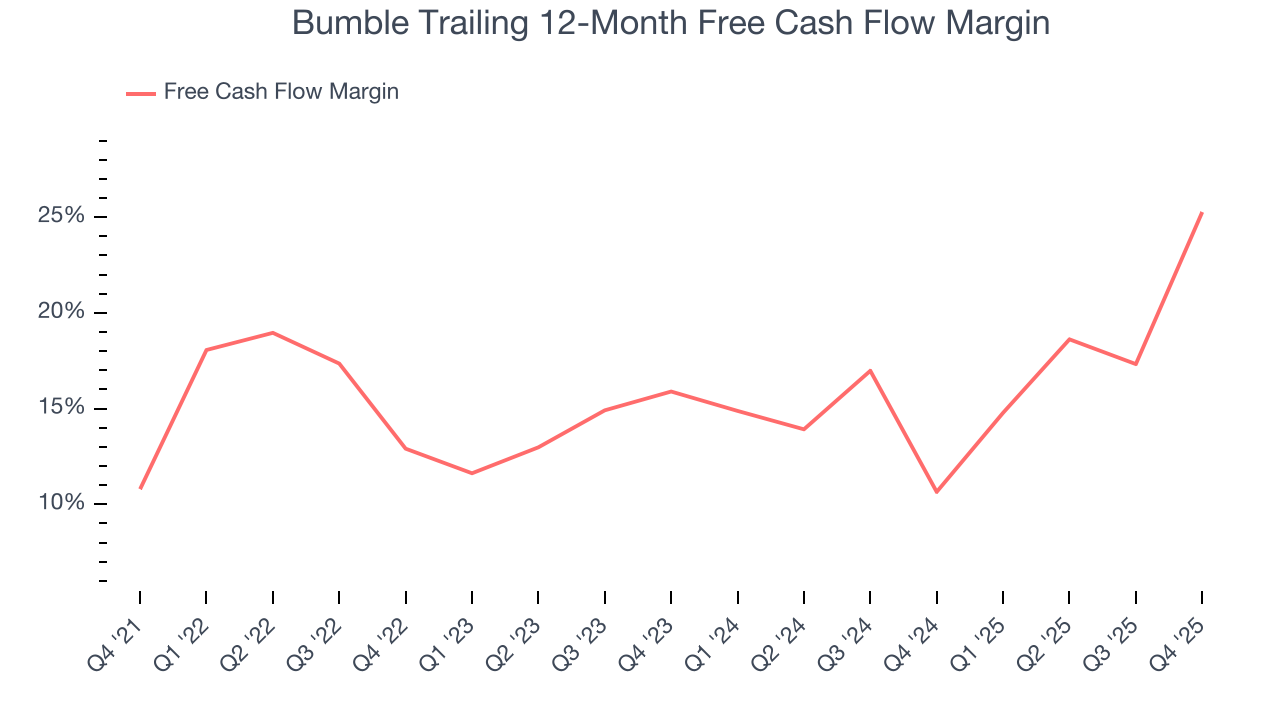
Bumble’s free cash flow clocked in at $67.73 million in Q4, equivalent to a 27.3% margin. Its cash flow turned positive after being negative in the same quarter last year, building on its favorable historical trend.
12. Balance Sheet Assessment
Bumble reported $261.7 million of cash and $615.2 million of debt on its balance sheet in the most recent quarter. As investors in high-quality companies, we primarily focus on two things: 1) that a company’s debt level isn’t too high and 2) that its interest payments are not excessively burdening the business.
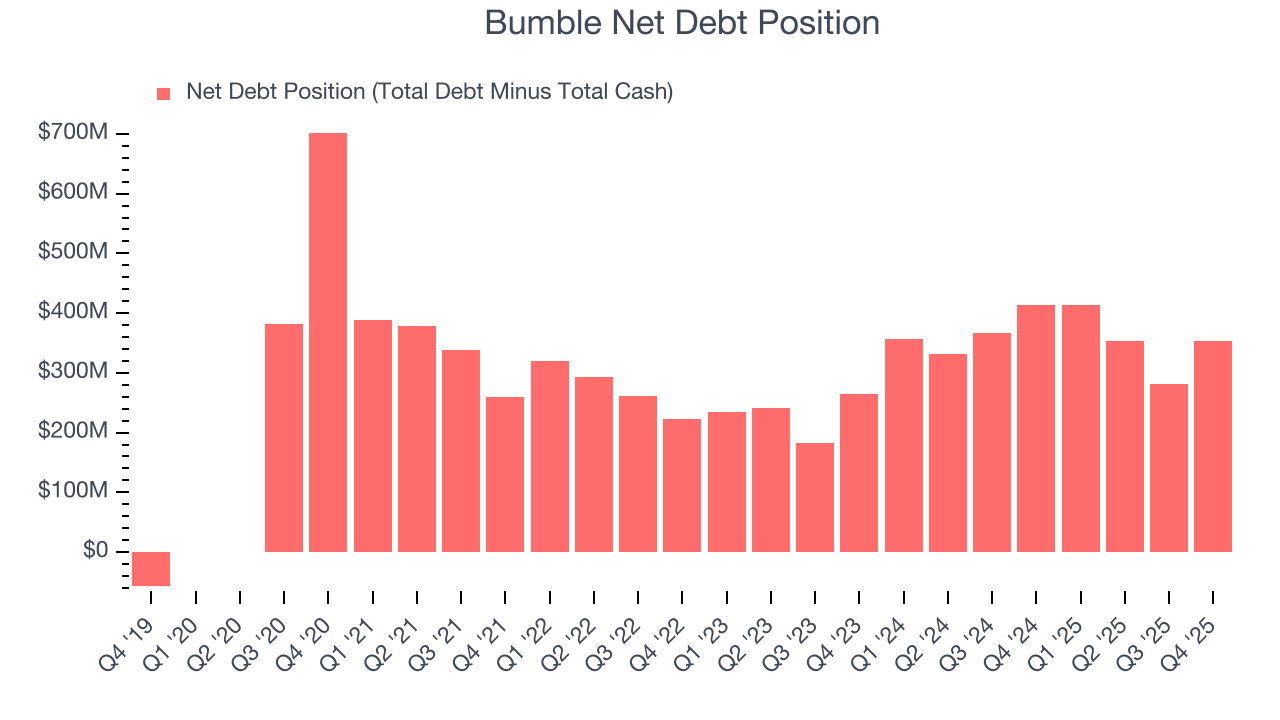
With $336.6 million of EBITDA over the last 12 months, we view Bumble’s 1.0× net-debt-to-EBITDA ratio as safe. We also see its $46.48 million of annual interest expenses as appropriate. The company’s profits give it plenty of breathing room, allowing it to continue investing in growth initiatives.
13. Key Takeaways from Bumble’s Q4 Results
We were impressed by Bumble’s optimistic EBITDA guidance for next quarter, which blew past analysts’ expectations. We were also excited its EBITDA outperformed Wall Street’s estimates by a wide margin. On the other hand, its number of buyers declined. Zooming out, we think this was a solid print. The stock traded up 21.7% to $3.51 immediately following the results.
14. Is Now The Time To Buy Bumble?
Updated: March 24, 2026 at 10:29 PM EDT
We think that the latest earnings result is only one piece of the bigger puzzle. If you’re deciding whether to own Bumble, you should also grasp the company’s longer-term business quality and valuation.
Bumble’s business quality ultimately falls short of our standards. To begin with, its revenue growth was weak over the last three years, and analysts expect its demand to deteriorate over the next 12 months. While its impressive EBITDA margins show it has a highly efficient business model, the downside is its ARPU has declined over the last two years. On top of that, its projected EPS for the next year is lacking.
Bumble’s EV/EBITDA ratio based on the next 12 months is 3.1x. This valuation multiple is fair, but we don’t have much faith in the company. We're fairly confident there are better investments elsewhere.
Wall Street analysts have a consensus one-year price target of $4.28 on the company (compared to the current share price of $3.42).
Although the price target is bullish, readers should exercise caution because analysts tend to be overly optimistic. The firms they work for, often big banks, have relationships with companies that extend into fundraising, M&A advisory, and other rewarding business lines. As a result, they typically hesitate to say bad things for fear they will lose out. We at StockStory do not suffer from such conflicts of interest, so we’ll always tell it like it is.