Roku (ROKU)
We admire Roku. Its revenue and EPS are projected to skyrocket next year, an optimistic sign for its share price.― StockStory Analyst Team


1. News


2. Summary
Why We Like Roku
With a name meaning six in Japanese because it was the founder's sixth company that he started, Roku (NASDAQ: ROKU) makes hardware players that offer access to various online streaming TV services.
- Total Hours Streamed have grown by 18,380% annually, allowing for more profitable cross-selling opportunities if it can build complementary products and features
- Strong engagement trends coupled with 104% annual growth in its average revenue per user demonstrate its platform’s stickiness with die-hard customers
- Performance over the past three years shows its incremental sales were extremely profitable, as its annual earnings per share growth of 29.2% outpaced its revenue gains
We see a bright future for Roku. This is one of the best consumer internet stocks in our coverage.
Is Now The Time To Buy Roku?








At $94.68 per share, Roku trades at 21x forward EV/EBITDA. This may not be an obvious bargain, but you still stand to generate a nice return over a multi-year investment period.
If you like the business model and believe the bull case, you can own a smaller position; our work shows that high-quality companies outperform the market over a multi-year period regardless of entry price.
3. Roku (ROKU) Research Report: Q4 CY2025 Update
Streaming TV platform Roku (NASDAQ: ROKU) beat Wall Street’s revenue expectations in Q4 CY2025, with sales up 16.1% year on year to $1.39 billion. Guidance for next quarter’s revenue was optimistic at $1.2 billion at the midpoint, 3% above analysts’ estimates. Its GAAP profit of $0.53 per share was 88.8% above analysts’ consensus estimates.
Roku (ROKU) Q4 CY2025 Highlights:
- Revenue: $1.39 billion vs analyst estimates of $1.35 billion (16.1% year-on-year growth, 3% beat)
- EPS (GAAP): $0.53 vs analyst estimates of $0.28 (88.8% beat)
- Adjusted EBITDA: $169.4 million vs analyst estimates of $146 million (12.1% margin, 16% beat)
- Revenue Guidance for Q1 CY2026 is $1.2 billion at the midpoint, above analyst estimates of $1.17 billion
- EBITDA guidance for the upcoming financial year 2026 is $635 million at the midpoint, above analyst estimates of $581 million
- Operating Margin: 4.7%, up from -3.3% in the same quarter last year
- Free Cash Flow Margin: 34.7%, up from 10.4% in the previous quarter
- Market Capitalization: $12.99 billion
Company Overview
With a name meaning six in Japanese because it was the founder's sixth company that he started, Roku (NASDAQ: ROKU) makes hardware players that offer access to various online streaming TV services.
Roku was originally founded by Anthony Wood in 2002. He would eventually go to work at Netflix tasked with developing a Netflix branded streaming player. Days before launch, Netflix decided it couldn’t release its own hardware player that would put it into competition with other hardware distribution partners like Sony or Samsung, so instead it spun Roku out.
Roku’s streaming content operating system runs on either Roku TV models or as the OS on a range of smart TV models. The company owns and operates the Roku channel, a collection of content offered for free. Its business is built on scaling the number of active accounts to grow the number of hours of viewing throughout its ecosystem, and then monetize through a combination of advertising and commissions from sales of subscription services.
The Roku ecosystem offers benefits to each of its stakeholders, ranging from consumers, content publishers, advertisers, Roku TV brand partners, and other partners. Consumers can discover and access a wide variety of streaming content, content publishers have access to a large base of over 50 million customers, while advertisers can leverage Roku’s data to serve targeted and measurable ads to TV viewers who increasingly don’t watch TV through traditional channels.
4. Consumer Subscription
Consumers today expect goods and services to be hyper-personalized and on demand. Whether it be what music they listen to, what movie they watch, or even finding a date, online consumer businesses are expected to delight their customers with simple user interfaces that magically fulfill demand. Subscription models have further increased usage and stickiness of many online consumer services.
Roku (NASDAQ: ROKU) competes for streaming TV subscribers with Apple (NASDAQ: AAPL), Alphabet (NASDAQ:GOOG.L), Amazon (NASDAQ:AMZN), and competes with Disney (NYSE:DIS), Netflix (NASDAQ: NFLX), AT&T’s Warner (NYSE:T) and ViacomCBS (NASDAQ: VIAC) for streaming audiences, and a range of streaming advertisers notably YouTube and Amazon.
5. Revenue Growth
Reviewing a company’s long-term sales performance reveals insights into its quality. Even a bad business can shine for one or two quarters, but a top-tier one grows for years. Thankfully, Roku’s 14.9% annualized revenue growth over the last three years was solid. Its growth beat the average consumer internet company and shows its offerings resonate with customers, a helpful starting point for our analysis.
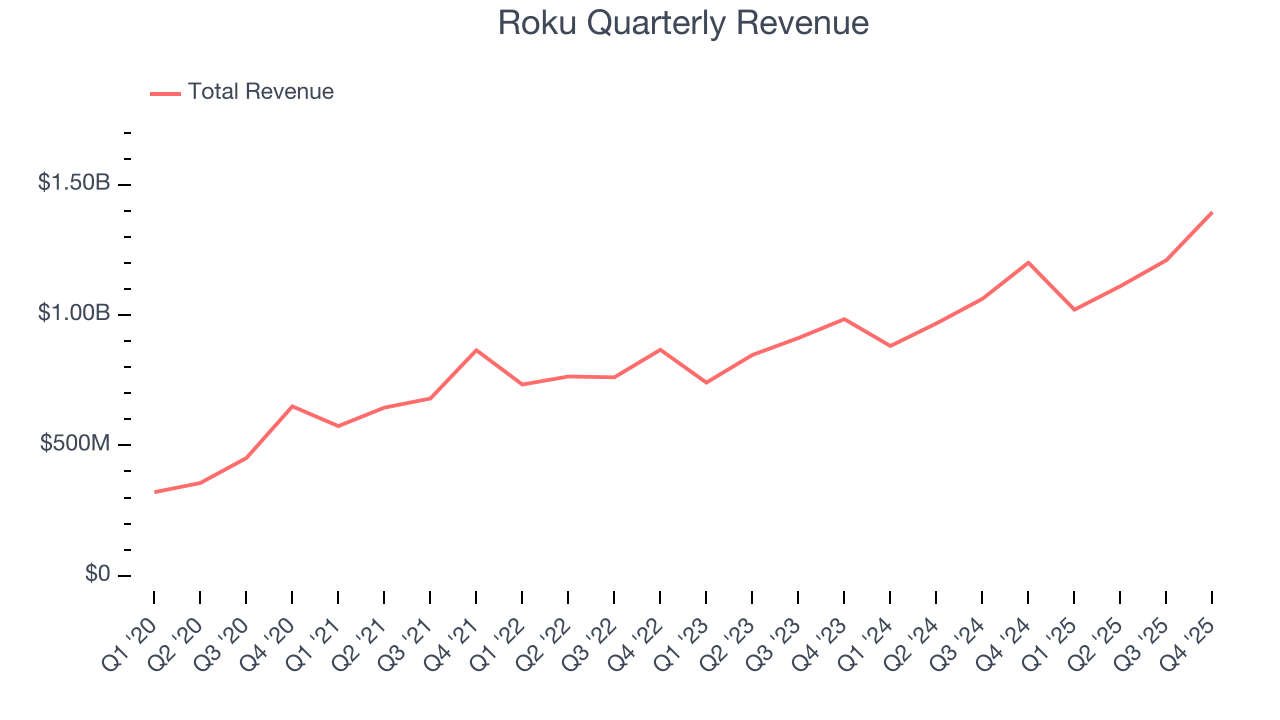
This quarter, Roku reported year-on-year revenue growth of 16.1%, and its $1.39 billion of revenue exceeded Wall Street’s estimates by 3%. Company management is currently guiding for a 17.6% year-on-year increase in sales next quarter.
Looking further ahead, sell-side analysts expect revenue to grow 12.9% over the next 12 months, a slight deceleration versus the last three years. Despite the slowdown, this projection is above average for the sector and suggests the market is forecasting some success for its newer products and services.
6. Gross Margin & Pricing Power
For internet subscription businesses like Roku, gross profit tells us how much money the company gets to keep after covering the base cost of its products and services, which typically include customer service, data center and infrastructure expenses, royalties, and other content-related costs if the company’s offerings include features such as video or music.
Roku’s gross margin is below the broader consumer internet industry, giving it less room to hire engineering talent that can develop new products and services. As you can see below, it averaged a 43.8% gross margin over the last two years. Said differently, Roku had to pay a chunky $56.16 to its service providers for every $100 in revenue. 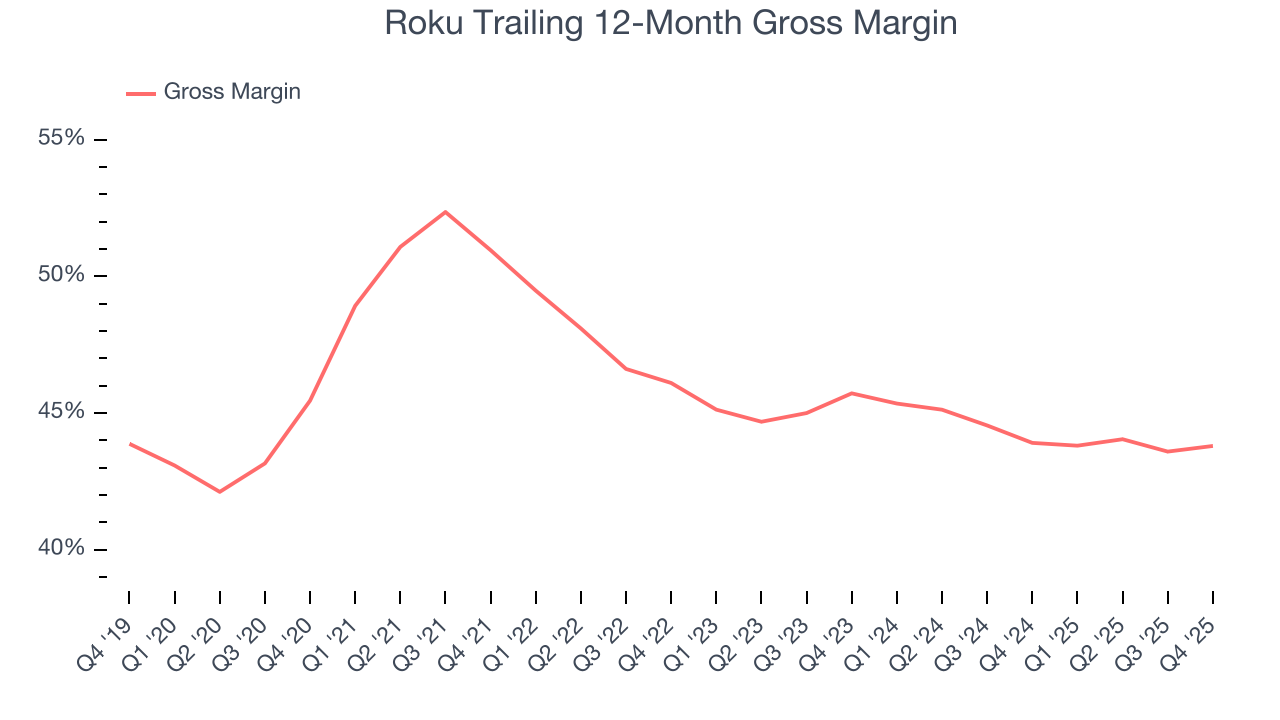
Roku produced a 43.5% gross profit margin in Q4, in line with the same quarter last year. Zooming out, the company’s full-year margin has remained steady over the past 12 months, suggesting its input costs have been stable and it isn’t under pressure to lower prices.
7. User Acquisition Efficiency
Consumer internet businesses like Roku grow from a combination of product virality, paid advertisement, and incentives (unlike enterprise software products, which are often sold by dedicated sales teams).
It’s relatively expensive for Roku to acquire new users as the company has spent 46.8% of its gross profit on sales and marketing expenses over the last year. This inefficiency indicates that Roku operates in a competitive market and must continue investing to maintain an acceptable growth trajectory. 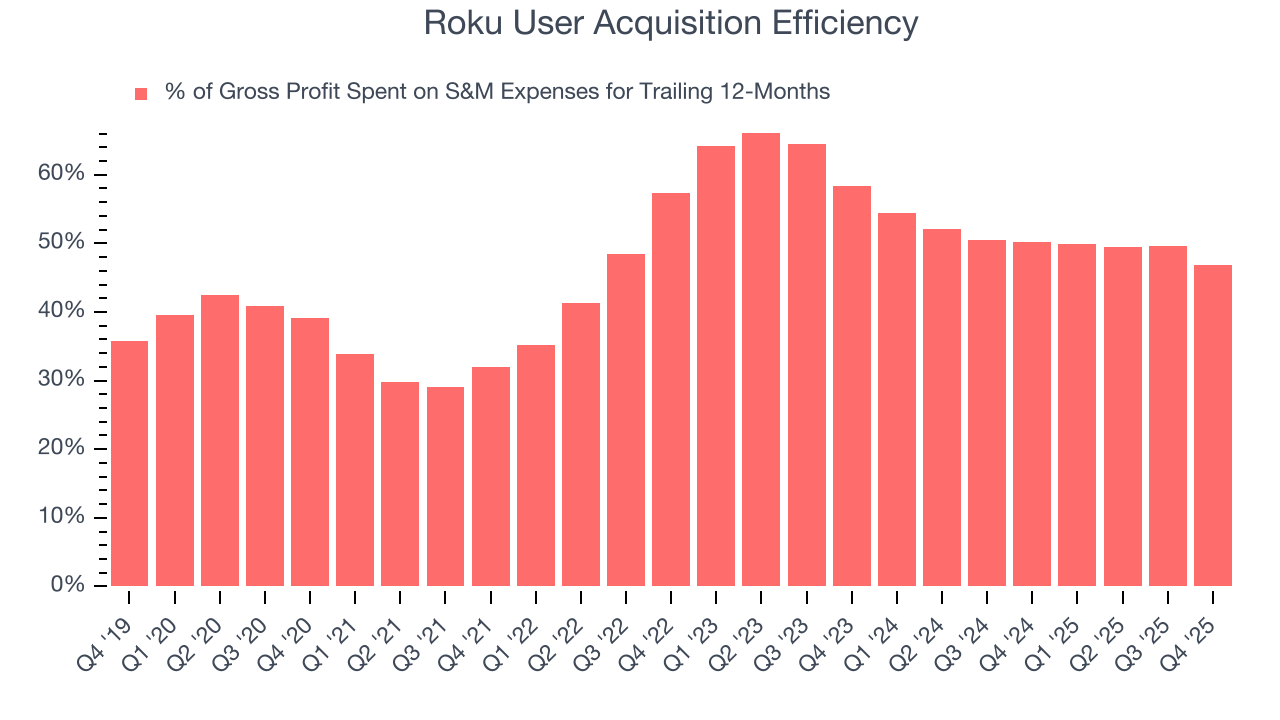
8. EBITDA
Operating income is often evaluated to assess a company’s underlying profitability. In a similar vein, EBITDA is used to analyze consumer internet companies because it excludes various one-time or non-cash expenses (depreciation), providing a clearer view of the business’s profit potential.
Roku has managed its cost base well over the last two years. It demonstrated solid profitability for a consumer internet business, producing an average EBITDA margin of 7.7%. This result was particularly impressive because of its low gross margin, which is mostly a factor of what it sells and takes huge shifts to move meaningfully. Companies have more control over their operating margins, and it’s a show of well-managed operations if they’re high when gross margins are low.
Analyzing the trend in its profitability, Roku’s EBITDA margin rose by 11.6 percentage points over the last few years, as its sales growth gave it operating leverage.
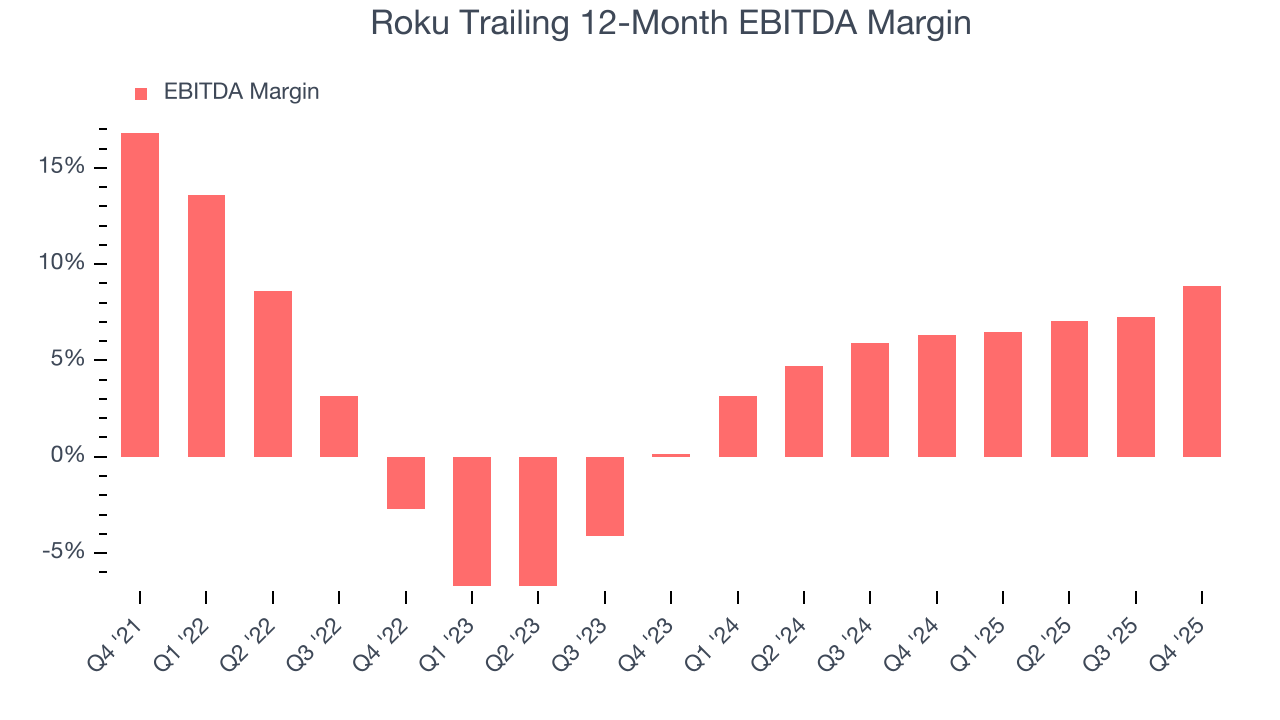
This quarter, Roku generated an EBITDA margin profit margin of 12.1%, up 5.7 percentage points year on year. The increase was solid, and because its EBITDA margin rose more than its gross margin, we can infer it was more efficient with expenses such as marketing, R&D, and administrative overhead.
9. Earnings Per Share
Revenue trends explain a company’s historical growth, but the long-term change in earnings per share (EPS) points to the profitability of that growth – for example, a company could inflate its sales through excessive spending on advertising and promotions.
Roku’s full-year EPS flipped from negative to positive over the last three years. This is a good sign and shows it’s at an inflection point.
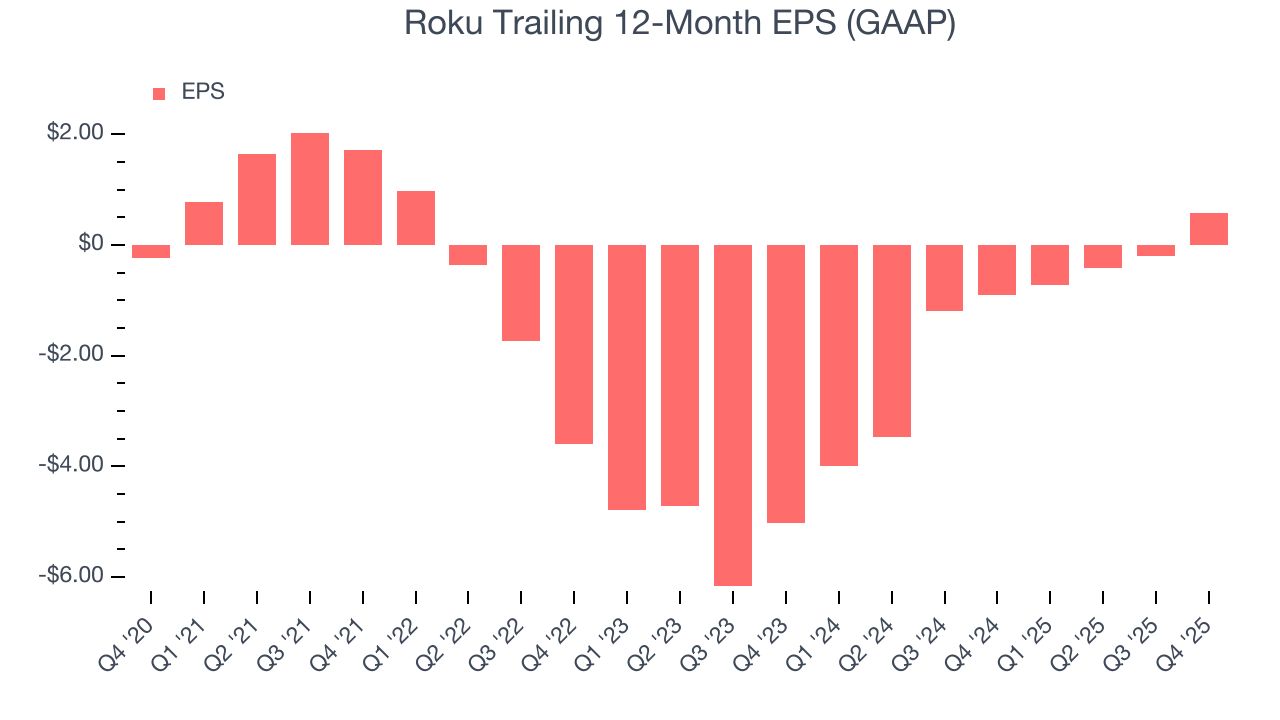
In Q4, Roku reported EPS of $0.53, up from negative $0.24 in the same quarter last year. This print easily cleared analysts’ estimates, and shareholders should be content with the results. Over the next 12 months, Wall Street expects Roku’s full-year EPS of $0.58 to grow 120%.
10. Cash Is King
Free cash flow isn't a prominently featured metric in company financials and earnings releases, but we think it's telling because it accounts for all operating and capital expenses, making it tough to manipulate. Cash is king.
Roku has shown impressive cash profitability, giving it the option to reinvest or return capital to investors. The company’s free cash flow margin averaged 12.1% over the last two years, better than the broader consumer internet sector.
Taking a step back, we can see that Roku’s margin expanded by 22.9 percentage points over the last few years. This is encouraging, and we can see it became a less capital-intensive business because its free cash flow profitability rose more than its operating profitability.
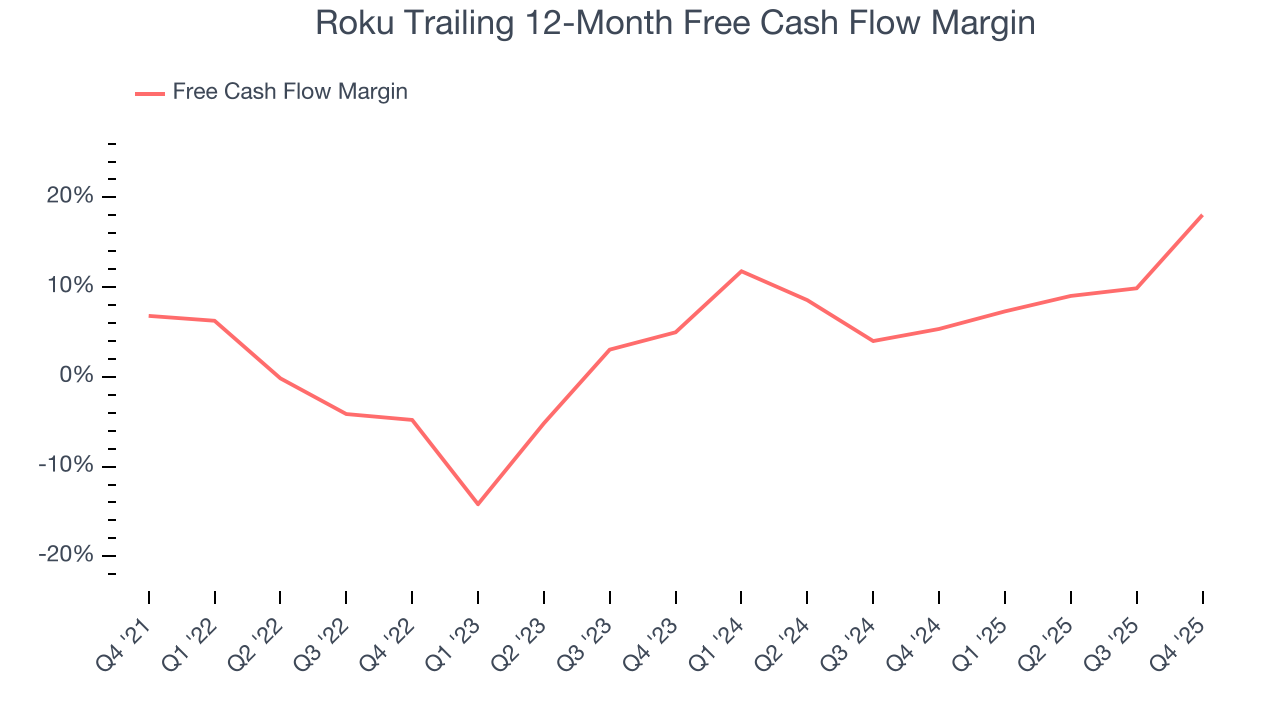
Roku’s free cash flow clocked in at $483.6 million in Q4, equivalent to a 34.7% margin. This result was good as its margin was 28.3 percentage points higher than in the same quarter last year, building on its favorable historical trend.
11. Balance Sheet Assessment
Businesses that maintain a cash surplus face reduced bankruptcy risk.
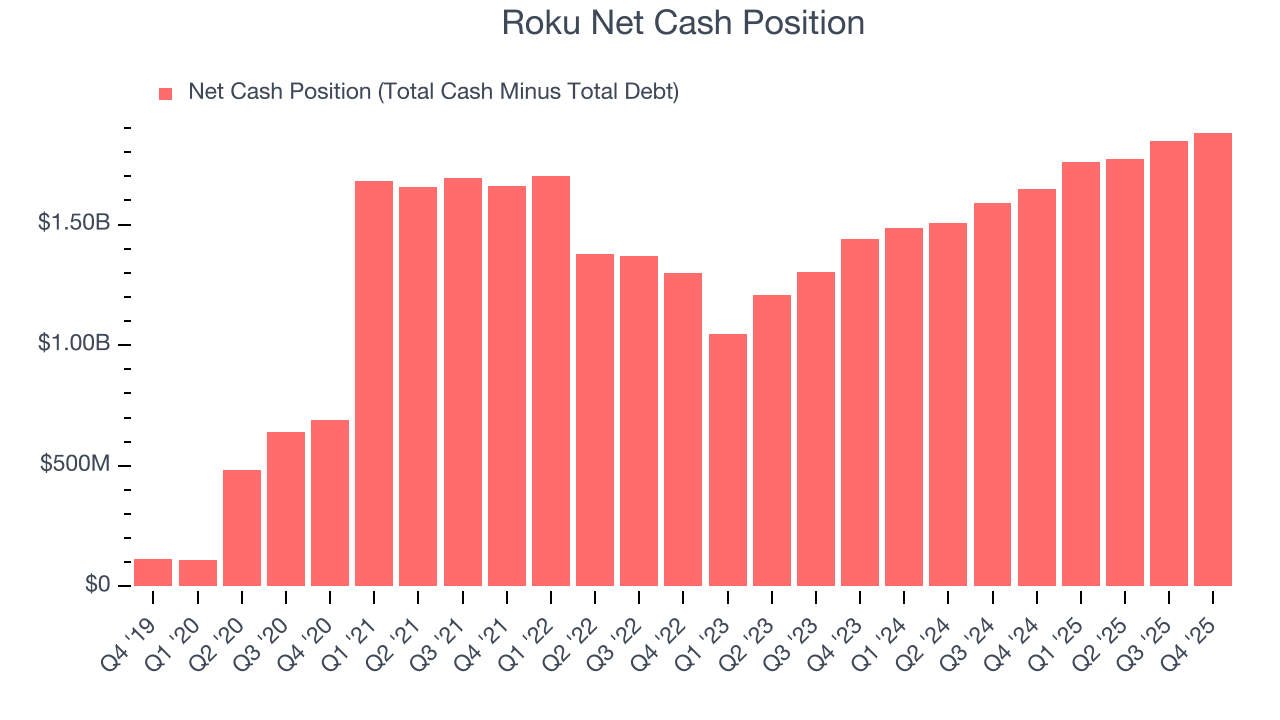
Roku is a well-capitalized company with $2.32 billion of cash and $435.9 million of debt on its balance sheet. This $1.88 billion net cash position is 14.5% of its market cap and gives it the freedom to borrow money, return capital to shareholders, or invest in growth initiatives. Leverage is not an issue here.
12. Key Takeaways from Roku’s Q4 Results
We were impressed by Roku’s optimistic EBITDA guidance for next quarter, which blew past analysts’ expectations. We were also excited its EBITDA outperformed Wall Street’s estimates by a wide margin. Zooming out, we think this was a solid print. The stock traded up 7.5% to $88.99 immediately following the results.
13. Is Now The Time To Buy Roku?
Updated: March 12, 2026 at 10:25 PM EDT
Before deciding whether to buy Roku or pass, we urge investors to consider business quality, valuation, and the latest quarterly results.
There is a lot to like about Roku. To begin with, its revenue growth was solid over the last three years, and its growth over the next 12 months is expected to accelerate. And while its gross margins make it more difficult to reach positive operating profits compared to other consumer internet businesses, its rising cash profitability gives it more optionality. Additionally, Roku’s EPS growth over the last three years has been fantastic.
Roku’s EV/EBITDA ratio based on the next 12 months is 21x. This multiple isn’t necessarily cheap, but we’ll happily own Roku as its fundamentals shine bright. We’re in the camp that investments like this should be held for at least three to five years to negate the short-term price volatility that can come with relatively high valuations.
Wall Street analysts have a consensus one-year price target of $127.11 on the company (compared to the current share price of $94.68).