
Accenture (ACN)
Accenture piques our interest. Its fusion of high growth and profitability makes it an asset with nice upside.― StockStory Analyst Team


1. News
2. Summary
Why Accenture Is Interesting
With a workforce of approximately 774,000 people serving clients in more than 120 countries, Accenture (NYSE:ACN) is a professional services firm that helps organizations transform their businesses through consulting, technology, operations, and digital services.
- Dominant market position is represented by its $72.11 billion in revenue and gives it fixed cost leverage when sales grow
- Industry-leading 36.2% return on capital demonstrates management’s skill in finding high-return investments
- A blemish is its earnings growth underperformed the sector average over the last two years as its EPS grew by just 6.1% annually
Accenture shows some potential. If you like the company, the price seems reasonable.
Why Is Now The Time To Buy Accenture?







Accenture’s stock price of $201.87 implies a valuation ratio of 14.2x forward P/E. Many business services companies may feature a higher valuation multiple, but that doesn’t make Accenture a great deal. We think the current multiple fairly reflects the revenue characteristics.
It could be a good time to invest if you see something the market doesn’t.
3. Accenture (ACN) Research Report: Q1 CY2026 Update
Global professional services company Accenture (NYSE:ACN) reported revenue ahead of Wall Street’s expectations in Q1 CY2026, with sales up 8.3% year on year to $18.04 billion. On the other hand, next quarter’s revenue guidance of $18.68 billion was less impressive, coming in 0.5% below analysts’ estimates. Its GAAP profit of $2.93 per share was 3.4% above analysts’ consensus estimates.
Accenture (ACN) Q1 CY2026 Highlights:
- Revenue: $18.04 billion vs analyst estimates of $17.89 billion (8.3% year-on-year growth, 0.8% beat)
- EPS (GAAP): $2.93 vs analyst estimates of $2.83 (3.4% beat)
- Revenue Guidance for Q2 CY2026 is $18.68 billion at the midpoint, below analyst estimates of $18.78 billion
- EPS (GAAP) guidance for the full year is $13.38 at the midpoint, roughly in line with what analysts were expecting
- Operating Margin: 13.8%, in line with the same quarter last year
- Free Cash Flow Margin: 20.3%, up from 16.1% in the same quarter last year
- Market Capitalization: $120.1 billion
Company Overview
With a workforce of approximately 774,000 people serving clients in more than 120 countries, Accenture (NYSE:ACN) is a professional services firm that helps organizations transform their businesses through consulting, technology, operations, and digital services.
Accenture operates through five main service areas: Strategy & Consulting, Technology, Operations, Industry X, and Song. The company works with executives to reinvent their enterprises, implement operational improvements, and drive growth. Its technology services span cloud computing, systems integration, security, software engineering, data and AI, and automation, helping clients build digital cores and optimize operations.
The company's operations services manage business processes for clients, including finance, procurement, supply chain, and human resources functions. Through Industry X, Accenture combines digital capabilities with engineering expertise to help clients transform product design, manufacturing, and servicing. Its Song division focuses on creating personalized customer experiences across design, digital products, marketing, commerce, and customer service.
For example, a global retailer might engage Accenture to modernize its supply chain using AI and cloud technology, redesign its e-commerce platform, and implement new customer service solutions—all while Accenture manages the retailer's back-office operations.
Accenture organizes its business across five industry groups: Communications, Media & Technology; Financial Services; Health & Public Service; Products; and Resources. This industry focus allows the company to develop specialized solutions for specific sectors while leveraging cross-industry expertise. The company maintains partnerships with leading technology providers like Microsoft, Amazon Web Services, Google, and Salesforce to enhance its service offerings.
Revenue comes primarily from Fortune Global 2000 companies and government agencies. Accenture operates through three geographic markets: North America, Europe/Middle East/Africa (EMEA), and Growth Markets, with each region responsible for client relationships and service delivery in their respective territories.
4. IT Services & Consulting
IT Services & Consulting companies stand to benefit from increasing enterprise demand for digital transformation, AI-driven automation, and cybersecurity resilience. Many enterprises can't attack these topics alone and need IT services and consulting on everything from technical advice to implementation. Challenges in meeting these needs will include finding talent in specialized and evolving IT fields. While AI and automation can enhance productivity, they also threaten to commoditize certain consulting functions. Another ongoing challenge will be pricing pressures from offshore IT service providers, which have lower labor costs and increasingly equal access to advanced technology like AI.
Accenture's main competitors include other global professional services firms such as Deloitte, PwC, EY, and KPMG, as well as technology consulting companies like IBM (NYSE:IBM), Cognizant (NASDAQ:CTSH), Infosys (NYSE:INFY), and Capgemini (OTCMKTS:CAPMF).
5. Revenue Growth
A company’s long-term performance is an indicator of its overall quality. Any business can put up a good quarter or two, but many enduring ones grow for years.
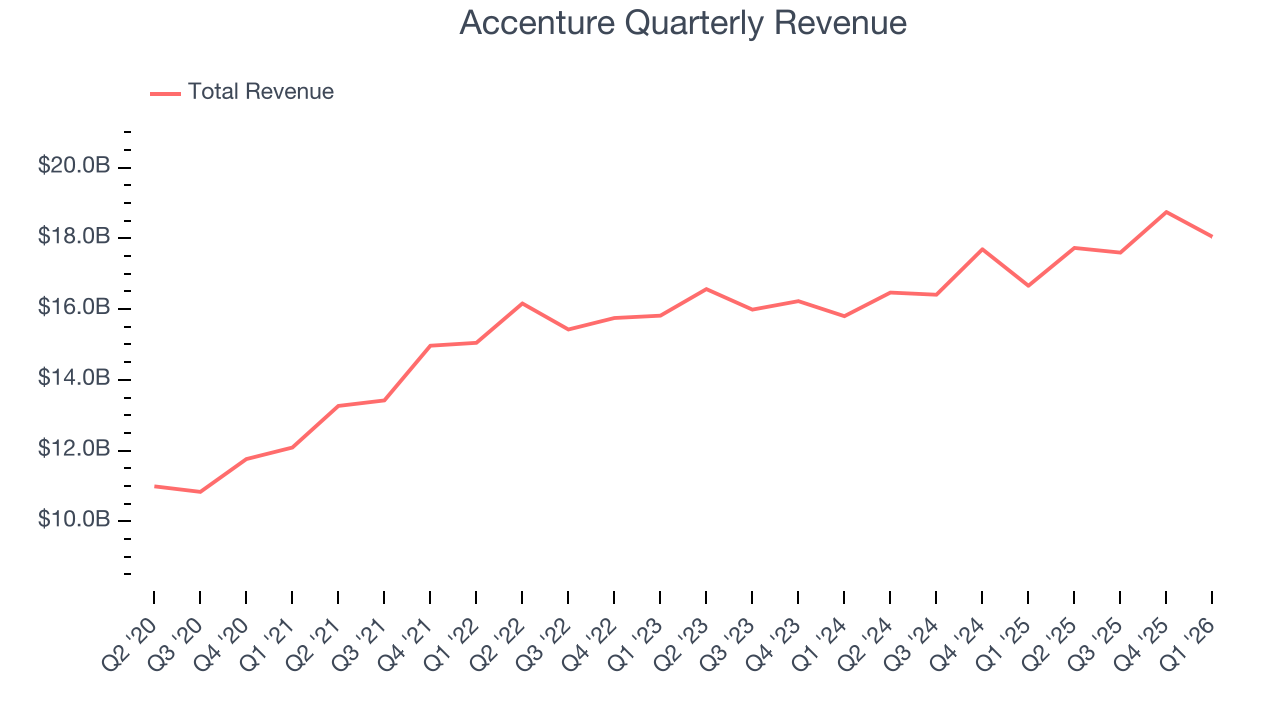
With $72.11 billion in revenue over the past 12 months, Accenture is a behemoth in the business services sector and benefits from economies of scale, giving it an edge in distribution. This also enables it to gain more leverage on its fixed costs than smaller competitors and the flexibility to offer lower prices.
As you can see below, Accenture grew its sales at an impressive 9.6% compounded annual growth rate over the last five years. This is an encouraging starting point for our analysis because it shows Accenture’s demand was higher than many business services companies.
Long-term growth is the most important, but within business services, a half-decade historical view may miss new innovations or demand cycles. Accenture’s annualized revenue growth of 5.7% over the last two years is below its five-year trend, but we still think the results were respectable. 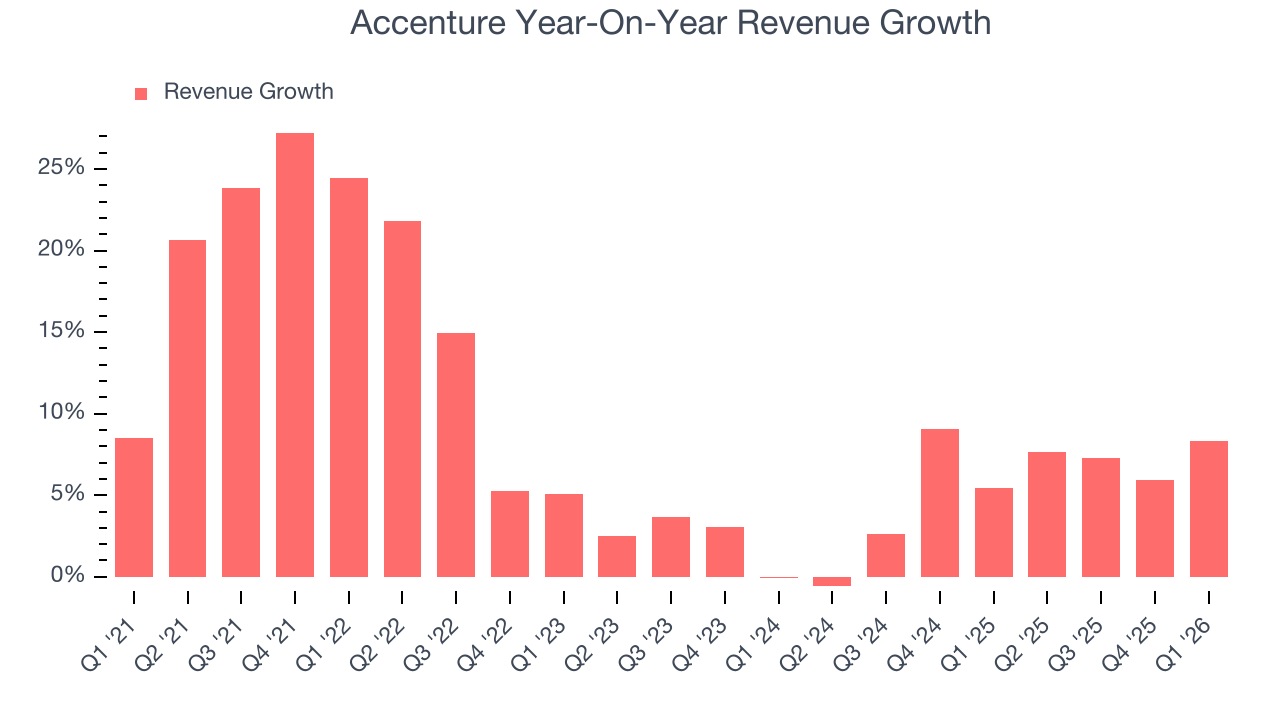
This quarter, Accenture reported year-on-year revenue growth of 8.3%, and its $18.04 billion of revenue exceeded Wall Street’s estimates by 0.8%. Company management is currently guiding for a 5.3% year-on-year increase in sales next quarter.
Looking further ahead, sell-side analysts expect revenue to grow 5.4% over the next 12 months, similar to its two-year rate. This projection is above average for the sector and suggests its newer products and services will help sustain its recent top-line performance.
6. Operating Margin
Accenture’s operating margin has generally stayed the same over the last 12 months, averaging 14.7% over the last five years. This profitability was top-notch for a business services business, showing it’s an well-run company with an efficient cost structure.
Analyzing the trend in its profitability, Accenture’s operating margin might fluctuated slightly but has generally stayed the same over the last five years. This raises questions about the company’s expense base because its revenue growth should have given it leverage on its fixed costs, resulting in better economies of scale and profitability.
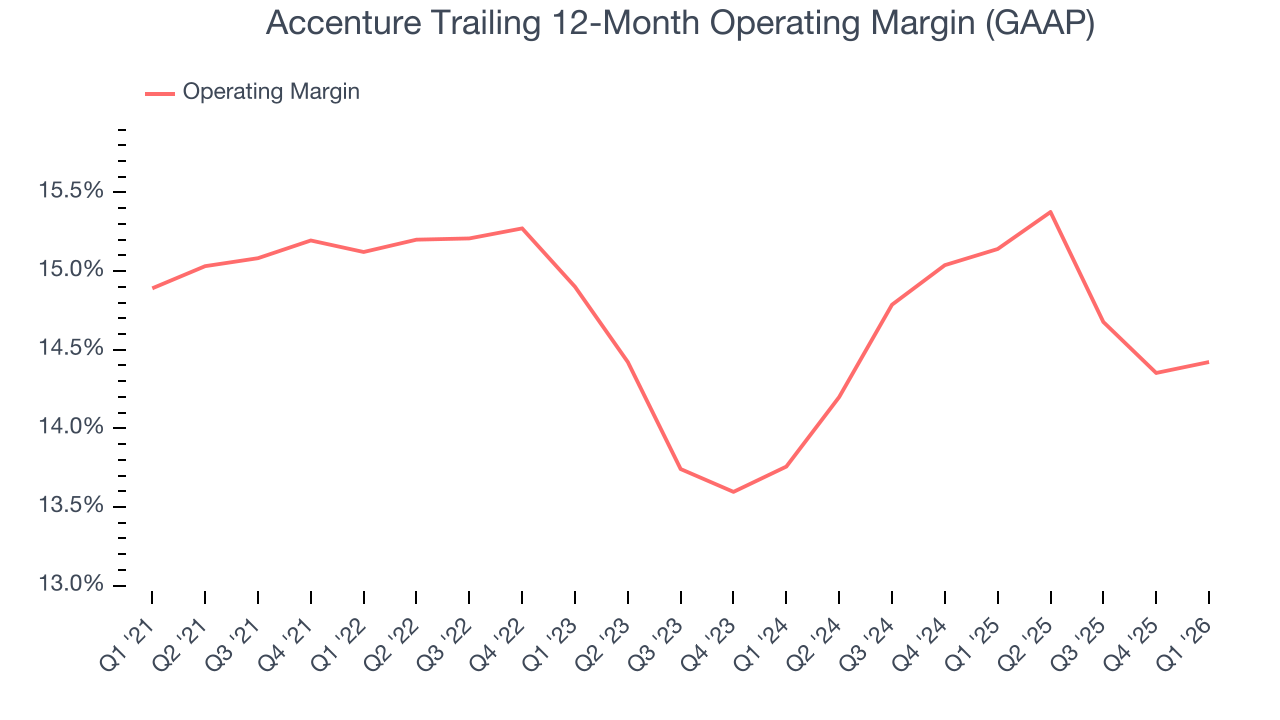
This quarter, Accenture generated an operating margin profit margin of 13.8%, in line with the same quarter last year. This indicates the company’s overall cost structure has been relatively stable.
7. Earnings Per Share
We track the long-term change in earnings per share (EPS) for the same reason as long-term revenue growth. Compared to revenue, however, EPS highlights whether a company’s growth is profitable.
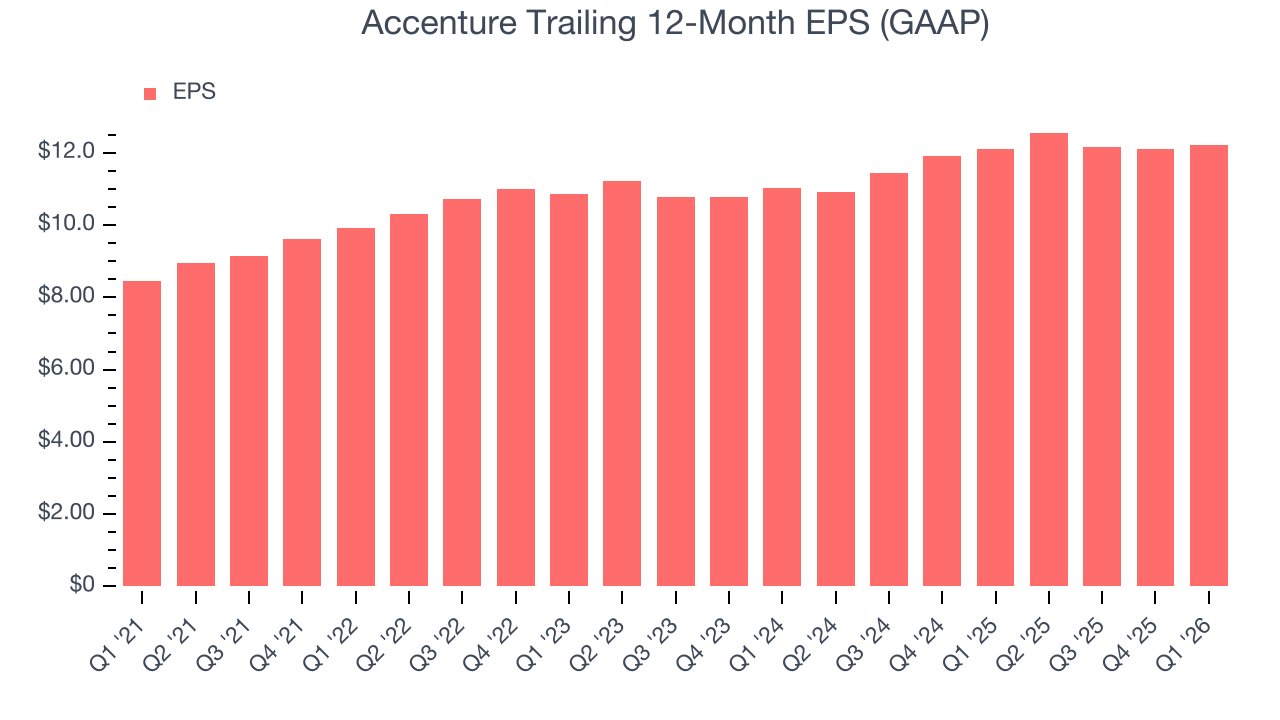
Accenture’s decent 7.7% annual EPS growth over the last five years aligns with its revenue performance. This tells us it maintained its per-share profitability as it expanded.
Like with revenue, we analyze EPS over a more recent period because it can provide insight into an emerging theme or development for the business.
For Accenture, its two-year annual EPS growth of 5.2% was lower than its five-year trend. This wasn’t great, but at least the company was successful in other measures of financial health.
In Q1, Accenture reported EPS of $2.93, up from $2.82 in the same quarter last year. This print beat analysts’ estimates by 3.4%. Over the next 12 months, Wall Street expects Accenture’s full-year EPS of $12.21 to grow 17.4%.
8. Cash Is King
If you’ve followed StockStory for a while, you know we emphasize free cash flow. Why, you ask? We believe that in the end, cash is king, and you can’t use accounting profits to pay the bills.
Accenture has shown terrific cash profitability, enabling it to reinvest, return capital to investors, and stay ahead of the competition while maintaining an ample cushion. The company’s free cash flow margin was among the best in the business services sector, averaging 14.5% over the last five years.
Taking a step back, we can see that Accenture’s margin expanded by 5.4 percentage points during that time. This is encouraging, and we can see it became a less capital-intensive business because its free cash flow profitability rose while its operating profitability was flat.
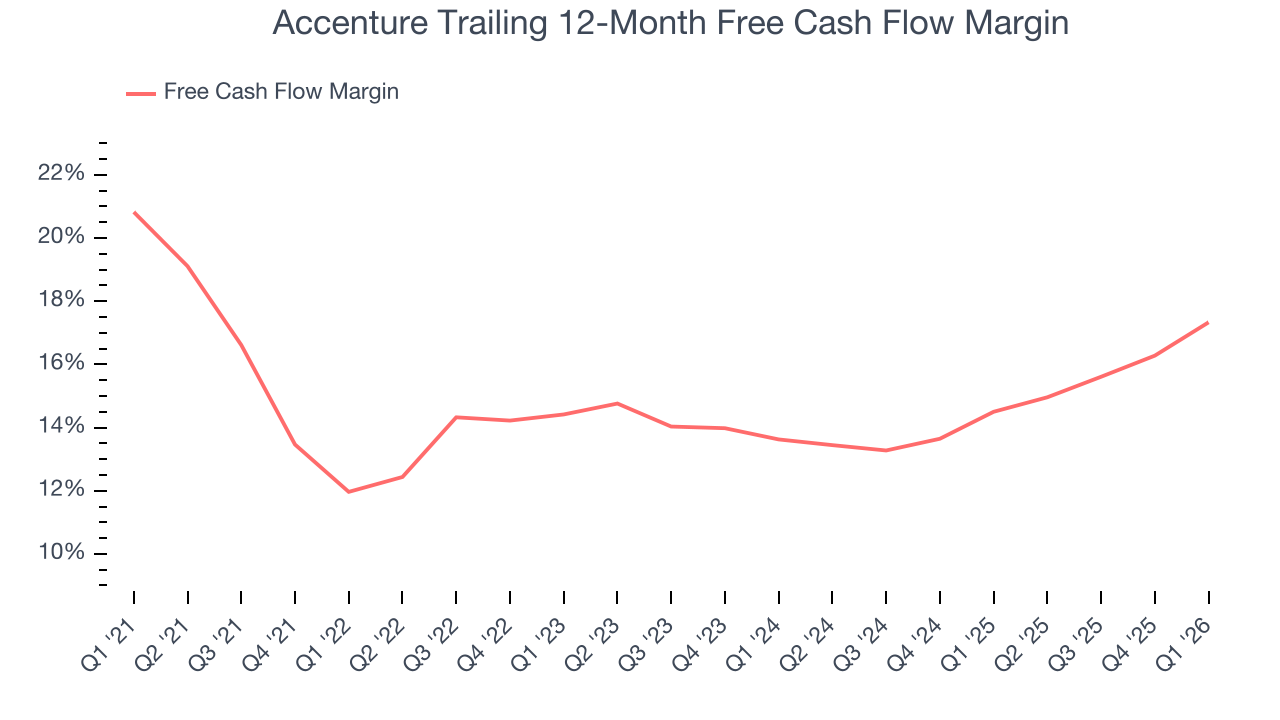
Accenture’s free cash flow clocked in at $3.67 billion in Q1, equivalent to a 20.3% margin. This result was good as its margin was 4.2 percentage points higher than in the same quarter last year, building on its favorable historical trend.
9. Return on Invested Capital (ROIC)
EPS and free cash flow tell us whether a company was profitable while growing its revenue. But was it capital-efficient? Enter ROIC, a metric showing how much operating profit a company generates relative to the money it has raised (debt and equity).
Accenture’s five-year average ROIC was 36.2%, placing it among the best business services companies. This illustrates its management team’s ability to invest in highly profitable ventures and produce tangible results for shareholders.
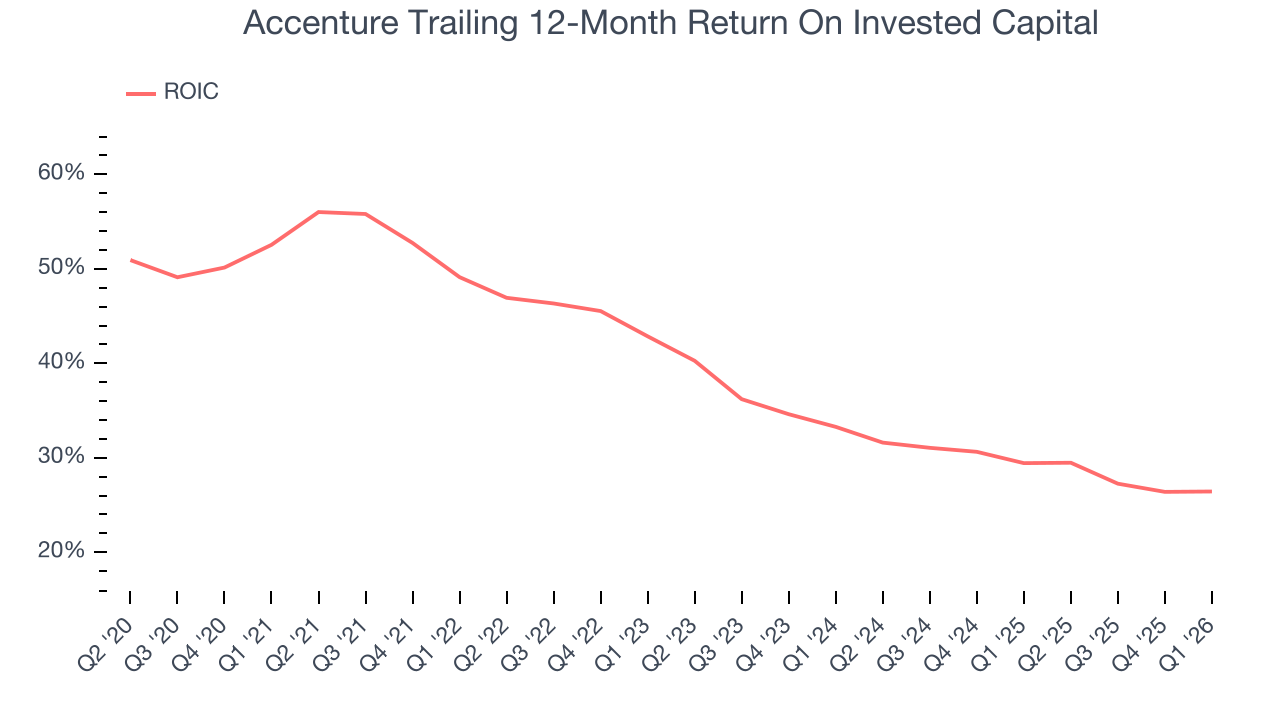
We like to invest in businesses with high returns, but the trend in a company’s ROIC is what often surprises the market and moves the stock price. Unfortunately, Accenture’s ROIC has decreased significantly over the last few years. Only time will tell if its new bets can bear fruit and potentially reverse the trend.
10. Balance Sheet Assessment
One of the best ways to mitigate bankruptcy risk is to hold more cash than debt.
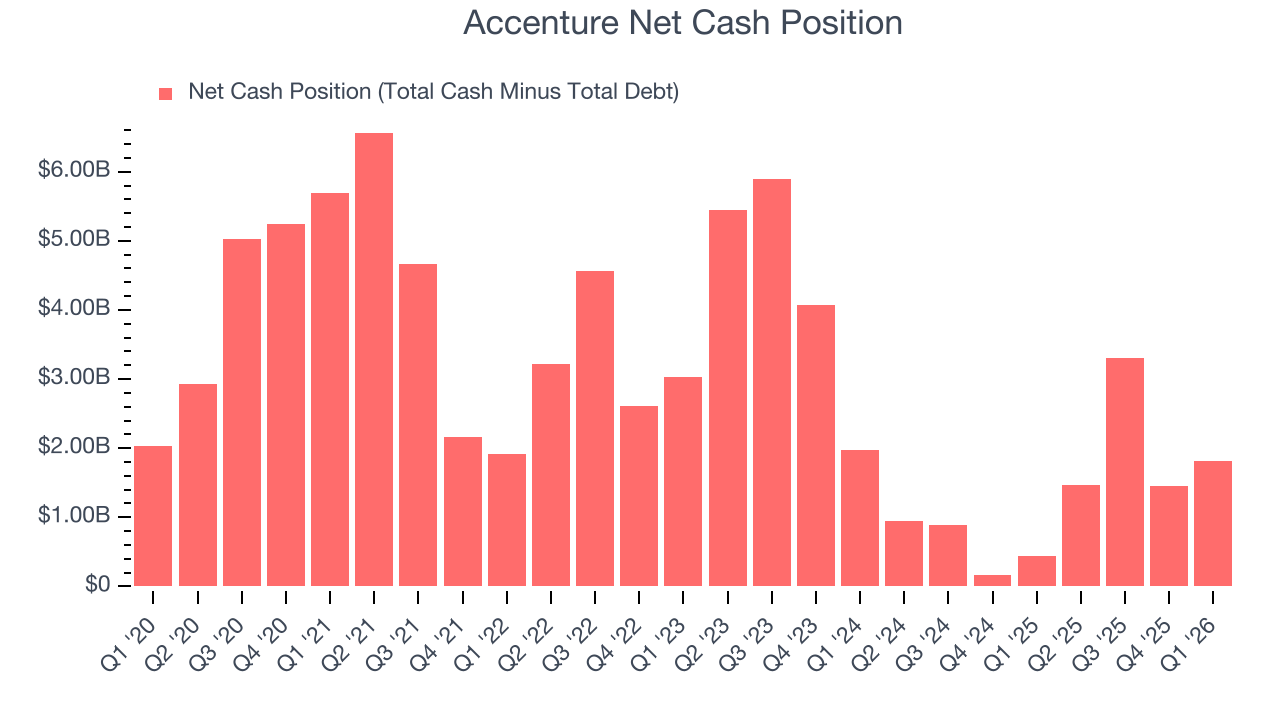
Accenture is a profitable, well-capitalized company with $9.41 billion of cash and $7.59 billion of debt on its balance sheet. This $1.81 billion net cash position gives it the freedom to borrow money, return capital to shareholders, or invest in growth initiatives. Leverage is not an issue here.
11. Key Takeaways from Accenture’s Q1 Results
It was good to see Accenture beat analysts’ EPS expectations this quarter. We were also happy its revenue narrowly outperformed Wall Street’s estimates. On the other hand, its revenue guidance for next quarter slightly missed and its full-year EPS guidance was in line with Wall Street’s estimates. Overall, this quarter could have been better. The stock traded down 2.8% to $189.50 immediately after reporting.
12. Is Now The Time To Buy Accenture?
Updated: March 23, 2026 at 12:56 AM EDT
Are you wondering whether to buy Accenture or pass? We urge investors to not only consider the latest earnings results but also longer-term business quality and valuation as well.
First of all, the company’s revenue growth was impressive over the last five years. And while its diminishing returns show management's recent bets still have yet to bear fruit, its scale makes it a trusted partner with negotiating leverage. Additionally, Accenture’s rising cash profitability gives it more optionality.
Accenture’s P/E ratio based on the next 12 months is 14.2x. Looking at the business services landscape right now, Accenture trades at a pretty interesting price. For those confident in the business and its management team, this is a good time to invest.
Wall Street analysts have a consensus one-year price target of $253.81 on the company (compared to the current share price of $201.87), implying they see 25.7% upside in buying Accenture in the short term.