Ross Stores (ROST)
Ross Stores is a sound business. It repeatedly invests in lucrative growth initiatives, generating robust cash flows and returns on capital.― StockStory Analyst Team


1. News


2. Summary
Why Ross Stores Is Interesting
Selling excess inventory or overstocked items from other retailers, Ross Stores (NASDAQ:ROST) is an off-price concept that sells apparel and other goods at prices much lower than department stores.
- Market-beating returns on capital illustrate that management has a knack for investing in profitable ventures
- Same-store sales growth lends it the confidence to gradually expand its store base so it can reach more customers
- One pitfall is its gross margin of 34.6% is an output of its commoditized inventory
Ross Stores is close to becoming a high-quality business. If you’re a believer, the valuation seems reasonable.
Why Is Now The Time To Buy Ross Stores?





Ross Stores’s stock price of $208.23 implies a valuation ratio of 28.6x forward P/E. Compared to other consumer retail companies, we think this multiple is fair for the quality you get.
This could be a good time to invest if you think there are underappreciated aspects of the business.
3. Ross Stores (ROST) Research Report: Q4 CY2025 Update
Off-price retail company Ross Stores (NASDAQ:ROST) beat Wall Street’s revenue expectations in Q4 CY2025, with sales up 12.2% year on year to $6.64 billion. Its GAAP profit of $2 per share was 4.9% above analysts’ consensus estimates.
Ross Stores (ROST) Q4 CY2025 Highlights:
- Revenue: $6.64 billion vs analyst estimates of $6.43 billion (12.2% year-on-year growth, 3.2% beat)
- EPS (GAAP): $2 vs analyst estimates of $1.91 (4.9% beat)
- Adjusted EBITDA: $820.8 million vs analyst estimates of $905.6 million (12.4% margin, 9.4% miss)
- EPS (GAAP) guidance for the upcoming financial year 2026 is $7.19 at the midpoint, in line with analyst estimates
- Operating Margin: 12.3%, in line with the same quarter last year
- Free Cash Flow Margin: 13.9%, up from 11.4% in the same quarter last year
- Locations: 2,267 at quarter end, up from 2,186 in the same quarter last year
- Same-Store Sales rose 9% year on year (3% in the same quarter last year)
- Market Capitalization: $65.43 billion
Company Overview
Selling excess inventory or overstocked items from other retailers, Ross Stores (NASDAQ:ROST) is an off-price concept that sells apparel and other goods at prices much lower than department stores.
For example, if department store Nordstrom is left with a glut of spring dresses because of unusually cold weather, Nordstrom may sell those in bulk to Ross at pennies on the dollar rather than discount the items and try to sell them individually. This is often done to clear floor space for a new season or to avoid promotions that could damage future pricing power.
Because of Ross’ unique buying approach, shopping there is often a treasure hunt–what the consumer loses in reliable selection or the latest trends is made up for with very low prices. Prices of Ross goods can be as much as 50% lower than those of department stores. Over time, the company’s size and buying power has led to a more consistent selection of items from brands such as Nike, Calvin Klein, and Columbia to name a few.
The core customer is the value-conscious shopper who enjoys the thrill of the hunt. This customer is typically a middle-aged, middle-income woman. This customer is willing to spend more time going through less organized racks and shopping exclusively in person–since Ross has a very limited online presence–in exchange for meaningful discounts.
4. Discount Retailer
Discount retailers understand that many shoppers love a good deal, and they focus on providing excellent value to shoppers by selling general merchandise at major discounts. They can do this because of unique purchasing, procurement, and pricing strategies that involve scouring the market for trendy goods or buying excess inventory from manufacturers and other retailers. They then turn around and sell these snacks, paper towels, toys, clothes, and myriad other products at highly enticing prices. Despite the unique draw and lure of discounts, these discount retailers must also contend with the secular headwinds of online shopping and challenged retail foot traffic in places like suburban strip malls.
Off-price and discount retail competitors include TJX (NYSE:TJX), Burlington Stores (NYSE:BURL), and Ollie’s Bargain Outlet (NASDAQ:OLLI).
5. Revenue Growth
A company’s long-term performance is an indicator of its overall quality. Any business can experience short-term success, but top-performing ones enjoy sustained growth for years.
With $22.75 billion in revenue over the past 12 months, Ross Stores is one of the larger companies in the consumer retail industry and benefits from a well-known brand that influences purchasing decisions. However, its scale is a double-edged sword because there are only a finite number of places to build new stores, making it harder to find incremental growth. For Ross Stores to boost its sales, it likely needs to adjust its prices or lean into foreign markets.
As you can see below, Ross Stores grew its sales at a tepid 6.8% compounded annual growth rate over the last three years, but to its credit, it opened new stores and increased sales at existing, established locations.
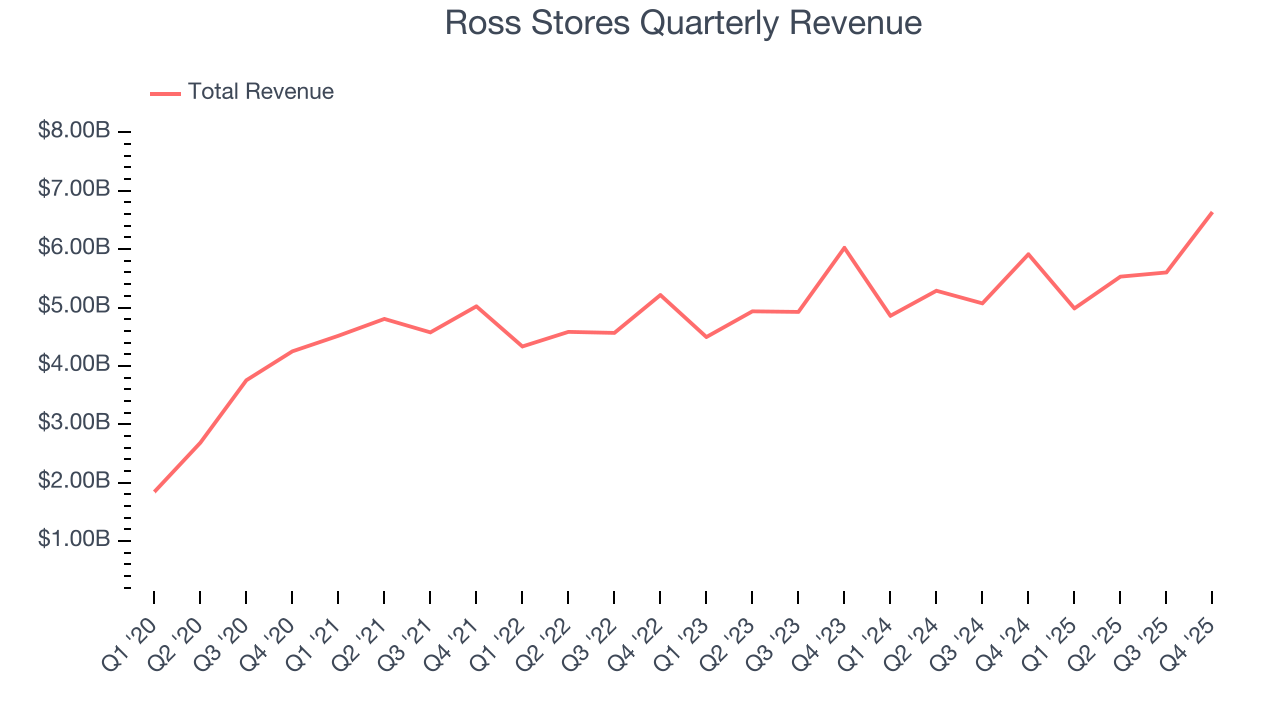
This quarter, Ross Stores reported year-on-year revenue growth of 12.2%, and its $6.64 billion of revenue exceeded Wall Street’s estimates by 3.2%.
Looking ahead, sell-side analysts expect revenue to grow 4.4% over the next 12 months, a slight deceleration versus the last three years. We still think its growth trajectory is attractive given its scale and suggests the market is baking in success for its products.
6. Store Performance
Number of Stores
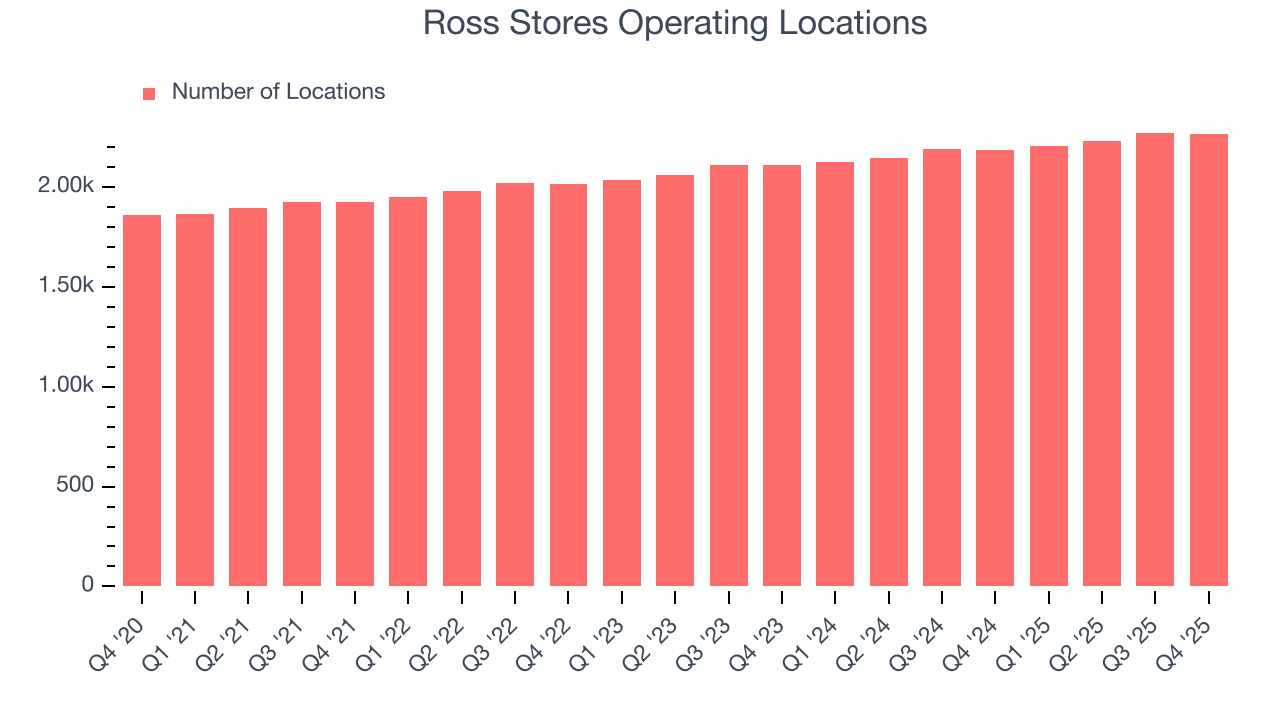
Ross Stores sported 2,267 locations in the latest quarter. Over the last two years, it has opened new stores quickly, averaging 3.9% annual growth. This was faster than the broader consumer retail sector.
When a retailer opens new stores, it usually means it’s investing for growth because demand is greater than supply, especially in areas where consumers may not have a store within reasonable driving distance.
Same-Store Sales
A company's store base only paints one part of the picture. When demand is high, it makes sense to open more. But when demand is low, it’s prudent to close some locations and use the money in other ways. Same-store sales gives us insight into this topic because it measures organic growth for a retailer's e-commerce platform and brick-and-mortar shops that have existed for at least a year.
Ross Stores’s demand has been spectacular for a retailer over the last two years. On average, the company has increased its same-store sales by an impressive 3.6% per year. This performance suggests its rollout of new stores is beneficial for shareholders. We like this backdrop because it gives Ross Stores multiple ways to win: revenue growth can come from new stores, e-commerce, or increased foot traffic and higher sales per customer at existing locations.
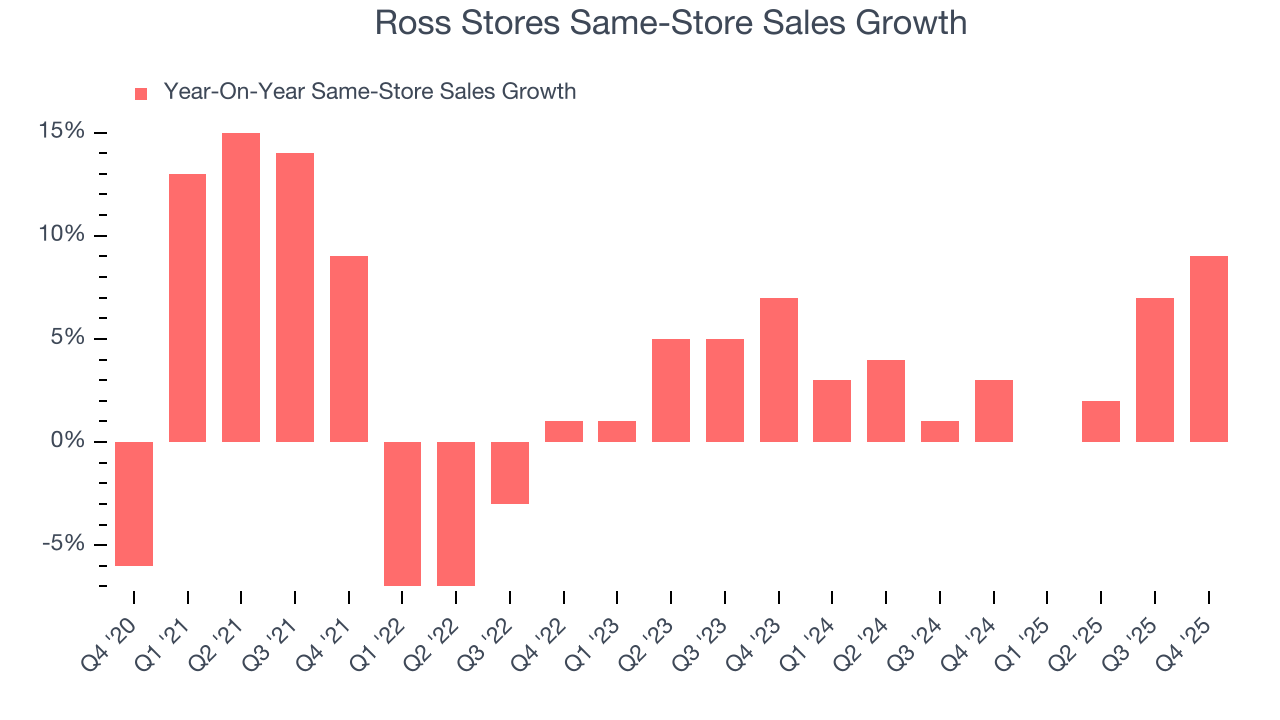
In the latest quarter, Ross Stores’s same-store sales rose 9% year on year. This growth was an acceleration from its historical levels, which is always an encouraging sign.
7. Gross Margin & Pricing Power
Ross Stores has bad unit economics for a retailer, signaling it operates in a competitive market and lacks pricing power because its inventory is sold in many places. As you can see below, it averaged a 34.6% gross margin over the last two years. Said differently, Ross Stores had to pay a chunky $65.43 to its suppliers for every $100 in revenue. 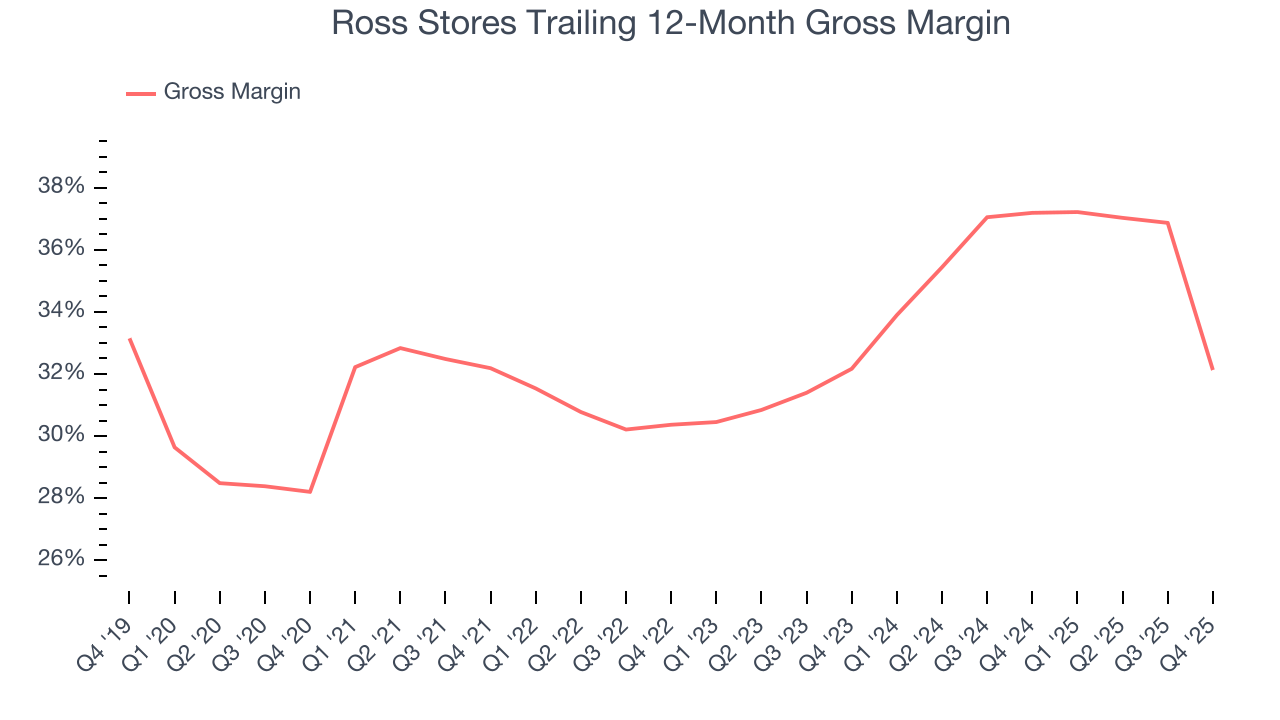
This quarter, Ross Stores’s gross profit margin was 27.2%, down 17.1 percentage points year on year. Ross Stores’s full-year margin has also been trending down over the past 12 months, decreasing by 5.1 percentage points. If this move continues, it could suggest a more competitive environment with pressure to discount products and higher input costs (such as labor and freight expenses to transport goods).
8. Operating Margin
Operating margin is a key measure of profitability. Think of it as net income - the bottom line - excluding the impact of taxes and interest on debt, which are less connected to business fundamentals.
Ross Stores’s operating margin has more or less stayed the same over the last 12 months , averaging 12.1% over the last two years. This profitability was top-notch for a consumer retail business, showing it’s an well-run company with an efficient cost structure. This result was particularly impressive because of its low gross margin, which is mostly a factor of what it sells and takes huge shifts to move meaningfully. Companies have more control over their operating margins, and it’s a show of well-managed operations if they’re high when gross margins are low.
Analyzing the trend in its profitability, Ross Stores’s operating margin might fluctuated slightly but has generally stayed the same over the last year. This raises questions about the company’s expense base because its revenue growth should have given it leverage on its fixed costs, resulting in better economies of scale and profitability.
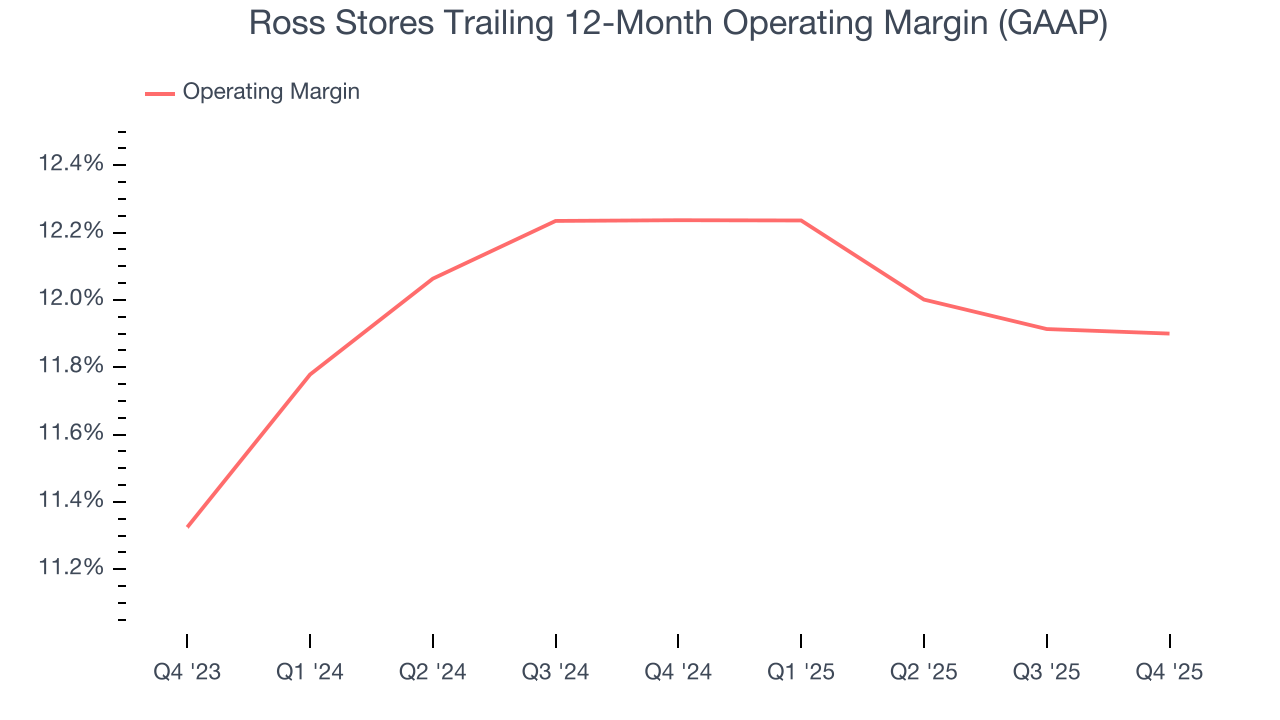
In Q4, Ross Stores generated an operating margin profit margin of 12.3%, in line with the same quarter last year. This indicates the company’s cost structure has recently been stable.
9. Earnings Per Share
Revenue trends explain a company’s historical growth, but the long-term change in earnings per share (EPS) points to the profitability of that growth – for example, a company could inflate its sales through excessive spending on advertising and promotions.
Ross Stores’s EPS grew at 14.7% compounded annual growth rate over the last three years, higher than its 6.8% annualized revenue growth. This tells us the company became more profitable on a per-share basis as it expanded.
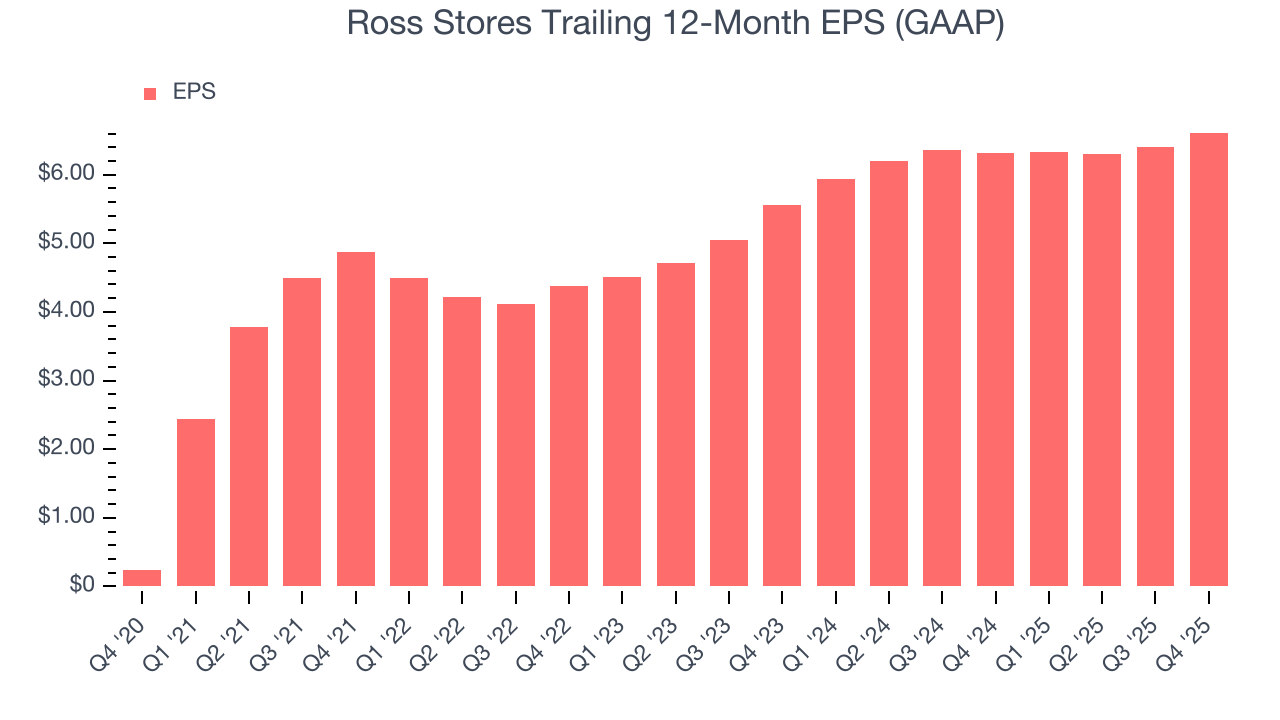
In Q4, Ross Stores reported EPS of $2, up from $1.79 in the same quarter last year. This print beat analysts’ estimates by 4.9%. Over the next 12 months, Wall Street expects Ross Stores’s full-year EPS of $6.61 to grow 9.1%.
10. Cash Is King
Free cash flow isn't a prominently featured metric in company financials and earnings releases, but we think it's telling because it accounts for all operating and capital expenses, making it tough to manipulate. Cash is king.
Ross Stores has shown robust cash profitability, giving it an edge over its competitors and the ability to reinvest or return capital to investors. The company’s free cash flow margin averaged 8.8% over the last two years, quite impressive for a consumer retail business. Ross Stores has shown robust cash profitability relative to peers over the last two years, giving the company fewer opportunities to return capital to shareholders.
Taking a step back, we can see that Ross Stores’s margin expanded by 2 percentage points over the last year. This shows the company is heading in the right direction, and we can see it became a less capital-intensive business because its free cash flow profitability rose while its operating profitability was flat.
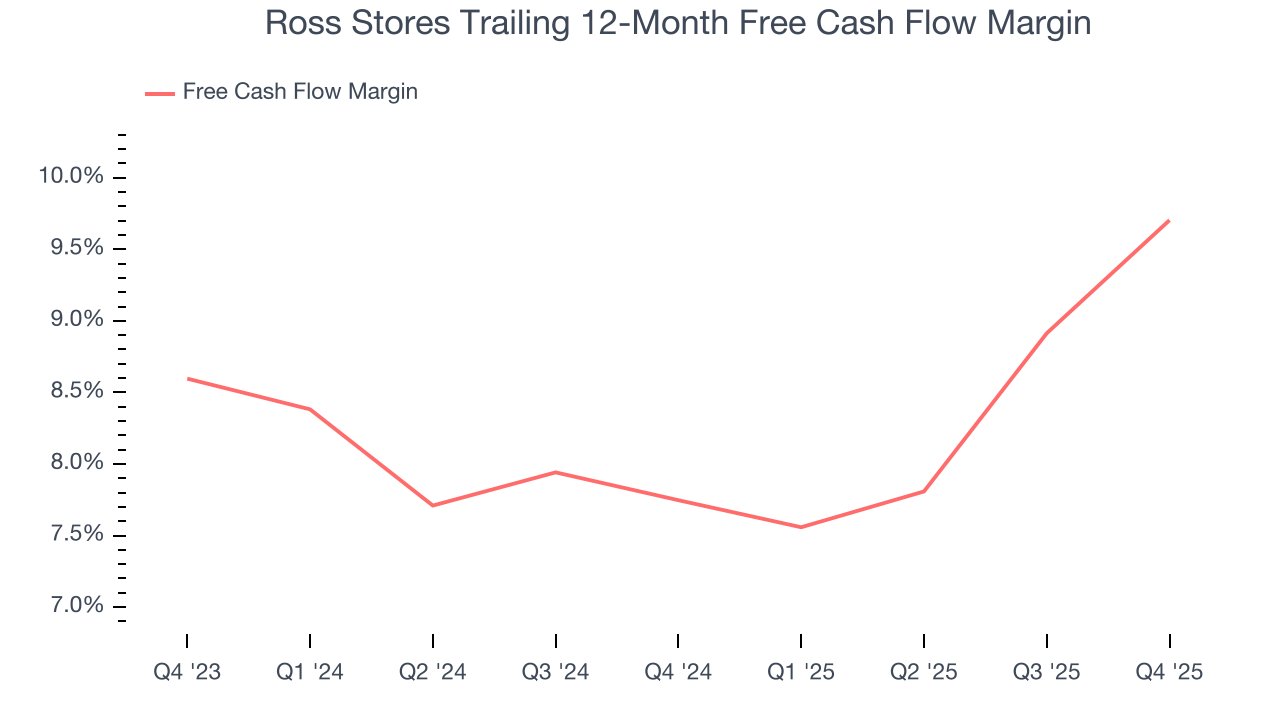
Ross Stores’s free cash flow clocked in at $920.8 million in Q4, equivalent to a 13.9% margin. This result was good as its margin was 2.4 percentage points higher than in the same quarter last year, building on its favorable historical trend.
11. Return on Invested Capital (ROIC)
EPS and free cash flow tell us whether a company was profitable while growing its revenue. But was it capital-efficient? Enter ROIC, a metric showing how much operating profit a company generates relative to the money it has raised (debt and equity).
Ross Stores’s five-year average ROIC was 31.6%, placing it among the best consumer retail companies. This illustrates its management team’s ability to invest in highly profitable ventures and produce tangible results for shareholders.
12. Balance Sheet Assessment
Ross Stores reported $4.59 billion of cash and $5.21 billion of debt on its balance sheet in the most recent quarter. As investors in high-quality companies, we primarily focus on two things: 1) that a company’s debt level isn’t too high and 2) that its interest payments are not excessively burdening the business.
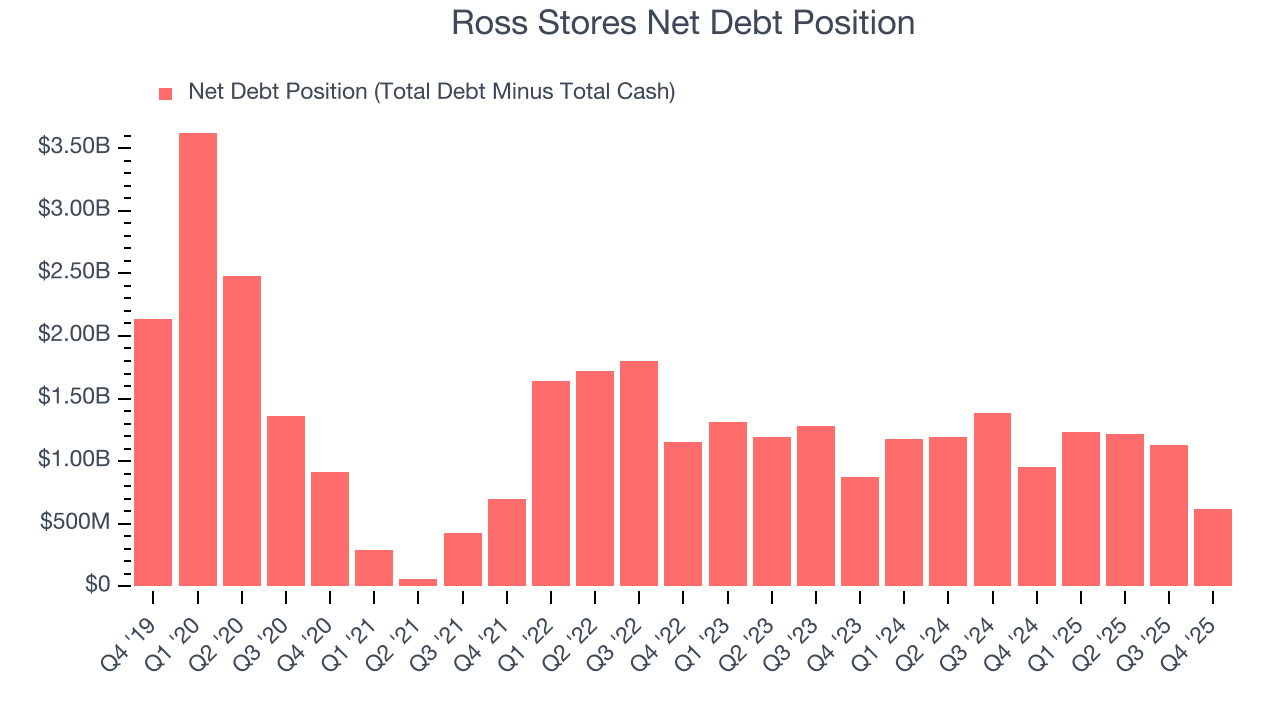
With $3.09 billion of EBITDA over the last 12 months, we view Ross Stores’s 0.2× net-debt-to-EBITDA ratio as safe. We also see its $66.51 million of annual interest expenses as appropriate. The company’s profits give it plenty of breathing room, allowing it to continue investing in growth initiatives.
13. Key Takeaways from Ross Stores’s Q4 Results
We enjoyed seeing Ross Stores beat analysts’ revenue expectations this quarter. We were also happy its gross margin outperformed Wall Street’s estimates. On the other hand, its EBITDA missed. Zooming out, we think this was a mixed quarter. The stock traded up 6.1% to $209.52 immediately after reporting.
14. Is Now The Time To Buy Ross Stores?
Updated: March 13, 2026 at 10:30 PM EDT
A common mistake we notice when investors are deciding whether to buy a stock or not is that they simply look at the latest earnings results. Business quality and valuation matter more, so we urge you to understand these dynamics as well.
Ross Stores is a fine business. Although its revenue growth was a little slower over the last three years, its stellar ROIC suggests it has been a well-run company historically. And while its gross margins make it more challenging to reach positive operating profits compared to other consumer retail businesses, its expanding store base shows it’s playing offense to grow its brand.
Ross Stores’s P/E ratio based on the next 12 months is 28.6x. Looking at the consumer retail landscape right now, Ross Stores trades at a pretty interesting price. If you’re a fan of the business and management team, now is a good time to scoop up some shares.
Wall Street analysts have a consensus one-year price target of $229.81 on the company (compared to the current share price of $208.23), implying they see 10.4% upside in buying Ross Stores in the short term.