Levi's (LEVI)
We wouldn’t recommend Levi's. Its sales have underperformed and its low returns on capital show it has few growth opportunities.― StockStory Analyst Team


1. News
2. Summary
Why We Think Levi's Will Underperform
Credited for inventing the first pair of blue jeans in 1873, Levi's (NYSE:LEVI) is an apparel company renowned for its iconic denim products and classic American style.
- 6.2% annual revenue growth over the last five years was slower than its consumer discretionary peers
- Responsiveness to unforeseen market trends is restricted due to its substandard operating margin profitability
- Poor free cash flow generation means it has few chances to reinvest for growth, repurchase shares, or distribute capital
Levi's lacks the business quality we seek. We’re looking for better stocks elsewhere.
Why There Are Better Opportunities Than Levi's







Levi's is trading at $21.32 per share, or 15.1x forward P/E. Yes, this valuation multiple is lower than that of other consumer discretionary peers, but we’ll remind you that you often get what you pay for.
Our advice is to pay up for elite businesses whose advantages are tailwinds to earnings growth. Don’t get sucked into lower-quality businesses just because they seem like bargains. These mediocre businesses often never achieve a higher multiple as hoped, a phenomenon known as a “value trap”.
3. Levi's (LEVI) Research Report: Q4 CY2025 Update
Denim clothing company Levi's (NYSE:LEVI) reported Q4 CY2025 results exceeding the market’s revenue expectations, but sales were flat year on year at $1.77 billion. Its non-GAAP profit of $0.41 per share was 4.6% above analysts’ consensus estimates.
Levi's (LEVI) Q4 CY2025 Highlights:
- Revenue: $1.77 billion vs analyst estimates of $1.71 billion (flat year on year, 3.4% beat)
- Adjusted EPS: $0.41 vs analyst estimates of $0.39 (4.6% beat)
- Adjusted EBITDA: $268.2 million vs analyst estimates of $268.3 million (15.2% margin, in line)
- Adjusted EPS guidance for the upcoming financial year 2026 is $1.43 at the midpoint, missing analyst estimates by 3.4%
- Operating Margin: 11.9%, in line with the same quarter last year
- Free Cash Flow Margin: 12.2%, down from 13.2% in the same quarter last year
- Constant Currency Revenue rose 5% year on year (7% in the same quarter last year)
- Market Capitalization: $8.31 billion
Company Overview
Credited for inventing the first pair of blue jeans in 1873, Levi's (NYSE:LEVI) is an apparel company renowned for its iconic denim products and classic American style.
Levi's is headquartered in San Francisco and was originally founded to capitalize on the California Gold Rush. Since then, the company has expanded its reach to more than 110 countries, offering a range of clothing and accessories.
Levi's primarily operates under three major brands: flagship Levi's, Signature, and Denizen. It also owns the Dockers and Beyond Yoga brands, though they make up a smaller percentage of sales. Each brand caters to different consumer needs and market segments, yet all retain the core values of quality and durability that the company is known for.
The company’s marketing and retail strategy is key to maintaining its relevance. Levi's employs a mix of traditional and digital marketing, tapping into nostalgia while engaging with younger audiences through social media. The company’s retail presence spans flagship stores, department stores, online platforms, and a global network of franchisees, ensuring widespread accessibility to its products.
4. Apparel and Accessories
Thanks to social media and the internet, not only are styles changing more frequently today than in decades past but also consumers are shifting the way they buy their goods, favoring omnichannel and e-commerce experiences. Some apparel and accessories companies have made concerted efforts to adapt while those who are slower to move may fall behind.
Levi's primary competitors include Wrangler and Lee (owned by Kontoor Brands, NYSE:KTB), Gap (NYSE:GPS), American Eagle Outfitters (NYSE:AEO), and Calvin Klein and Tommy Hilfiger (owned by PVH Corp, NYSE:PVH).
5. Revenue Growth
A company’s long-term performance is an indicator of its overall quality. Any business can put up a good quarter or two, but many enduring ones grow for years. Unfortunately, Levi’s 7.1% annualized revenue growth over the last five years was weak. This was below our standard for the consumer discretionary sector and is a poor baseline for our analysis.
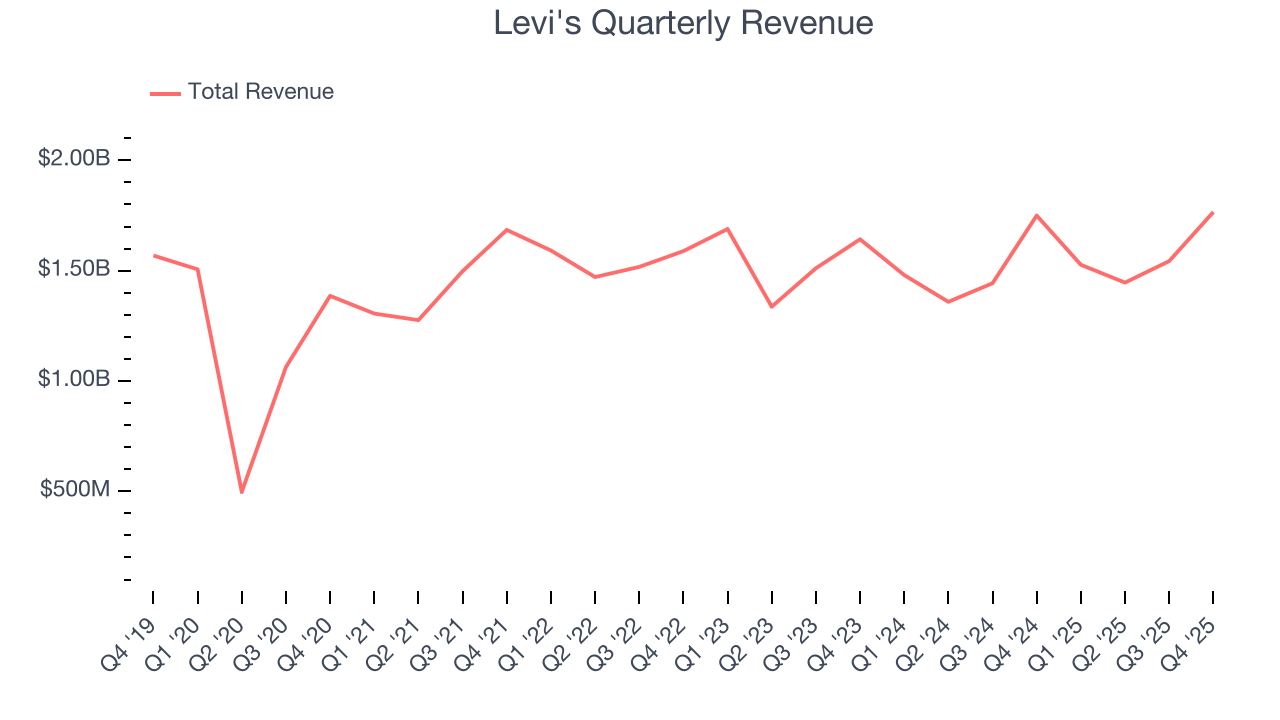
We at StockStory place the most emphasis on long-term growth, but within consumer discretionary, a stretched historical view may miss a company riding a successful new product or trend. Levi’s recent performance shows its demand has slowed as its revenue was flat over the last two years. 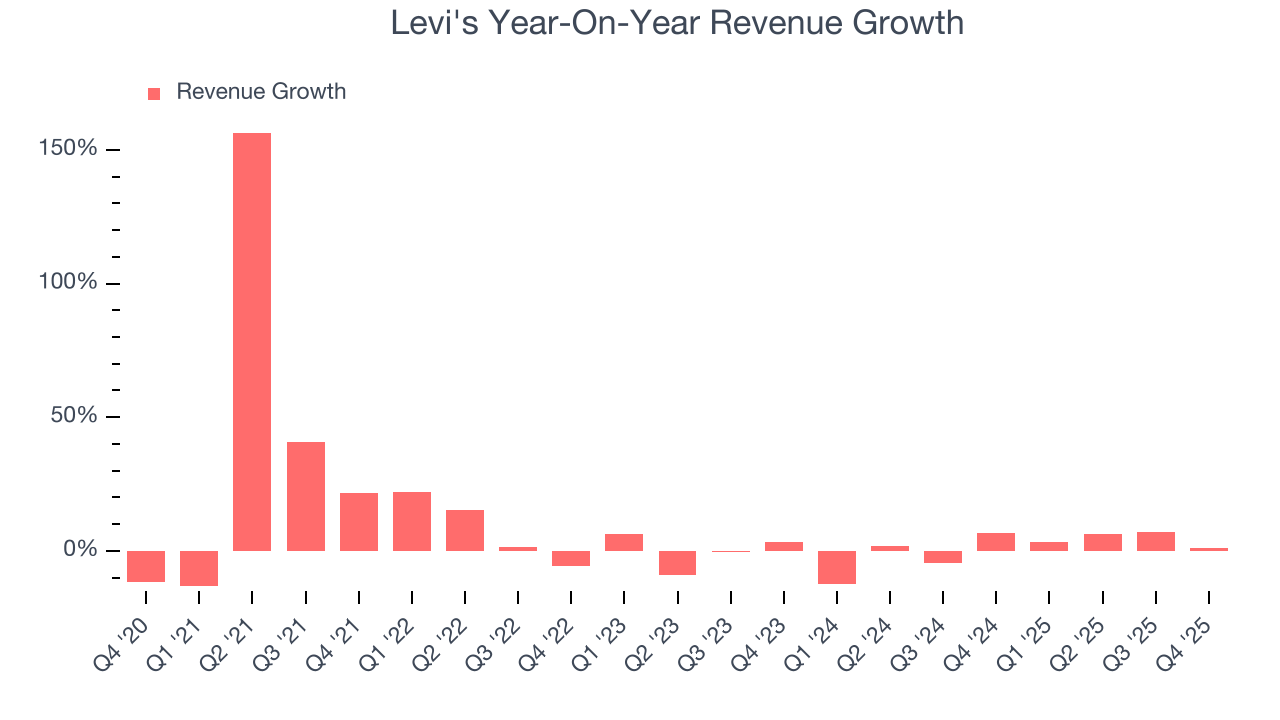
We can better understand the company’s sales dynamics by analyzing its constant currency revenue, which excludes currency movements that are outside their control and not indicative of demand. Over the last two years, its constant currency sales averaged 5% year-on-year growth. Because this number is better than its normal revenue growth, we can see that foreign exchange rates have been a headwind for Levi's. 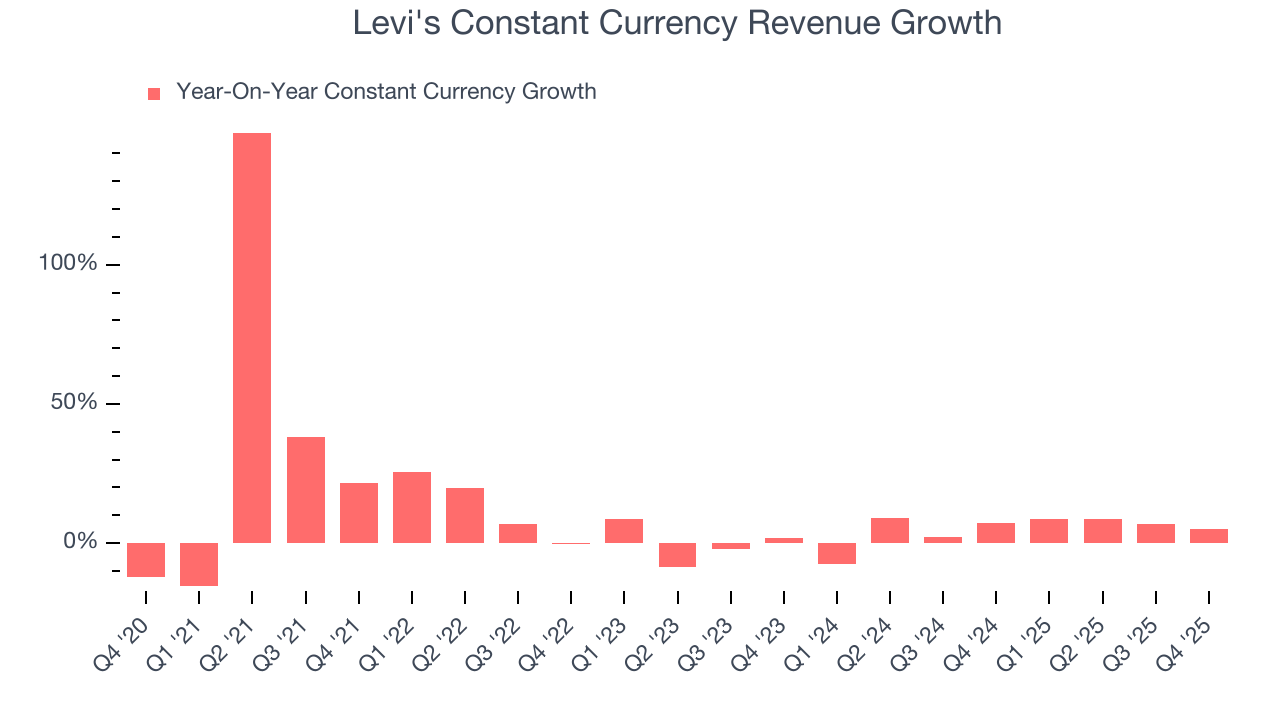
This quarter, Levi’s $1.77 billion of revenue was flat year on year but beat Wall Street’s estimates by 3.4%.
Looking ahead, sell-side analysts expect revenue to grow 4.3% over the next 12 months. Although this projection indicates its newer products and services will fuel better top-line performance, it is still below average for the sector.
6. Operating Margin
Operating margin is an important measure of profitability as it shows the portion of revenue left after accounting for all core expenses – everything from the cost of goods sold to advertising and wages. It’s also useful for comparing profitability across companies with different levels of debt and tax rates because it excludes interest and taxes.
Levi’s operating margin has risen over the last 12 months and averaged 7.7% over the last two years. The company’s higher efficiency is a breath of fresh air, but its suboptimal cost structure means it still sports inadequate profitability for a consumer discretionary business.
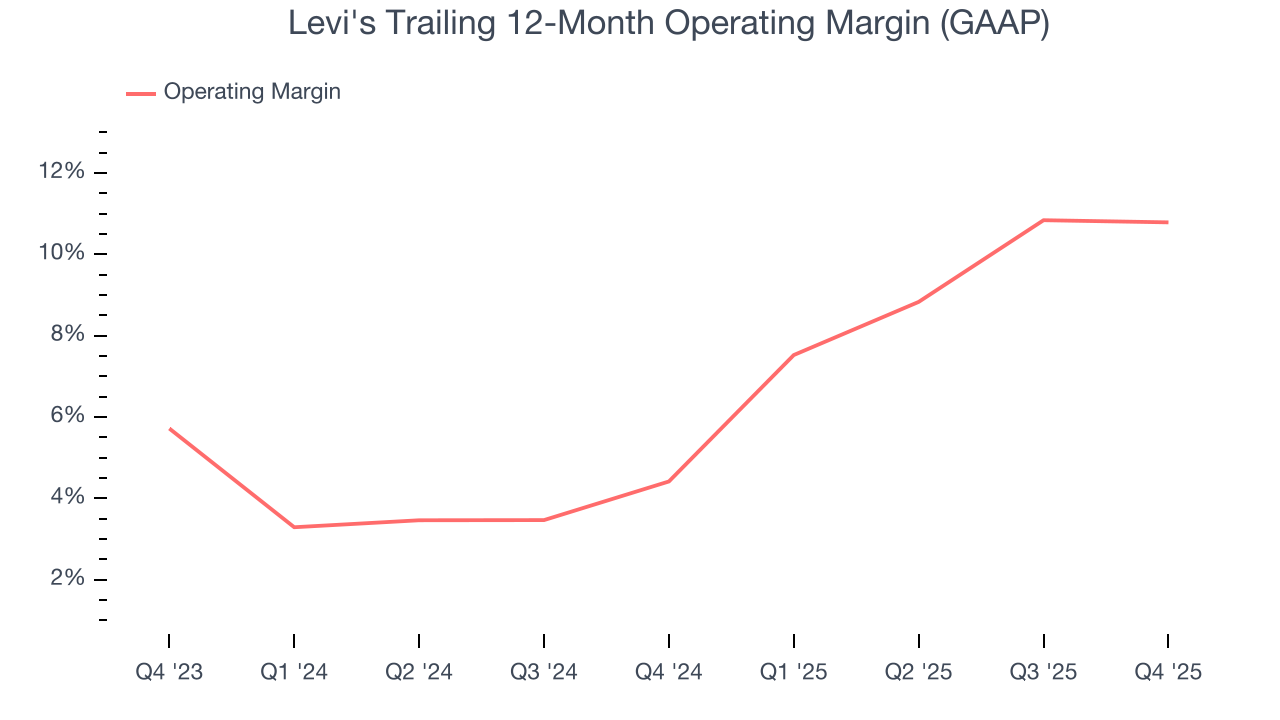
In Q4, Levi's generated an operating margin profit margin of 11.9%, in line with the same quarter last year. This indicates the company’s overall cost structure has been relatively stable.
7. Earnings Per Share
Revenue trends explain a company’s historical growth, but the long-term change in earnings per share (EPS) points to the profitability of that growth – for example, a company could inflate its sales through excessive spending on advertising and promotions.
Levi’s EPS grew at a remarkable 46.5% compounded annual growth rate over the last five years, higher than its 7.1% annualized revenue growth. This tells us the company became more profitable on a per-share basis as it expanded.
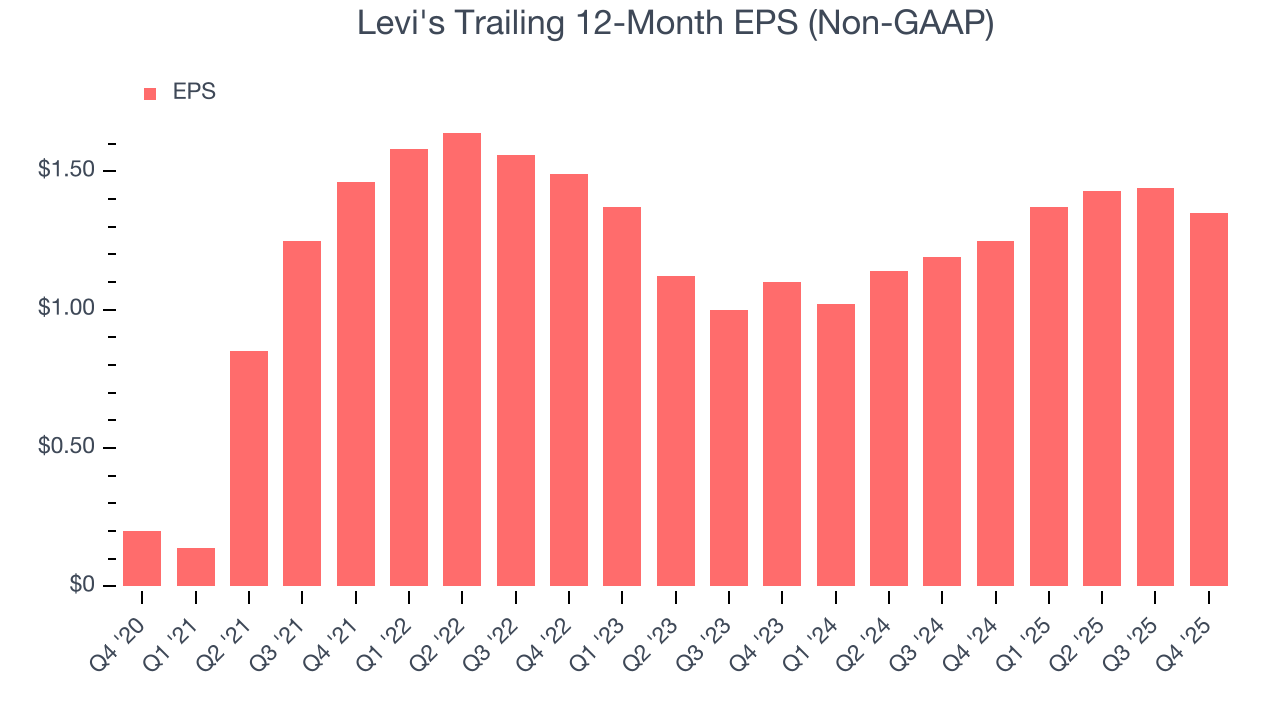
In Q4, Levi's reported adjusted EPS of $0.41, down from $0.50 in the same quarter last year. Despite falling year on year, this print beat analysts’ estimates by 4.6%. Over the next 12 months, Wall Street expects Levi’s full-year EPS of $1.35 to grow 9.1%.
8. Cash Is King
If you’ve followed StockStory for a while, you know we emphasize free cash flow. Why, you ask? We believe that in the end, cash is king, and you can’t use accounting profits to pay the bills.
Levi's has shown poor cash profitability over the last two years, giving the company limited opportunities to return capital to shareholders. Its free cash flow margin averaged 8%, lousy for a consumer discretionary business.
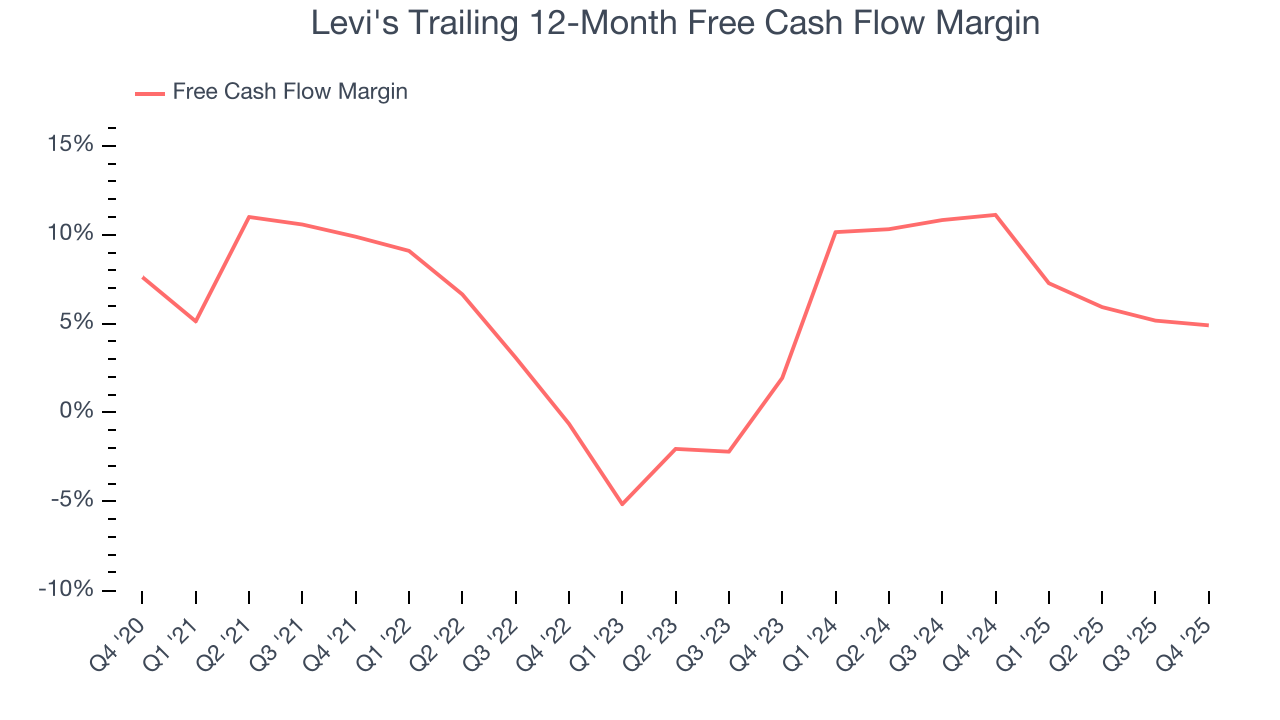
Levi’s free cash flow clocked in at $215.7 million in Q4, equivalent to a 12.2% margin. The company’s cash profitability regressed as it was 1 percentage points lower than in the same quarter last year, but it’s still above its two-year average. We wouldn’t put too much weight on this quarter’s decline because investment needs can be seasonal, causing short-term swings. Long-term trends carry greater meaning.
Over the next year, analysts predict Levi’s cash conversion will improve. Their consensus estimates imply its free cash flow margin of 4.9% for the last 12 months will increase to 7.6%, it options for capital deployment (investments, share buybacks, etc.).
9. Return on Invested Capital (ROIC)
EPS and free cash flow tell us whether a company was profitable while growing its revenue. But was it capital-efficient? Enter ROIC, a metric showing how much operating profit a company generates relative to the money it has raised (debt and equity).
Levi's historically did a mediocre job investing in profitable growth initiatives. Its five-year average ROIC was 14.2%, somewhat low compared to the best consumer discretionary companies that consistently pump out 25%+.
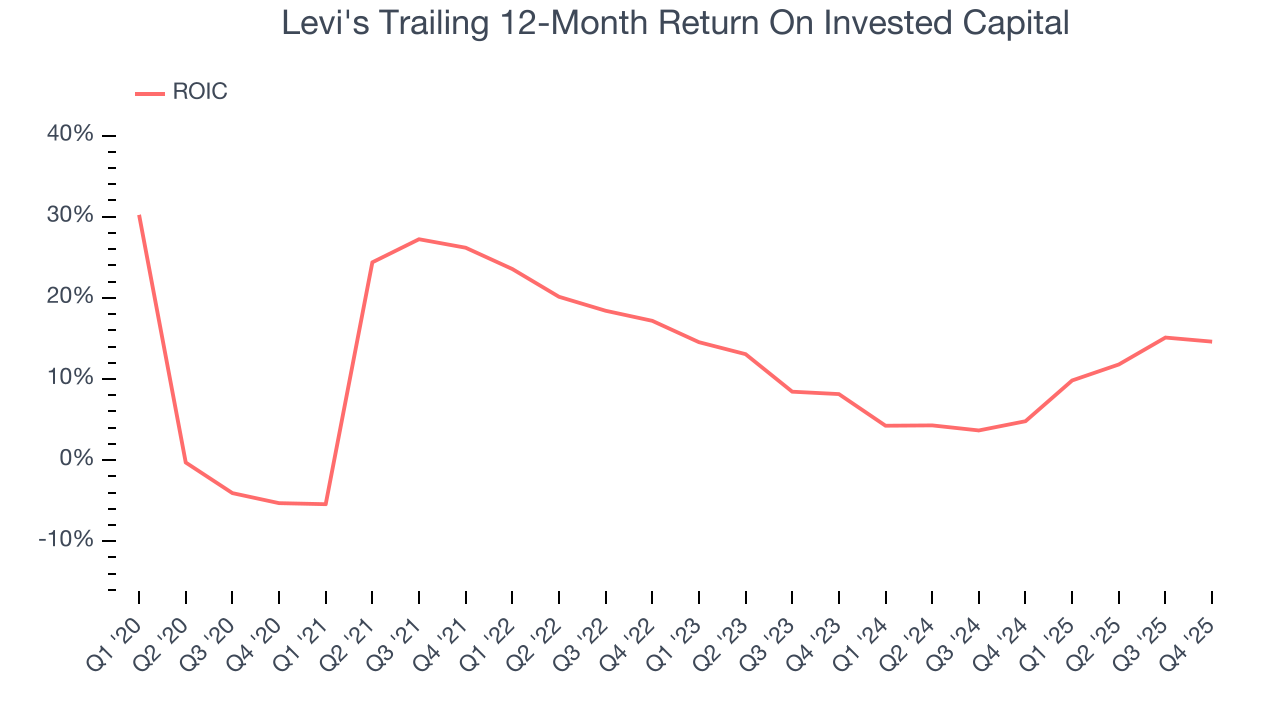
We like to invest in businesses with high returns, but the trend in a company’s ROIC is what often surprises the market and moves the stock price. Over the last few years, Levi’s ROIC has unfortunately decreased significantly. Paired with its already low returns, these declines suggest its profitable growth opportunities are few and far between.
10. Balance Sheet Assessment
Levi's reported $848.8 million of cash and $2.31 billion of debt on its balance sheet in the most recent quarter. As investors in high-quality companies, we primarily focus on two things: 1) that a company’s debt level isn’t too high and 2) that its interest payments are not excessively burdening the business.
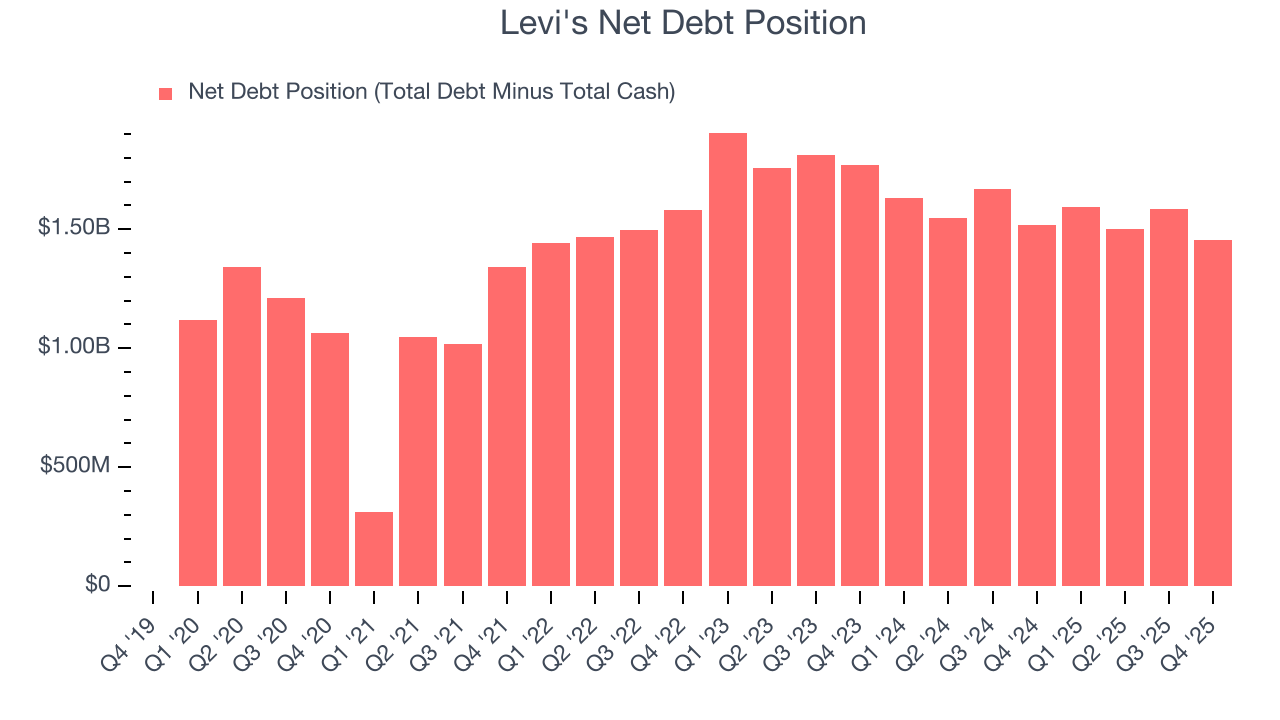
With $924.9 million of EBITDA over the last 12 months, we view Levi’s 1.6× net-debt-to-EBITDA ratio as safe. We also see its $21.8 million of annual interest expenses as appropriate. The company’s profits give it plenty of breathing room, allowing it to continue investing in growth initiatives.
11. Key Takeaways from Levi’s Q4 Results
We were impressed by how significantly Levi's blew past analysts’ constant currency revenue expectations this quarter. We were also happy its revenue outperformed Wall Street’s estimates. On the other hand, its full-year EPS guidance missed. Overall, this print had some key positives. The market seemed to be hoping for more, and the stock traded down 1% to $20.25 immediately following the results.
12. Is Now The Time To Buy Levi's?
Updated: January 28, 2026 at 5:07 PM EST
The latest quarterly earnings matters, sure, but we actually think longer-term fundamentals and valuation matter more. Investors should consider all these pieces before deciding whether or not to invest in Levi's.
Levi's falls short of our quality standards. For starters, its revenue growth was weak over the last five years, and analysts expect its demand to deteriorate over the next 12 months. And while its remarkable EPS growth over the last five years shows its profits are trickling down to shareholders, the downside is its constant currency sales performance has disappointed. On top of that, its projected EPS for the next year is lacking.
Levi’s P/E ratio based on the next 12 months is 13.9x. While this valuation is fair, the upside isn’t great compared to the potential downside. There are better investments elsewhere.
Wall Street analysts have a consensus one-year price target of $27.38 on the company (compared to the current share price of $20.25).
Although the price target is bullish, readers should exercise caution because analysts tend to be overly optimistic. The firms they work for, often big banks, have relationships with companies that extend into fundraising, M&A advisory, and other rewarding business lines. As a result, they typically hesitate to say bad things for fear they will lose out. We at StockStory do not suffer from such conflicts of interest, so we’ll always tell it like it is.