
iHeartMedia (IHRT)
iHeartMedia is up against the odds. Not only has its sales growth been weak but also its negative returns on capital show it destroyed value.― StockStory Analyst Team


1. News




2. Summary
Why We Think iHeartMedia Will Underperform
Occasionally featuring celebrity hosts like Ryan Seacrest on its shows, iHeartMedia (NASDAQ:IHRT) is a leading multimedia company renowned for its extensive network of radio stations, digital platforms, and live events across the globe.
- Lackluster 5.6% annual revenue growth over the last five years indicates the company is losing ground to competitors
- Historical operating margin losses point to an inefficient cost structure
- Unfavorable liquidity position could lead to additional equity financing that dilutes shareholders
iHeartMedia doesn’t fulfill our quality requirements. We believe there are better businesses elsewhere.
Why There Are Better Opportunities Than iHeartMedia





iHeartMedia’s stock price of $2.62 implies a valuation ratio of 7.5x forward EV-to-EBITDA. This valuation is fair for the quality you get, but we’re on the sidelines for now.
It’s better to pay up for high-quality businesses with strong long-term earnings potential rather than buy lower-quality stocks because they appear cheap. These challenged businesses often don’t re-rate, a phenomenon known as a “value trap”.
3. iHeartMedia (IHRT) Research Report: Q4 CY2025 Update
Global media and entertainment company iHeartMedia (NASDAQ:IHRT) reported revenue ahead of Wall Street’s expectations in Q4 CY2025, but sales were flat year on year at $1.13 billion. Its GAAP loss of $0.27 per share was significantly below analysts’ consensus estimates.
iHeartMedia (IHRT) Q4 CY2025 Highlights:
- Revenue: $1.13 billion vs analyst estimates of $1.10 billion (flat year on year, 2.8% beat)
- EPS (GAAP): -$0.27 vs analyst estimates of $0.13 (significant miss)
- Adjusted EBITDA: $220.3 million vs analyst estimates of $226.9 million (19.5% margin, 2.9% miss)
- EBITDA guidance for the upcoming financial year 2026 is $800 million at the midpoint, below analyst estimates of $861.7 million
- Operating Margin: 7.6%, down from 9.3% in the same quarter last year
- Free Cash Flow was $137.6 million, up from -$24.21 million in the same quarter last year
- Market Capitalization: $469.8 million
Company Overview
Occasionally featuring celebrity hosts like Ryan Seacrest on its shows, iHeartMedia (NASDAQ:IHRT) is a leading multimedia company renowned for its extensive network of radio stations, digital platforms, and live events across the globe.
iHeartMedia got its start as a single radio station and has since evolved into one of the largest radio and media companies. This growth stemmed from recognizing radio's potential as a personal, engaging medium to deliver varied audio content, from music and news to talk shows.
iHeartMedia offers a diverse range of content, including broadcast and online radio, podcasts, live music events, and syndicated programming. By providing on-demand, versatile audio content, the company caters to a broad spectrum of listener interests and offers advertisers targeted marketing opportunities.
The company generates revenue through advertising, live events, and digital subscriptions. Its extensive network ensures constant content flow, appealing to various tastes.
4. Consumer Discretionary - Broadcasting
The Consumer Discretionary sector, by definition, is made up of companies selling non-essential goods and services. When economic conditions deteriorate or tastes shift, consumers can easily cut back or eliminate these purchases. For long-term investors with five-year holding periods, this creates a structural challenge: the sector is inherently hit-driven, with low switching costs and fickle customers. As a result, only a handful of companies can reliably grow demand and compound earnings over long periods, which is why our bar is high and High Quality ratings are rare.
Broadcasting companies produce and distribute television and radio content, generating revenue primarily through advertising and, in some cases, retransmission fees (payments cable and satellite operators make to carry local channels). Tailwinds include resilient demand for live sports and event programming, which commands premium ad rates, and political advertising during election cycles. Headwinds, however, are substantial: secular cord-cutting (consumers canceling traditional pay-TV subscriptions) is shrinking linear audiences, digital platforms are capturing an increasing share of advertising budgets, and content production costs continue to rise. Regulatory scrutiny over media consolidation and spectrum ownership further constrains strategic flexibility.
Competitors in the audio and radio broadcasting industry include Sirius XM (NASDAQ:SIRI), Cumulus Media (NASDAQ:CMLS), and Townsquare Media (NYSE:TSQ).
5. Revenue Growth
A company’s long-term sales performance is one signal of its overall quality. Any business can put up a good quarter or two, but the best consistently grow over the long haul. Unfortunately, iHeartMedia’s 5.6% annualized revenue growth over the last five years was weak. This fell short of our benchmark for the consumer discretionary sector and is a rough starting point for our analysis.
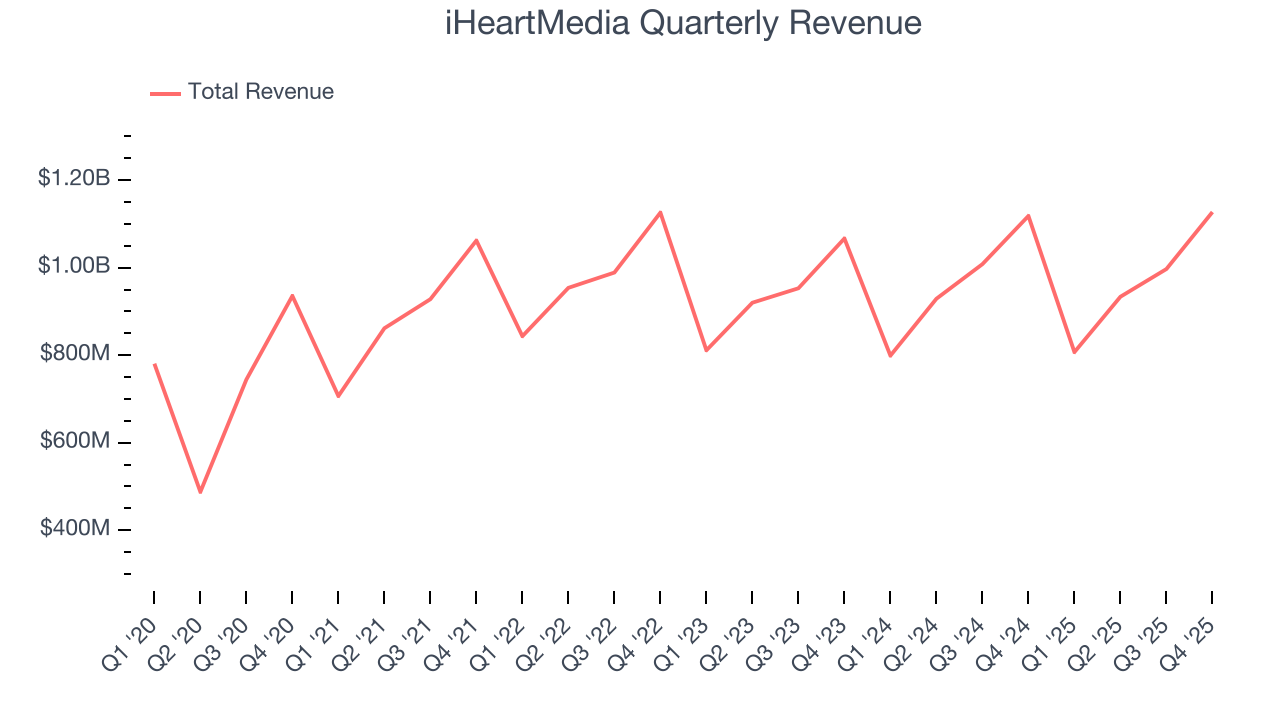
Long-term growth is the most important, but within consumer discretionary, product cycles are short and revenue can be hit-driven due to rapidly changing trends and consumer preferences. iHeartMedia’s recent performance shows its demand has slowed as its annualized revenue growth of 1.5% over the last two years was below its five-year trend. We’re wary when companies in the sector see decelerations in revenue growth, as it could signal changing consumer tastes aided by low switching costs. 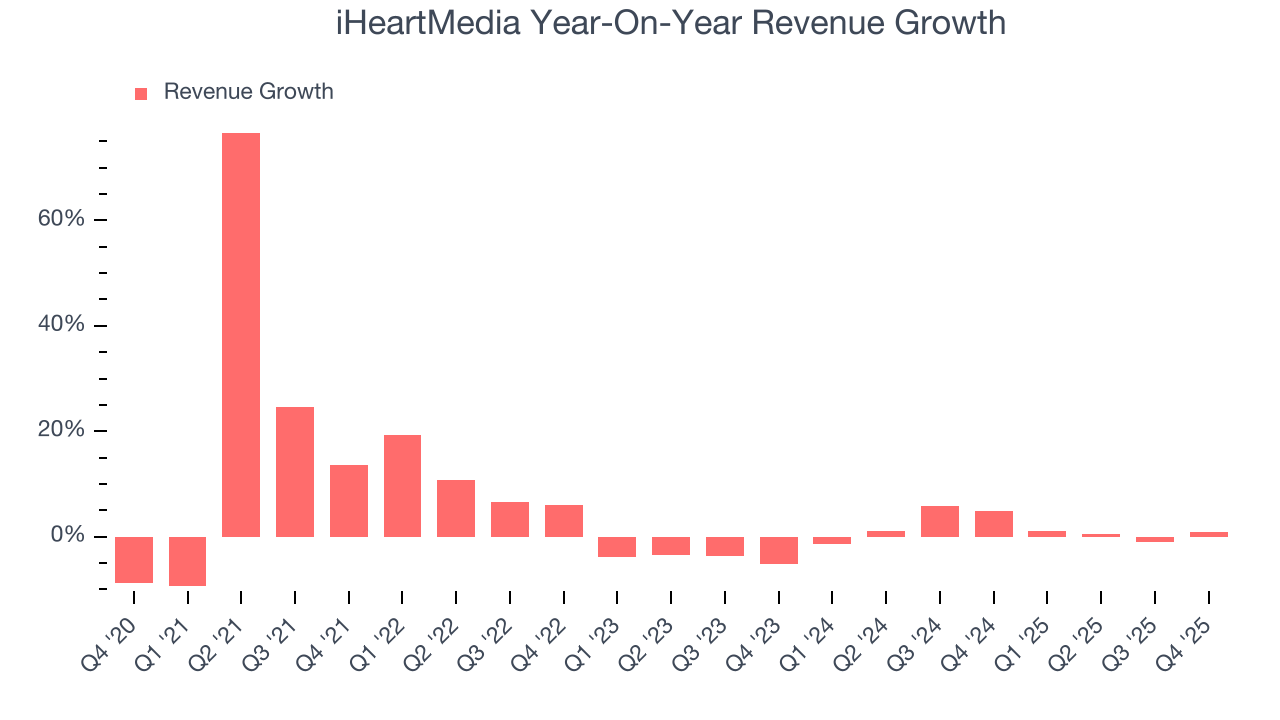
We can dig further into the company’s revenue dynamics by analyzing its three most important segments: Multiplatform, Digital Audio, and Services, which are 59%, 34.3%, and 7% of revenue. Over the last two years, iHeartMedia’s Digital Audio revenue (podcasting) averaged 14.3% year-on-year growth while its Multiplatform (broadcasting, networks, events) and Services (media representation) revenues averaged 4.2% and 15.7% declines. 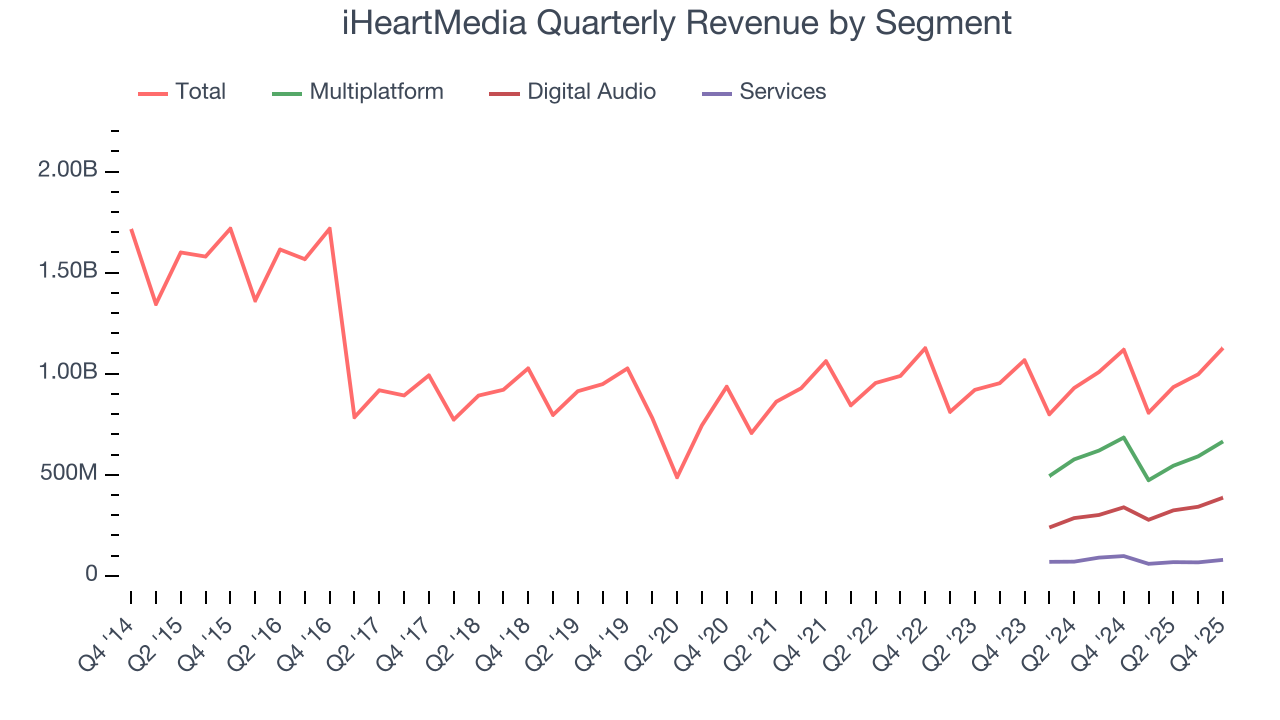
This quarter, iHeartMedia’s $1.13 billion of revenue was flat year on year but beat Wall Street’s estimates by 2.8%.
Looking ahead, sell-side analysts expect revenue to grow 5.4% over the next 12 months. Although this projection suggests its newer products and services will catalyze better top-line performance, it is still below the sector average.
6. Operating Margin
Operating margin is a key measure of profitability. Think of it as net income - the bottom line - excluding the impact of taxes and interest on debt, which are less connected to business fundamentals.
iHeartMedia’s operating margin has been trending up over the last 12 months, but it still averaged negative 10.2% over the last two years. This is due to its large expense base and inefficient cost structure.
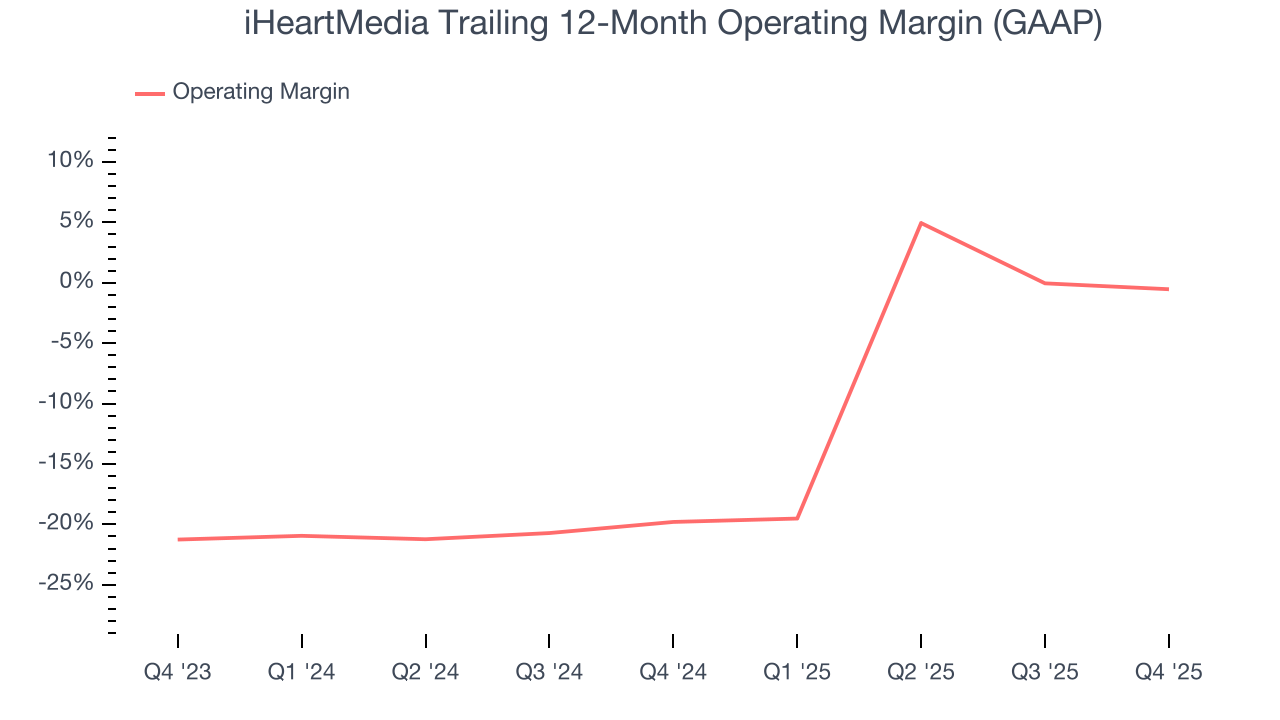
This quarter, iHeartMedia generated an operating margin profit margin of 7.6%, down 1.7 percentage points year on year. This reduction is quite minuscule and indicates the company’s overall cost structure has been relatively stable.
7. Earnings Per Share
Revenue trends explain a company’s historical growth, but the long-term change in earnings per share (EPS) points to the profitability of that growth – for example, a company could inflate its sales through excessive spending on advertising and promotions.
Although iHeartMedia’s full-year earnings are still negative, it reduced its losses and improved its EPS by 25.2% annually over the last five years. The next few quarters will be critical for assessing its long-term profitability.
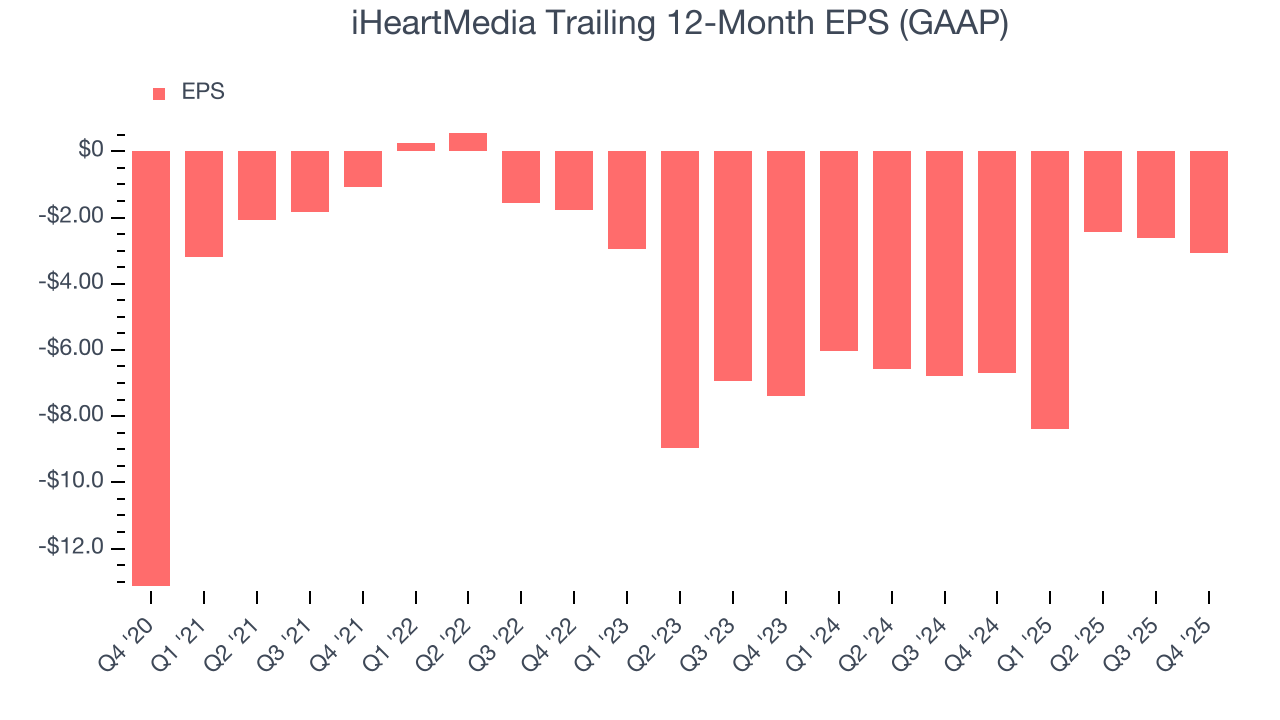
In Q4, iHeartMedia reported EPS of negative $0.27, down from $0.21 in the same quarter last year. This print missed analysts’ estimates. Over the next 12 months, Wall Street is optimistic. Analysts forecast iHeartMedia’s full-year EPS of negative $3.08 will flip to positive $0.53.
8. Cash Is King
If you’ve followed StockStory for a while, you know we emphasize free cash flow. Why, you ask? We believe that in the end, cash is king, and you can’t use accounting profits to pay the bills.
While iHeartMedia posted positive free cash flow this quarter, the broader story hasn’t been so clean. Over the last two years, iHeartMedia’s demanding reinvestments to stay relevant have drained its resources, putting it in a pinch and limiting its ability to return capital to investors. Its free cash flow margin averaged negative 98.8%, meaning it lit $98.80 of cash on fire for every $100 in revenue.
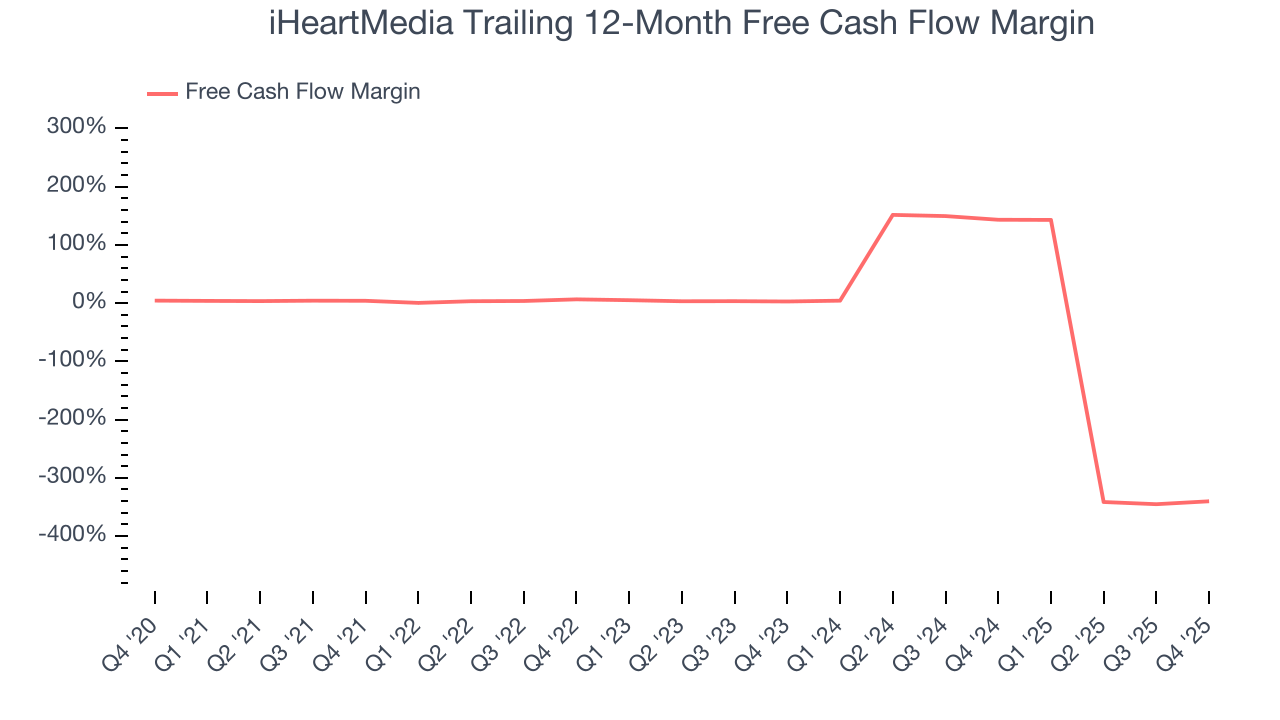
iHeartMedia’s free cash flow clocked in at $137.6 million in Q4, equivalent to a 12.2% margin. Its cash flow turned positive after being negative in the same quarter last year
9. Return on Invested Capital (ROIC)
EPS and free cash flow tell us whether a company was profitable while growing its revenue. But was it capital-efficient? A company’s ROIC explains this by showing how much operating profit it makes compared to the money it has raised (debt and equity).
iHeartMedia’s five-year average ROIC was negative 3.4%, meaning management lost money while trying to expand the business. Its returns were among the worst in the consumer discretionary sector.
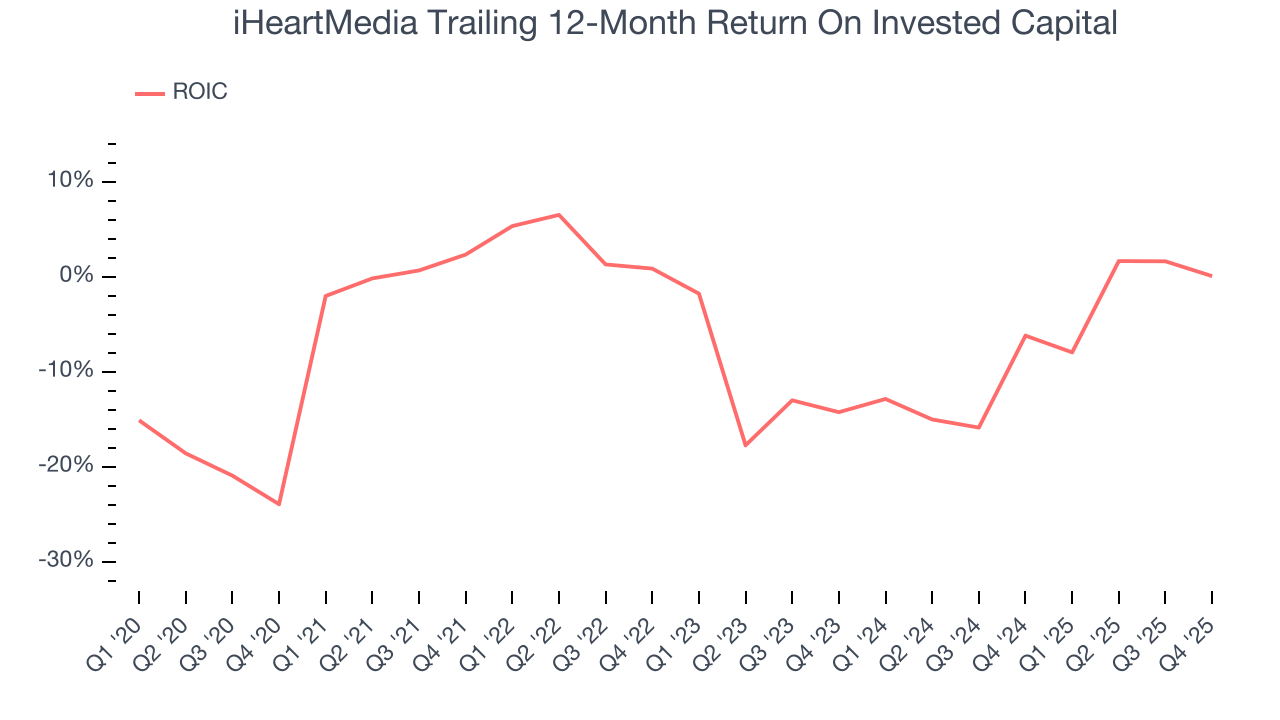
We like to invest in businesses with high returns, but the trend in a company’s ROIC is what often surprises the market and moves the stock price. On average, iHeartMedia’s ROIC decreased by 4.7 percentage points annually each year over the last few years. Paired with its already low returns, these declines suggest its profitable growth opportunities are few and far between.
10. Balance Sheet Assessment
iHeartMedia reported $270,900 of cash and $5.05 million of debt on its balance sheet in the most recent quarter. As investors in high-quality companies, we primarily focus on two things: 1) that a company’s debt level isn’t too high and 2) that its interest payments are not excessively burdening the business.
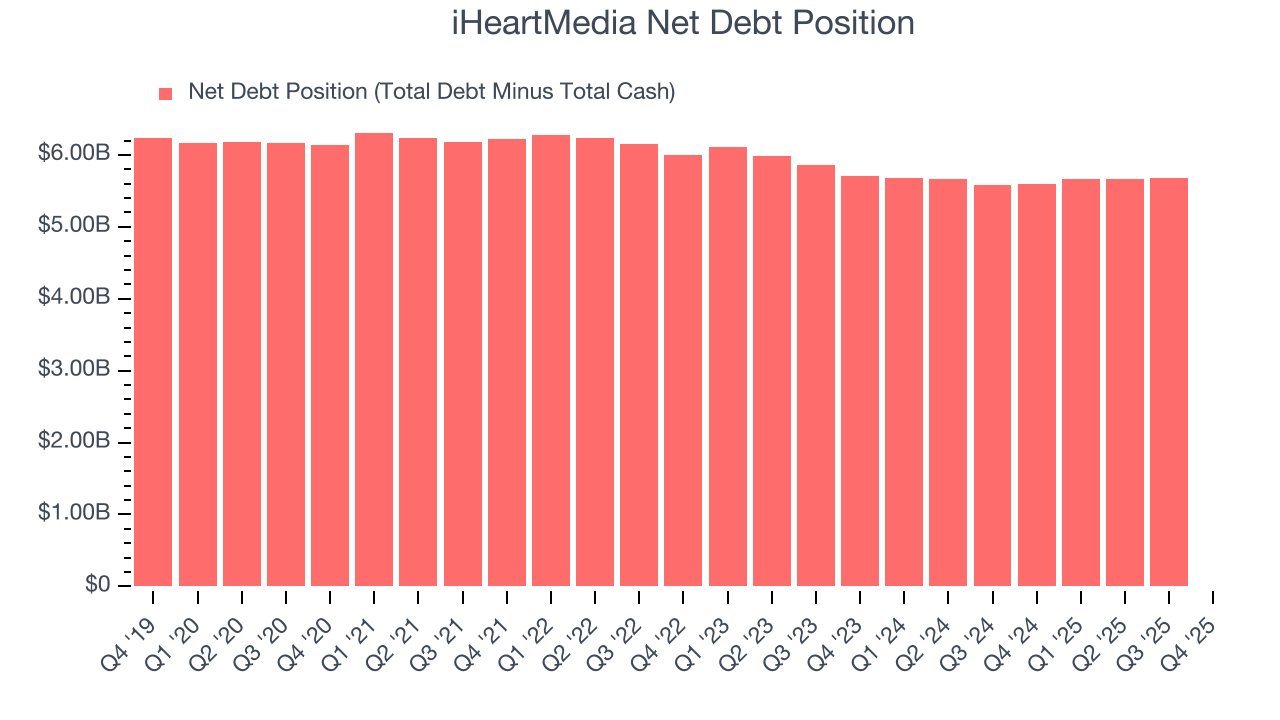
With $685.8 million of EBITDA over the last 12 months, we view iHeartMedia’s 0.0× net-debt-to-EBITDA ratio as safe. We also see its $203.6 million of annual interest expenses as appropriate. The company’s profits give it plenty of breathing room, allowing it to continue investing in growth initiatives.
11. Key Takeaways from iHeartMedia’s Q4 Results
It was encouraging to see iHeartMedia beat analysts’ revenue expectations this quarter. On the other hand, its EPS missed and its full-year EBITDA guidance fell short of Wall Street’s estimates. Overall, this was a softer quarter. The stock traded down 1.8% to $3.06 immediately following the results.
12. Is Now The Time To Buy iHeartMedia?
Updated: March 12, 2026 at 10:49 PM EDT
The latest quarterly earnings matters, sure, but we actually think longer-term fundamentals and valuation matter more. Investors should consider all these pieces before deciding whether or not to invest in iHeartMedia.
iHeartMedia doesn’t pass our quality test. While its projected EPS for the next year implies the company’s fundamentals will improve, the downside is its relatively low ROIC suggests management has struggled to find compelling investment opportunities. On top of that, its cash burn raises the question of whether it can sustainably maintain growth.
iHeartMedia’s EV-to-EBITDA ratio based on the next 12 months is 7.5x. While this valuation is fair, the upside isn’t great compared to the potential downside. There are better investments elsewhere.
Wall Street analysts have a consensus one-year price target of $3.13 on the company (compared to the current share price of $2.62).
Although the price target is bullish, readers should exercise caution because analysts tend to be overly optimistic. The firms they work for, often big banks, have relationships with companies that extend into fundraising, M&A advisory, and other rewarding business lines. As a result, they typically hesitate to say bad things for fear they will lose out. We at StockStory do not suffer from such conflicts of interest, so we’ll always tell it like it is.