
Perella Weinberg (PWP)
Perella Weinberg is up against the odds. Its poor investment decisions are evident in its negative returns on capital, a troubling sign for investors.― StockStory Analyst Team


1. News





2. Summary
Why We Think Perella Weinberg Will Underperform
Founded in 2006 by veteran investment bankers Joseph Perella and Peter Weinberg during a wave of boutique advisory firm launches, Perella Weinberg Partners (NASDAQ:PWP) is a global independent advisory firm that provides strategic and financial advice to corporations, financial sponsors, and government institutions.
- Earnings per share have contracted by 25.2% annually over the last four years, a headwind for returns as stock prices often echo long-term EPS performance
- Negative return on equity shows that some of its growth strategies have backfired
- On the plus side, its additional sales over the last two years increased its profitability as the 22% annual growth in its earnings per share outpaced its revenue
Perella Weinberg doesn’t fulfill our quality requirements. We’re looking for better stocks elsewhere.
Why There Are Better Opportunities Than Perella Weinberg






At $17.24 per share, Perella Weinberg trades at 13.5x forward P/E. This multiple is high given its weaker fundamentals.
Paying up for elite businesses with strong earnings potential is better than investing in lower-quality companies with shaky fundamentals. That’s how you avoid big downside over the long term.
3. Perella Weinberg (PWP) Research Report: Q4 CY2025 Update
Financial advisory firm Perella Weinberg Partners (NASDAQ:PWP) reported Q4 CY2025 results topping the market’s revenue expectations, but sales fell by 2.9% year on year to $219.2 million. Its non-GAAP profit of $0.17 per share was 65.9% above analysts’ consensus estimates.
Perella Weinberg (PWP) Q4 CY2025 Highlights:
- Revenue: $219.2 million vs analyst estimates of $171.6 million (2.9% year-on-year decline, 27.7% beat)
- Pre-tax Profit: $21.78 million (9.9% margin)
- Adjusted EPS: $0.17 vs analyst estimates of $0.10 (65.9% beat)
- Market Capitalization: $1.44 billion
Company Overview
Founded in 2006 by veteran investment bankers Joseph Perella and Peter Weinberg during a wave of boutique advisory firm launches, Perella Weinberg Partners (NASDAQ:PWP) is a global independent advisory firm that provides strategic and financial advice to corporations, financial sponsors, and government institutions.
The firm specializes in advising clients on complex financial matters including mergers and acquisitions, capital structure optimization, and strategic decision-making. Operating through ten offices across five countries, PWP serves clients in multiple industries including Consumer & Retail, Energy & Energy Transition, Financial Services, Healthcare, Industrials, and Technology.
PWP's business model centers on providing high-touch, relationship-based advisory services that combine industry expertise with technical financial knowledge. For example, a mid-sized technology company considering acquisition opportunities might engage PWP to evaluate potential targets, determine appropriate valuations, and negotiate deal terms. Similarly, a large industrial corporation facing activist investor pressure might seek PWP's counsel on strategic alternatives and shareholder communications.
The firm generates revenue primarily through advisory fees, which typically include retainer payments and success-based compensation tied to transaction completion. PWP's independence from larger financial institutions allows it to provide conflict-free advice, as it doesn't have the lending, trading, or research divisions that might create competing interests at full-service investment banks.
PWP also offers specialized capital markets advisory services, helping clients navigate financing options and develop tailored capital structure solutions. Through its Tudor, Pickering, Holt & Co. division, the firm provides specialized underwriting and research services focused on the energy sector and energy transition, giving it particular depth in this industry vertical.
4. Investment Banking & Brokerage
Investment banks and brokerages facilitate capital raises, mergers and acquisitions, and securities trading. The sector benefits from corporate activity during economic expansion, increased retail trading participation, and advisory opportunities in emerging sectors. Headwinds include economic cycle vulnerability affecting deal flow, compressed trading commissions due to electronic platforms, and regulatory capital requirements constraining certain higher-risk activities.
Perella Weinberg Partners competes with independent advisory firms like Evercore (NYSE:EVR), Lazard (NYSE:LAZ), and PJT Partners (NYSE:PJT), as well as the investment banking divisions of major financial institutions such as Goldman Sachs (NYSE:GS), Morgan Stanley (NYSE:MS), and JPMorgan Chase (NYSE:JPM).
5. Revenue Growth
A company’s long-term sales performance can indicate its overall quality. Even a bad business can shine for one or two quarters, but a top-tier one grows for years. Over the last five years, Perella Weinberg grew its revenue at a decent 7.7% compounded annual growth rate. Its growth was slightly above the average financials company and shows its offerings resonate with customers.
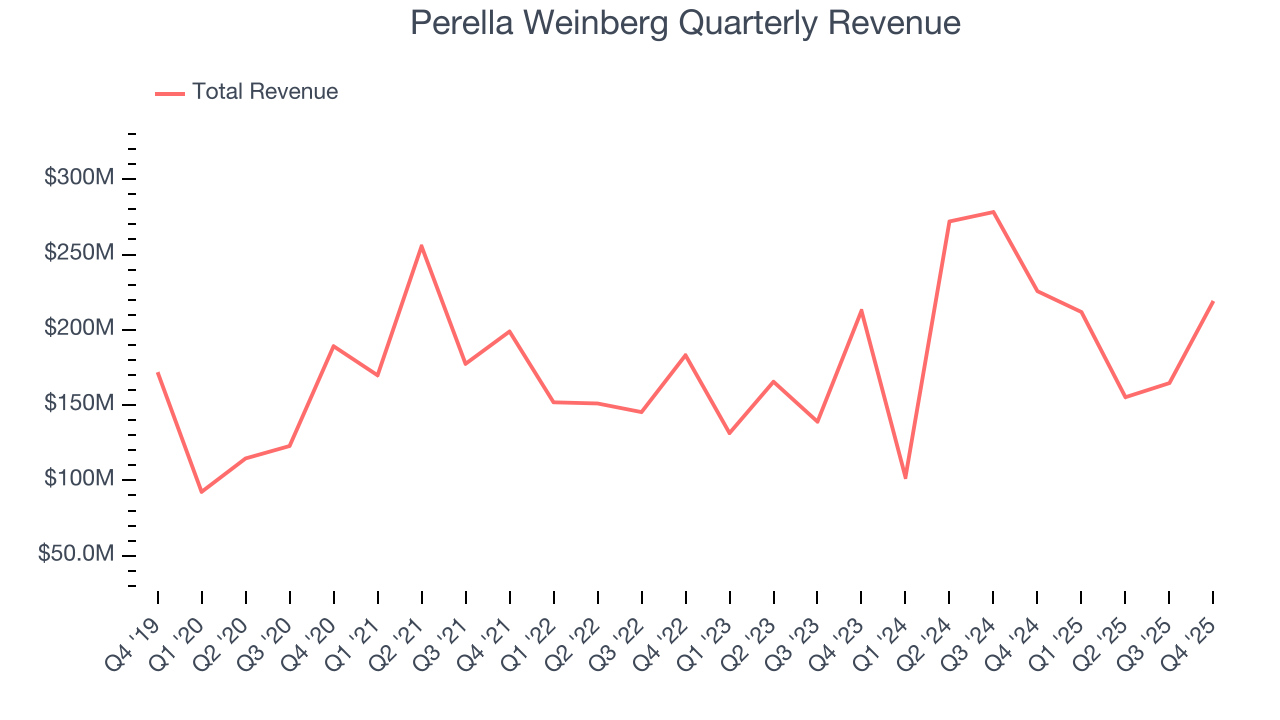
Long-term growth is the most important, but within financials, a half-decade historical view may miss recent interest rate changes and market returns. Perella Weinberg’s annualized revenue growth of 7.6% over the last two years aligns with its five-year trend, suggesting its demand was stable. 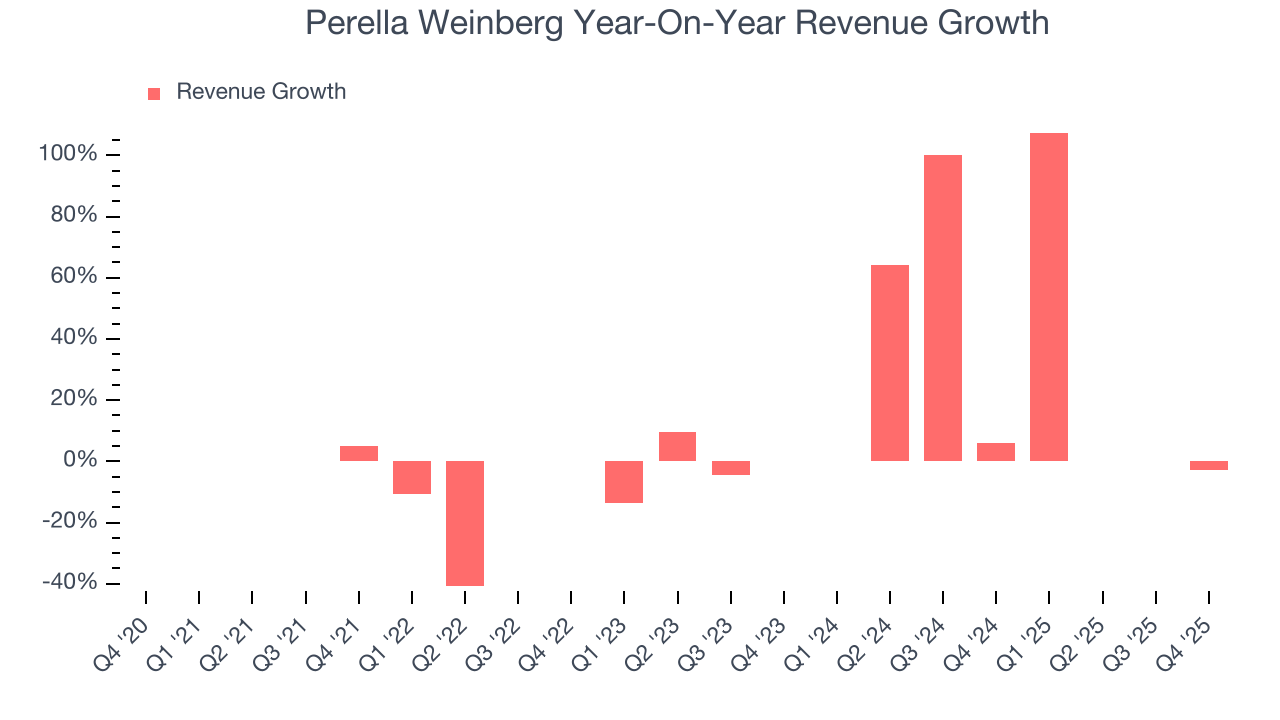 Note: Quarters not shown were determined to be outliers, impacted by outsized investment gains/losses that are not indicative of the recurring fundamentals of the business.
This quarter, Perella Weinberg’s revenue fell by 2.9% year on year to $219.2 million but beat Wall Street’s estimates by 27.7%.
6. Pre-Tax Profit Margin
Revenue growth is one major determinant of business quality, and the efficiency of operations is another. For Investment Banking & Brokerage companies, we look at pre-tax profit rather than the operating margin that defines sectors such as consumer, tech, and industrials.
The pre-tax profit margin includes interest because it's central to how financial institutions generate revenue and manage costs. Tax considerations are excluded since they represent government policy rather than operational performance, giving investors a clearer view of business fundamentals.
Over the last five years, Perella Weinberg’s pre-tax profit margin has fallen by 10.9 percentage points, going from 2.9% to 6.9%. It has also expanded by 24.3 percentage points on a two-year basis, showing its expenses have consistently grown at a slower rate than revenue. This typically signals prudent management.
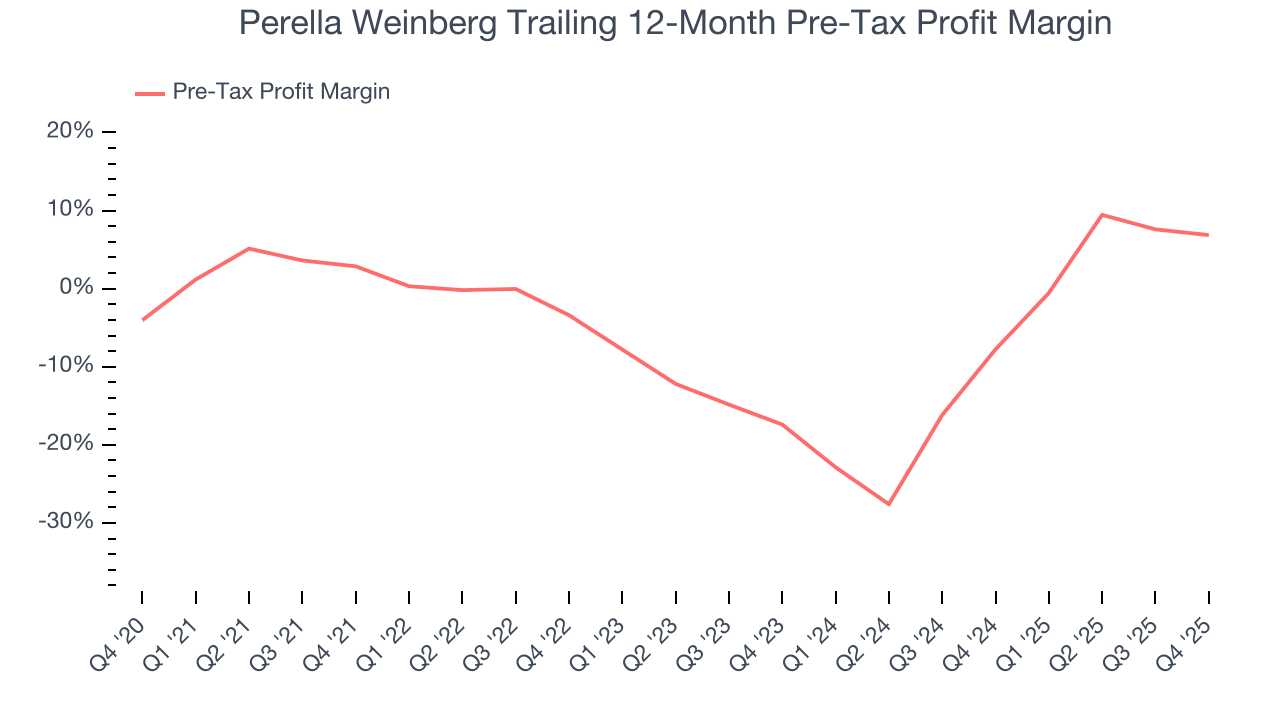
In Q4, Perella Weinberg’s pre-tax profit margin was 9.9%. This result was 2.4 percentage points worse than the same quarter last year.
7. Earnings Per Share
Revenue trends explain a company’s historical growth, but the long-term change in earnings per share (EPS) points to the profitability of that growth – for example, a company could inflate its sales through excessive spending on advertising and promotions.
Perella Weinberg’s full-year EPS dropped 146%, or 25.2% annually, over the last four years. We tend to steer our readers away from companies with falling revenue and EPS, where diminishing earnings could imply changing secular trends and preferences. If the tide turns unexpectedly, Perella Weinberg’s low margin of safety could leave its stock price susceptible to large downswings.
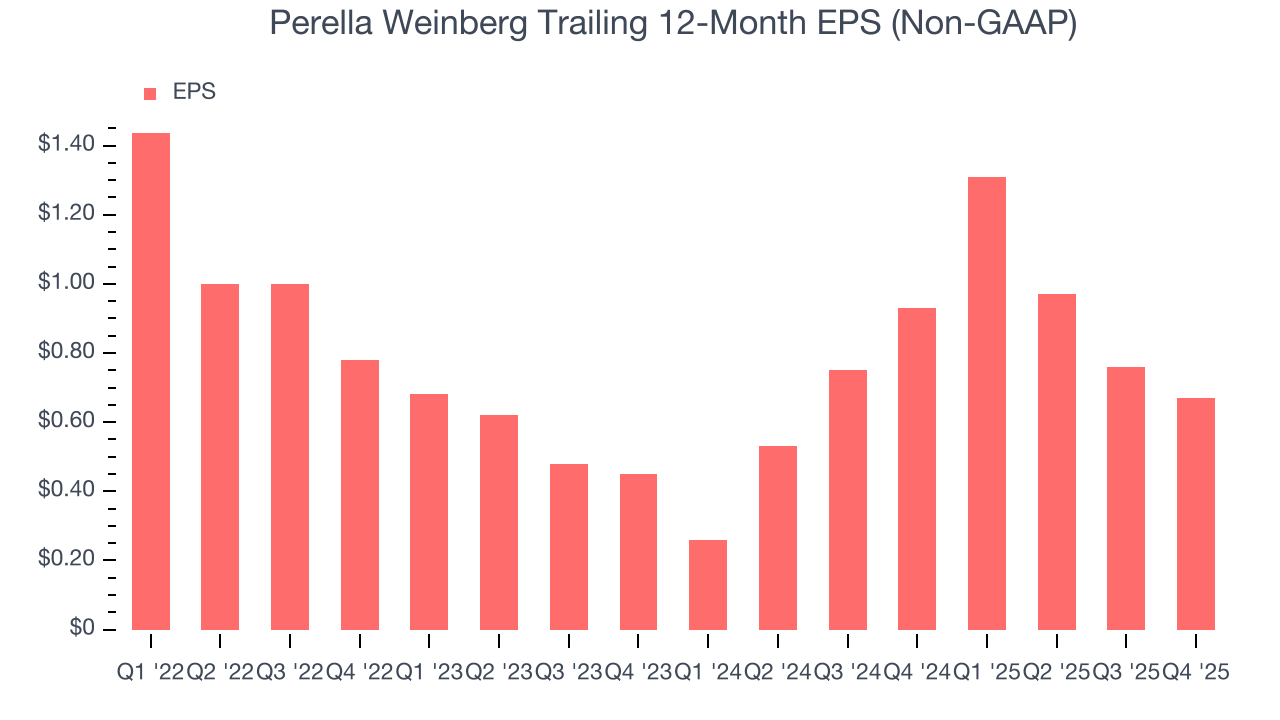
Like with revenue, we analyze EPS over a more recent period because it can provide insight into an emerging theme or development for the business.
Perella Weinberg’s EPS grew at a spectacular 22% compounded annual growth rate over the last two years, higher than its 7.6% annualized revenue growth. This tells us the company became more profitable on a per-share basis as it expanded.
We can take a deeper look into Perella Weinberg’s earnings quality to better understand the drivers of its performance. While we mentioned earlier that Perella Weinberg’s pre-tax profit margin declined this quarter, a two-year view shows its margin has expanded. This was the most relevant factor (aside from the revenue impact) behind its higher earnings; taxes can also affect EPS but don’t tell us as much about a company’s fundamentals.
In Q4, Perella Weinberg reported adjusted EPS of $0.17, down from $0.26 in the same quarter last year. Despite falling year on year, this print easily cleared analysts’ estimates. Over the next 12 months, Wall Street expects Perella Weinberg’s full-year EPS of $0.67 to grow 84.8%.
8. Return on Equity
Return on equity, or ROE, tells us how much profit a company generates for each dollar of shareholder equity, a key funding source for banks. Over a long period, banks with high ROE tend to compound shareholder wealth faster through retained earnings, buybacks, and dividends.
Over the last five years, Perella Weinberg has averaged an ROE of negative 9.9%, a bad result not only in absolute terms but also relative to the majority of firms putting up 25%+. It also shows that Perella Weinberg has little to no competitive moat.
9. Balance Sheet Assessment
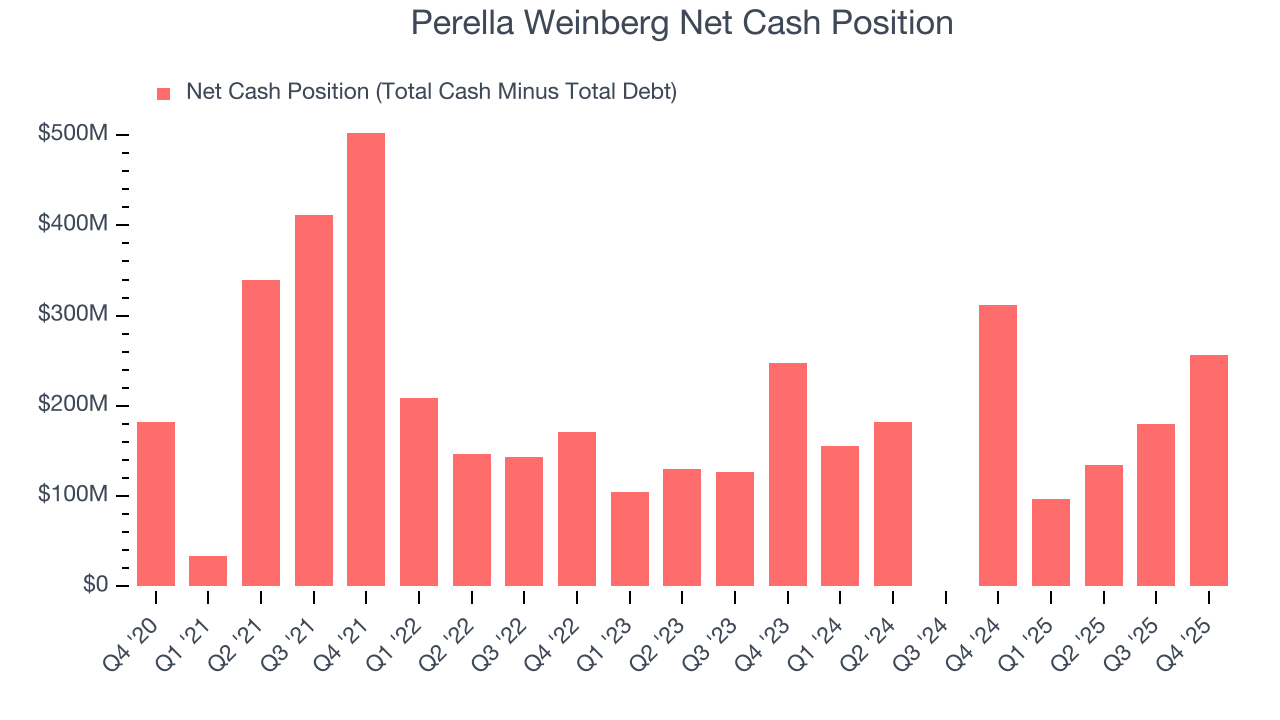
Perella Weinberg reported $255.9 million of cash and $0 of debt on its balance sheet in the most recent quarter.
Given the company has no debt, leverage is not an issue here.
10. Key Takeaways from Perella Weinberg’s Q4 Results
It was good to see Perella Weinberg beat analysts’ EPS expectations this quarter. We were also excited its revenue outperformed Wall Street’s estimates by a wide margin. Zooming out, we think this was a solid print. The stock remained flat at $21.53 immediately following the results.
11. Is Now The Time To Buy Perella Weinberg?
Updated: March 26, 2026 at 12:56 AM EDT
Are you wondering whether to buy Perella Weinberg or pass? We urge investors to not only consider the latest earnings results but also longer-term business quality and valuation as well.
Perella Weinberg falls short of our quality standards. Although its revenue growth was decent over the last five years and is expected to accelerate over the next 12 months, its declining EPS over the last four years makes it a less attractive asset to the public markets. And while the company’s expanding pre-tax profit margin shows the business has become more efficient, the downside is its relatively low ROE suggests management has struggled to find compelling investment opportunities.
Perella Weinberg’s P/E ratio based on the next 12 months is 13.4x. This valuation tells us a lot of optimism is priced in - we think there are better stocks to buy right now.
Wall Street analysts have a consensus one-year price target of $24.88 on the company (compared to the current share price of $17.43).
Although the price target is bullish, readers should exercise caution because analysts tend to be overly optimistic. The firms they work for, often big banks, have relationships with companies that extend into fundraising, M&A advisory, and other rewarding business lines. As a result, they typically hesitate to say bad things for fear they will lose out. We at StockStory do not suffer from such conflicts of interest, so we’ll always tell it like it is.