Qualcomm (QCOM)
Qualcomm piques our interest. Its blend of high growth and outstanding profitability makes for a nice return algorithm.― StockStory Analyst Team


1. News


2. Summary
Why Qualcomm Is Interesting
Having been at the forefront of developing the standards for cellular connectivity for over four decades, Qualcomm (NASDAQ:QCOM) is a leading innovator and a fabless manufacturer of wireless technology chips used in smartphones, autos and internet of things appliances.
- Stellar returns on capital showcase management’s ability to surface highly profitable business ventures
- Robust free cash flow profile gives it the flexibility to invest in growth initiatives or return capital to shareholders, and its improved cash conversion implies it’s becoming a less capital-intensive business
- One risk is its estimated sales growth of 2.8% for the next 12 months implies demand will slow from its two-year trend
Qualcomm has the potential to be a high-quality business. If you like the story, the valuation seems fair.
Why Is Now The Time To Buy Qualcomm?





Qualcomm is trading at $147.27 per share, or 12.8x forward P/E. Qualcomm’s multiple is lower than that of many semiconductor companies. Even so, we think it is justified for the top-line growth you get.
If you think the market is not giving the company enough credit for its fundamentals, now could be a good time to invest.
3. Qualcomm (QCOM) Research Report: Q4 CY2025 Update
Wireless chipmaker Qualcomm (NASDAQ:QCOM) met Wall Street’s revenue expectations in Q4 CY2025, with sales up 5% year on year to $12.25 billion. On the other hand, next quarter’s revenue guidance of $10.6 billion was less impressive, coming in 4.9% below analysts’ estimates. Its non-GAAP profit of $3.50 per share was 2.9% above analysts’ consensus estimates.
Qualcomm (QCOM) Q4 CY2025 Highlights:
- Revenue: $12.25 billion vs analyst estimates of $12.21 billion (5% year-on-year growth, in line)
- Adjusted EPS: $3.50 vs analyst estimates of $3.40 (2.9% beat)
- Adjusted Operating Income: $4.41 billion vs analyst estimates of $4.29 billion (36% margin, 2.8% beat)
- Revenue Guidance for Q1 CY2026 is $10.6 billion at the midpoint, below analyst estimates of $11.15 billion
- Adjusted EPS guidance for Q1 CY2026 is $2.55 at the midpoint, below analyst estimates of $2.87
- Operating Margin: 27.5%, down from 30.5% in the same quarter last year
- Free Cash Flow Margin: 36%, similar to the same quarter last year
- Inventory Days Outstanding: 109, down from 145 in the previous quarter
- Market Capitalization: $157.2 billion
Company Overview
Having been at the forefront of developing the standards for cellular connectivity for over four decades, Qualcomm (NASDAQ:QCOM) is a leading innovator and a fabless manufacturer of wireless technology chips used in smartphones, autos and internet of things appliances.
Qualcomm has one of the more unique semiconductor business models. Its research has created the intellectual property that is the foundation for the global wireless industry. In the 1990s they developed the original code division multiple access (CDMA) technology that became the standard for cell phone networks first in the US, then around the world. Qualcomm has had a hand in developing Wi-Fi, GPS, and Bluetooth, along with RFID (Radio Frequency ID), and 4G and 5G technology.
It monetizes its portfolio of more than 140,000 patents through designing semiconductors used in handsets, autos, and IoT and also through licensing its patents for others to incorporate in their own products. Qualcomm outsources manufacturing of its chips, its main product family is the Snapdragon chip, an all in one chip used to power mobile devices: it includes a cellular modem, integrated Wi-Fi, Bluetooth, and GPS, along with a CPU (central processing unit) and GPU (graphics processing unit). Different versions of Snapdragon are used in different types of devices (tablets, laptops, handsets) based on the different battery life or processing requirements.
Qualcomm’s stranglehold on wireless’s foundational technology has enmeshed it in disputes over royalty payments, which are highly consequential to Qualcomm’s business model as it receives a royalty of roughly 5% of the average price of every smartphone sold, and those licensing revenues are nearly pure profit. In 2017, Apple refused to continue paying the royalty which degenerated into a lawsuit with Apple switching to Intel modem chips, only to return to Qualcomm in 2019, when Intel decided not to make 5G modems. Qualcomm also ran into similar disputes with Chinese handset makers such as Huawei in the past few years, all of which have since been resolved, with Qualcomm continuing to receive its royalty payments. Because of its unique position in the semiconductor world, Qualcomm became a geopolitical football during China-US trade tensions over the past few years: China blocked Qualcomm’s attempted acquisition of NXPI over antitrust concerns, while the US blocked Broadcom proposed hostile takeover of Qualcomm over national security concerns.
Qualcomms peers and competitors include AMD (NASDAQ:AMD), Broadcom (NASDAQ:AVGO), Intel (NASDAQ:INTC), MediaTek (TWSE:2454), NXP Semiconductors NV (NASDAQ:NXPI), Nvidia (NASDAQ: NVDA), and Samsung (KOSI:005930).
4. Processors and Graphics Chips
Chips need to keep getting smaller in order to advance on Moore’s law, and that is proving increasingly more complicated and expensive to achieve with time. That has caused most digital chip makers to become “fabless” designers, rather than manufacturers, instead relying on contracted foundries like TSMC to manufacture their designs. This has benefitted the digital chip makers’ free cash flow margins, as exiting the manufacturing business has removed large cash expenses from their business models.
5. Revenue Growth
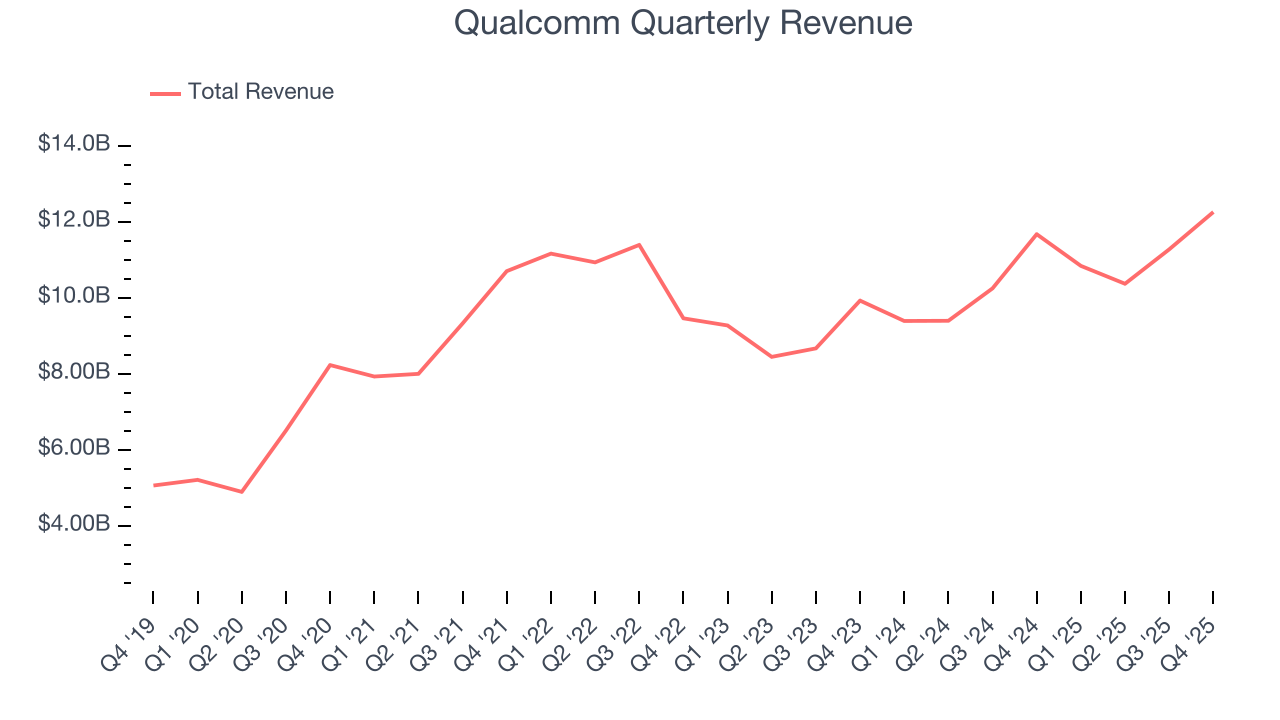
A company’s long-term sales performance can indicate its overall quality. Even a bad business can shine for one or two quarters, but a top-tier one grows for years. Luckily, Qualcomm’s sales grew at a solid 12.5% compounded annual growth rate over the last five years. Its growth beat the average semiconductor company and shows its offerings resonate with customers, a helpful starting point for our analysis. Semiconductors are a cyclical industry, and long-term investors should be prepared for periods of high growth followed by periods of revenue contractions.
Long-term growth is the most important, but short-term results matter for semiconductors because the rapid pace of technological innovation (Moore's Law) could make yesterday's hit product obsolete today. Qualcomm’s annualized revenue growth of 11% over the last two years is below its five-year trend, but we still think the results suggest healthy demand. 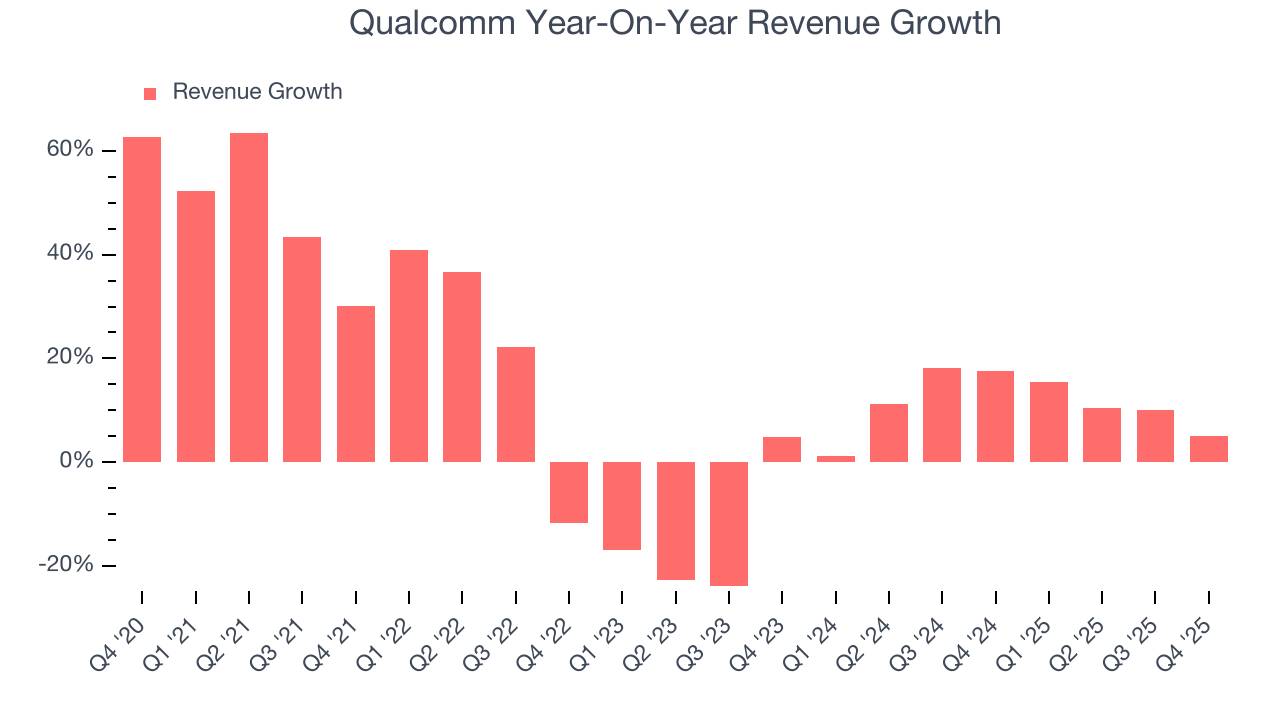
This quarter, Qualcomm grew its revenue by 5% year on year, and its $12.25 billion of revenue was in line with Wall Street’s estimates. Beyond meeting estimates, this marks 9 straight quarters of growth, showing that the current upcycle has had a good run - a typical upcycle usually lasts 8-10 quarters. Company management is currently guiding for a 2.2% year-on-year decline in sales next quarter.
Looking further ahead, sell-side analysts expect revenue to remain flat over the next 12 months, a deceleration versus the last two years. This projection doesn't excite us and suggests its products and services will face some demand challenges. At least the company is tracking well in other measures of financial health.
6. Product Demand & Outstanding Inventory
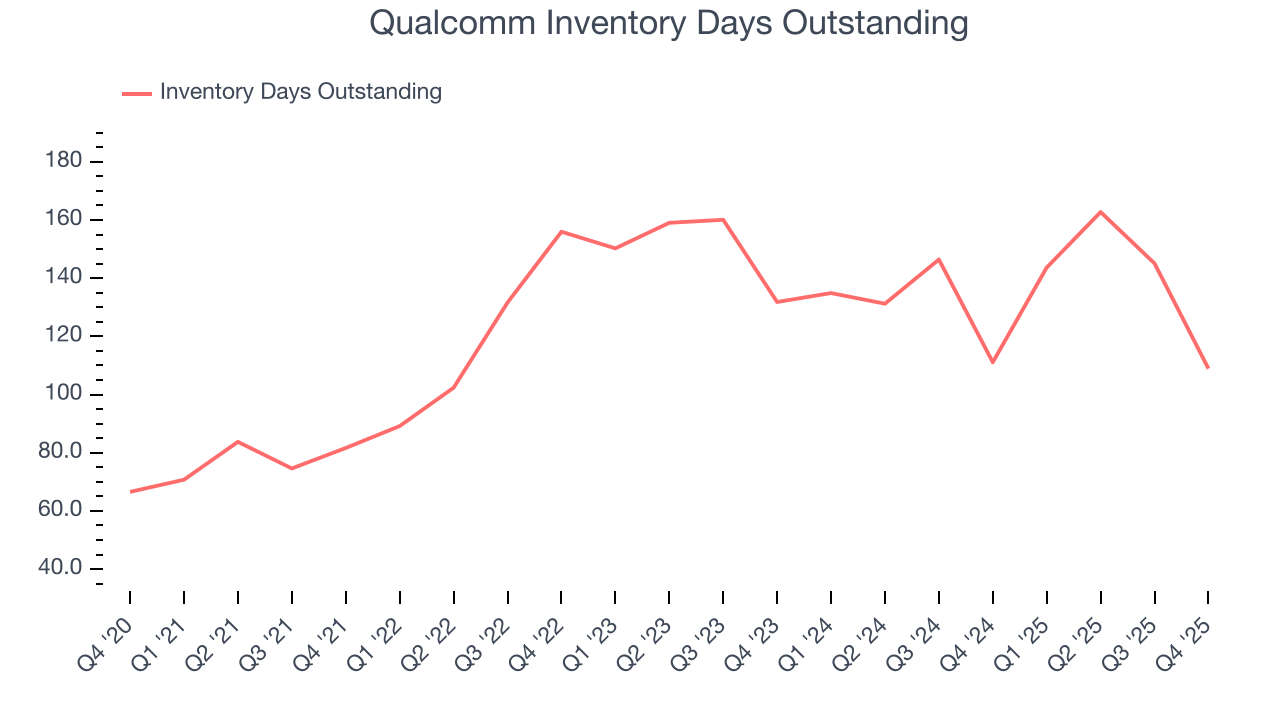
Days Inventory Outstanding (DIO) is an important metric for chipmakers, as it reflects a business’ capital intensity and the cyclical nature of semiconductor supply and demand. In a tight supply environment, inventories tend to be stable, allowing chipmakers to exert pricing power. Steadily increasing DIO can be a warning sign that demand is weak, and if inventories continue to rise, the company may have to downsize production.
This quarter, Qualcomm’s DIO came in at 109, which is 15 days below its five-year average. At the moment, these numbers show no indication of an excessive inventory buildup.
7. Gross Margin & Pricing Power
In the semiconductor industry, a company’s gross profit margin is a critical metric to track because it sheds light on its pricing power, complexity of products, and ability to procure raw materials, equipment, and labor.
Qualcomm’s gross margin is well ahead of its semiconductor peers, and its strong pricing power is an output of its differentiated, value-add products. As you can see below, it averaged an excellent 55.4% gross margin over the last two years. Said differently, roughly $55.45 was left to spend on selling, marketing, R&D, and general administrative overhead for every $100 in revenue. 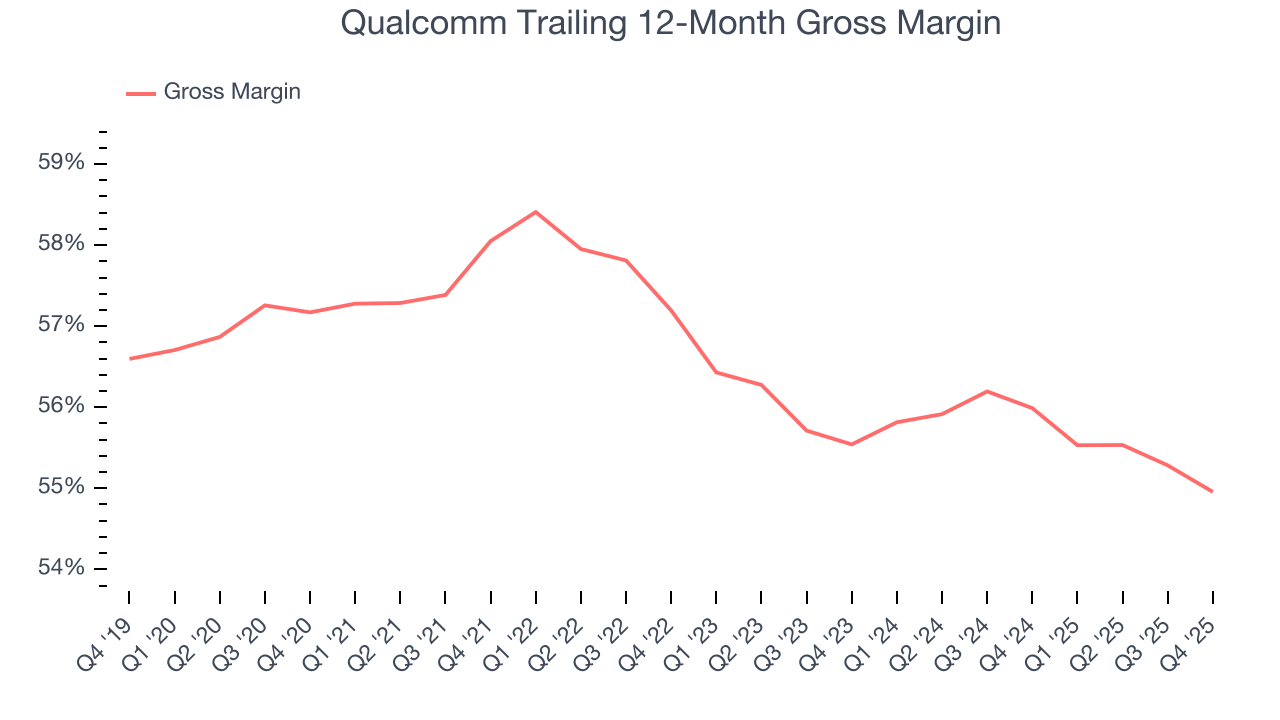
Qualcomm produced a 54.6% gross profit margin in Q4, marking a 1.2 percentage point decrease from 55.8% in the same quarter last year. Qualcomm’s full-year margin has also been trending down over the past 12 months, decreasing by 1 percentage points. If this move continues, it could suggest a more competitive environment with some pressure to lower prices and higher input costs (such as raw materials and manufacturing expenses).
8. Operating Margin
Operating margin is one of the best measures of profitability because it tells us how much money a company takes home after procuring and manufacturing its products, marketing and selling those products, and most importantly, keeping them relevant through research and development.
Qualcomm has been an efficient company over the last two years. It was one of the more profitable businesses in the semiconductor sector, boasting an average operating margin of 26.8%. This result isn’t surprising as its high gross margin gives it a favorable starting point.
Analyzing the trend in its profitability, Qualcomm’s operating margin decreased by 3.8 percentage points over the last five years. This raises questions about the company’s expense base because its revenue growth should have given it leverage on its fixed costs, resulting in better economies of scale and profitability.
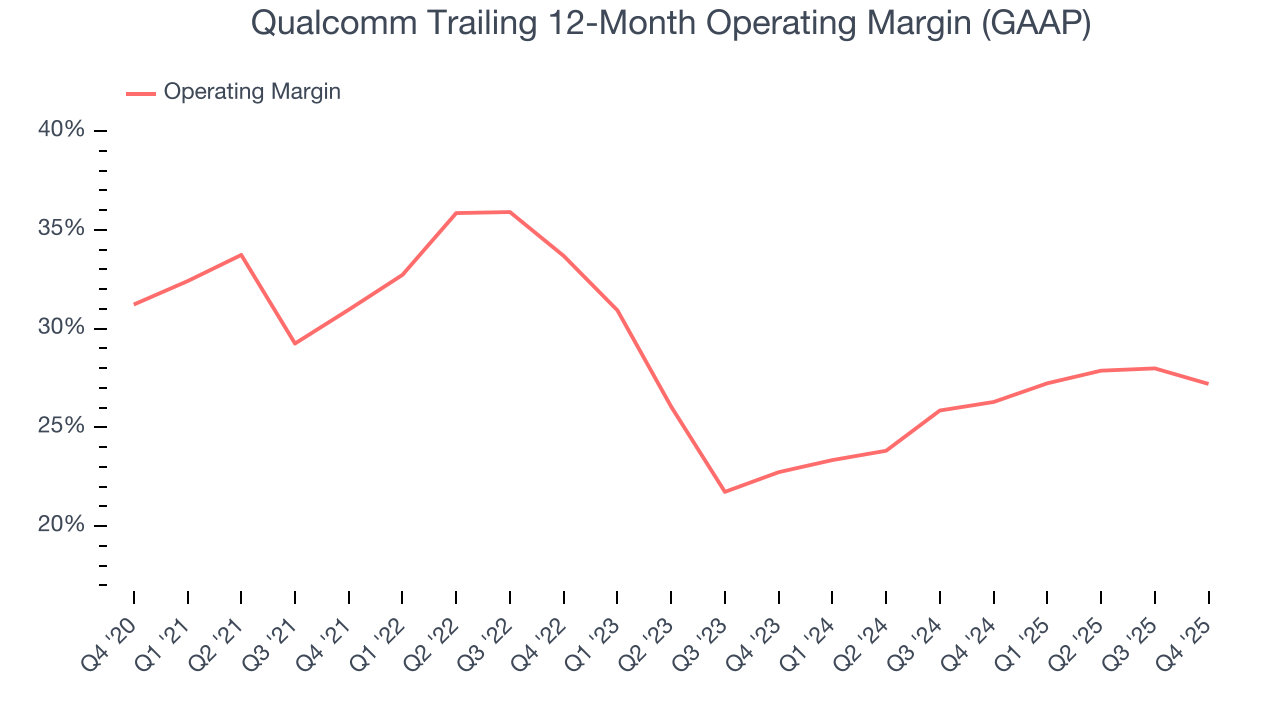
This quarter, Qualcomm generated an operating margin profit margin of 27.5%, down 3 percentage points year on year. Since Qualcomm’s operating margin decreased more than its gross margin, we can assume it was less efficient because expenses such as marketing, R&D, and administrative overhead increased.
9. Earnings Per Share
We track the long-term change in earnings per share (EPS) for the same reason as long-term revenue growth. Compared to revenue, however, EPS highlights whether a company’s growth is profitable.
Qualcomm’s EPS grew at a decent 17.7% compounded annual growth rate over the last five years, higher than its 12.5% annualized revenue growth. However, this alone doesn’t tell us much about its business quality because its operating margin didn’t improve.
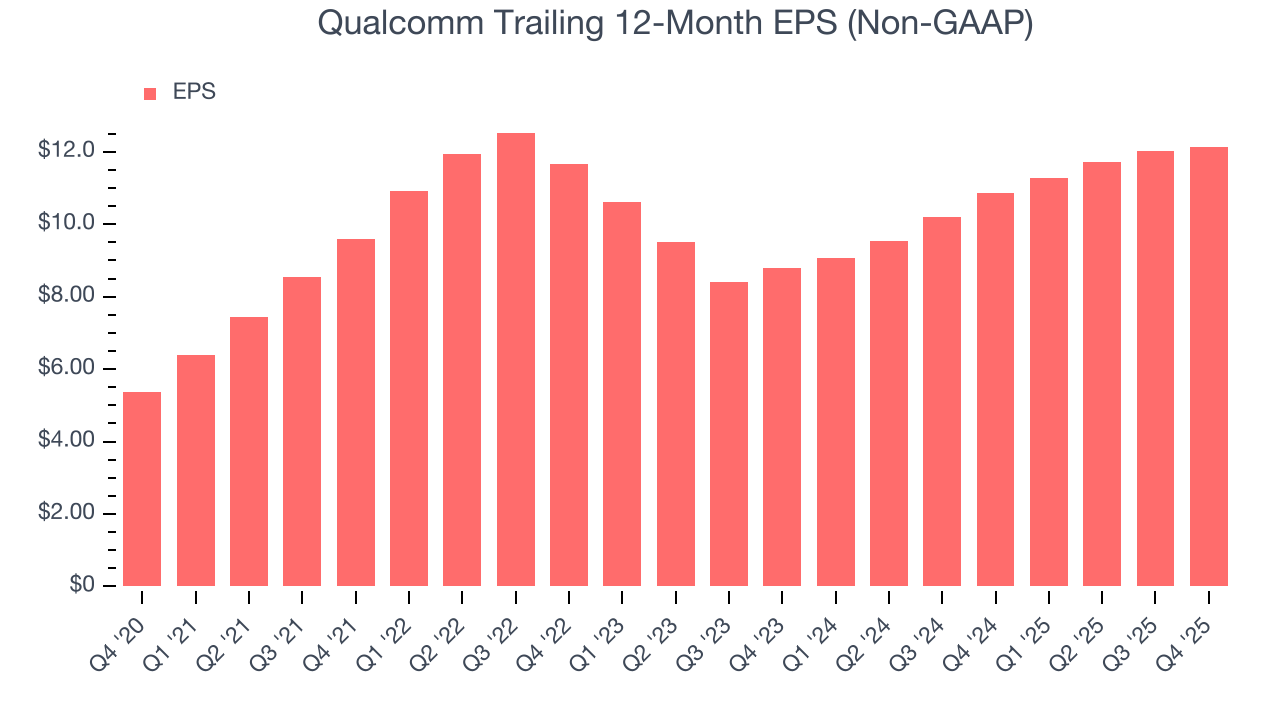
We can take a deeper look into Qualcomm’s earnings quality to better understand the drivers of its performance. A five-year view shows that Qualcomm has repurchased its stock, shrinking its share count by 6.7%. This tells us its EPS outperformed its revenue not because of increased operational efficiency but financial engineering, as buybacks boost per share earnings. 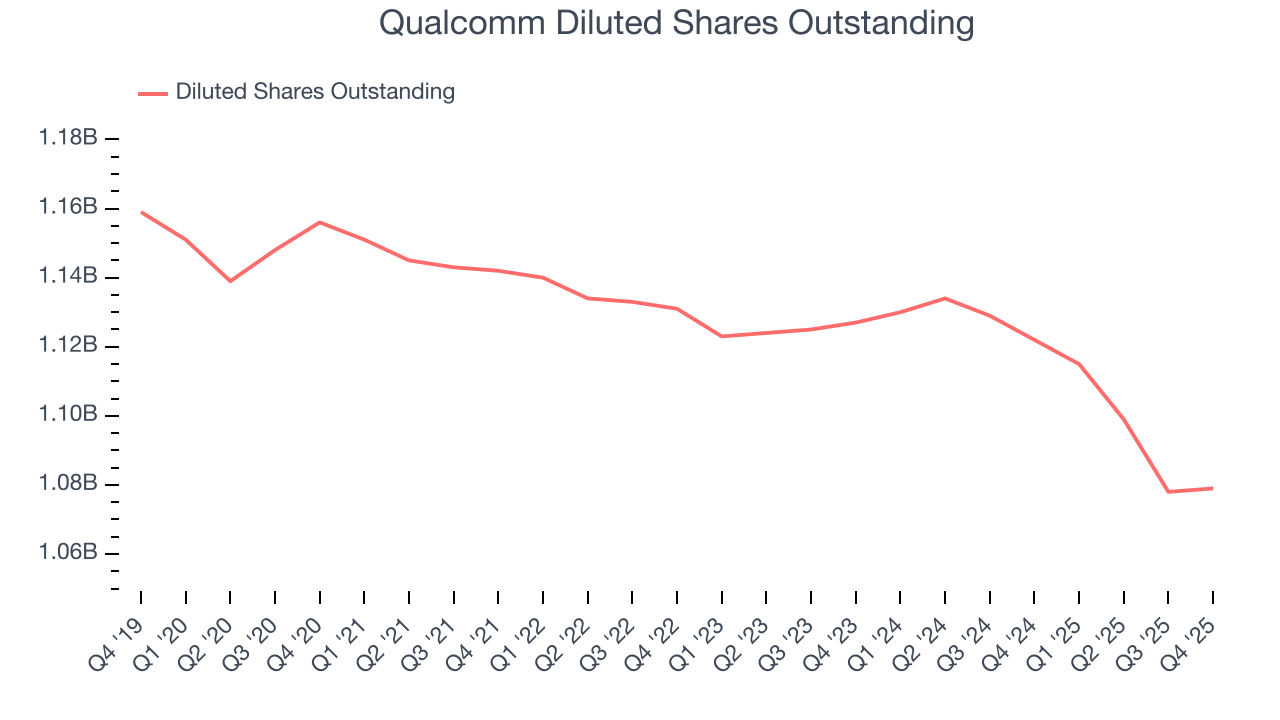
In Q4, Qualcomm reported adjusted EPS of $3.50, up from $3.41 in the same quarter last year. This print beat analysts’ estimates by 2.9%. Over the next 12 months, Wall Street expects Qualcomm’s full-year EPS of $12.12 to shrink by 3.6%.
10. Cash Is King
Although earnings are undoubtedly valuable for assessing company performance, we believe cash is king because you can’t use accounting profits to pay the bills.
Qualcomm has shown terrific cash profitability, and if sustainable, puts it in an advantageous position to invest in new products, return capital to investors, and consolidate the market during industry downturns. The company’s free cash flow margin was among the best in the semiconductor sector, averaging an eye-popping 30% over the last two years.
Taking a step back, we can see that Qualcomm’s margin expanded by 8.3 percentage points over the last five years. This is encouraging, and we can see it became a less capital-intensive business because its free cash flow profitability rose while its operating profitability fell.
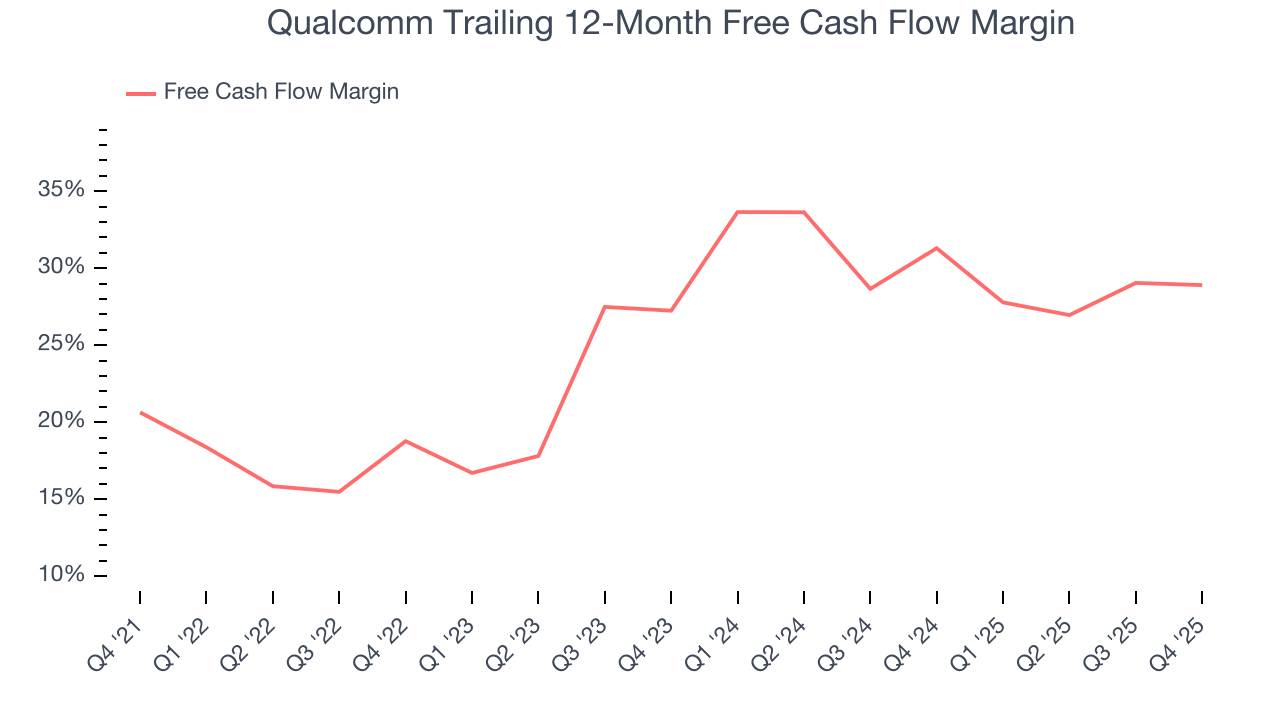
Qualcomm’s free cash flow clocked in at $4.42 billion in Q4, equivalent to a 36% margin. This cash profitability was in line with the comparable period last year and above its two-year average.
11. Return on Invested Capital (ROIC)
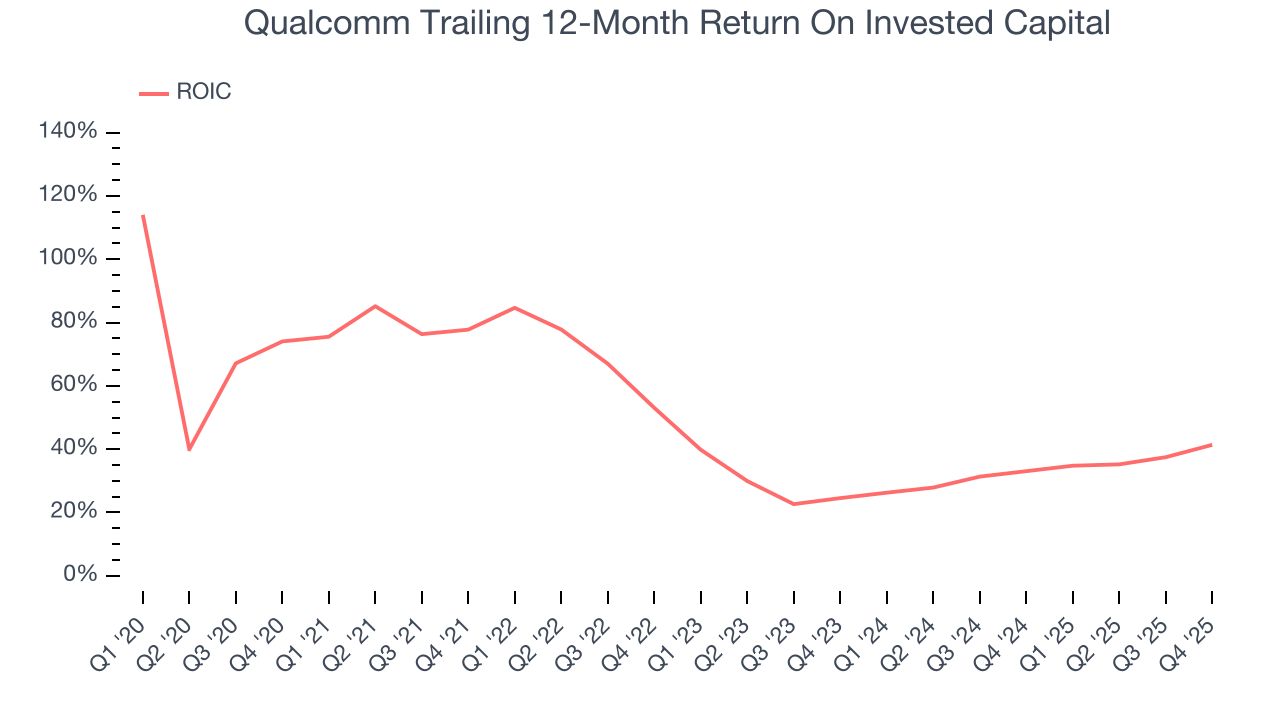
EPS and free cash flow tell us whether a company was profitable while growing its revenue. But was it capital-efficient? A company’s ROIC explains this by showing how much operating profit it makes compared to the money it has raised (debt and equity).
Qualcomm’s five-year average ROIC was 46%, placing it among the best semiconductor companies. This illustrates its management team’s ability to invest in highly profitable ventures and produce tangible results for shareholders.
12. Key Takeaways from Qualcomm’s Q4 Results
We were impressed by Qualcomm’s strong improvement in inventory levels. We were also happy its adjusted operating income outperformed Wall Street’s estimates. On the other hand, its revenue guidance for next quarter missed. Zooming out, we think this was a mixed quarter. Investors were likely hoping for more, and shares traded down 7.7% to $134.29 immediately after reporting.
13. Is Now The Time To Buy Qualcomm?
Updated: February 4, 2026 at 4:37 PM EST
The latest quarterly earnings matters, sure, but we actually think longer-term fundamentals and valuation matter more. Investors should consider all these pieces before deciding whether or not to invest in Qualcomm.
Qualcomm possesses a number of positive attributes. To kick things off, its revenue growth was solid over the last five years. And while Qualcomm’s projected EPS for the next year is lacking, its powerful free cash flow generation enables it to stay ahead of the competition through consistent reinvestment of profits.
Qualcomm’s P/E ratio based on the next 12 months is 12.7x. Looking at the semiconductor space right now, Qualcomm trades at a compelling valuation. If you believe in the company and its growth potential, now is an opportune time to buy shares.
Wall Street analysts have a consensus one-year price target of $187.69 on the company (compared to the current share price of $134.29), implying they see 39.6% upside in buying Qualcomm in the short term.