
Red Robin (RRGB)
We wouldn’t recommend Red Robin. Not only did its demand evaporate but also its negative returns on capital show it destroyed shareholder value.― StockStory Analyst Team


1. News





2. Summary
Why We Think Red Robin Will Underperform
Known for its bottomless steak fries, Red Robin (NASDAQ:RRGB) is a chain of casual restaurants specializing in burgers and general American fare.
- Annual revenue declines of 1.2% over the last six years indicate problems with its market positioning
- Forecasted revenue decline of 5.7% for the upcoming 12 months implies demand will fall even further
- 9× net-debt-to-EBITDA ratio makes lenders less willing to extend additional capital, potentially necessitating dilutive equity offerings
Red Robin is in the penalty box. We see more favorable opportunities in the market.
Why There Are Better Opportunities Than Red Robin





Red Robin’s stock price of $4.10 implies a valuation ratio of 9.1x forward EV-to-EBITDA. Yes, this valuation multiple is lower than that of other restaurant peers, but we’ll remind you that you often get what you pay for.
Cheap stocks can look like a great deal at first glance, but they can be value traps. They often have less earnings power, meaning there is more reliance on a re-rating to generate good returns - an unlikely scenario for low-quality companies.
3. Red Robin (RRGB) Research Report: Q3 CY2025 Update
Burger restaurant chain Red Robin (NASDAQ:RRGB) announced better-than-expected revenue in Q3 CY2025, but sales fell by 3.5% year on year to $265.1 million. The company expects the full year’s revenue to be around $1.2 billion, close to analysts’ estimates. Its non-GAAP loss of $0.70 per share was 10% above analysts’ consensus estimates.
Red Robin (RRGB) Q3 CY2025 Highlights:
- Revenue: $265.1 million vs analyst estimates of $256.7 million (3.5% year-on-year decline, 3.3% beat)
- Adjusted EPS: -$0.70 vs analyst estimates of -$0.78 (10% beat)
- Adjusted EBITDA: $7.6 million vs analyst estimates of $4.41 million (2.9% margin, 72.3% beat)
- The company reconfirmed its revenue guidance for the full year of $1.2 billion at the midpoint
- EBITDA guidance for the full year is $65 million at the midpoint, above analyst estimates of $62.89 million
- Operating Margin: -4.6%, in line with the same quarter last year
- Same-Store Sales fell 1.2% year on year (0.6% in the same quarter last year)
- Market Capitalization: $84 million
Company Overview
Known for its bottomless steak fries, Red Robin (NASDAQ:RRGB) is a chain of casual restaurants specializing in burgers and general American fare.
Initially started as a tavern called Sam’s, Red Robin Gourmet Burgers was founded in 1969 in Seattle, Washington. Today, the chain boasts a vast, customizable burger menu that includes everything from classic cheeseburgers to the daring Banzai burger featuring a Teriyaki-glazed patty topped with sweet grilled pineapple. For those who don’t love burgers, Red Robin also offers chicken entrees, salads, and kids’ meals such as corn dogs.
The core Red Robin customer is the everyday American family looking to celebrate a birthday, a little league victory, or a job promotion. With its reasonable prices for a sit-down restaurant, it can also serve as the destination for a family’s Thursday night dinner as well.
When you walk into a Red Robin, you'll typically find a spacious, lively setup. On average, these establishments cover anywhere from 4,000 to 5,500 square feet. Red Robin locations have ample seating, often using a mix of booths, tables, and a bar area, allowing for both intimate dinners and larger gatherings. To complete the look, there are typically bright colors (especially Red Robin’s signature red, warm woods, and playful memorabilia.
4. Sit-Down Dining
Sit-down restaurants offer a complete dining experience with table service. These establishments span various cuisines and are renowned for their warm hospitality and welcoming ambiance, making them perfect for family gatherings, special occasions, or simply unwinding. Their extensive menus range from appetizers to indulgent desserts and wines and cocktails. This space is extremely fragmented and competition includes everything from publicly-traded companies owning multiple chains to single-location mom-and-pop restaurants.
Competitors offering burgers and American fare in a sit-down restaurant format include Chili’s owner Brinker International (NYSE:EAT), Applebee’s owner Dine Brands (NYSE:DIN), Texas Roadhouse (NASDAQ:TXRH), and The Cheesecake Factory (NASDAQ:CAKE).
5. Revenue Growth
A company’s long-term performance is an indicator of its overall quality. Any business can put up a good quarter or two, but the best consistently grow over the long haul.
With $1.23 billion in revenue over the past 12 months, Red Robin is a mid-sized restaurant chain, which sometimes brings disadvantages compared to larger competitors benefiting from better brand awareness and economies of scale.
As you can see below, Red Robin’s revenue declined by 1.2% per year over the last six years (we compare to 2019 to normalize for COVID-19 impacts), a poor baseline for our analysis.
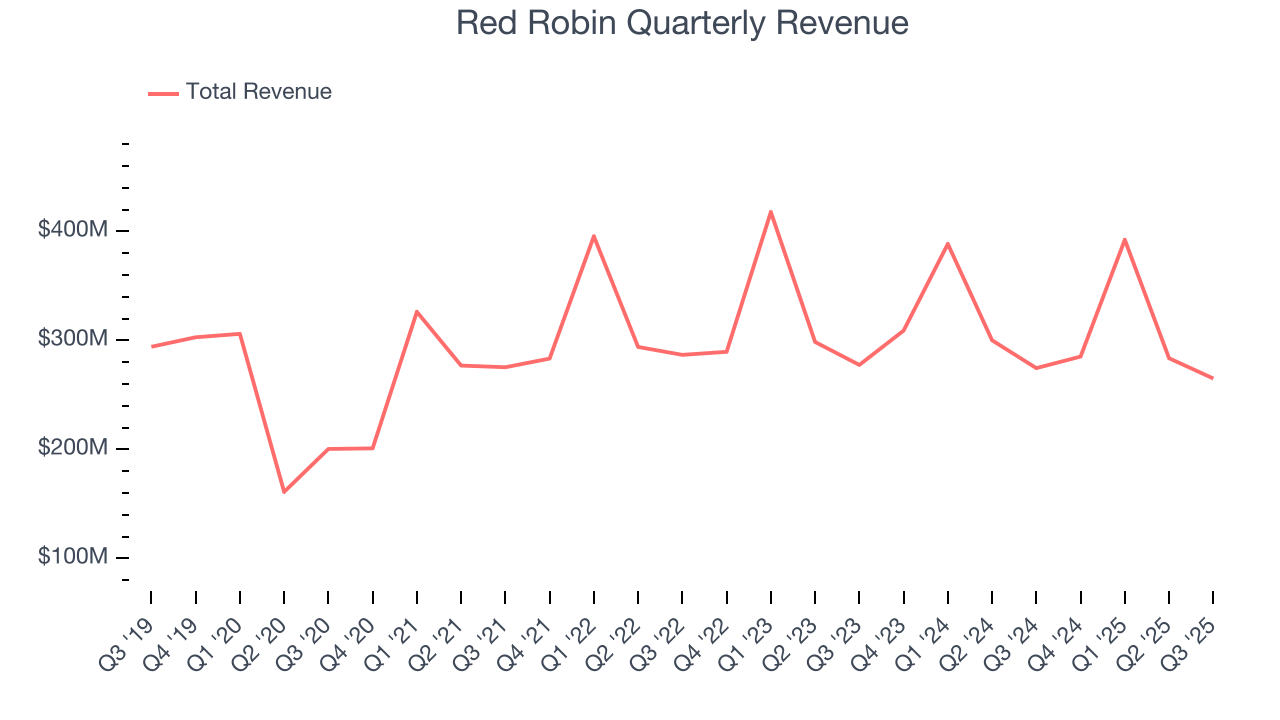
This quarter, Red Robin’s revenue fell by 3.5% year on year to $265.1 million but beat Wall Street’s estimates by 3.3%.
Looking ahead, sell-side analysts expect revenue to decline by 5% over the next 12 months, a deceleration versus the last six years. This projection doesn't excite us and implies its menu offerings will face some demand challenges.
6. Same-Store Sales
Same-store sales is an industry measure of whether revenue is growing at existing restaurants, and it is driven by customer visits (often called traffic) and the average spending per customer (ticket).
Red Robin’s demand within its existing dining locations has barely increased over the last two years as its same-store sales were flat.
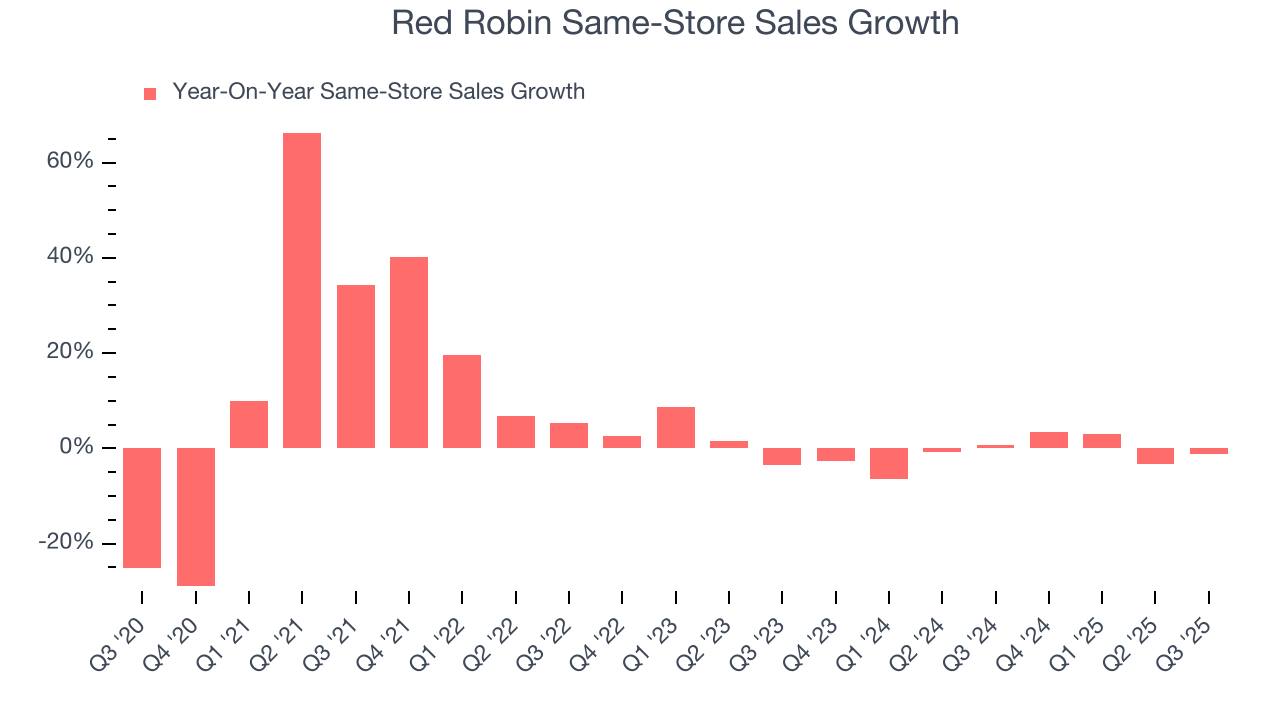
In the latest quarter, Red Robin’s same-store sales fell by 1.2% year on year. This performance was more or less in line with its historical levels.
7. Gross Margin & Pricing Power
Red Robin has bad unit economics for a restaurant company, signaling it operates in a competitive market and has little room for error if demand unexpectedly falls. As you can see below, it averaged a 13.5% gross margin over the last two years. Said differently, Red Robin had to pay a chunky $86.46 to its suppliers for every $100 in revenue. 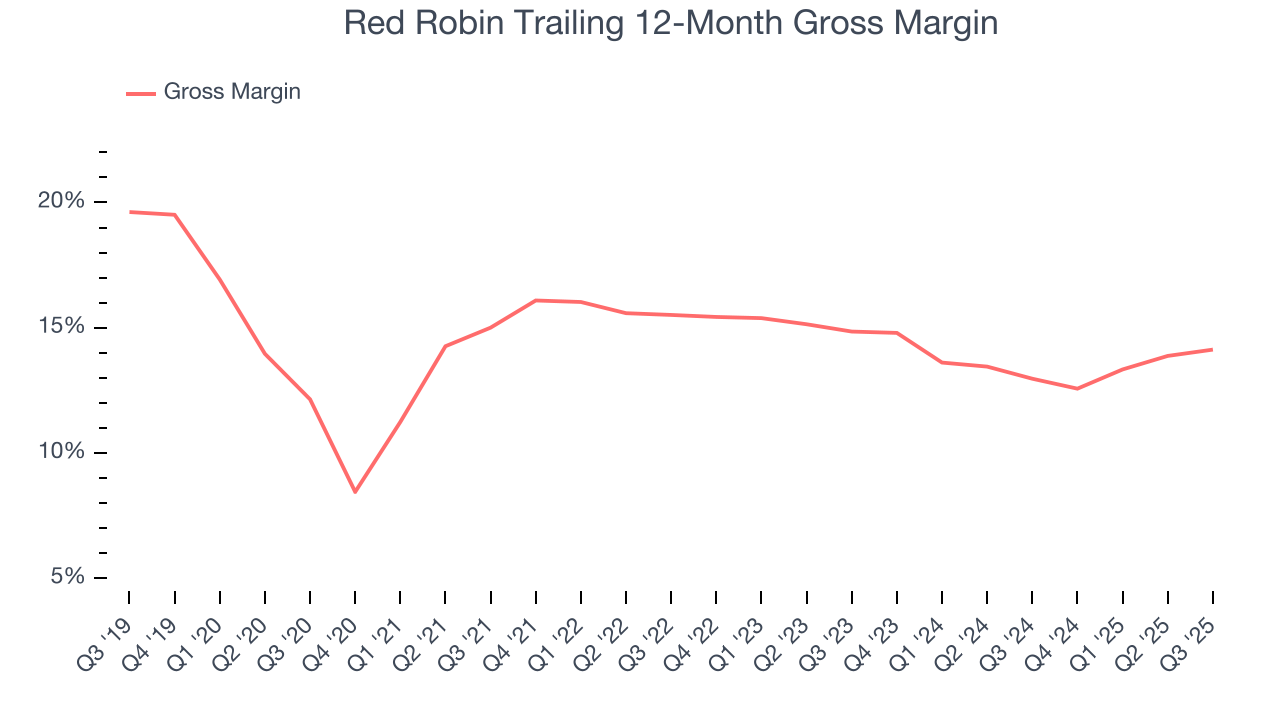
Red Robin produced a 11.3% gross profit margin in Q3, marking a 1 percentage point increase from 10.3% in the same quarter last year. Red Robin’s full-year margin has also been trending up over the past 12 months, increasing by 1.2 percentage points. If this move continues, it could suggest better unit economics due to some combination of stable to improving pricing power and input costs (such as ingredients and transportation expenses).
8. Operating Margin
Red Robin was roughly breakeven when averaging the last two years of quarterly operating profits, one of the worst outcomes in the restaurant sector. This result isn’t too surprising given its low gross margin as a starting point.
On the plus side, Red Robin’s operating margin rose by 2.5 percentage points over the last year.
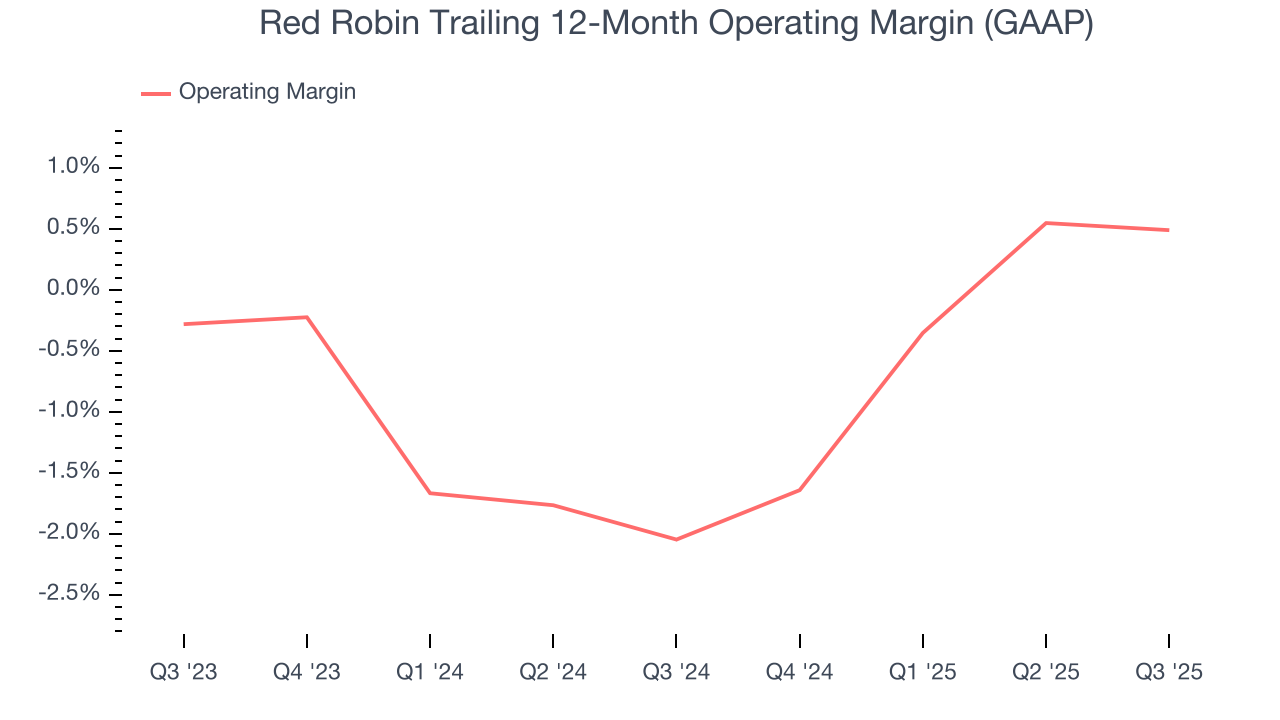
In Q3, Red Robin generated a negative 4.6% operating margin. The company's consistent lack of profits raise a flag.
9. Earnings Per Share
We track the long-term change in earnings per share (EPS) for the same reason as long-term revenue growth. Compared to revenue, however, EPS highlights whether a company’s growth is profitable.
Sadly for Red Robin, its EPS declined by 19% annually over the last six years, more than its revenue. This tells us the company struggled because its fixed cost base made it difficult to adjust to shrinking demand.
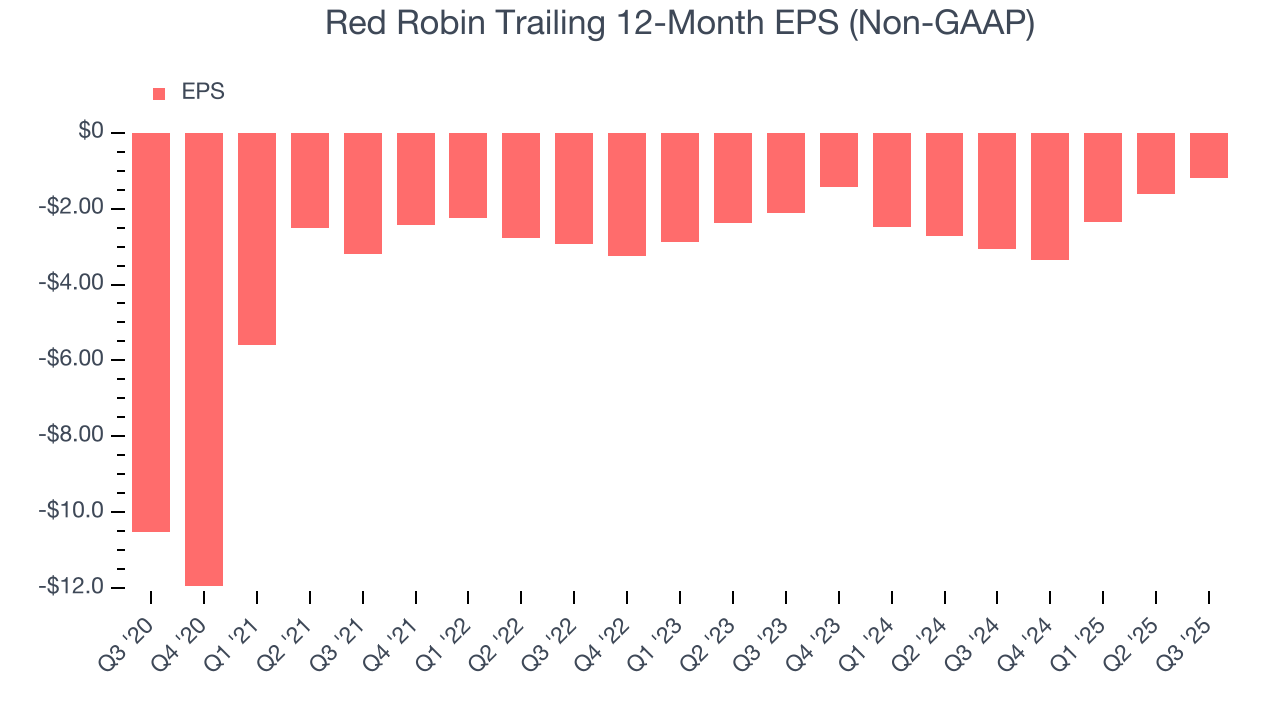
In Q3, Red Robin reported adjusted EPS of negative $0.70, up from negative $1.13 in the same quarter last year. This print beat analysts’ estimates by 10%. Over the next 12 months, Wall Street expects Red Robin to improve its earnings losses. Analysts forecast its full-year EPS of negative $1.19 will advance to negative $0.59.
10. Return on Invested Capital (ROIC)
Growth gives us insight into a company’s long-term potential, but how capital-efficient was that growth? A company’s ROIC explains this by showing how much operating profit it makes compared to the money it has raised (debt and equity).
Red Robin’s five-year average ROIC was negative 2.1%, meaning management lost money while trying to expand the business. Its returns were among the worst in the restaurant sector.
11. Balance Sheet Risk
As long-term investors, the risk we care about most is the permanent loss of capital, which can happen when a company goes bankrupt or raises money from a disadvantaged position. This is separate from short-term stock price volatility, something we are much less bothered by.
Red Robin’s $526.6 million of debt exceeds the $30.87 million of cash on its balance sheet. Furthermore, its 9× net-debt-to-EBITDA ratio (based on its EBITDA of $57.91 million over the last 12 months) shows the company is overleveraged.
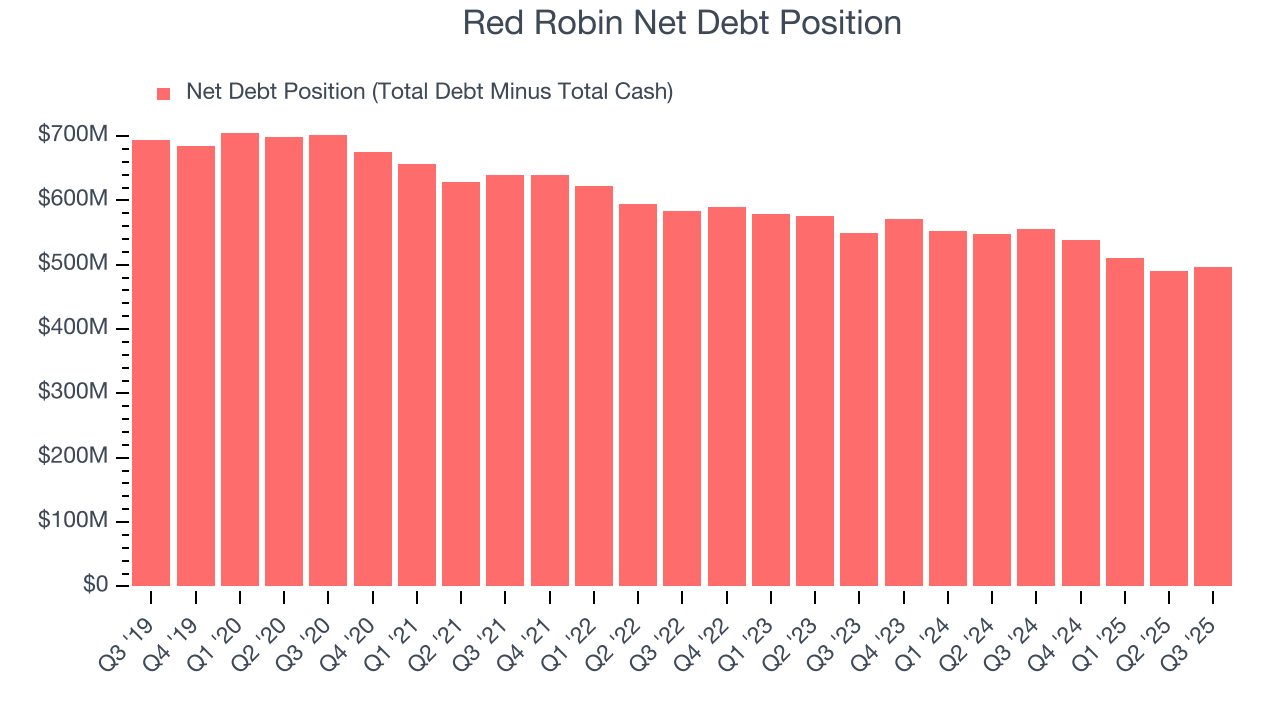
At this level of debt, incremental borrowing becomes increasingly expensive and credit agencies could downgrade the company’s rating if profitability falls. Red Robin could also be backed into a corner if the market turns unexpectedly – a situation we seek to avoid as investors in high-quality companies.
We hope Red Robin can improve its balance sheet and remain cautious until it increases its profitability or pays down its debt.
12. Key Takeaways from Red Robin’s Q3 Results
We were impressed by how significantly Red Robin blew past analysts’ EBITDA expectations this quarter. We were also excited its revenue outperformed Wall Street’s estimates by a wide margin. Zooming out, we think this was a good print with some key areas of upside. The stock traded up 13.8% to $5.35 immediately after reporting.
13. Is Now The Time To Buy Red Robin?
Updated: January 24, 2026 at 9:40 PM EST
When considering an investment in Red Robin, investors should account for its valuation and business qualities as well as what’s happened in the latest quarter.
We see the value of companies helping consumers, but in the case of Red Robin, we’re out. First off, its revenue has declined over the last six years, and analysts expect its demand to deteriorate over the next 12 months. On top of that, Red Robin’s declining EPS over the last six years makes it a less attractive asset to the public markets, and its relatively low ROIC suggests management has struggled to find compelling investment opportunities.
Red Robin’s EV-to-EBITDA ratio based on the next 12 months is 9.1x. At this valuation, there’s a lot of good news priced in - we think other companies feature superior fundamentals at the moment.
Wall Street analysts have a consensus one-year price target of $11.25 on the company (compared to the current share price of $4.10).
Although the price target is bullish, readers should exercise caution because analysts tend to be overly optimistic. The firms they work for, often big banks, have relationships with companies that extend into fundraising, M&A advisory, and other rewarding business lines. As a result, they typically hesitate to say bad things for fear they will lose out. We at StockStory do not suffer from such conflicts of interest, so we’ll always tell it like it is.