
Brown-Forman (BF.B)
We aren’t fans of Brown-Forman. Its plummeting sales and returns on capital show its profits are shrinking as demand fizzles out.― StockStory Analyst Team


1. News





2. Summary
Why We Think Brown-Forman Will Underperform
Best known for its Jack Daniel’s whiskey, Brown-Forman (NYSE:BF.B) is an alcoholic beverage company with a broad portfolio of brands in wines and spirits.
- Forecasted revenue decline of 4% for the upcoming 12 months implies demand will fall off a cliff
- Core business is underperforming as its organic revenue has disappointed over the past two years, suggesting it might need acquisitions to stimulate growth
- The good news is that its disciplined cost controls and effective management have materialized in a strong operating margin
Brown-Forman doesn’t pass our quality test. Better businesses are for sale in the market.
Why There Are Better Opportunities Than Brown-Forman







At $30.76 per share, Brown-Forman trades at 18.8x forward P/E. This multiple expensive for its subpar fundamentals.
We’d rather pay up for companies with elite fundamentals than get a decent price on a poor one. High-quality businesses often have more durable earnings power, helping us sleep well at night.
3. Brown-Forman (BF.B) Research Report: Q1 CY2025 Update
Alcohol company Brown-Forman (NYSE:BF.B) fell short of the market’s revenue expectations in Q1 CY2025, with sales falling 7.3% year on year to $894 million. Its GAAP profit of $0.31 per share was 7.4% below analysts’ consensus estimates.
Brown-Forman (BF.B) Q1 CY2025 Highlights:
- Revenue: $894 million vs analyst estimates of $969.8 million (7.3% year-on-year decline, 7.8% miss)
- EPS (GAAP): $0.31 vs analyst expectations of $0.33 (7.4% miss)
- Operating Margin: 22.9%, down from 38.9% in the same quarter last year
- Organic Revenue was down 3% year on year
- Market Capitalization: $15.68 billion
Company Overview
Best known for its Jack Daniel’s whiskey, Brown-Forman (NYSE:BF.B) is an alcoholic beverage company with a broad portfolio of brands in wines and spirits.
Aside from Jack Daniel’s, the company also goes to market with Woodford Reserve (bourbon), Finlandia (Vodka), Herradura and El Jimador (tequila), Sonoma-Cutrer Vineyards (wine), Korbel (champagne), and others. Brown-Forman’s history dates back to 1870, and some of its brands were developed and nurtured organically while others were acquired.
The core Brown-Forman customer is a discerning spirits and wine enthusiast. These customers value exceptional taste as well as authenticity and are not afraid to pay for it. Brown-Forman therefore uses quality ingredients and time-honored production techniques to meet these needs, and the company’s products are on the more premium end of the alcoholic beverage price spectrum.
Brown-Forman products can be found in a wide range of establishments. These include grocery stores that feature liquor and wine sections based on state regulations, liquor stores, premium retail outlets such as duty-free stores, and high-end restaurants and bars worldwide.
4. Beverages, Alcohol, and Tobacco
These companies' performance is influenced by brand strength, marketing strategies, and shifts in consumer preferences. Changing consumption patterns are particularly relevant and can be seen in the rise of cannabis, craft beer, and vaping or the steady decline of soda and cigarettes. Companies that spend on innovation to meet consumers where they are with regards to trends can reap huge demand benefits while those who ignore trends can see stagnant volumes. Finally, with the advent of the social media, the cost of starting a brand from scratch is much lower, meaning that new entrants can chip away at the market shares of established players.
Competitors in the alcohol, spirits, and wine space include Diageo (LSE:DGE), Pernod Ricard (ENXTPA:RI), and Constellation Brands (NYSE:STZ).
5. Sales Growth
Reviewing a company’s long-term sales performance reveals insights into its quality. Any business can experience short-term success, but top-performing ones enjoy sustained growth for years.
With $3.98 billion in revenue over the past 12 months, Brown-Forman carries some recognizable products but is a mid-sized consumer staples company. Its size could bring disadvantages compared to larger competitors benefiting from better brand awareness and economies of scale.
As you can see below, Brown-Forman struggled to increase demand as its $3.98 billion of sales for the trailing 12 months was close to its revenue three years ago. This shows demand was soft, a poor baseline for our analysis.
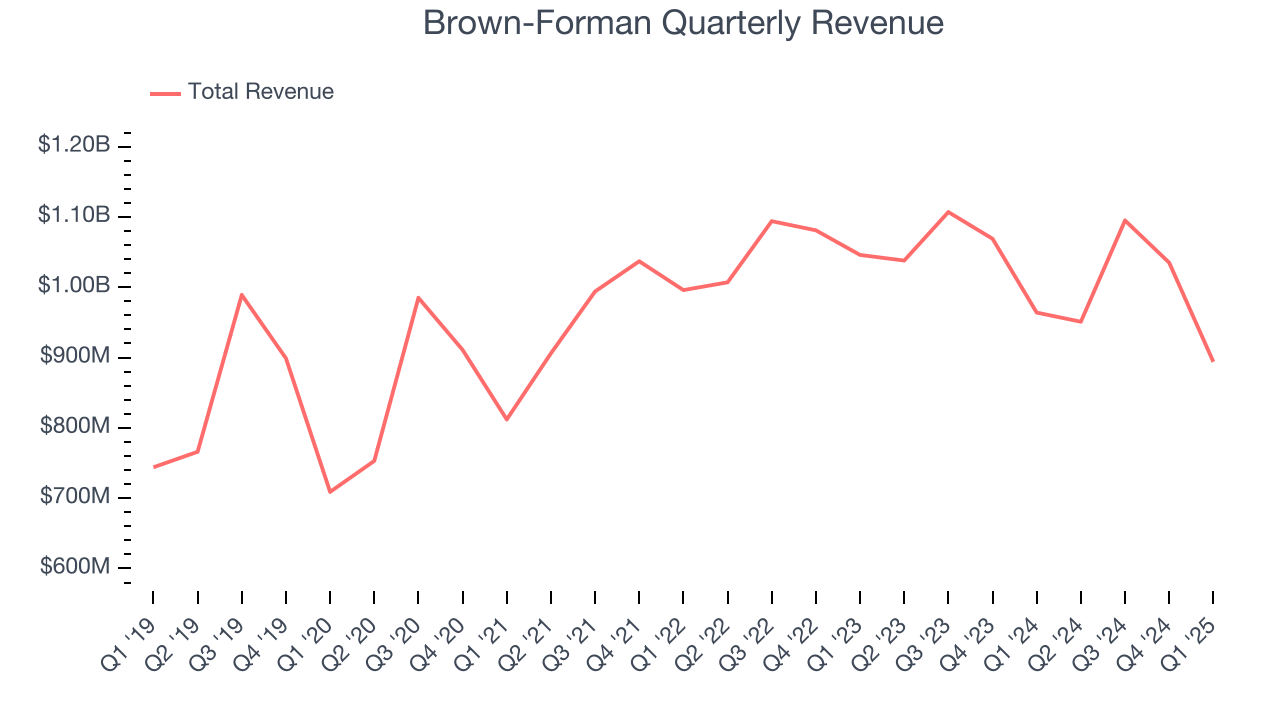
This quarter, Brown-Forman missed Wall Street’s estimates and reported a rather uninspiring 7.3% year-on-year revenue decline, generating $894 million of revenue.
Looking ahead, sell-side analysts expect revenue to grow 3.3% over the next 12 months. Although this projection implies its newer products will fuel better top-line performance, it is still below the sector average.
6. Gross Margin & Pricing Power
All else equal, we prefer higher gross margins because they make it easier to generate more operating profits and indicate that a company commands pricing power by offering more differentiated products.
Brown-Forman has best-in-class unit economics for a consumer staples company, enabling it to invest in areas such as marketing and talent to grow its brand. As you can see below, it averaged an elite 59.7% gross margin over the last two years. That means Brown-Forman only paid its suppliers $40.28 for every $100 in revenue. 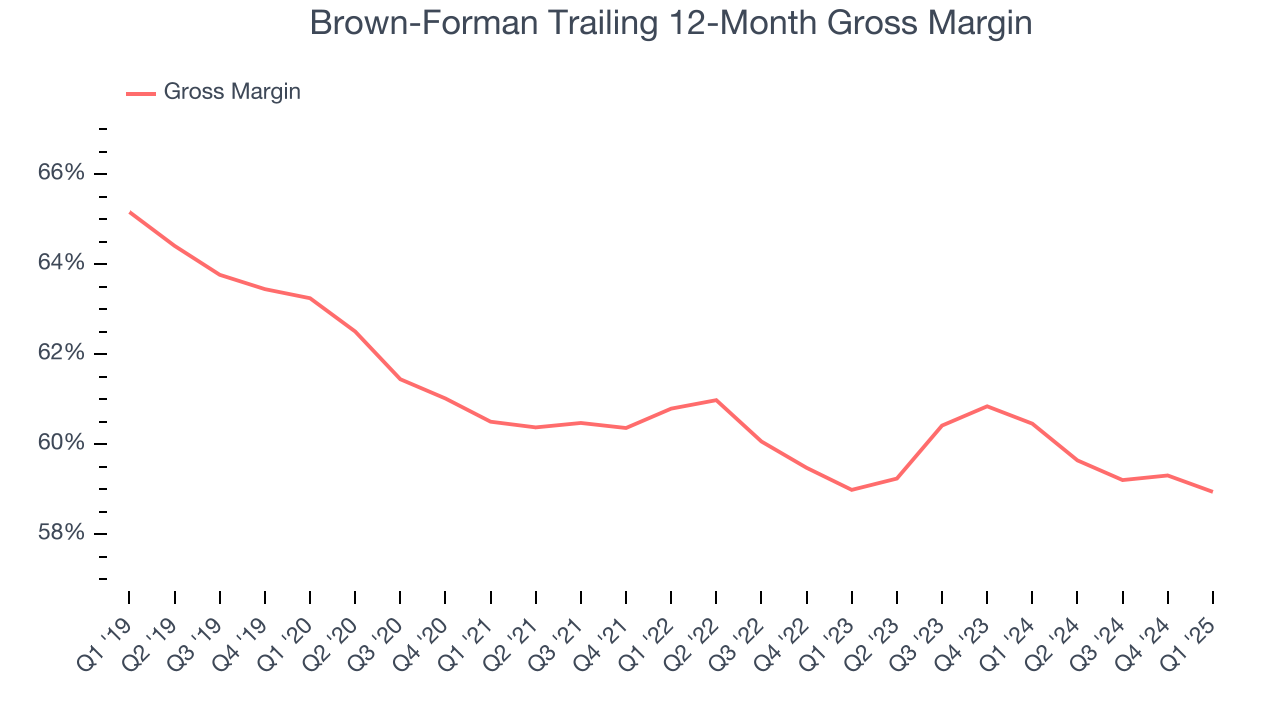
Brown-Forman produced a 57.4% gross profit margin in Q1, down 1.6 percentage points year on year and missing analysts’ estimates by 3.9%. Brown-Forman’s full-year margin has also been trending down over the past 12 months, decreasing by 1.5 percentage points. If this move continues, it could suggest a more competitive environment with some pressure to lower prices and higher input costs (such as raw materials and manufacturing expenses).
7. Operating Margin
Brown-Forman has been a well-oiled machine over the last two years. It demonstrated elite profitability for a consumer staples business, boasting an average operating margin of 30.9%. This result isn’t surprising as its high gross margin gives it a favorable starting point.
Looking at the trend in its profitability, Brown-Forman’s operating margin decreased by 6 percentage points over the last year. Even though its historical margin was healthy, shareholders will want to see Brown-Forman become more profitable in the future.
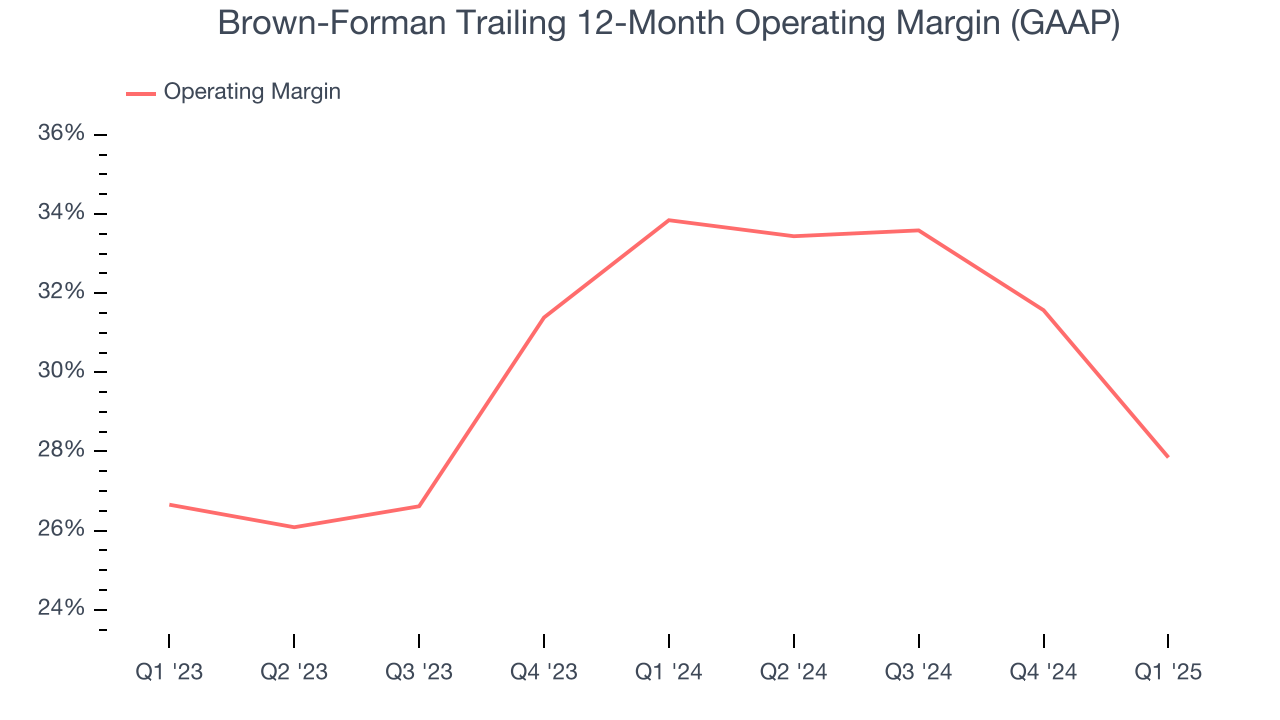
In Q1, Brown-Forman generated an operating margin profit margin of 22.9%, down 16 percentage points year on year. Since Brown-Forman’s operating margin decreased more than its gross margin, we can assume it was less efficient because expenses such as marketing, and administrative overhead increased.
8. Earnings Per Share
We track the change in earnings per share (EPS) for the same reason as long-term revenue growth. Compared to revenue, however, EPS highlights whether a company’s growth is profitable.
Brown-Forman’s EPS grew at an unimpressive 1.8% compounded annual growth rate over the last three years. This performance was better than its flat revenue but doesn’t tell us much about its business quality because its operating margin didn’t expand.
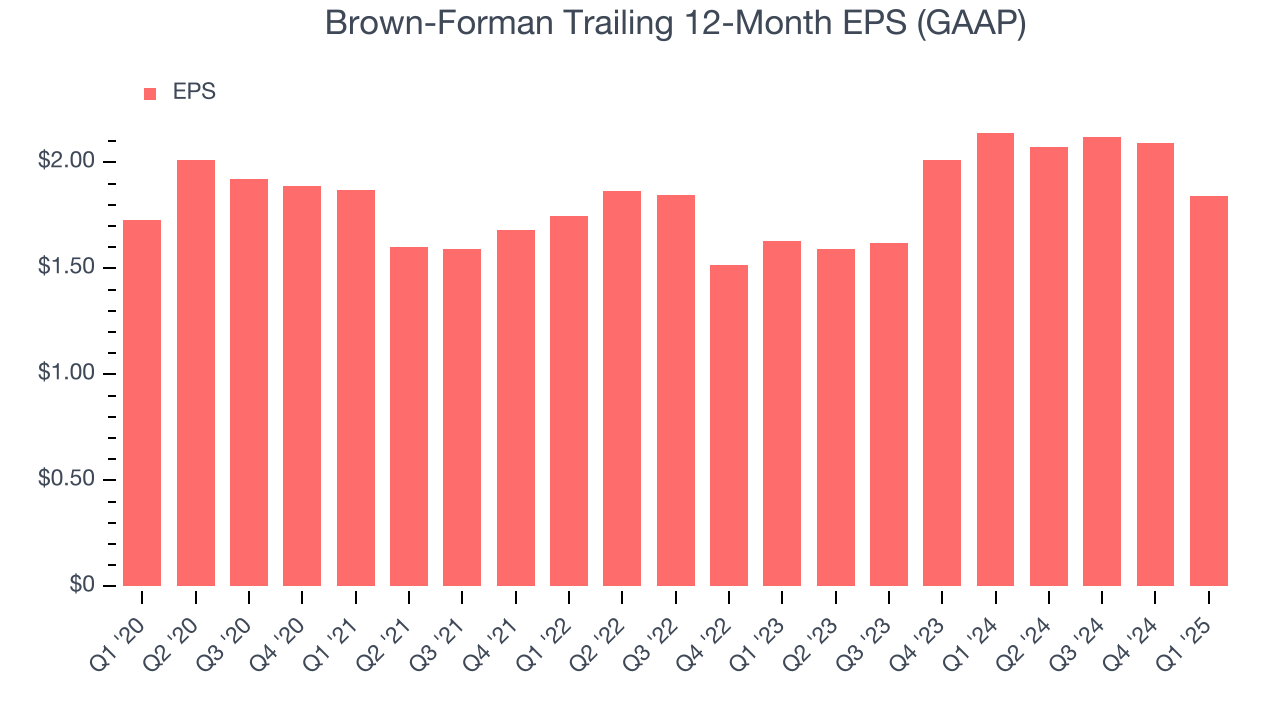
In Q1, Brown-Forman reported EPS at $0.31, down from $0.56 in the same quarter last year. This print missed analysts’ estimates. Over the next 12 months, Wall Street expects Brown-Forman’s full-year EPS of $1.84 to stay about the same.
9. Cash Is King
Free cash flow isn't a prominently featured metric in company financials and earnings releases, but we think it's telling because it accounts for all operating and capital expenses, making it tough to manipulate. Cash is king.
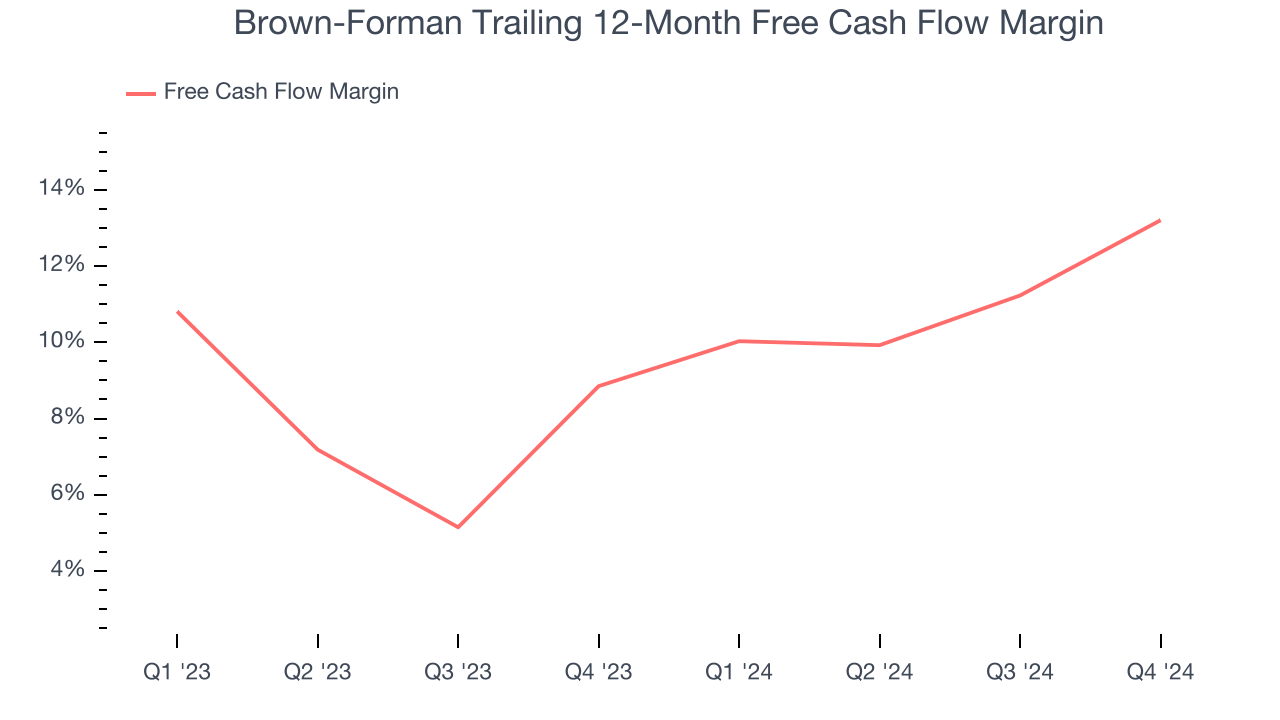
Brown-Forman has shown robust cash profitability, driven by its attractive business model that enables it to reinvest or return capital to investors. The company’s free cash flow margin averaged 10.3% over the last two years, quite impressive for a consumer staples business.
10. Return on Invested Capital (ROIC)
EPS and free cash flow tell us whether a company was profitable while growing its revenue. But was it capital-efficient? Enter ROIC, a metric showing how much operating profit a company generates relative to the money it has raised (debt and equity).
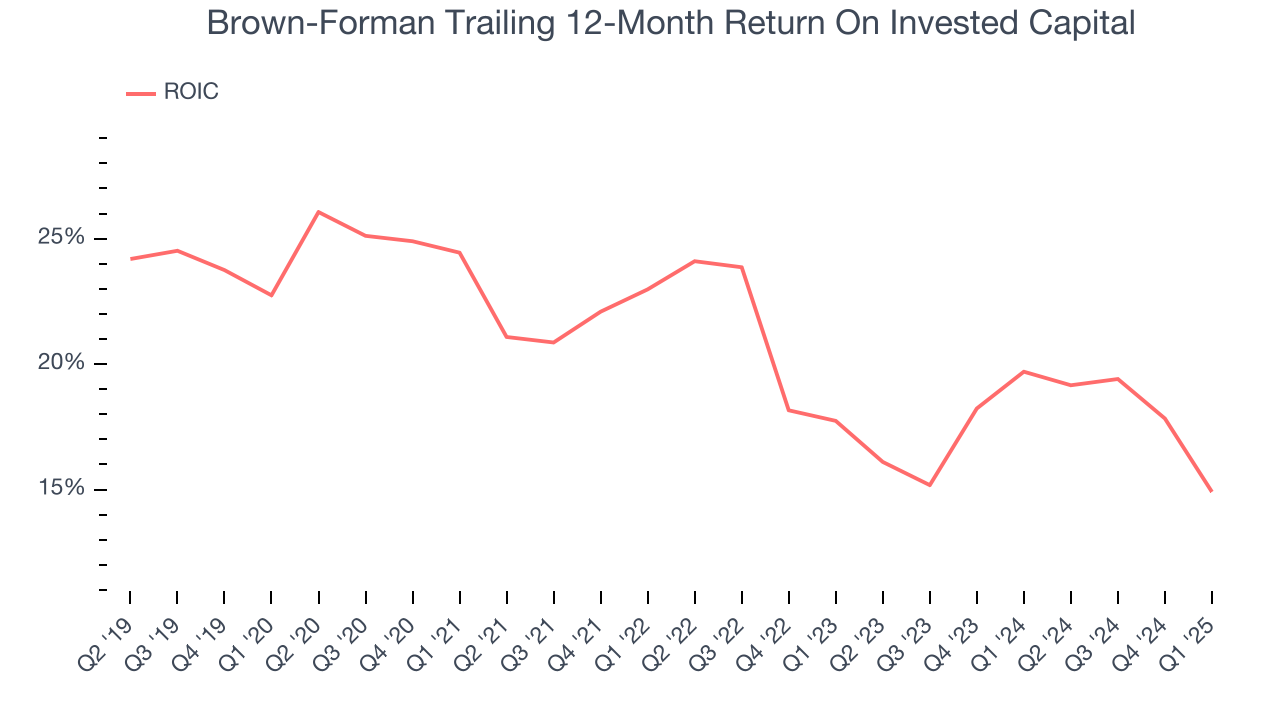
Although Brown-Forman hasn’t been the highest-quality company lately because of its poor top-line performance, it historically found a few growth initiatives that worked out well. Its five-year average ROIC was 20%, impressive for a consumer staples business.
11. Balance Sheet Assessment
Brown-Forman reported $444 million of cash and $2.73 billion of debt on its balance sheet in the most recent quarter. As investors in high-quality companies, we primarily focus on two things: 1) that a company’s debt level isn’t too high and 2) that its interest payments are not excessively burdening the business.
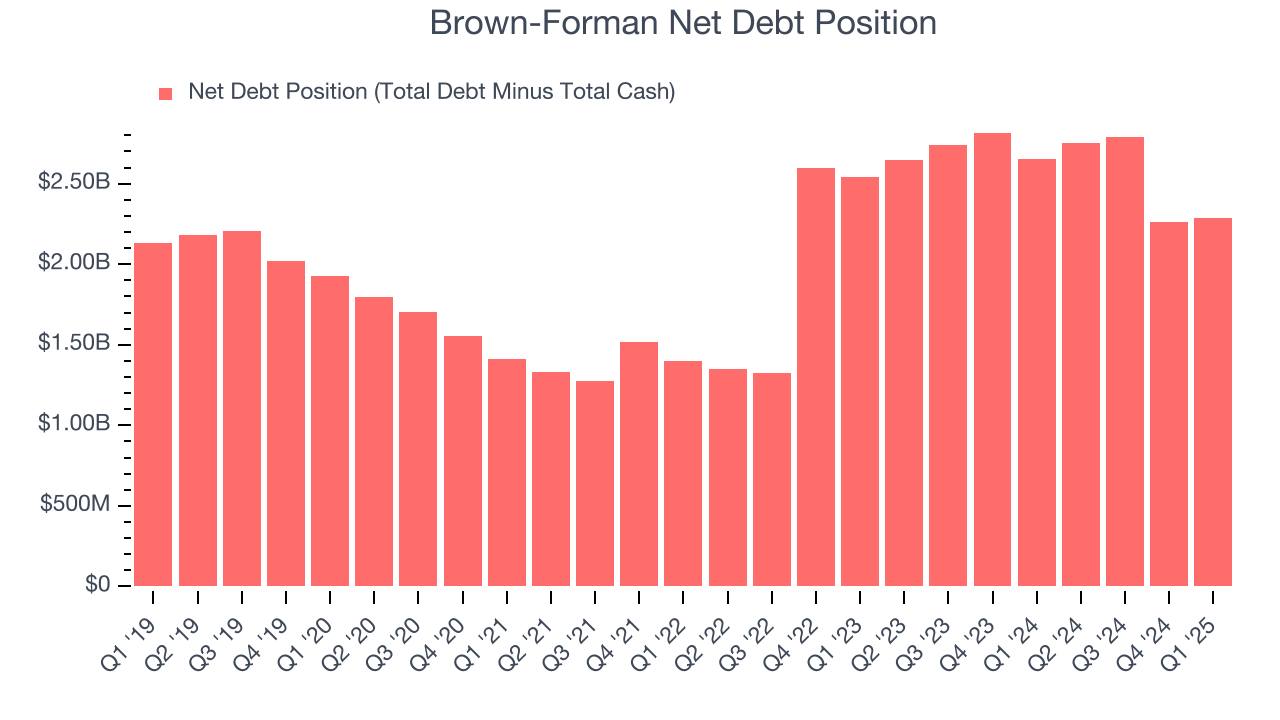
With $1.25 billion of EBITDA over the last 12 months, we view Brown-Forman’s 1.8× net-debt-to-EBITDA ratio as safe. We also see its $61 million of annual interest expenses as appropriate. The company’s profits give it plenty of breathing room, allowing it to continue investing in growth initiatives.
12. Key Takeaways from Brown-Forman’s Q1 Results
We struggled to find many positives in these results. Its revenue missed and its organic revenue fell short of Wall Street’s estimates. Overall, this quarter could have been better. The stock traded down 16.9% to $27.61 immediately following the results.
13. Is Now The Time To Buy Brown-Forman?
Updated: December 14, 2025 at 9:52 PM EST
We think that the latest earnings result is only one piece of the bigger puzzle. If you’re deciding whether to own Brown-Forman, you should also grasp the company’s longer-term business quality and valuation.
Brown-Forman isn’t a terrible business, but it isn’t one of our picks. First off, its revenue growth was weak over the last three years, and analysts expect its demand to deteriorate over the next 12 months. And while its impressive operating margins show it has a highly efficient business model, the downside is its projected EPS for the next year is lacking. On top of that, its declining operating margin shows the business has become less efficient.
Brown-Forman’s P/E ratio based on the next 12 months is 18.8x. Investors with a higher risk tolerance might like the company, but we don’t really see a big opportunity at the moment. We're fairly confident there are better stocks to buy right now.
Wall Street analysts have a consensus one-year price target of $30.80 on the company (compared to the current share price of $30.76).