
Kennametal (KMT)
Kennametal is in for a bumpy ride. Its weak sales growth and low returns on capital show it struggled to generate demand and profits.― StockStory Analyst Team


1. News






2. Summary
Why We Think Kennametal Will Underperform
Involved in manufacturing hard tips of anti-tank projectiles in World War II, Kennametal (NYSE:KMT) is a provider of industrial materials and tools for various sectors.
- Annual sales declines of 2.3% for the past two years show its products and services struggled to connect with the market during this cycle
- Performance over the past two years shows each sale was less profitable as its earnings per share dropped by 4.7% annually, worse than its revenue
- Organic sales performance over the past two years indicates the company may need to make strategic adjustments or rely on M&A to catalyze faster growth
Kennametal’s quality is not up to our standards. You should search for better opportunities.
Why There Are Better Opportunities Than Kennametal








At $34.44 per share, Kennametal trades at 20.6x forward P/E. Yes, this valuation multiple is lower than that of other industrials peers, but we’ll remind you that you often get what you pay for.
Cheap stocks can look like great bargains at first glance, but you often get what you pay for. These mediocre businesses often have less earnings power, meaning there is more reliance on a re-rating to generate good returns - an unlikely scenario for low-quality companies.
3. Kennametal (KMT) Research Report: Q3 CY2025 Update
Industrial materials and tools company Kennametal (NYSE:KMT) reported Q3 CY2025 results exceeding the market’s revenue expectations, with sales up 3.3% year on year to $498 million. On top of that, next quarter’s revenue guidance ($510 million at the midpoint) was surprisingly good and 4.7% above what analysts were expecting. Its non-GAAP profit of $0.34 per share was 44.6% above analysts’ consensus estimates.
Kennametal (KMT) Q3 CY2025 Highlights:
- Revenue: $498 million vs analyst estimates of $477.3 million (3.3% year-on-year growth, 4.3% beat)
- Adjusted EPS: $0.34 vs analyst estimates of $0.24 (44.6% beat)
- The company lifted its revenue guidance for the full year to $2.14 billion at the midpoint from $2 billion, a 6.8% increase
- Management raised its full-year Adjusted EPS guidance to $1.50 at the midpoint, a 36.4% increase
- Operating Margin: 7.5%, in line with the same quarter last year
- Free Cash Flow was -$5.50 million, down from $21.09 million in the same quarter last year
- Organic Revenue rose 3% year on year vs analyst estimates of 1.8% declines (483.7 basis point beat)
- Market Capitalization: $1.69 billion
Company Overview
Involved in manufacturing hard tips of anti-tank projectiles in World War II, Kennametal (NYSE:KMT) is a provider of industrial materials and tools for various sectors.
Initially established in 1938 with a focus on products for cutting tools, the company sought to expand its product line through continuous investment into research and development. In specific, this enabled the company to expand its advanced material offerings which has been foundational for its growth. Today, its products have different uses across the aerospace, automotive, and energy industries. The company also works with government entities, particularly for projects related to aerospace, energy, and infrastructure.
Kennametal’s cutting tools enable manufacturers to cut, shape, and finish metal components. Tools like drill bits or mining cutters are used by metal fabricators and mining operators. In addition to cutting tools are its engineered components and wear-resistant materials. These include wear-resistant inserts, metal alloys, and ceramic materials designed to withstand extreme temperatures, corrosive environments, and other applications.
The company uses distributors, a direct sales team, and digital platforms to reach customers. Its partnerships and alliances have also strengthened the company’s market presence and helped drive growth. In terms of contracts, Kennametal offers different types of contracts (supply agreements, long-term service, joint development agreements) to adhere to specific needs.
4. Professional Tools and Equipment
Automation that increases efficiency and connected equipment that collects analyzable data have been trending, creating new demand. Some professional tools and equipment companies also provide software to accompany measurement or automated machinery, adding a stream of recurring revenues to their businesses. On the other hand, professional tools and equipment companies are at the whim of economic cycles. Consumer spending and interest rates, for example, can greatly impact the industrial production that drives demand for these companies’ offerings.
Competitors offering similar products include Xylem (NYSE:XYL), A.O. Smith (NYSE:AOS), and Watts Water (NYSE:WTS).
5. Revenue Growth
Reviewing a company’s long-term sales performance reveals insights into its quality. Any business can have short-term success, but a top-tier one grows for years. Unfortunately, Kennametal’s 2.3% annualized revenue growth over the last five years was sluggish. This was below our standards and is a tough starting point for our analysis.
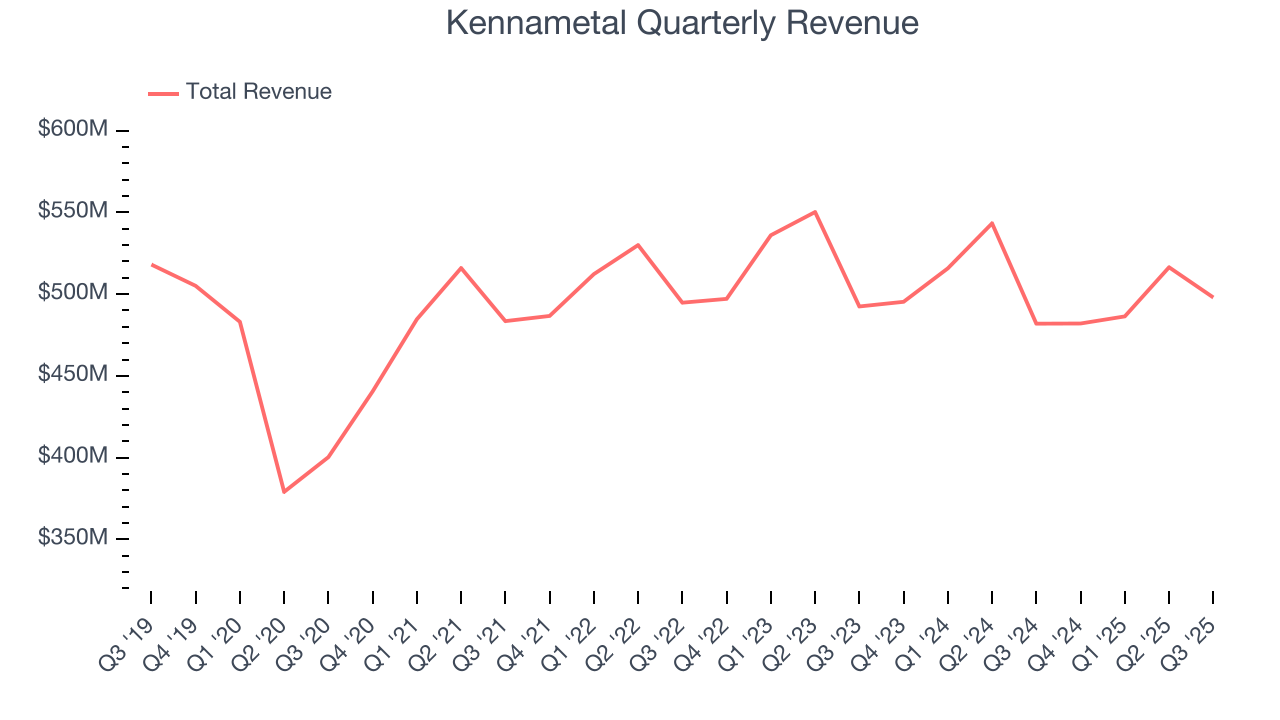
Long-term growth is the most important, but within industrials, a half-decade historical view may miss new industry trends or demand cycles. Kennametal’s performance shows it grew in the past but relinquished its gains over the last two years, as its revenue fell by 2.3% annually. 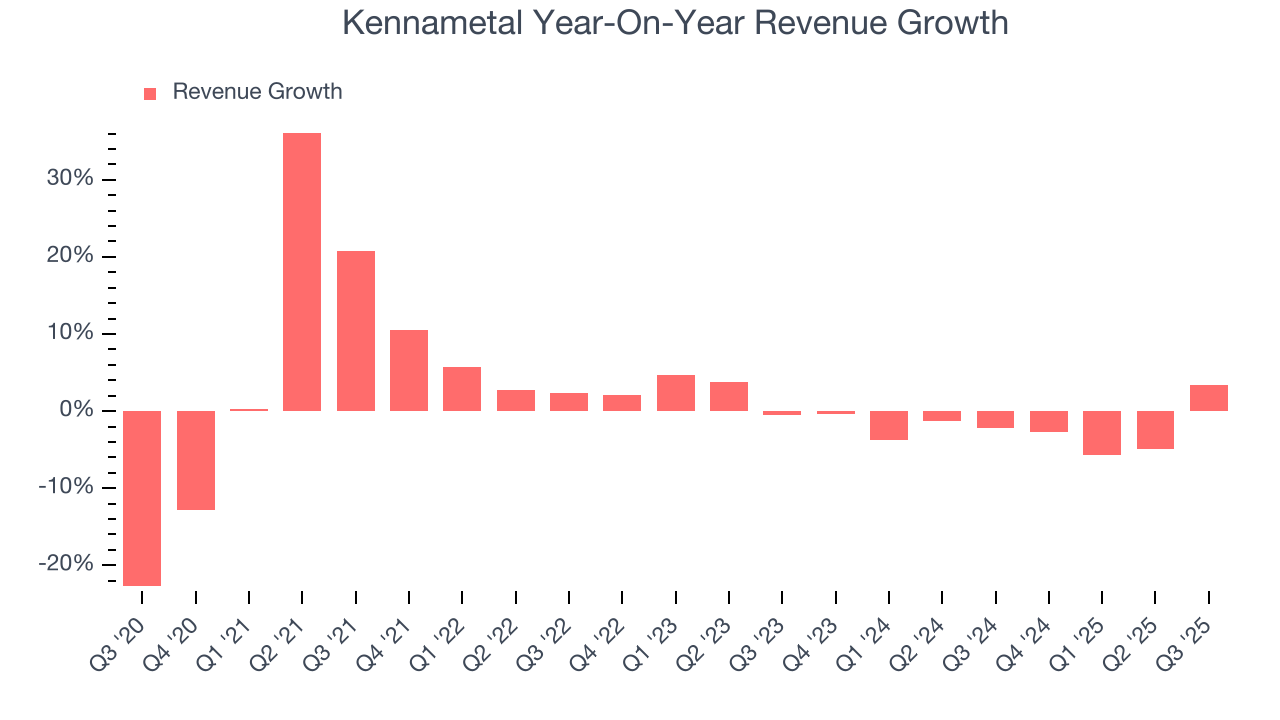
Kennametal also reports organic revenue, which strips out one-time events like acquisitions and currency fluctuations that don’t accurately reflect its fundamentals. Over the last two years, Kennametal’s organic revenue averaged 2.3% year-on-year declines. Because this number aligns with its two-year revenue growth, we can see the company’s core operations (not acquisitions and divestitures) drove most of its results. 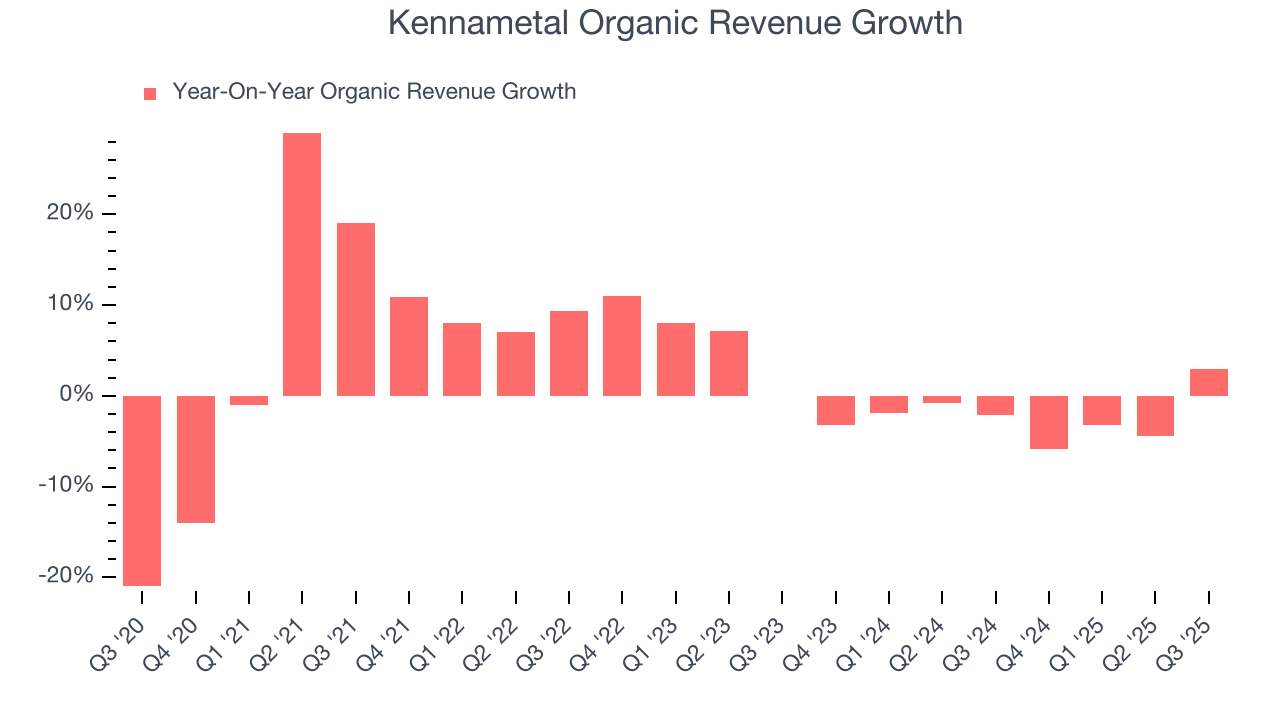
This quarter, Kennametal reported modest year-on-year revenue growth of 3.3% but beat Wall Street’s estimates by 4.3%. Company management is currently guiding for a 5.8% year-on-year increase in sales next quarter.
Looking further ahead, sell-side analysts expect revenue to grow 2.2% over the next 12 months. Although this projection indicates its newer products and services will catalyze better top-line performance, it is still below average for the sector.
6. Gross Margin & Pricing Power
At StockStory, we prefer high gross margin businesses because they indicate the company has pricing power or differentiated products, giving it a chance to generate higher operating profits.
Kennametal’s unit economics are better than the typical industrials business, signaling its products are somewhat differentiated through quality or brand. As you can see below, it averaged a decent 31.2% gross margin over the last five years. That means for every $100 in revenue, roughly $31.23 was left to spend on selling, marketing, R&D, and general administrative overhead. 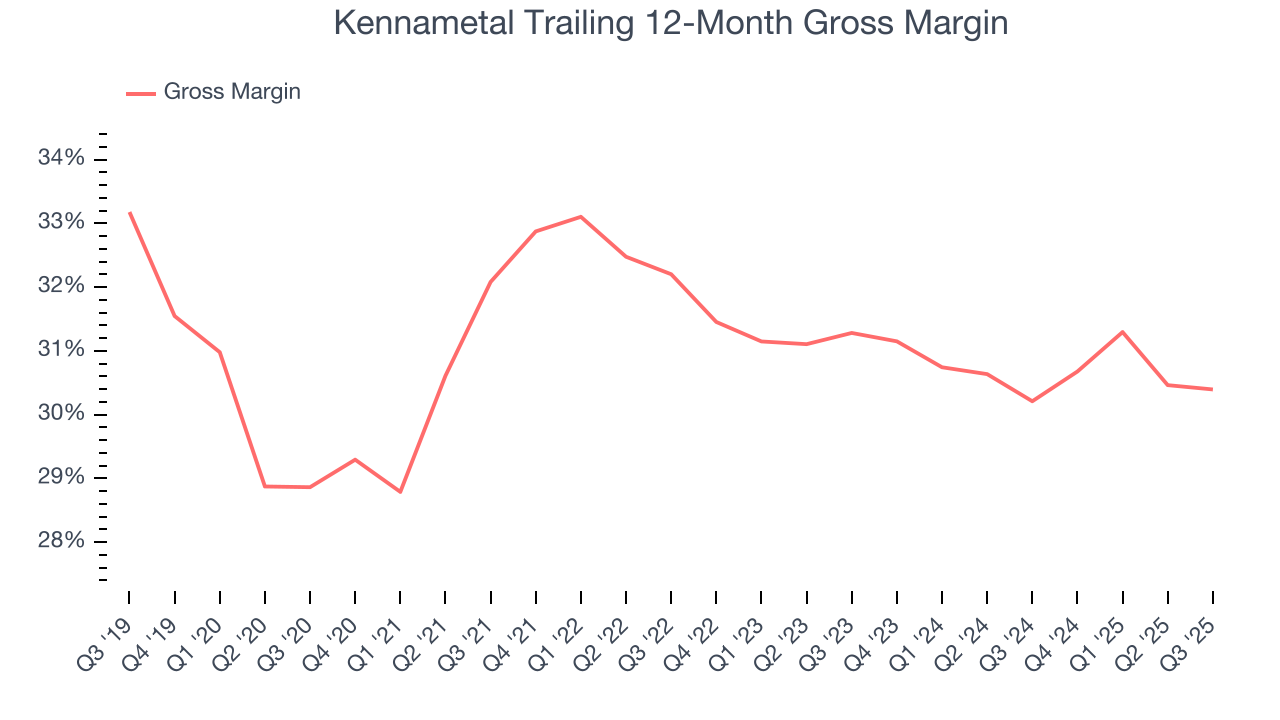
In Q3, Kennametal produced a 31% gross profit margin, in line with the same quarter last year. On a wider time horizon, the company’s full-year margin has remained steady over the past four quarters, suggesting its input costs (such as raw materials and manufacturing expenses) have been stable and it isn’t under pressure to lower prices.
7. Operating Margin
Kennametal has done a decent job managing its cost base over the last five years. The company has produced an average operating margin of 8.8%, higher than the broader industrials sector.
Analyzing the trend in its profitability, Kennametal’s operating margin decreased by 1.7 percentage points over the last five years. This raises questions about the company’s expense base because its revenue growth should have given it leverage on its fixed costs, resulting in better economies of scale and profitability.
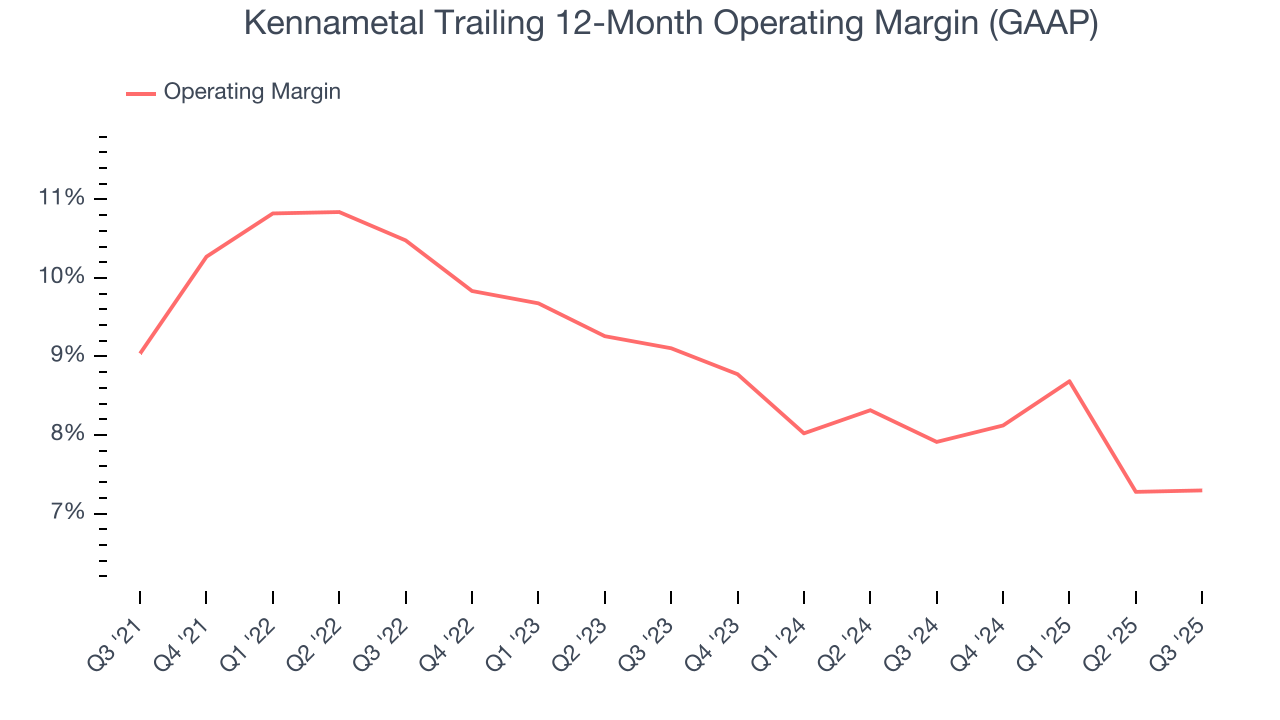
In Q3, Kennametal generated an operating margin profit margin of 7.5%, in line with the same quarter last year. This indicates the company’s cost structure has recently been stable.
8. Earnings Per Share
We track the long-term change in earnings per share (EPS) for the same reason as long-term revenue growth. Compared to revenue, however, EPS highlights whether a company’s growth is profitable.
Kennametal’s EPS grew at a solid 11.6% compounded annual growth rate over the last five years, higher than its 2.3% annualized revenue growth. This tells us the company became more profitable on a per-share basis as it expanded.
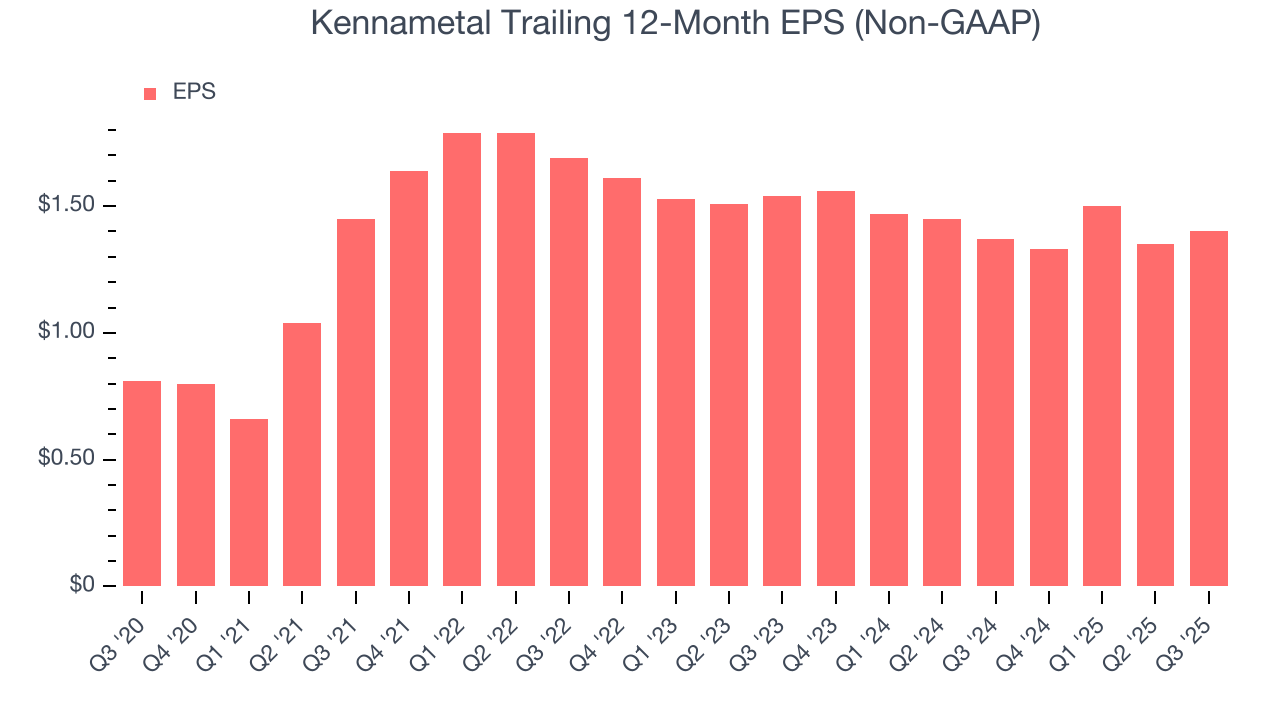
Diving into the nuances of Kennametal’s earnings can give us a better understanding of its performance. A five-year view shows that Kennametal has repurchased its stock, shrinking its share count by 7.8%. This tells us its EPS outperformed its revenue not because of increased operational efficiency but financial engineering, as buybacks boost per share earnings. 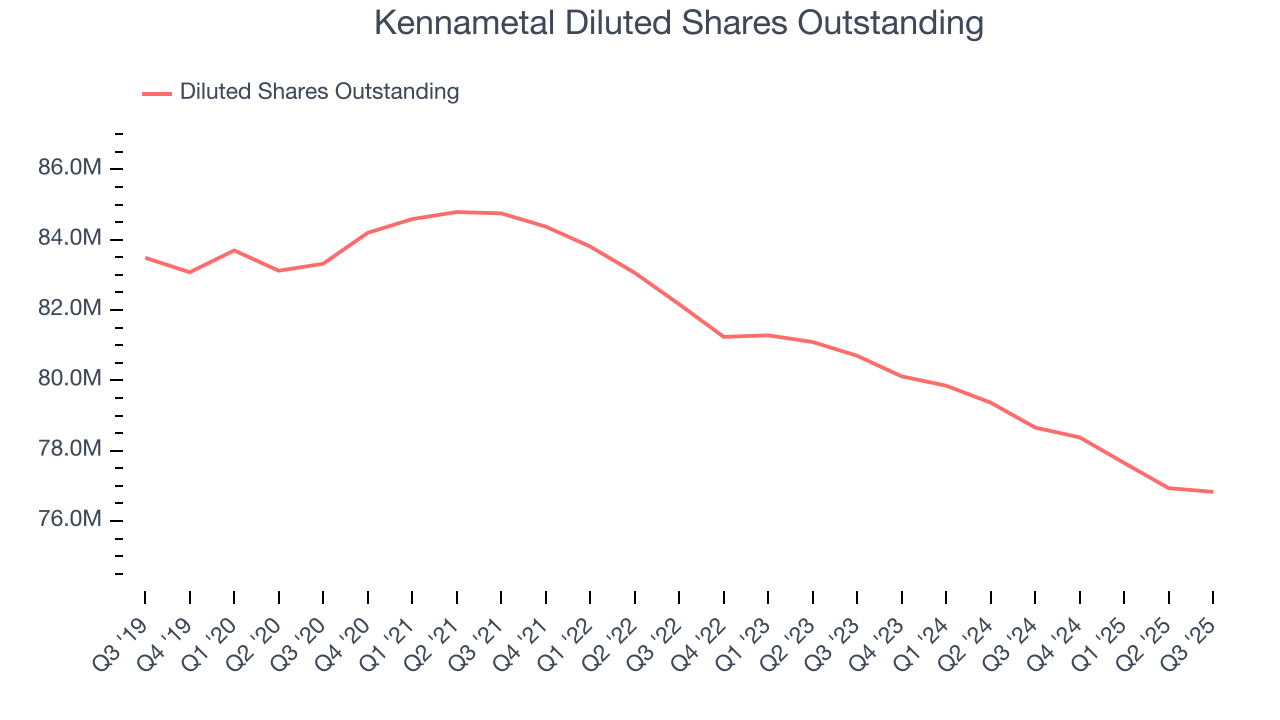
Like with revenue, we analyze EPS over a shorter period to see if we are missing a change in the business.
For Kennametal, its two-year annual EPS declines of 4.7% mark a reversal from its (seemingly) healthy five-year trend. We hope Kennametal can return to earnings growth in the future.
In Q3, Kennametal reported adjusted EPS of $0.34, up from $0.29 in the same quarter last year. This print easily cleared analysts’ estimates, and shareholders should be content with the results. Over the next 12 months, Wall Street expects Kennametal’s full-year EPS of $1.40 to shrink by 21.4%.
9. Cash Is King
Free cash flow isn't a prominently featured metric in company financials and earnings releases, but we think it's telling because it accounts for all operating and capital expenses, making it tough to manipulate. Cash is king.
Kennametal has shown decent cash profitability, giving it some flexibility to reinvest or return capital to investors. The company’s free cash flow margin averaged 6.8% over the last five years, slightly better than the broader industrials sector.
Taking a step back, we can see that Kennametal’s margin dropped by 2.5 percentage points during that time. Continued declines could signal it is in the middle of an investment cycle.
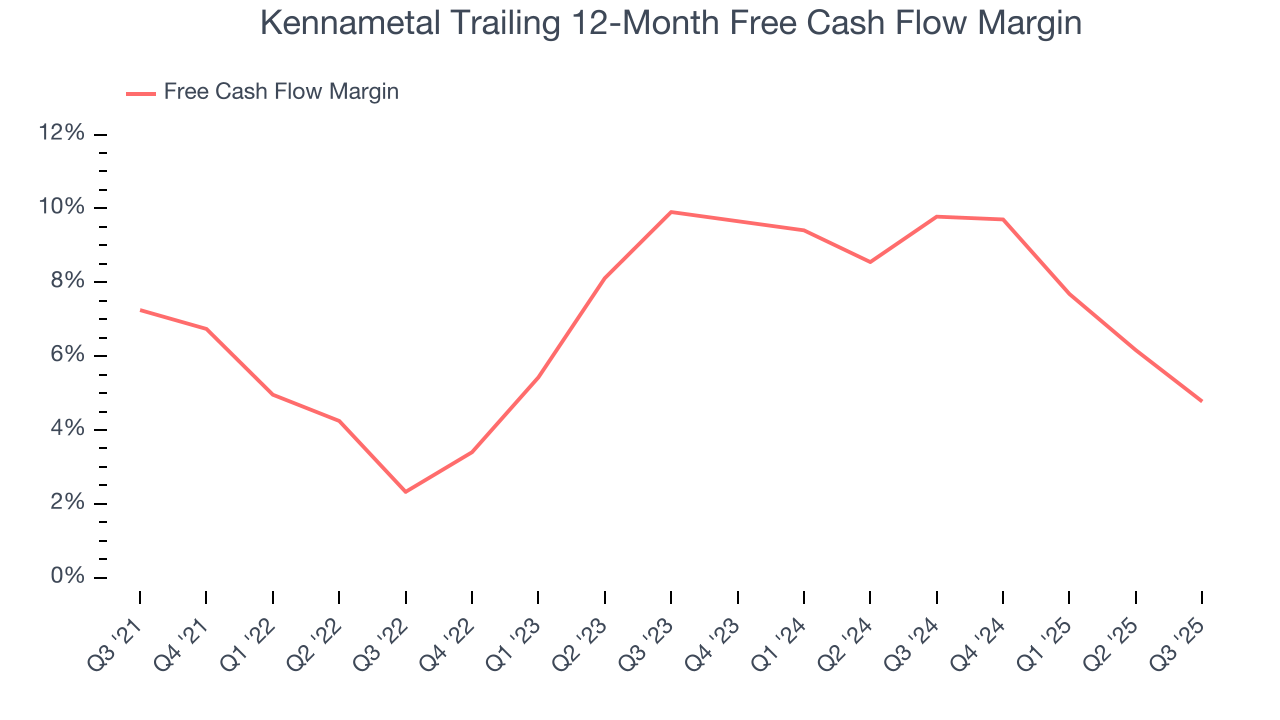
Kennametal burned through $5.50 million of cash in Q3, equivalent to a negative 1.1% margin. The company’s cash flow turned negative after being positive in the same quarter last year, suggesting its historical struggles have dragged on.
10. Return on Invested Capital (ROIC)
EPS and free cash flow tell us whether a company was profitable while growing its revenue. But was it capital-efficient? A company’s ROIC explains this by showing how much operating profit it makes compared to the money it has raised (debt and equity).
Kennametal historically did a mediocre job investing in profitable growth initiatives. Its five-year average ROIC was 7.7%, somewhat low compared to the best industrials companies that consistently pump out 20%+.
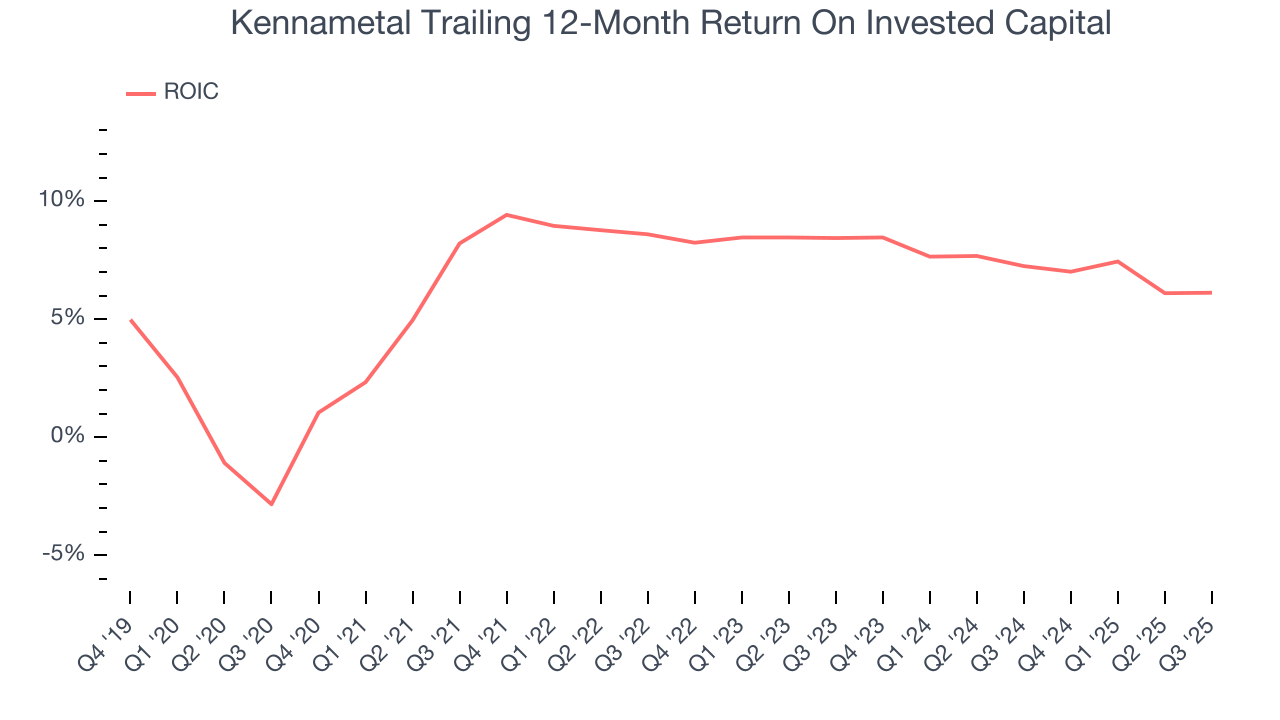
We like to invest in businesses with high returns, but the trend in a company’s ROIC is what often surprises the market and moves the stock price. Over the last few years, Kennametal’s ROIC averaged 1.7 percentage point decreases each year. Paired with its already low returns, these declines suggest its profitable growth opportunities are few and far between.
11. Balance Sheet Assessment
Kennametal reported $103.5 million of cash and $598.4 million of debt on its balance sheet in the most recent quarter. As investors in high-quality companies, we primarily focus on two things: 1) that a company’s debt level isn’t too high and 2) that its interest payments are not excessively burdening the business.
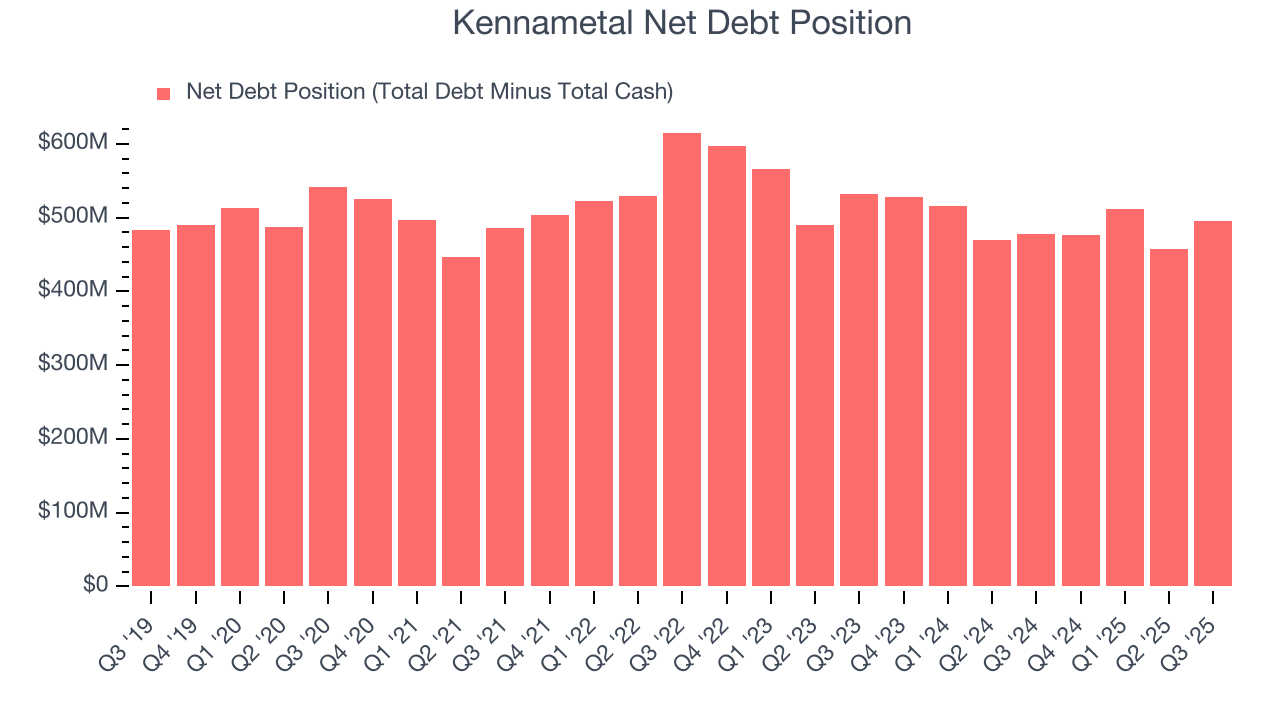
With $311.3 million of EBITDA over the last 12 months, we view Kennametal’s 1.6× net-debt-to-EBITDA ratio as safe. We also see its $12.43 million of annual interest expenses as appropriate. The company’s profits give it plenty of breathing room, allowing it to continue investing in growth initiatives.
12. Key Takeaways from Kennametal’s Q3 Results
We were impressed by how significantly Kennametal blew past analysts’ organic revenue expectations this quarter. We were also glad its EPS guidance for next quarter trumped Wall Street’s estimates. Zooming out, we think this was a good print with some key areas of upside. The stock traded up 8.5% to $24 immediately following the results.
13. Is Now The Time To Buy Kennametal?
Updated: January 24, 2026 at 10:38 PM EST
Are you wondering whether to buy Kennametal or pass? We urge investors to not only consider the latest earnings results but also longer-term business quality and valuation as well.
We cheer for all companies making their customers lives easier, but in the case of Kennametal, we’ll be cheering from the sidelines. To begin with, its revenue growth was weak over the last five years. And while its projected EPS for the next year implies the company’s fundamentals will improve, the downside is its organic revenue declined. On top of that, its relatively low ROIC suggests management has struggled to find compelling investment opportunities.
Kennametal’s P/E ratio based on the next 12 months is 20.6x. This valuation multiple is fair, but we don’t have much confidence in the company. There are more exciting stocks to buy at the moment.
Wall Street analysts have a consensus one-year price target of $29.88 on the company (compared to the current share price of $34.44).