
United Parks & Resorts (PRKS)
We wouldn’t buy United Parks & Resorts. Its weak sales growth and low returns on capital show it struggled to generate demand and profits.― StockStory Analyst Team


1. News




2. Summary
Why We Think United Parks & Resorts Will Underperform
Parent company of SeaWorld and home of the world-famous Shamu, United Parks & Resorts (NYSE:PRKS) is a theme park chain featuring marine life, live entertainment, roller coasters, and waterparks.
- Annual revenue declines of 1.9% over the last two years indicate problems with its market positioning
- Lacking free cash flow limits its freedom to invest in growth initiatives, execute share buybacks, or pay dividends
- Demand will likely be soft over the next 12 months as Wall Street’s estimates imply tepid growth of 1.9%
United Parks & Resorts fails to meet our quality criteria. We see more favorable opportunities in the market.
Why There Are Better Opportunities Than United Parks & Resorts








United Parks & Resorts is trading at $31.95 per share, or 8.5x forward P/E. United Parks & Resorts’s valuation may seem like a great deal, but we think there are valid reasons why it’s so cheap.
We’d rather pay up for companies with elite fundamentals than get a bargain on weak ones. Cheap stocks can be value traps, and as their performance deteriorates, they will stay cheap or get even cheaper.
3. United Parks & Resorts (PRKS) Research Report: Q4 CY2025 Update
Theme park operator United Parks & Resorts (NYSE:PRKS) fell short of the market’s revenue expectations in Q4 CY2025, with sales falling 2.8% year on year to $373.5 million. Its GAAP profit of $0.28 per share was 48% below analysts’ consensus estimates.
United Parks & Resorts (PRKS) Q4 CY2025 Highlights:
- Revenue: $373.5 million vs analyst estimates of $376.7 million (2.8% year-on-year decline, 0.8% miss)
- EPS (GAAP): $0.28 vs analyst expectations of $0.54 (48% miss)
- Adjusted EBITDA: $115.2 million vs analyst estimates of $125.8 million (30.8% margin, 8.4% miss)
- Operating Margin: 15.1%, down from 19.7% in the same quarter last year
- Free Cash Flow Margin: 7.5%, down from 22.4% in the same quarter last year
- Visitors: 4.76 million, down 145,000 year on year
- Market Capitalization: $1.84 billion
Company Overview
Parent company of SeaWorld and home of the world-famous Shamu, United Parks & Resorts (NYSE:PRKS) is a theme park chain featuring marine life, live entertainment, roller coasters, and waterparks.
The company, originally named SeaWorld, was founded in 1964 by four UCLA graduates whose original idea was to develop an underwater restaurant. It has since rebranded into United Parks & Resorts, evolving into much more, and is known today for its aquatic shows and thrilling rides.
United Parks & Resorts's primary revenue streams are ticket sales, in-park dining, merchandise, and special events. Its parks seek to blend entertainment with marine education, enabling visitors to enjoy performances from marine animals while gaining insights into oceanic conservation.
4. Consumer Discretionary - Leisure Facilities
The Consumer Discretionary sector, by definition, is made up of companies selling non-essential goods and services. When economic conditions deteriorate or tastes shift, consumers can easily cut back or eliminate these purchases. For long-term investors with five-year holding periods, this creates a structural challenge: the sector is inherently hit-driven, with low switching costs and fickle customers. As a result, only a handful of companies can reliably grow demand and compound earnings over long periods, which is why our bar is high and High Quality ratings are rare.
Leisure facilities companies own and operate theme parks, fitness centers, bowling alleys, and other venue-based entertainment destinations, generating revenue from admissions, memberships, and on-site spending. Tailwinds include consumer preference for experiential spending, tourism recovery, and technology-enhanced guest experiences that support premium pricing. Headwinds are notable: high fixed costs, such as real estate, labor, and maintenance, make profitability highly sensitive to attendance fluctuations during economic slowdowns. Weather, pandemics, and safety incidents can disrupt operations unpredictably. Rising construction and labor costs inflate expansion budgets, while competition from at-home entertainment alternatives and other experiential options limits pricing power in many markets.
Competitors offering amusement park experiences nationally include Six Flags (NYSE:SIX), Cedar Fair (NYSE:FUN), and Walt Disney (NYSE:DIS).
5. Revenue Growth
A company’s long-term sales performance is one signal of its overall quality. Even a bad business can shine for one or two quarters, but a top-tier one grows for years. Over the last five years, United Parks & Resorts grew its sales at a 30.9% annual rate. Though this growth is acceptable on an absolute basis, we need to see more than just topline growth for the consumer discretionary sector, which can display significant earnings volatility. This means our bar for the sector is particularly high, reflecting the non-essential and hit-driven nature of the products and services offered. Additionally, five-year CAGR starts around Covid, when revenue was depressed then rebounded.
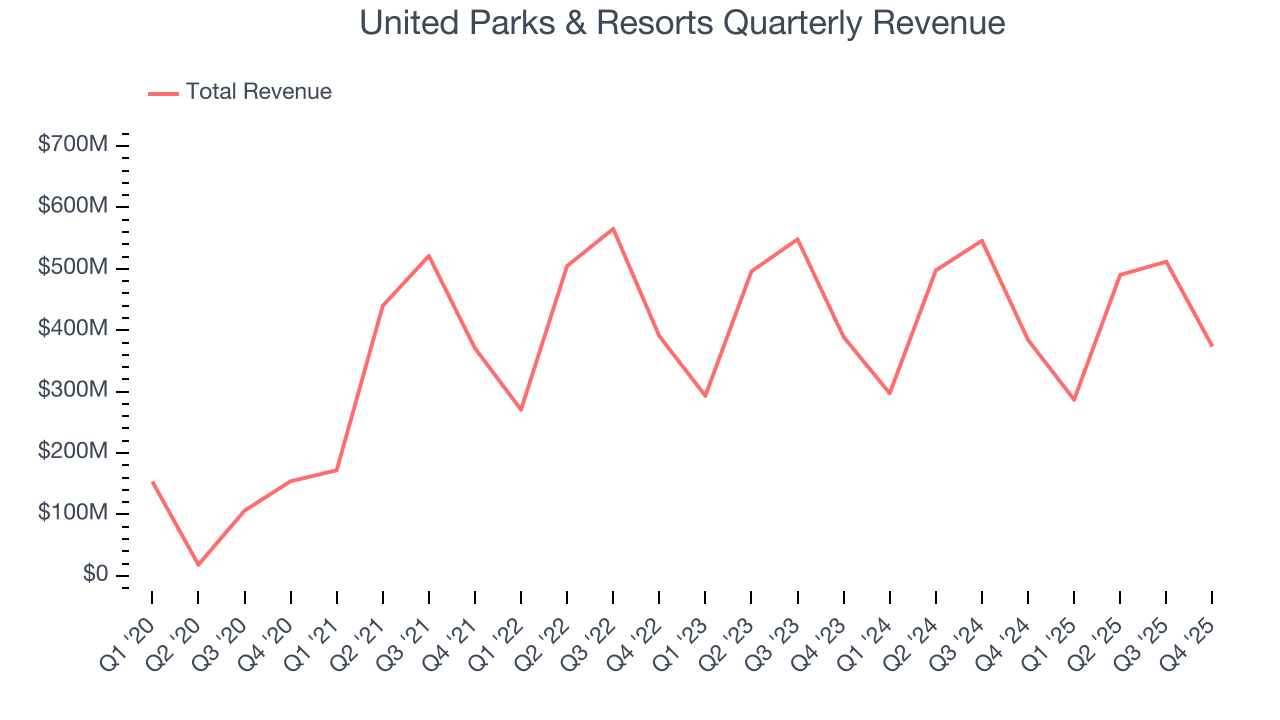
Long-term growth is the most important, but within consumer discretionary, product cycles are short and revenue can be hit-driven due to rapidly changing trends and consumer preferences. United Parks & Resorts’s performance shows it grew in the past but relinquished its gains over the last two years, as its revenue fell by 1.9% annually. Note that COVID hurt United Parks & Resorts’s business in 2020 and part of 2021, and it bounced back in a big way thereafter. 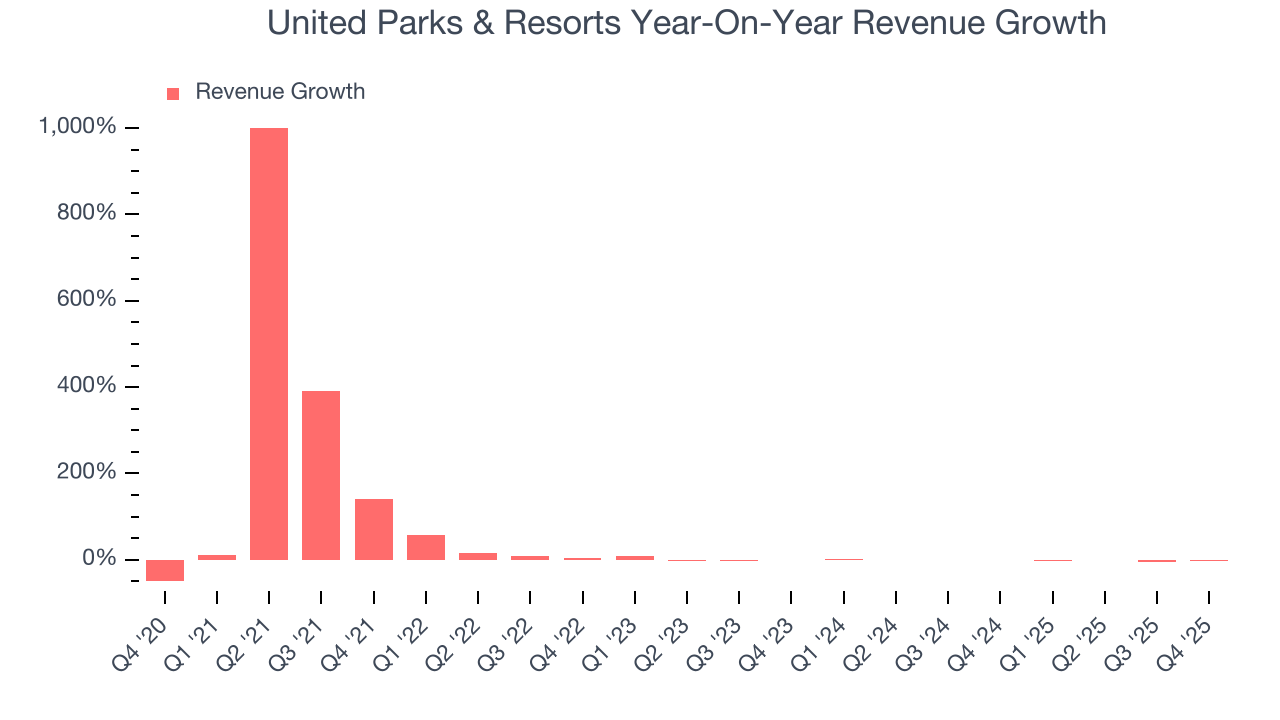
United Parks & Resorts also discloses its number of visitors, which reached 4.76 million in the latest quarter. Over the last two years, United Parks & Resorts’s visitors averaged 2.2% year-on-year declines. Because this number aligns with its revenue growth during the same period, we can see the company’s monetization was fairly consistent. 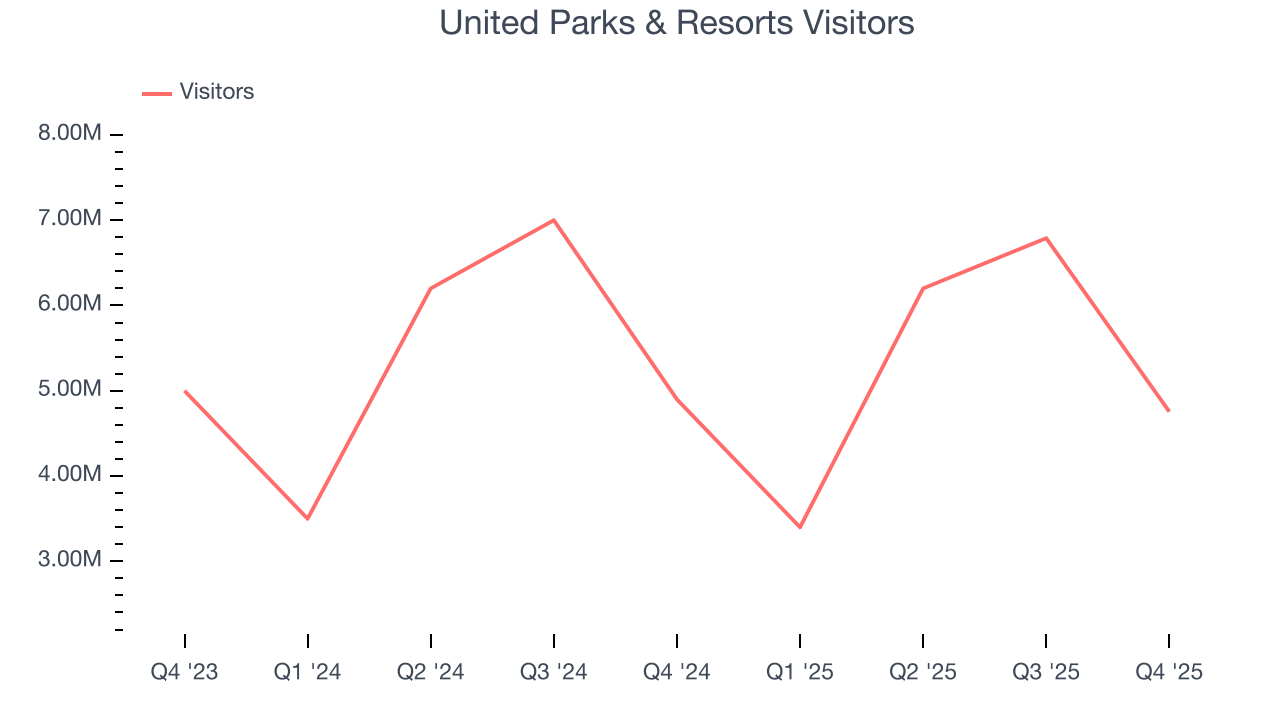
This quarter, United Parks & Resorts missed Wall Street’s estimates and reported a rather uninspiring 2.8% year-on-year revenue decline, generating $373.5 million of revenue.
Looking ahead, sell-side analysts expect revenue to grow 2.9% over the next 12 months. Although this projection implies its newer products and services will spur better top-line performance, it is still below average for the sector.
6. Operating Margin
Operating margin is an important measure of profitability as it shows the portion of revenue left after accounting for all core expenses – everything from the cost of goods sold to advertising and wages. It’s also useful for comparing profitability across companies with different levels of debt and tax rates because it excludes interest and taxes.
United Parks & Resorts’s operating margin has been trending down over the last 12 months and averaged 24.5% over the last two years. The company’s profitability was mediocre for a consumer discretionary business and shows it couldn’t pass its higher operating expenses onto its customers.
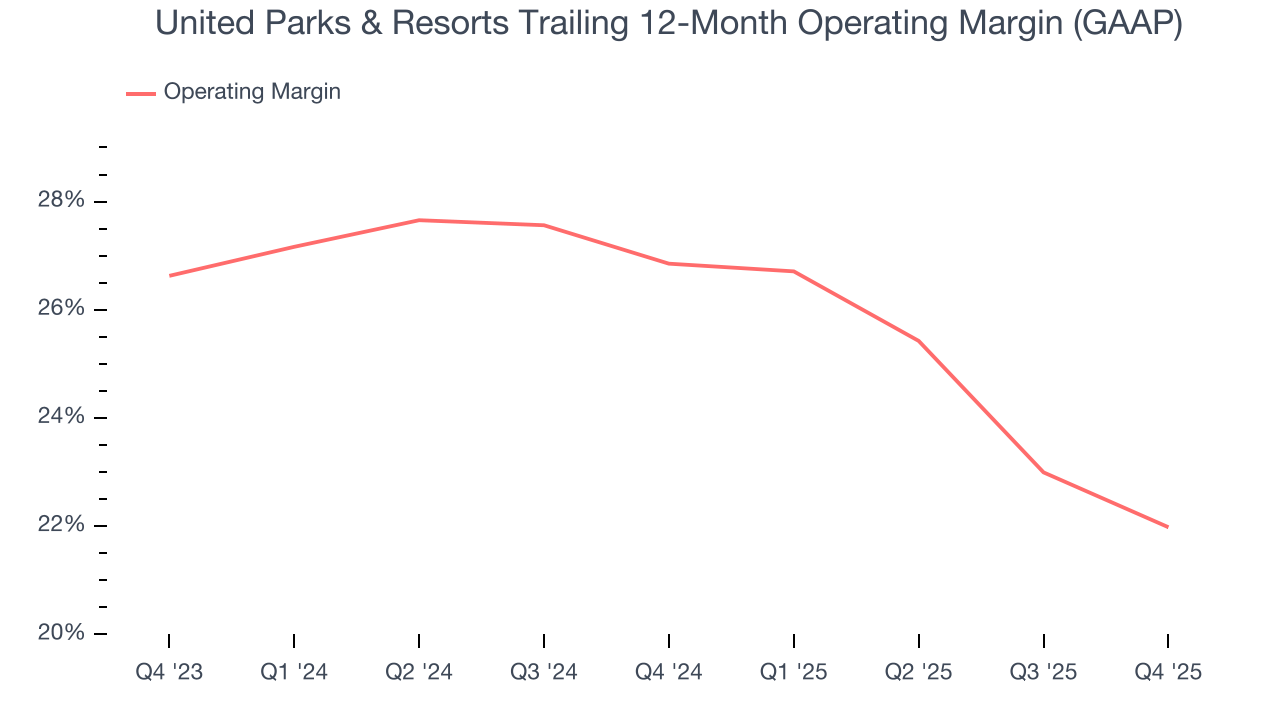
In Q4, United Parks & Resorts generated an operating margin profit margin of 15.1%, down 4.6 percentage points year on year. This contraction shows it was less efficient because its expenses increased relative to its revenue.
7. Earnings Per Share
We track the long-term change in earnings per share (EPS) for the same reason as long-term revenue growth. Compared to revenue, however, EPS highlights whether a company’s growth is profitable.
United Parks & Resorts’s full-year EPS flipped from negative to positive over the last five years. This is encouraging and shows it’s at a critical moment in its life.
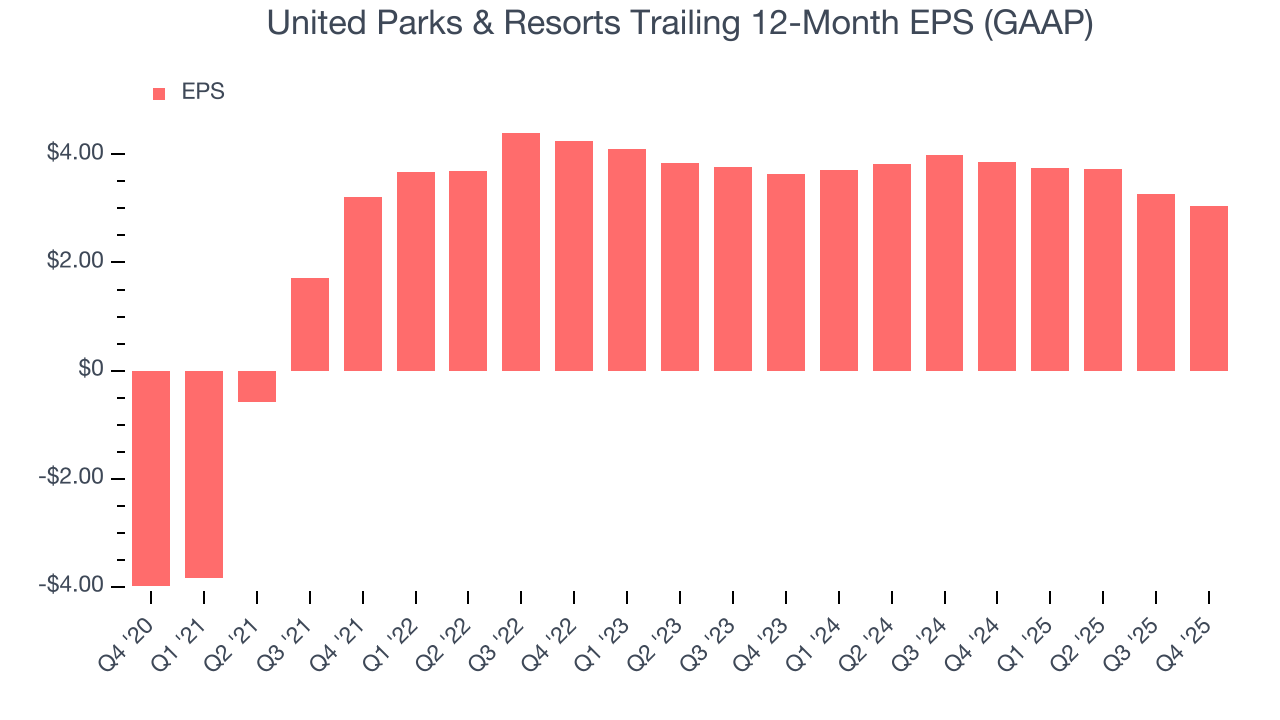
In Q4, United Parks & Resorts reported EPS of $0.28, down from $0.50 in the same quarter last year. This print missed analysts’ estimates. Over the next 12 months, Wall Street expects United Parks & Resorts’s full-year EPS of $3.04 to grow 29.7%.
8. Cash Is King
Free cash flow isn't a prominently featured metric in company financials and earnings releases, but we think it's telling because it accounts for all operating and capital expenses, making it tough to manipulate. Cash is king.
United Parks & Resorts has shown poor cash profitability over the last two years, giving the company limited opportunities to return capital to shareholders. Its free cash flow margin averaged 11.6%, lousy for a consumer discretionary business.
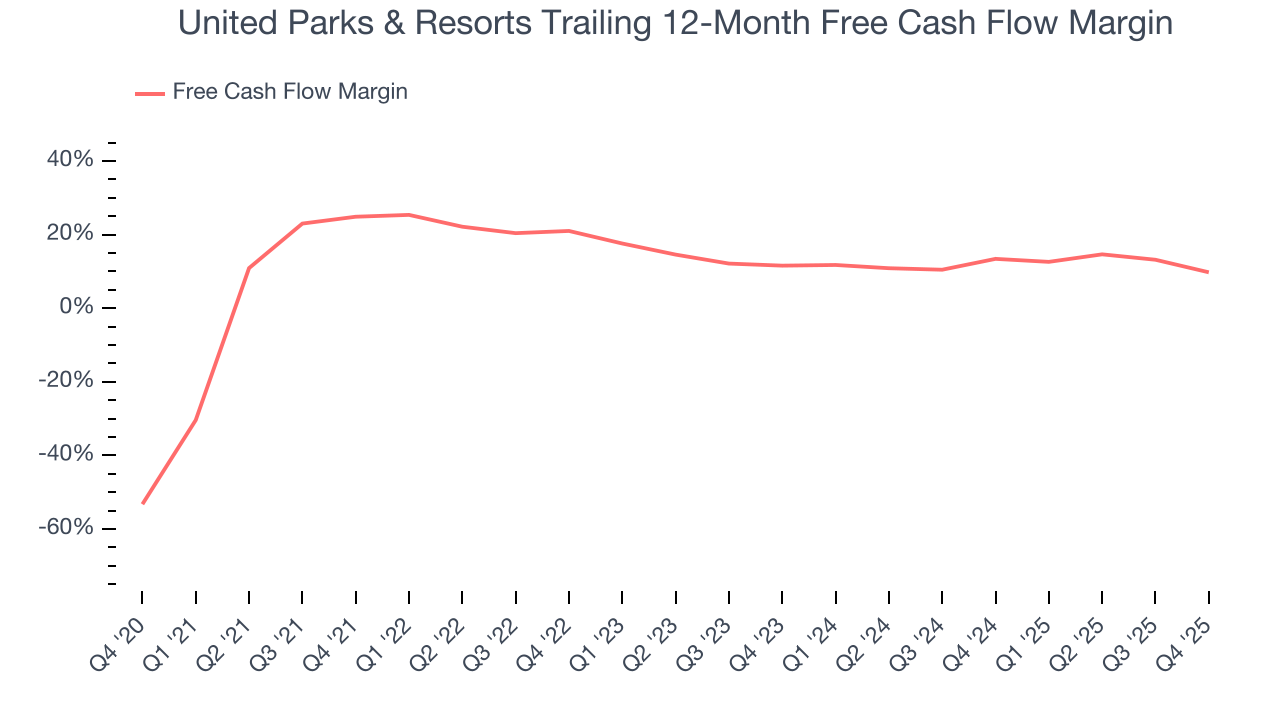
United Parks & Resorts’s free cash flow clocked in at $28.13 million in Q4, equivalent to a 7.5% margin. The company’s cash profitability regressed as it was 14.9 percentage points lower than in the same quarter last year, prompting us to pay closer attention. Short-term fluctuations typically aren’t a big deal because investment needs can be seasonal, but we’ll be watching to see if the trend extrapolates into future quarters.
9. Return on Invested Capital (ROIC)
EPS and free cash flow tell us whether a company was profitable while growing its revenue. But was it capital-efficient? A company’s ROIC explains this by showing how much operating profit it makes compared to the money it has raised (debt and equity).
United Parks & Resorts historically did a mediocre job investing in profitable growth initiatives. Its five-year average ROIC was 23.9%, somewhat low compared to the best consumer discretionary companies that consistently pump out 25%+.
We like to invest in businesses with high returns, but the trend in a company’s ROIC is what often surprises the market and moves the stock price. Over the last few years, United Parks & Resorts’s ROIC has unfortunately decreased. Paired with its already low returns, these declines suggest its profitable growth opportunities are few and far between.
10. Balance Sheet Assessment
United Parks & Resorts reported $99.76 million of cash and $2.25 billion of debt on its balance sheet in the most recent quarter. As investors in high-quality companies, we primarily focus on two things: 1) that a company’s debt level isn’t too high and 2) that its interest payments are not excessively burdening the business.
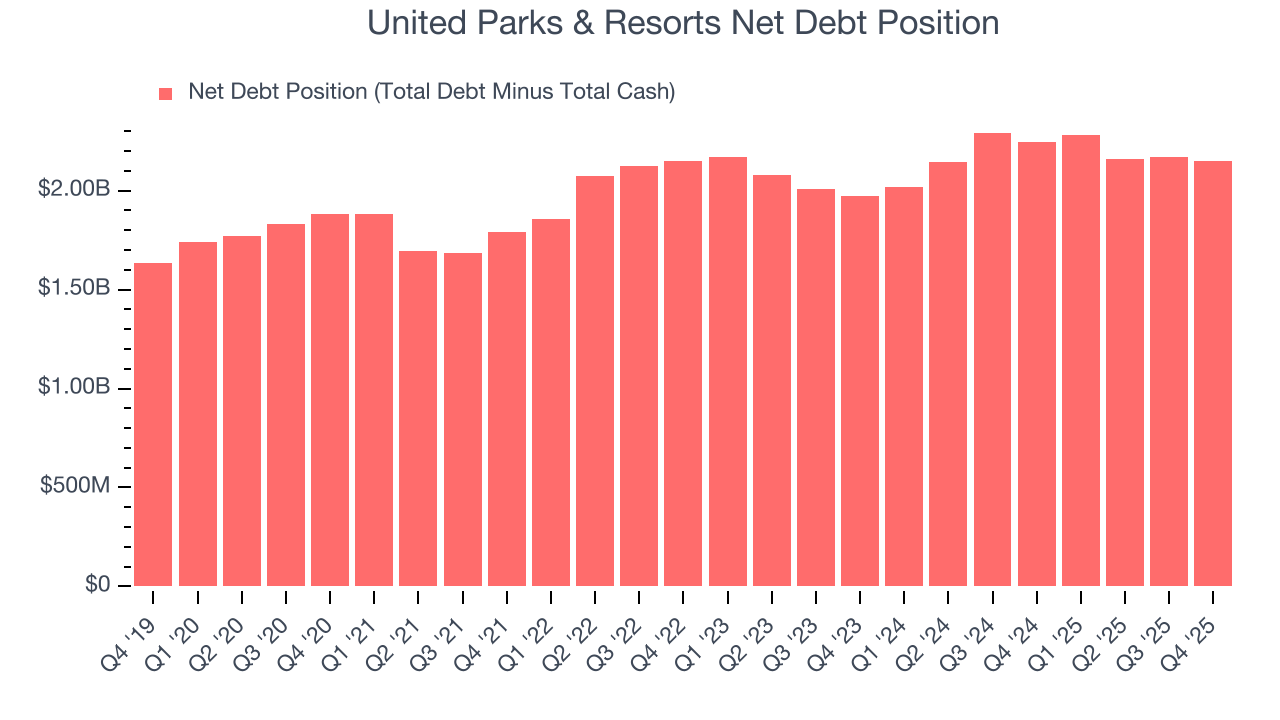
With $605.1 million of EBITDA over the last 12 months, we view United Parks & Resorts’s 3.6× net-debt-to-EBITDA ratio as safe. We also see its $69.01 million of annual interest expenses as appropriate. The company’s profits give it plenty of breathing room, allowing it to continue investing in growth initiatives.
11. Key Takeaways from United Parks & Resorts’s Q4 Results
We struggled to find many positives in these results. Its EPS missed and its EBITDA fell short of Wall Street’s estimates. Overall, this quarter could have been better. The stock traded down 1.9% to $33.13 immediately following the results.
12. Is Now The Time To Buy United Parks & Resorts?
Updated: March 19, 2026 at 10:57 PM EDT
Before making an investment decision, investors should account for United Parks & Resorts’s business fundamentals and valuation in addition to what happened in the latest quarter.
We cheer for all companies serving everyday consumers, but in the case of United Parks & Resorts, we’ll be cheering from the sidelines. On top of that, United Parks & Resorts’s number of visitors has disappointed, and its Forecasted free cash flow margin for next year suggests the company will fail to improve its cash conversion.
United Parks & Resorts’s P/E ratio based on the next 12 months is 8.2x. While this valuation is optically cheap, the potential downside is huge given its shaky fundamentals. There are more exciting stocks to buy at the moment.
Wall Street analysts have a consensus one-year price target of $42.18 on the company (compared to the current share price of $32.34).
Although the price target is bullish, readers should exercise caution because analysts tend to be overly optimistic. The firms they work for, often big banks, have relationships with companies that extend into fundraising, M&A advisory, and other rewarding business lines. As a result, they typically hesitate to say bad things for fear they will lose out. We at StockStory do not suffer from such conflicts of interest, so we’ll always tell it like it is.