
Marriott Vacations (VAC)
We wouldn’t buy Marriott Vacations. Its weak sales growth and low returns on capital show it struggled to generate demand and profits.― StockStory Analyst Team


1. News







2. Summary
Why We Think Marriott Vacations Will Underperform
Spun off from Marriott International in 1984, Marriott Vacations (NYSE:VAC) is a vacation company providing leisure experiences for travelers around the world.
- Annual revenue growth of 11.8% over the last five years was below our standards for the consumer discretionary sector
- Operating margin falls short of the industry average, and the smaller profit dollars make it harder to react to unexpected market developments
- 7× net-debt-to-EBITDA ratio shows it’s overleveraged and increases the probability of shareholder dilution if things turn unexpectedly
Marriott Vacations doesn’t satisfy our quality benchmarks. There are more promising alternatives.
Why There Are Better Opportunities Than Marriott Vacations







Marriott Vacations’s stock price of $64.43 implies a valuation ratio of 8.5x forward P/E. This is a cheap valuation multiple, but for good reason. You get what you pay for.
It’s better to pay up for high-quality businesses with higher long-term earnings potential rather than to buy lower-quality stocks because they appear cheap. These challenged businesses often don’t re-rate, a phenomenon known as a “value trap”.
3. Marriott Vacations (VAC) Research Report: Q4 CY2025 Update
Vacation ownership company Marriott Vacations (NYSE:VAC) reported Q4 CY2025 results topping the market’s revenue expectations, but sales were flat year on year at $1.32 billion. Its non-GAAP profit of $1.86 per share was 9% above analysts’ consensus estimates.
Marriott Vacations (VAC) Q4 CY2025 Highlights:
- Revenue: $1.32 billion vs analyst estimates of $1.3 billion (flat year on year, 2.1% beat)
- Adjusted EPS: $1.86 vs analyst estimates of $1.71 (9% beat)
- Adjusted EBITDA: $186 million vs analyst estimates of $178.4 million (14.1% margin, 4.3% beat)
- Adjusted EPS guidance for the upcoming financial year 2026 is $7.43 at the midpoint, beating analyst estimates by 8.2%
- EBITDA guidance for the upcoming financial year 2026 is $767.5 million at the midpoint, above analyst estimates of $736.4 million
- Guests: 1,507, down 1.54 million year on year
- Market Capitalization: $1.95 billion
Company Overview
Spun off from Marriott International in 1984, Marriott Vacations (NYSE:VAC) is a vacation company providing leisure experiences for travelers around the world.
Marriott Vacations operates through three primary segments: Vacation Ownership, Exchange and Third-Party Management, and Rentals. The Vacation Ownership segment includes the development, marketing, sale, and management of vacation ownership products under several brand names, including Marriott Vacation Club, Grand Residences by Marriott, and The Ritz-Carlton Destination Club. These brands represent a range of luxury to upscale vacation properties, offering customers the opportunity to purchase timeshare intervals at various resorts.
The Exchange and Third-Party Management segment, operating primarily under the Interval International brand, provides exchange, rental, and resort management services. Interval International, a prominent global provider of vacation exchange, offers its members the flexibility to exchange their vacation ownership for time at different resorts around the world, enhancing the value and utility of vacation ownership.
The Rentals segment includes rental operations related to the company's owned and managed vacation ownership resorts. This segment allows travelers to experience the Marriott Vacation Club brand without owning a timeshare, offering the flexibility of short-term vacation rentals.
4. Consumer Discretionary - Travel and Vacation Providers
The Consumer Discretionary sector, by definition, is made up of companies selling non-essential goods and services. When economic conditions deteriorate or tastes shift, consumers can easily cut back or eliminate these purchases. For long-term investors with five-year holding periods, this creates a structural challenge: the sector is inherently hit-driven, with low switching costs and fickle customers. As a result, only a handful of companies can reliably grow demand and compound earnings over long periods, which is why our bar is high and High Quality ratings are rare.
Travel and vacation providers operate tour packages, cruise lines, online travel agencies, and vacation rental platforms, connecting consumers with leisure and business travel experiences. Tailwinds include robust post-pandemic travel demand, a consumer preference shift toward experiences over goods, and technology-enabled personalization improving conversion and loyalty. However, headwinds are significant: the industry is acutely sensitive to macroeconomic cycles, geopolitical instability, and fuel price volatility. Low switching costs mean fierce price competition, while capacity additions in segments like cruises can lead to oversupply. Regulatory burdens, weather disruptions, and public health risks further create episodic but potentially severe demand shocks.
Marriott Vacations's primary competitors include Travel + Leisure (NYSE:TNL), Hilton Grand Vacations (NYSE:HGV), Bluegreen Vacations (NYSE:BXG), Interval Leisure Group (NASDAQ:IILG), and private companies Diamond Resorts and Anantara Vacation Club.
5. Revenue Growth
Reviewing a company’s long-term sales performance reveals insights into its quality. Any business can experience short-term success, but top-performing ones enjoy sustained growth for years. Over the last five years, Marriott Vacations grew its sales at a 11.8% compounded annual growth rate. Though this growth is acceptable on an absolute basis, we need to see more than just topline growth for the consumer discretionary sector, which can display significant earnings volatility. This means our bar for the sector is particularly high, reflecting the non-essential and hit-driven nature of the products and services offered. Additionally, five-year CAGR starts around Covid, when revenue was depressed then rebounded.
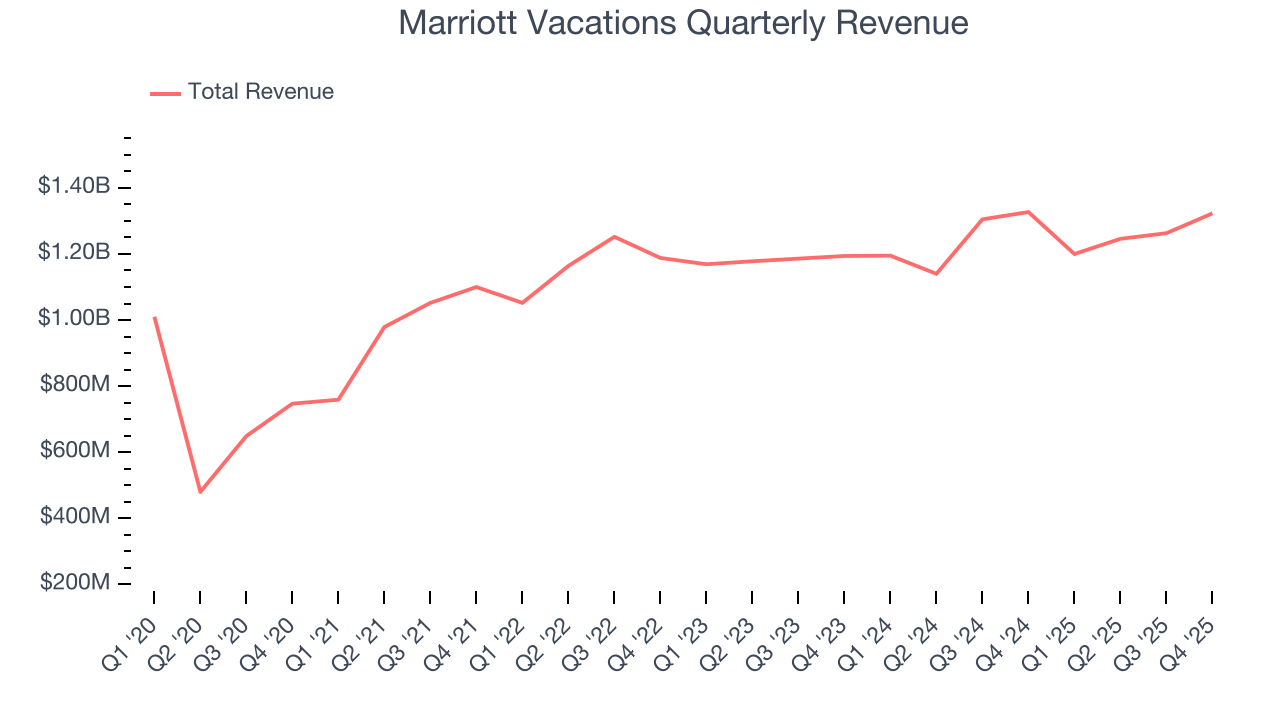
We at StockStory place the most emphasis on long-term growth, but within consumer discretionary, a stretched historical view may miss a company riding a successful new property or trend. Marriott Vacations’s recent performance shows its demand has slowed as its annualized revenue growth of 3.2% over the last two years was below its five-year trend. We’re wary when companies in the sector see decelerations in revenue growth, as it could signal changing consumer tastes aided by low switching costs. 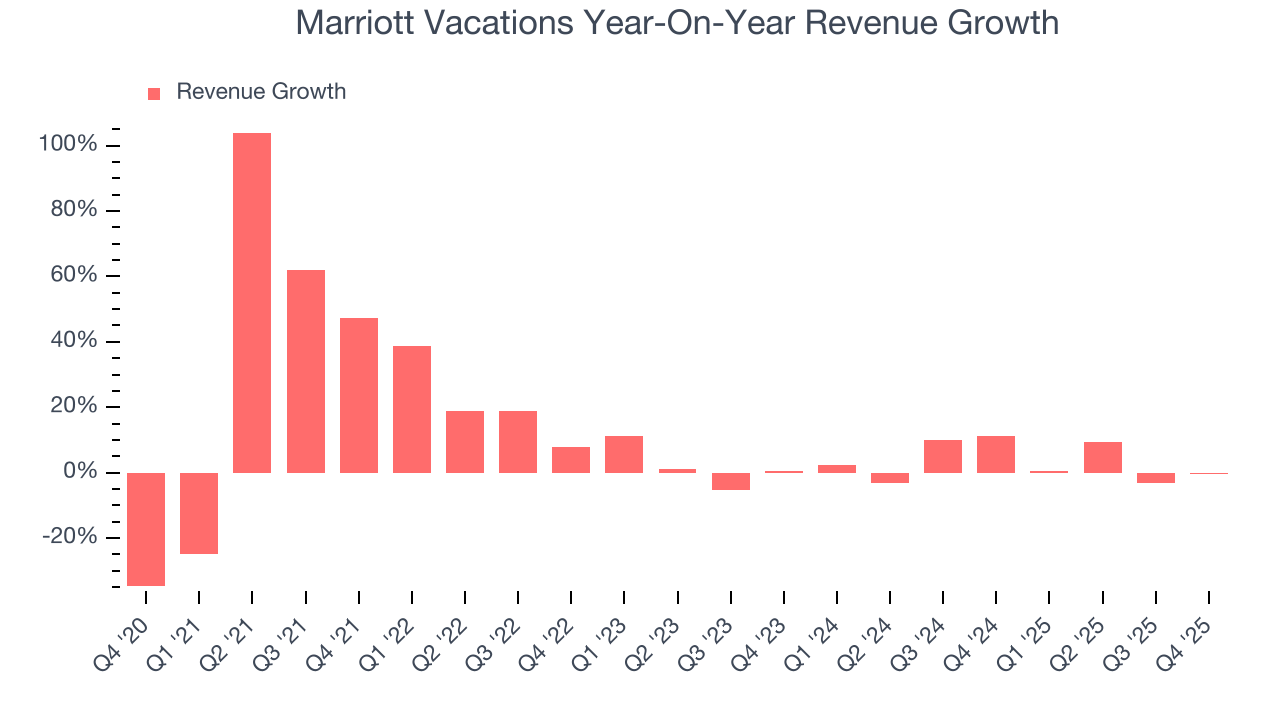
We can dig further into the company’s revenue dynamics by analyzing its number of guests and conducted tours, which clocked in at 1,507 and 109,965 in the latest quarter. Over the last two years, Marriott Vacations’s guests averaged 99.9% year-on-year declines while its conducted tours were flat. 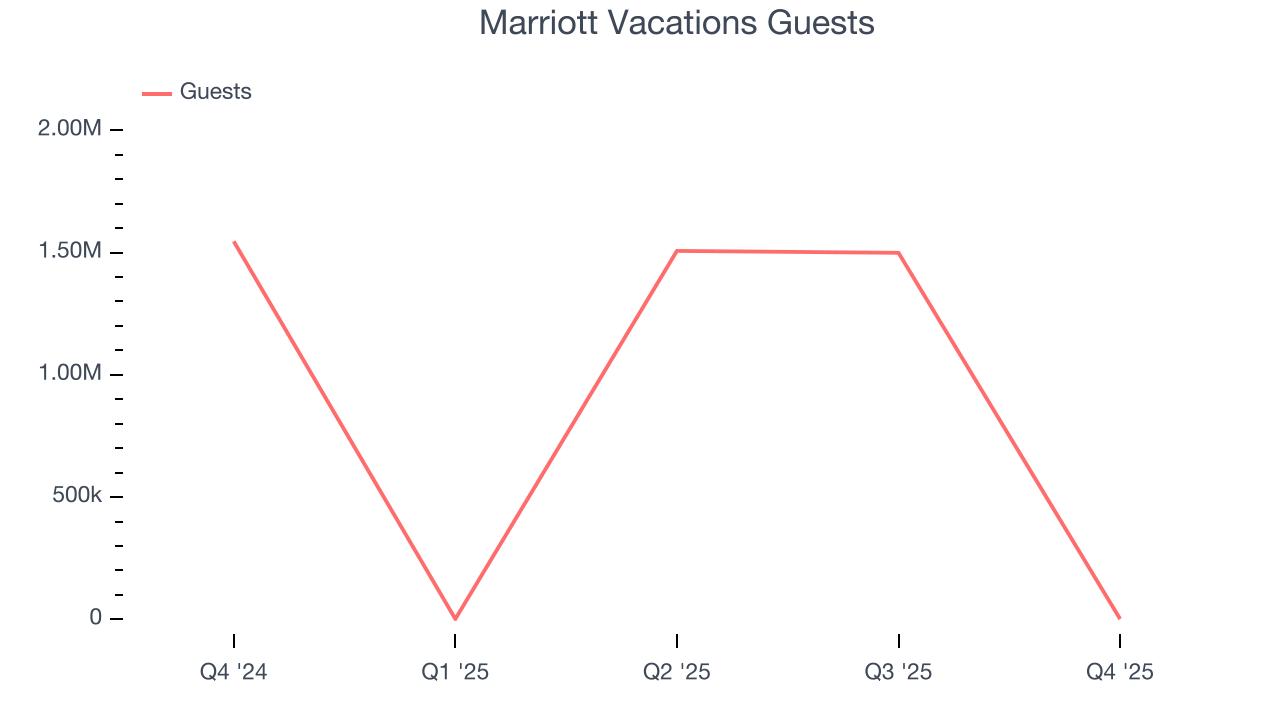
This quarter, Marriott Vacations’s $1.32 billion of revenue was flat year on year but beat Wall Street’s estimates by 2.1%.
Looking ahead, sell-side analysts expect revenue to grow 1% over the next 12 months, a slight deceleration versus the last two years. This projection is underwhelming and indicates its products and services will face some demand challenges.
6. Operating Margin
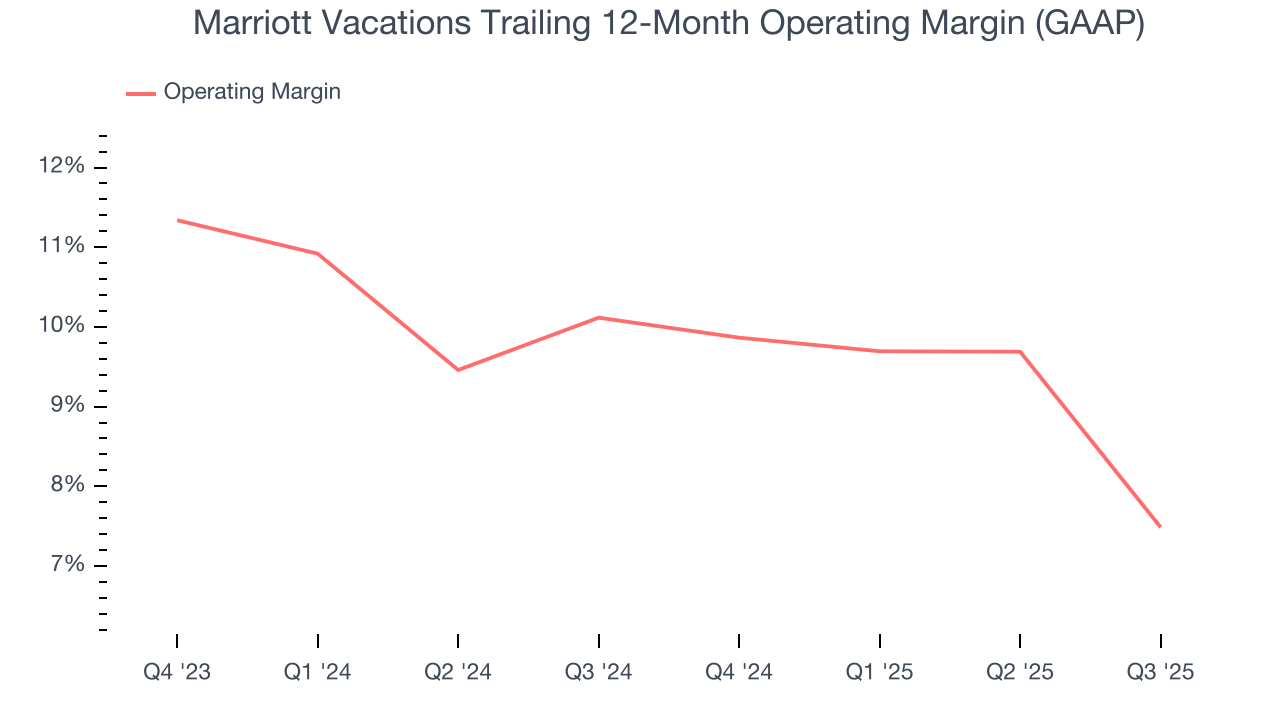
in line with the same quarter last year. This indicates the company’s overall cost structure has been relatively stable.
7. Earnings Per Share
Revenue trends explain a company’s historical growth, but the long-term change in earnings per share (EPS) points to the profitability of that growth – for example, a company could inflate its sales through excessive spending on advertising and promotions.
Marriott Vacations’s full-year EPS flipped from negative to positive over the last five years. This is encouraging and shows it’s at a critical moment in its life.
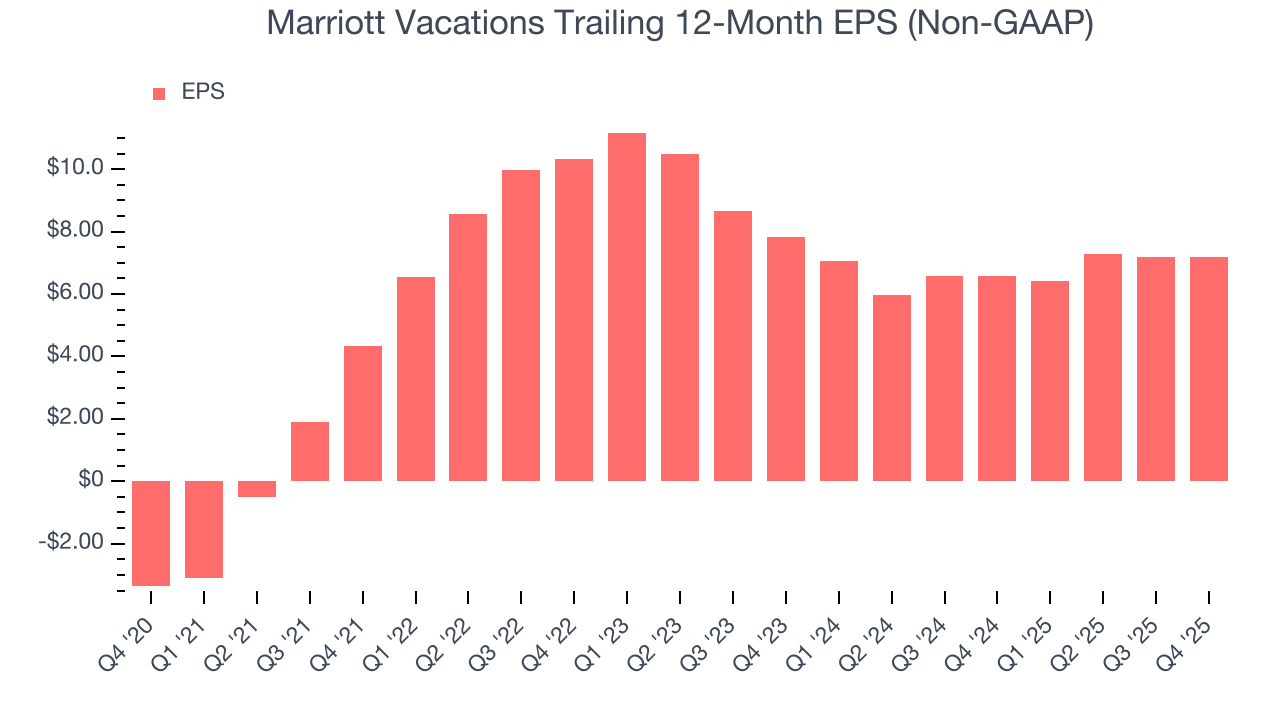
In Q4, Marriott Vacations reported adjusted EPS of $1.86, in line with the same quarter last year. This print beat analysts’ estimates by 9%. Over the next 12 months, Wall Street expects Marriott Vacations’s full-year EPS of $7.17 to shrink by 3.8%.
8. Cash Is King
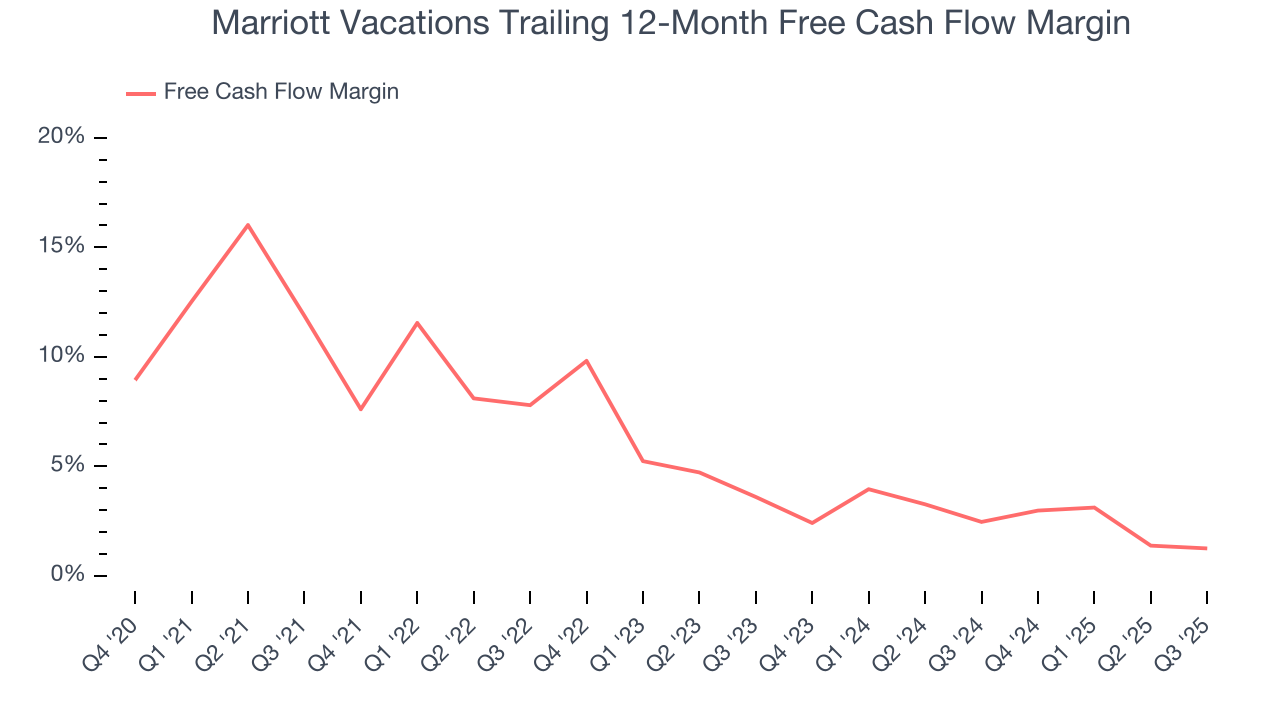
Free cash flow isn't a prominently featured metric in company financials and earnings releases, but we think it's telling because it accounts for all operating and capital expenses, making it tough to manipulate. Cash is king.
Marriott Vacations has shown poor cash profitability over the last two years, giving the company limited opportunities to return capital to shareholders. Its free cash flow margin averaged 1.4%, lousy for a consumer discretionary business.
9. Return on Invested Capital (ROIC)
EPS and free cash flow tell us whether a company was profitable while growing its revenue. But was it capital-efficient? A company’s ROIC explains this by showing how much operating profit it makes compared to the money it has raised (debt and equity).
Marriott Vacations historically did a mediocre job investing in profitable growth initiatives. Its five-year average ROIC was 6.2%, somewhat low compared to the best consumer discretionary companies that consistently pump out 25%+.
We like to invest in businesses with high returns, but the trend in a company’s ROIC is what often surprises the market and moves the stock price. Unfortunately, Marriott Vacations’s ROIC averaged 1.8 percentage point decreases each year over the last few years. Paired with its already low returns, these declines suggest its profitable growth opportunities are few and far between.
10. Balance Sheet Assessment
Marriott Vacations reported $733 million of cash and $3.53 billion of debt on its balance sheet in the most recent quarter. As investors in high-quality companies, we primarily focus on two things: 1) that a company’s debt level isn’t too high and 2) that its interest payments are not excessively burdening the business.
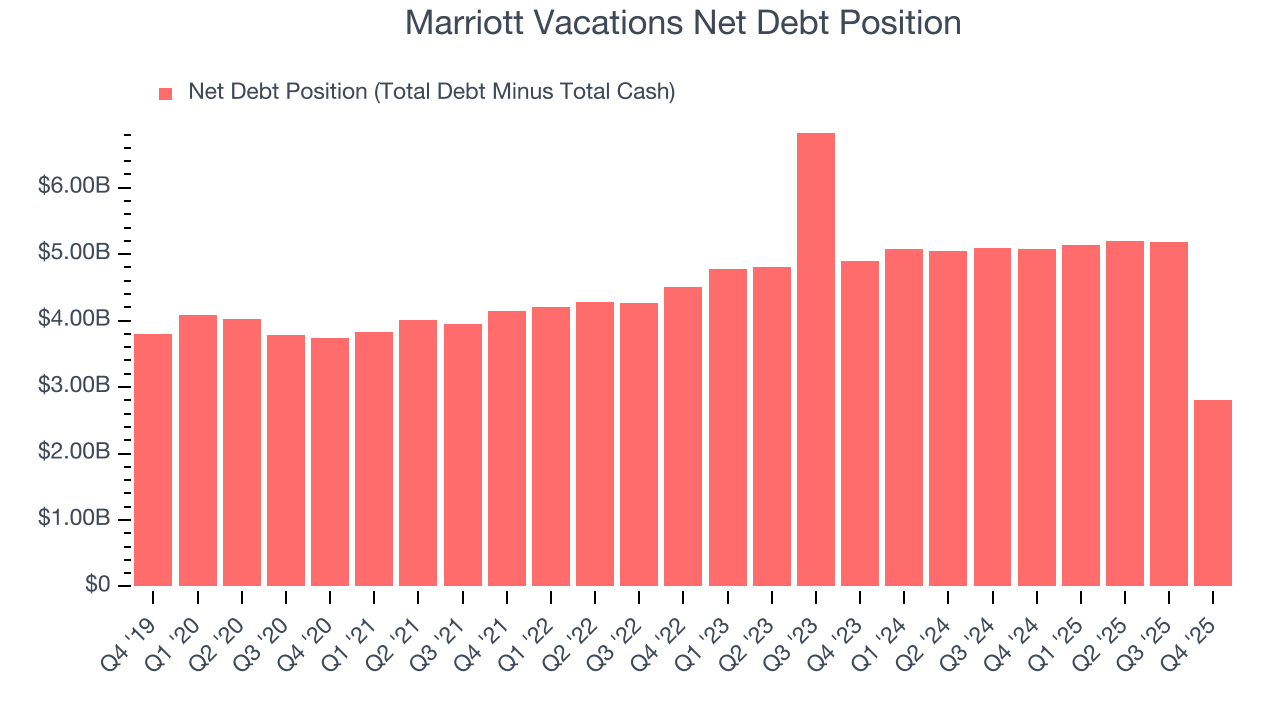
With $751 million of EBITDA over the last 12 months, we view Marriott Vacations’s 3.7× net-debt-to-EBITDA ratio as safe. We also see its $169 million of annual interest expenses as appropriate. The company’s profits give it plenty of breathing room, allowing it to continue investing in growth initiatives.
11. Key Takeaways from Marriott Vacations’s Q4 Results
It was encouraging to see Marriott Vacations’s full-year EBITDA guidance beat analysts’ expectations. We were also glad its EPS outperformed Wall Street’s estimates. Overall, we think this was a solid quarter with some key areas of upside. The stock traded up 8.7% to $63.02 immediately after reporting.
12. Is Now The Time To Buy Marriott Vacations?
Updated: March 15, 2026 at 10:54 PM EDT
Before making an investment decision, investors should account for Marriott Vacations’s business fundamentals and valuation in addition to what happened in the latest quarter.
We see the value of companies helping consumers, but in the case of Marriott Vacations, we’re out. On top of that, Marriott Vacations’s number of conducted tours has disappointed, and its projected EPS for the next year is lacking.
Marriott Vacations’s P/E ratio based on the next 12 months is 8.5x. While this valuation is optically cheap, the potential downside is huge given its shaky fundamentals. There are more exciting stocks to buy at the moment.
Wall Street analysts have a consensus one-year price target of $78.60 on the company (compared to the current share price of $64.43).
Although the price target is bullish, readers should exercise caution because analysts tend to be overly optimistic. The firms they work for, often big banks, have relationships with companies that extend into fundraising, M&A advisory, and other rewarding business lines. As a result, they typically hesitate to say bad things for fear they will lose out. We at StockStory do not suffer from such conflicts of interest, so we’ll always tell it like it is.