
ASGN (ASGN)
ASGN is in for a bumpy ride. Its sales have underperformed and its low returns on capital show it has few growth opportunities.― StockStory Analyst Team


1. News


2. Summary
Why We Think ASGN Will Underperform
Evolving from its roots in IT staffing to become a high-end technology consulting powerhouse, ASGN (NYSE:ASGN) provides specialized IT consulting services and staffing solutions to Fortune 1000 companies and U.S. federal government agencies.
- Customers postponed purchases of its products and services this cycle as its revenue declined by 6.2% annually over the last two years
- Incremental sales over the last five years were less profitable as its earnings per share were flat while its revenue grew
- Demand will likely be weak over the next 12 months as Wall Street expects flat revenue
ASGN is in the penalty box. We believe there are better opportunities elsewhere.
Why There Are Better Opportunities Than ASGN







ASGN is trading at $50.74 per share, or 10.6x forward P/E. ASGN’s multiple may seem like a great deal among business services peers, but we think there are valid reasons why it’s this cheap.
We’d rather pay up for companies with elite fundamentals than get a bargain on weak ones. Cheap stocks can be value traps, and as their performance deteriorates, they will stay cheap or get even cheaper.
3. ASGN (ASGN) Research Report: Q3 CY2025 Update
IT services provider ASGN (NYSE:ASGN) reported Q3 CY2025 results topping the market’s revenue expectations, but sales fell by 1.9% year on year to $1.01 billion. On the other hand, next quarter’s revenue guidance of $970 million was less impressive, coming in 0.6% below analysts’ estimates. Its non-GAAP profit of $1.31 per share was 7.1% above analysts’ consensus estimates.
ASGN (ASGN) Q3 CY2025 Highlights:
- Revenue: $1.01 billion vs analyst estimates of $1.00 billion (1.9% year-on-year decline, 0.7% beat)
- Adjusted EPS: $1.31 vs analyst estimates of $1.22 (7.1% beat)
- Adjusted EBITDA: $112.6 million vs analyst estimates of $110.5 million (11.1% margin, 1.9% beat)
- Revenue Guidance for Q4 CY2025 is $970 million at the midpoint, below analyst estimates of $975.4 million
- Adjusted EPS guidance for Q4 CY2025 is $1.16 at the midpoint, roughly in line with what analysts were expecting
- EBITDA guidance for Q4 CY2025 is $104.5 million at the midpoint, in line with analyst expectations
- Operating Margin: 6.7%, in line with the same quarter last year
- Free Cash Flow Margin: 7.1%, down from 12.4% in the same quarter last year
- Market Capitalization: $2.10 billion
Company Overview
Evolving from its roots in IT staffing to become a high-end technology consulting powerhouse, ASGN (NYSE:ASGN) provides specialized IT consulting services and staffing solutions to Fortune 1000 companies and U.S. federal government agencies.
ASGN operates through two main segments: Commercial (71% of revenue) and Federal Government (29%). The Commercial segment delivers IT services across five industry verticals: Financial Services, Consumer and Industrial, Technology/Media/Telecom, Healthcare, and Business/Government Services. The Federal segment provides solutions to defense, intelligence, and civilian agencies.
The company's business model centers on deploying skilled IT professionals for both short-term projects and long-term consulting engagements. ASGN maintains a diverse talent pool of onshore, nearshore, and offshore professionals with expertise in high-demand areas like cloud computing, data analytics, cybersecurity, and artificial intelligence. For example, a financial services client might engage ASGN consultants to implement a cloud migration strategy or develop AI-powered fraud detection systems.
ASGN has strategically shifted toward higher-margin IT consulting work, which now represents over half of its revenue. This evolution allows the company to deliver more complex solutions while maintaining its traditional staffing business. The company generates revenue by billing clients for the services of its consultants, typically on a time and materials basis or through fixed-price project engagements.
To stay competitive, ASGN invests in six core areas: leadership development, recruitment of in-demand skillsets, training programs, strategic partnerships, internal AI tools, and client AI roadmaps. The company has built specialized capabilities in emerging technologies, maintaining over 1,000 certifications in AI and machine learning alone through its Data and AI Center of Excellence.
ASGN has supplemented its organic growth with strategic acquisitions, completing 11 "tuck-in" purchases over a recent five-year period to expand its service capabilities and market reach. The company operates primarily in North America with additional delivery centers in Mexico, Europe, and India.
4. IT Services & Consulting
IT Services & Consulting companies stand to benefit from increasing enterprise demand for digital transformation, AI-driven automation, and cybersecurity resilience. Many enterprises can't attack these topics alone and need IT services and consulting on everything from technical advice to implementation. Challenges in meeting these needs will include finding talent in specialized and evolving IT fields. While AI and automation can enhance productivity, they also threaten to commoditize certain consulting functions. Another ongoing challenge will be pricing pressures from offshore IT service providers, which have lower labor costs and increasingly equal access to advanced technology like AI.
ASGN competes with other IT services and staffing firms including Accenture (NYSE: ACN), Cognizant (NASDAQ: CTSH), EPAM Systems (NYSE: EPAM), and Kforce (NASDAQ: KFRC), as well as with the consulting arms of major technology companies and specialized government contractors.
5. Revenue Growth
A company’s long-term performance is an indicator of its overall quality. Any business can put up a good quarter or two, but many enduring ones grow for years.
With $3.99 billion in revenue over the past 12 months, ASGN is a mid-sized business services company, which sometimes brings disadvantages compared to larger competitors benefiting from better economies of scale.
As you can see below, ASGN grew its sales at a sluggish 2.6% compounded annual growth rate over the last five years. This shows it failed to generate demand in any major way and is a rough starting point for our analysis.
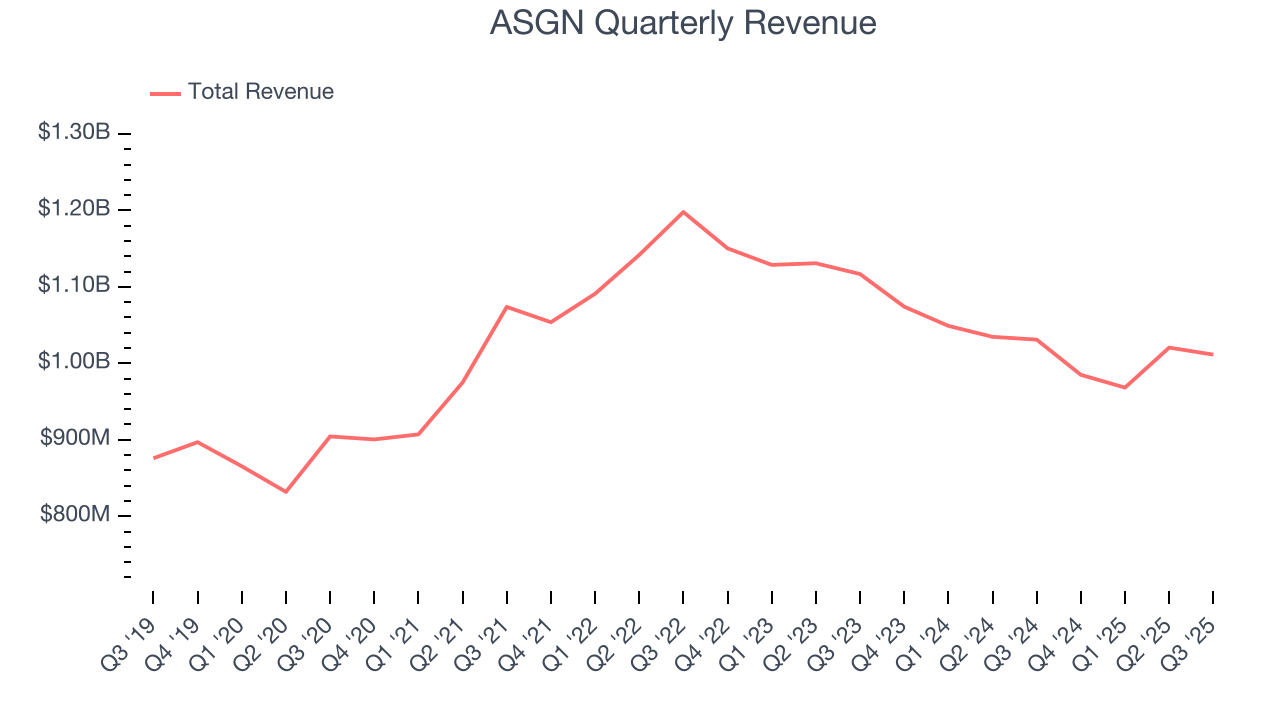
Long-term growth is the most important, but within business services, a half-decade historical view may miss new innovations or demand cycles. ASGN’s performance shows it grew in the past but relinquished its gains over the last two years, as its revenue fell by 6.2% annually. 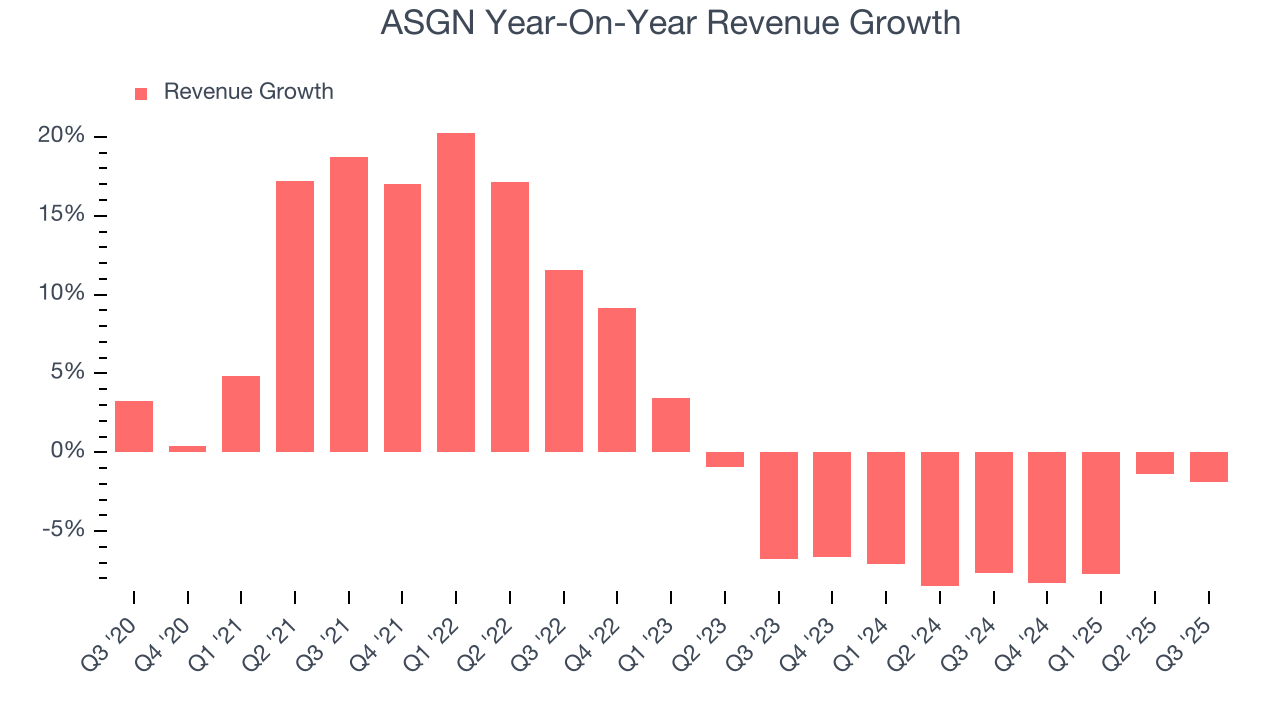
This quarter, ASGN’s revenue fell by 1.9% year on year to $1.01 billion but beat Wall Street’s estimates by 0.7%. Company management is currently guiding for a 1.5% year-on-year decline in sales next quarter.
Looking further ahead, sell-side analysts expect revenue to remain flat over the next 12 months. While this projection implies its newer products and services will fuel better top-line performance, it is still below average for the sector.
6. Operating Margin
ASGN was profitable over the last five years but held back by its large cost base. Its average operating margin of 8% was weak for a business services business.
Looking at the trend in its profitability, ASGN’s operating margin decreased by 2.3 percentage points over the last five years. This raises questions about the company’s expense base because its revenue growth should have given it leverage on its fixed costs, resulting in better economies of scale and profitability. ASGN’s performance was poor no matter how you look at it - it shows that costs were rising and it couldn’t pass them onto its customers.
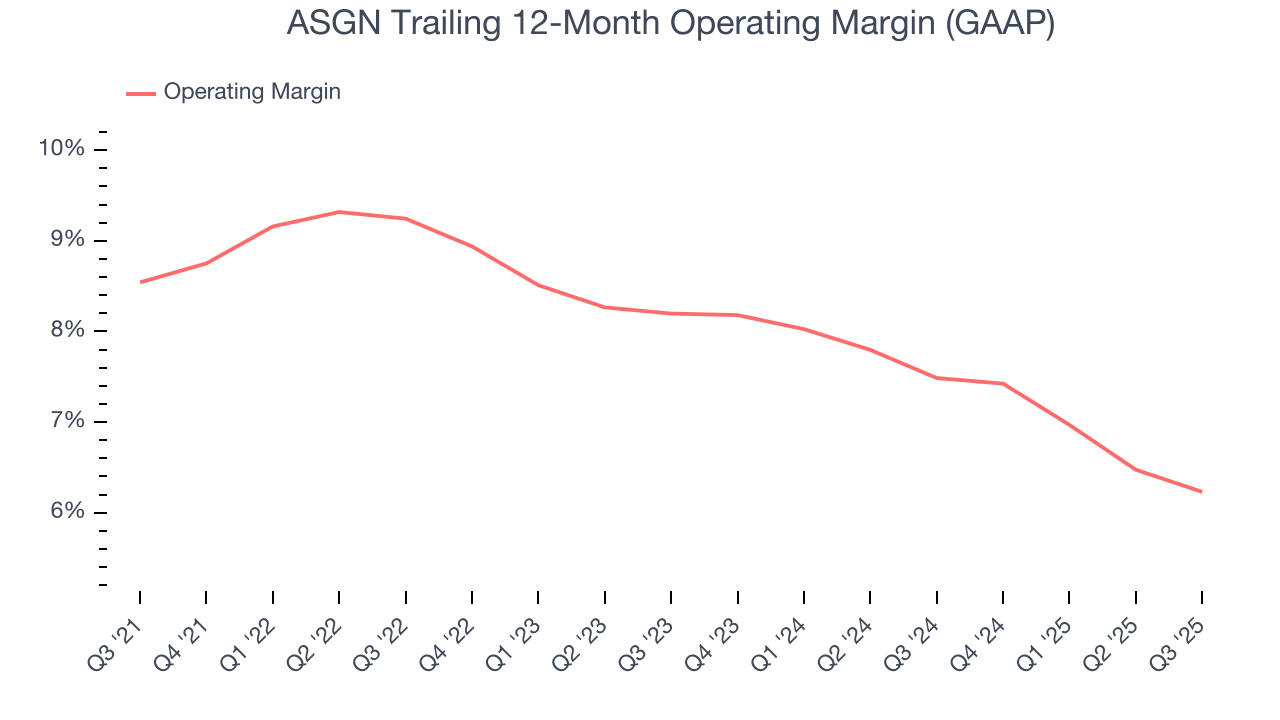
This quarter, ASGN generated an operating margin profit margin of 6.7%, in line with the same quarter last year. This indicates the company’s overall cost structure has been relatively stable.
7. Earnings Per Share
Revenue trends explain a company’s historical growth, but the long-term change in earnings per share (EPS) points to the profitability of that growth – for example, a company could inflate its sales through excessive spending on advertising and promotions.
ASGN’s flat EPS over the last five years was below its 2.6% annualized revenue growth. This tells us the company became less profitable on a per-share basis as it expanded due to non-fundamental factors such as interest expenses and taxes.
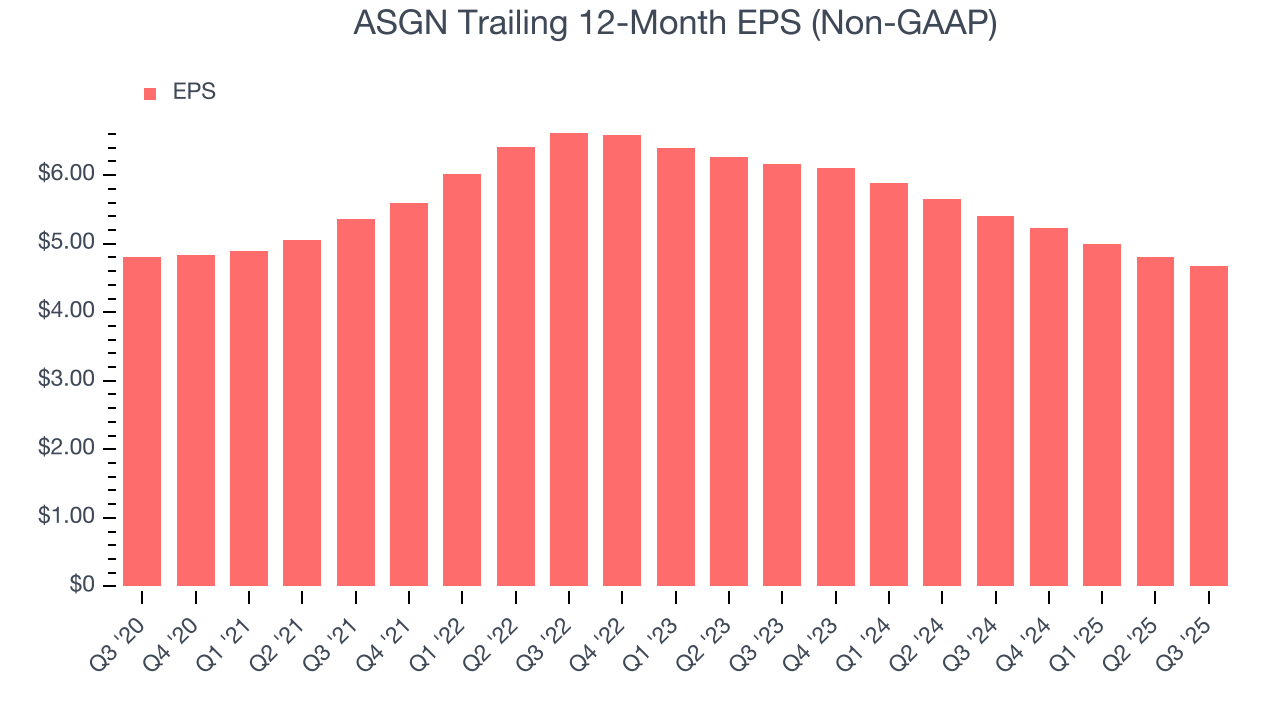
Diving into the nuances of ASGN’s earnings can give us a better understanding of its performance. As we mentioned earlier, ASGN’s operating margin was flat this quarter but declined by 2.3 percentage points over the last five years. This was the most relevant factor (aside from the revenue impact) behind its lower earnings; interest expenses and taxes can also affect EPS but don’t tell us as much about a company’s fundamentals.
Like with revenue, we analyze EPS over a shorter period to see if we are missing a change in the business.
For ASGN, its two-year annual EPS declines of 12.8% show its recent history was to blame for its underperformance over the last five years. These results were bad no matter how you slice the data.
In Q3, ASGN reported adjusted EPS of $1.31, down from $1.43 in the same quarter last year. Despite falling year on year, this print beat analysts’ estimates by 7.1%. Over the next 12 months, Wall Street expects ASGN’s full-year EPS of $4.68 to grow 2.7%.
8. Cash Is King
If you’ve followed StockStory for a while, you know we emphasize free cash flow. Why, you ask? We believe that in the end, cash is king, and you can’t use accounting profits to pay the bills.
ASGN has shown impressive cash profitability, giving it the option to reinvest or return capital to investors. The company’s free cash flow margin averaged 7.1% over the last five years, better than the broader business services sector. The divergence from its underwhelming operating margin stems from the add-back of non-cash charges like depreciation and stock-based compensation. GAAP operating profit expenses these line items, but free cash flow does not.
Taking a step back, we can see that ASGN’s margin dropped by 1.5 percentage points during that time. Continued declines could signal it is in the middle of an investment cycle.
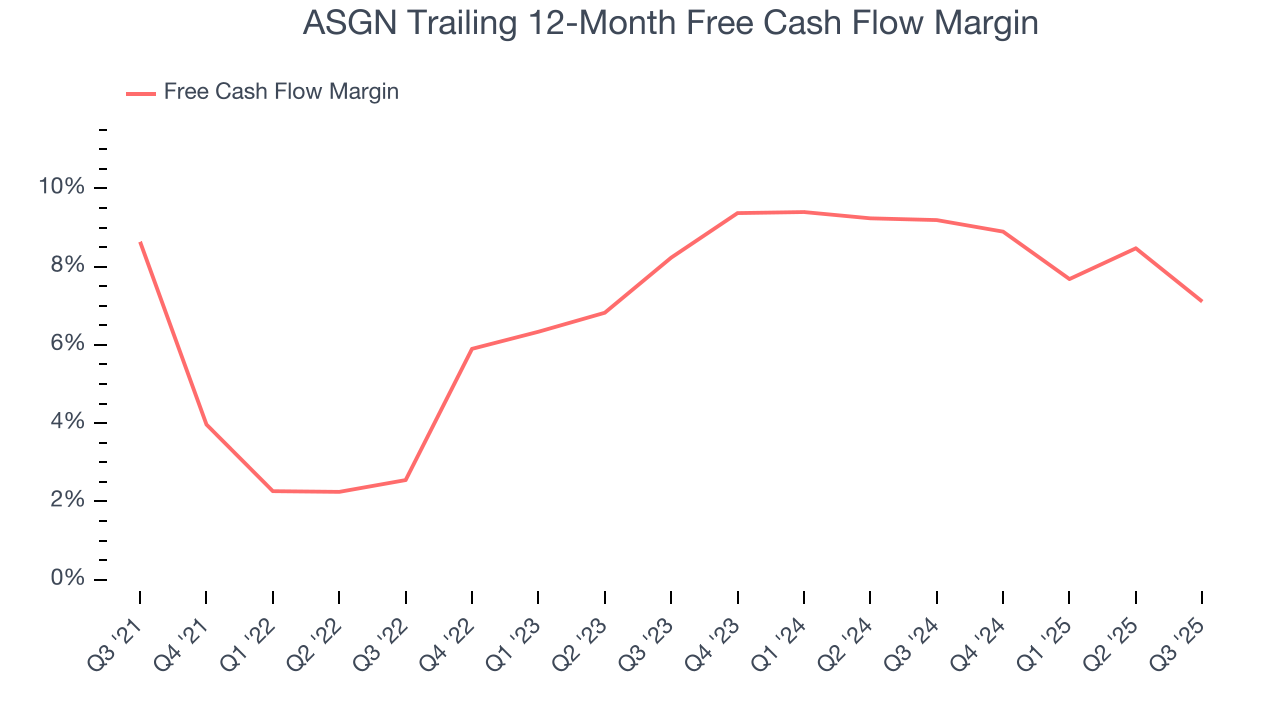
ASGN’s free cash flow clocked in at $72 million in Q3, equivalent to a 7.1% margin. The company’s cash profitability regressed as it was 5.3 percentage points lower than in the same quarter last year, suggesting its historical struggles have dragged on.
9. Return on Invested Capital (ROIC)
EPS and free cash flow tell us whether a company was profitable while growing its revenue. But was it capital-efficient? Enter ROIC, a metric showing how much operating profit a company generates relative to the money it has raised (debt and equity).
ASGN historically did a mediocre job investing in profitable growth initiatives. Its five-year average ROIC was 9.7%, somewhat low compared to the best business services companies that consistently pump out 25%+.
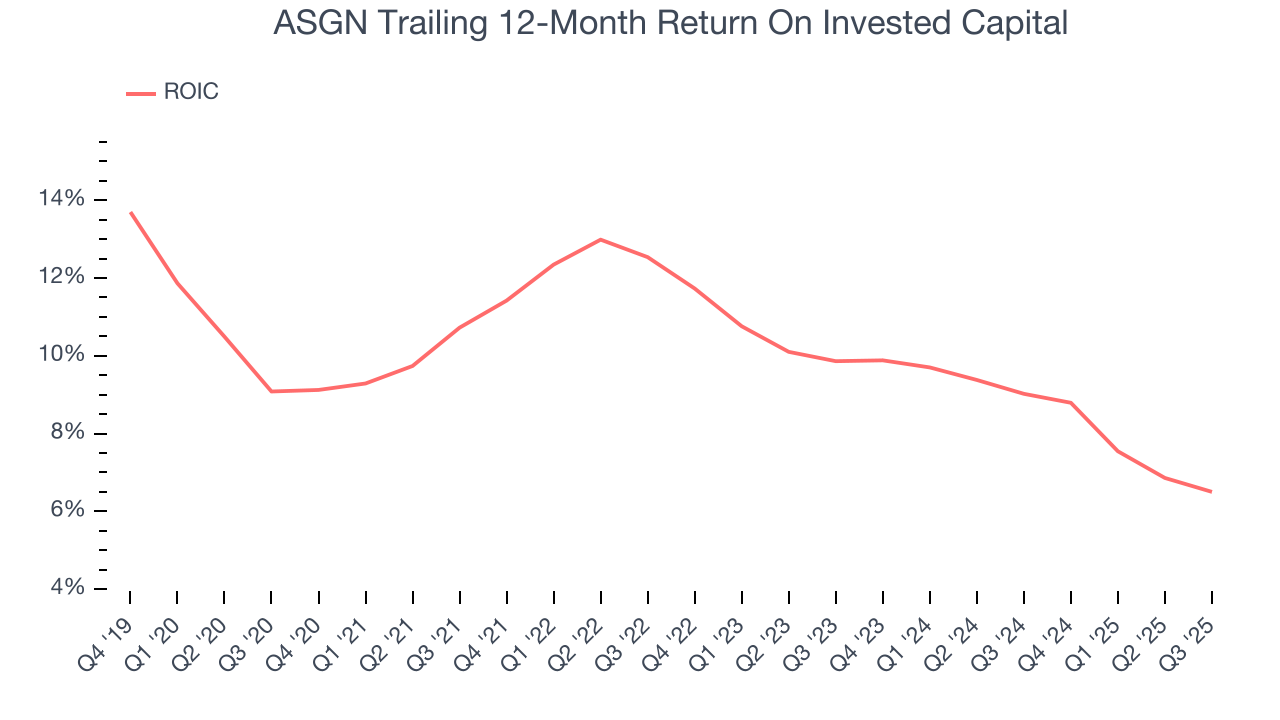
We like to invest in businesses with high returns, but the trend in a company’s ROIC is what often surprises the market and moves the stock price. On average, ASGN’s ROIC decreased by 3.9 percentage points annually over the last few years. Paired with its already low returns, these declines suggest its profitable growth opportunities are few and far between.
10. Balance Sheet Assessment
ASGN reported $126.5 million of cash and $1.17 billion of debt on its balance sheet in the most recent quarter. As investors in high-quality companies, we primarily focus on two things: 1) that a company’s debt level isn’t too high and 2) that its interest payments are not excessively burdening the business.
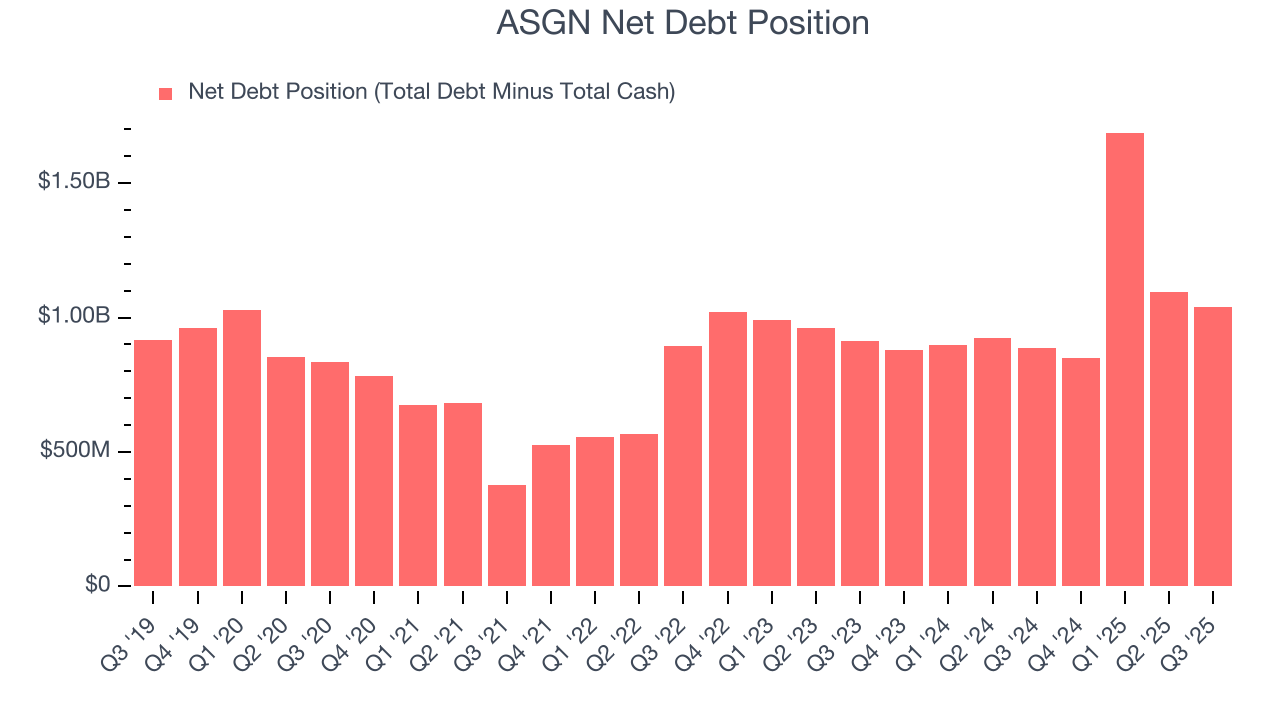
With $424.4 million of EBITDA over the last 12 months, we view ASGN’s 2.4× net-debt-to-EBITDA ratio as safe. We also see its $31.1 million of annual interest expenses as appropriate. The company’s profits give it plenty of breathing room, allowing it to continue investing in growth initiatives.
11. Key Takeaways from ASGN’s Q3 Results
It was good to see ASGN beat analysts’ EPS expectations this quarter. We were also happy its revenue narrowly outperformed Wall Street’s estimates. On the other hand, its revenue guidance for next quarter slightly missed. Zooming out, we think this was a mixed quarter. The stock remained flat at $48.33 immediately after reporting.
12. Is Now The Time To Buy ASGN?
Updated: January 26, 2026 at 11:29 PM EST
Are you wondering whether to buy ASGN or pass? We urge investors to not only consider the latest earnings results but also longer-term business quality and valuation as well.
We see the value of companies helping their customers, but in the case of ASGN, we’re out. To begin with, its revenue growth was uninspiring over the last five years, and analysts expect its demand to deteriorate over the next 12 months. And while its scale and strong customer awareness give it negotiating power, the downside is its weak EPS growth over the last five years shows it’s failed to produce meaningful profits for shareholders. On top of that, its projected EPS for the next year is lacking.
ASGN’s P/E ratio based on the next 12 months is 10.6x. This valuation tells us it’s a bit of a market darling with a lot of good news priced in - we think there are better opportunities elsewhere.
Wall Street analysts have a consensus one-year price target of $51.17 on the company (compared to the current share price of $50.74).