
Booking (BKNG)
Booking is a sound business. Its strong free cash flow generation allows it to invest in growth while maintaining a margin of safety.― StockStory Analyst Team


1. News






2. Summary
Why Booking Is Interesting
Formerly known as The Priceline Group, Booking Holdings (NASDAQ:BKNG) is the world’s largest online travel agency.
- Platform is difficult to replicate at scale and results in a best-in-class gross margin of 86.7%
- Successful business model is illustrated by its impressive EBITDA margin, and its rise over the last few years was fueled by some leverage on its fixed costs
- On the flip side, its highly competitive market means it’s on the never-ending treadmill of sales and marketing spend
Booking has some respectable qualities. If you like the stock, the price looks fair.
Why Is Now The Time To Buy Booking?





At $4,382 per share, Booking trades at 13x forward EV/EBITDA. Looking at the consumer internet space, we think the multiple is fair for the revenue growth characteristics.
This could be a good time to invest if you think there are underappreciated aspects of the business.
3. Booking (BKNG) Research Report: Q4 CY2025 Update
Online travel agency Booking Holdings (NASDAQ:BKNG) beat Wall Street’s revenue expectations in Q4 CY2025, with sales up 16% year on year to $6.35 billion. Its non-GAAP profit of $48.80 per share was in line with analysts’ consensus estimates.
Booking (BKNG) Q4 CY2025 Highlights:
- Revenue: $6.35 billion vs analyst estimates of $6.13 billion (16% year-on-year growth, 3.6% beat)
- Adjusted EPS: $48.80 vs analyst expectations of $48.67 (in line)
- Adjusted EBITDA: $2.20 billion vs analyst estimates of $2.11 billion (34.6% margin, 3.9% beat)
- Operating Margin: 32%, in line with the same quarter last year
- Free Cash Flow Margin: 22.3%, up from 15.2% in the previous quarter
- Room Nights Booked: 285 million, up 24 million year on year
- Market Capitalization: $133.5 billion
Company Overview
Formerly known as The Priceline Group, Booking Holdings (NASDAQ:BKNG) is the world’s largest online travel agency.
Its businesses span the range of travel offers including Booking.com, Rentalcars.com, Priceline, Agoda (Asia Pacific focused OTA), Kayak (price comparison site), and Opentable (restaurant reservations).
For consumers, Booking Holdings simplifies planning travel, by aggregating supply of hotels, flights, and experiences and using its scale and rewards programs to offer the best prices, while for suppliers, Booking delivers the largest audience of travel shoppers online.
Historically, Booking has held its largest market share in Europe, specifically in hotels, while it has long sought to take market share from market leader Expedia in North America. In 2015 it acquired HomeAway to build up an alternative accommodations business to compete with AirBnB.
4. Online Travel
Because of the enormous number of flights, hotels, and accommodations available, travel is a natural fit for marketplaces that aggregate suppliers, simplifying the shopping process for consumers. Online travel platforms today make up over 50% of the industry’s bookings, a percentage that has been rising for 20 years, and will likely continue in the years ahead.
Booking Holdings (NASDAQ:BKNG) competes with a range of online travel companies such as Expedia (NASDAQ:EXPE), Airbnb (NASDAQ:ABNB), TripAdvisor (NASDAQ:TRIP), Trivago (NASDAQ:TRIV) and Alphabet (NASDAQ: GOOG.L).
5. Revenue Growth
Examining a company’s long-term performance can provide clues about its quality. Any business can put up a good quarter or two, but the best consistently grow over the long haul. Luckily, Booking’s sales grew at a solid 16.3% compounded annual growth rate over the last three years. Its growth beat the average consumer internet company and shows its offerings resonate with customers, a helpful starting point for our analysis.
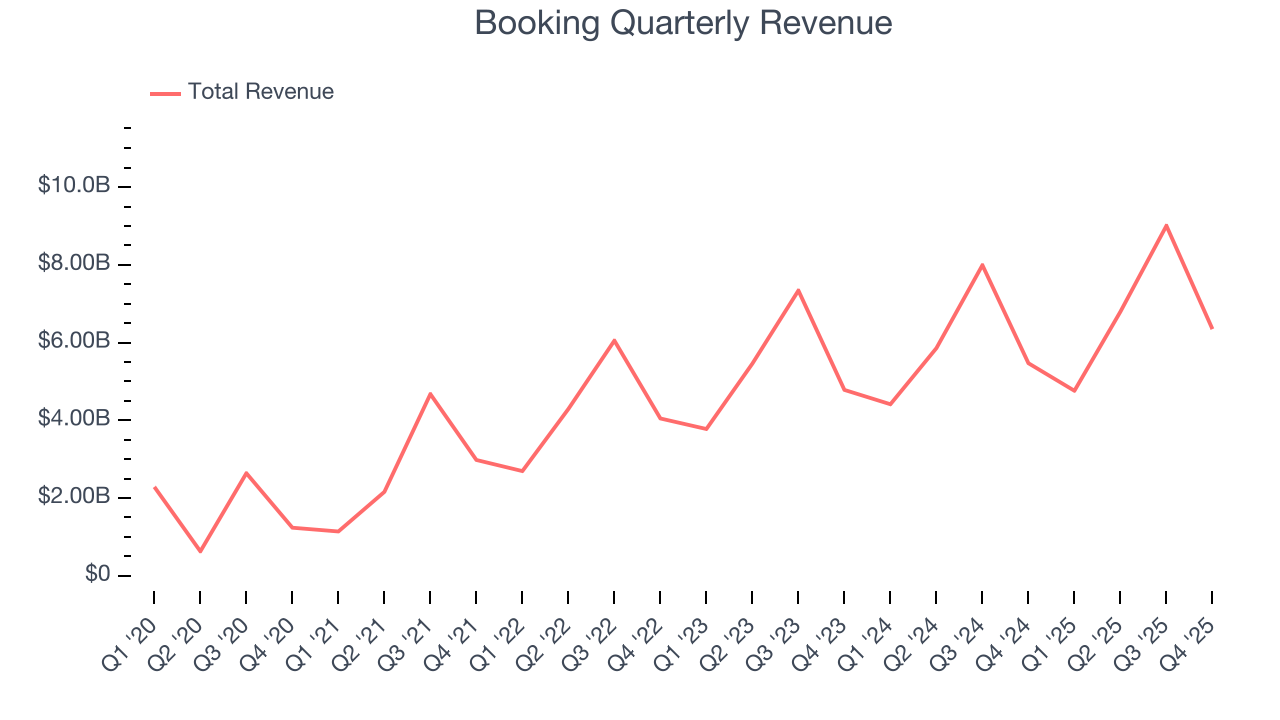
This quarter, Booking reported year-on-year revenue growth of 16%, and its $6.35 billion of revenue exceeded Wall Street’s estimates by 3.6%.
Looking ahead, sell-side analysts expect revenue to grow 8.6% over the next 12 months, a deceleration versus the last three years. This projection doesn't excite us and indicates its products and services will see some demand headwinds. At least the company is tracking well in other measures of financial health.
6. Room Nights Booked
Booking Growth
As an online travel company, Booking generates revenue growth by increasing both the number of stays (or experiences) booked and the commission charged on those bookings.
Over the last two years, Booking’s room nights booked, a key performance metric for the company, increased by 8.6% annually to 285 million in the latest quarter. This growth rate is decent for a consumer internet business and indicates people enjoy using its offerings. 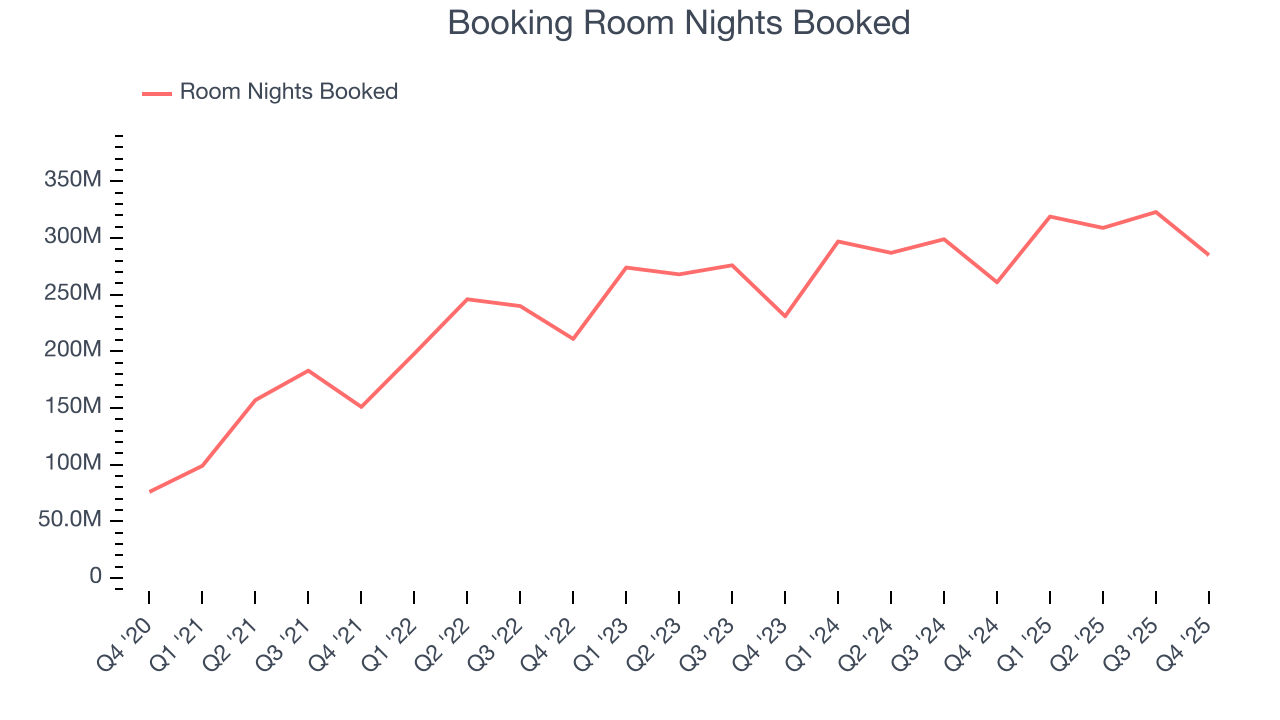
In Q4, Booking added 24 million room nights booked, leading to 9.2% year-on-year growth. The quarterly print isn’t too different from its two-year result, suggesting its new initiatives aren’t accelerating booking growth just yet.
Revenue Per Booking
Average revenue per booking (ARPB) is a critical metric to track because it not only measures how much users book on its platform but also the commission that Booking can charge.
Booking’s ARPB growth has been mediocre over the last two years, averaging 3.6%. This isn’t great, but the increase in room nights booked is more relevant for assessing long-term business potential. We’ll monitor the situation closely; if Booking tries boosting ARPB by taking a more aggressive approach to monetization, it’s unclear whether bookings can continue growing at the current pace. 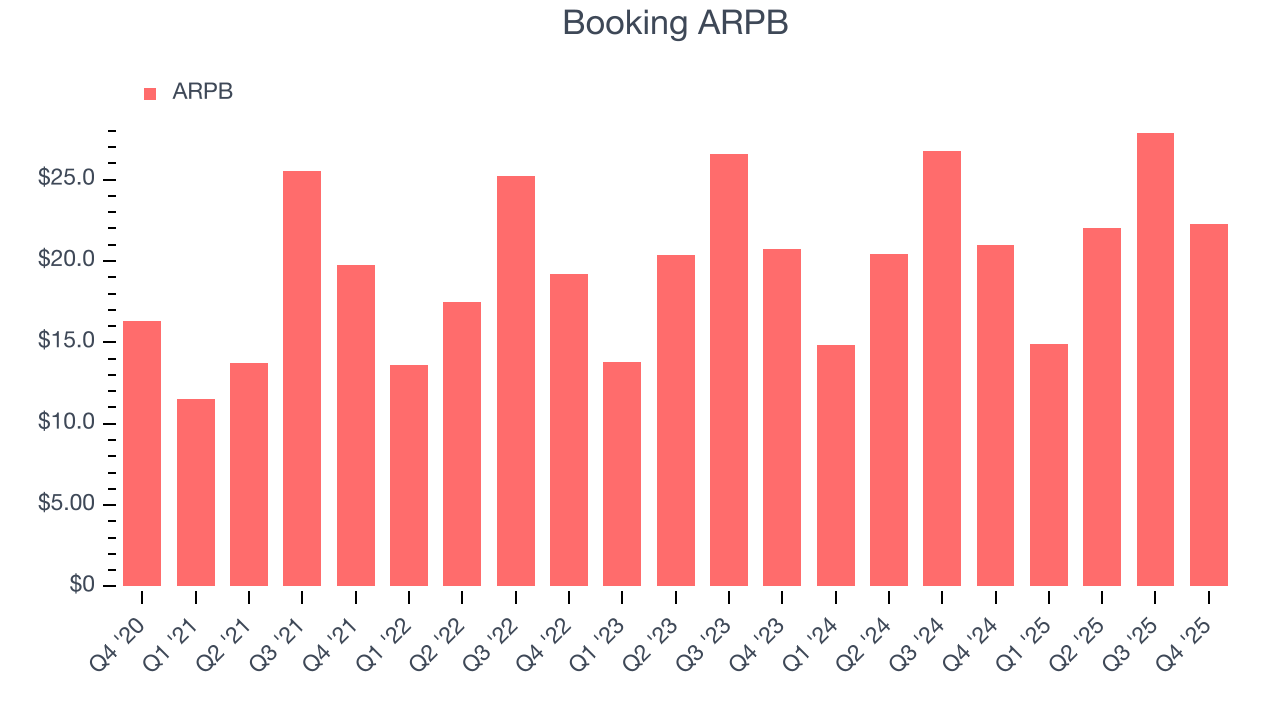
This quarter, Booking’s ARPB clocked in at $22.28. It grew by 6.3% year on year, slower than its booking growth.
7. Gross Margin & Pricing Power
A company’s gross profit margin has a significant impact on its ability to exert pricing power, develop new products, and invest in marketing. These factors can determine the winner in a competitive market.
For online travel businesses like Booking, gross profit tells us how much money the company gets to keep after covering the base cost of its products and services, which typically include customer support, payment processing, fulfillment fees (paid to the airlines, hotels, or car rental companies), and data center expenses to keep the app or website online.
Booking’s gross margin is one of the highest in the consumer internet sector, an output of its asset-lite business model and strong pricing power. It also enables the company to fund large investments in product and marketing during periods of rapid growth to achieve higher profits in the future. As you can see below, it averaged an elite 86.7% gross margin over the last two years. That means Booking only paid its providers $13.34 for every $100 in revenue. 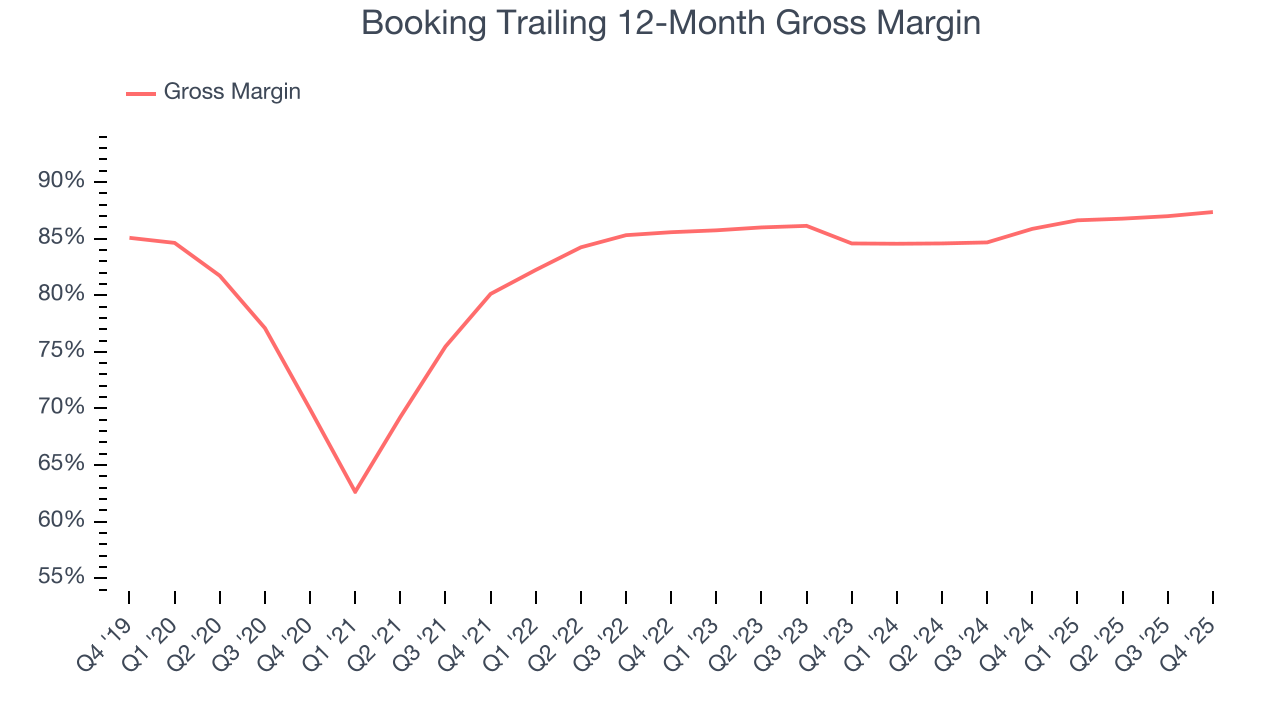
Booking’s gross profit margin came in at 86.3% this quarter, up 1.9 percentage points year on year. Booking’s full-year margin has also been trending up over the past 12 months, increasing by 1.5 percentage points. If this move continues, it could suggest better unit economics due to more leverage from its growing sales on the fixed portion of its cost of goods sold (such as servers).
8. User Acquisition Efficiency
Consumer internet businesses like Booking grow from a combination of product virality, paid advertisement, and incentives (unlike enterprise software products, which are often sold by dedicated sales teams).
It’s relatively expensive for Booking to acquire new users as the company has spent 47.3% of its gross profit on sales and marketing expenses over the last year. This inefficiency indicates that Booking operates in a competitive market and must continue investing to maintain an acceptable growth trajectory. 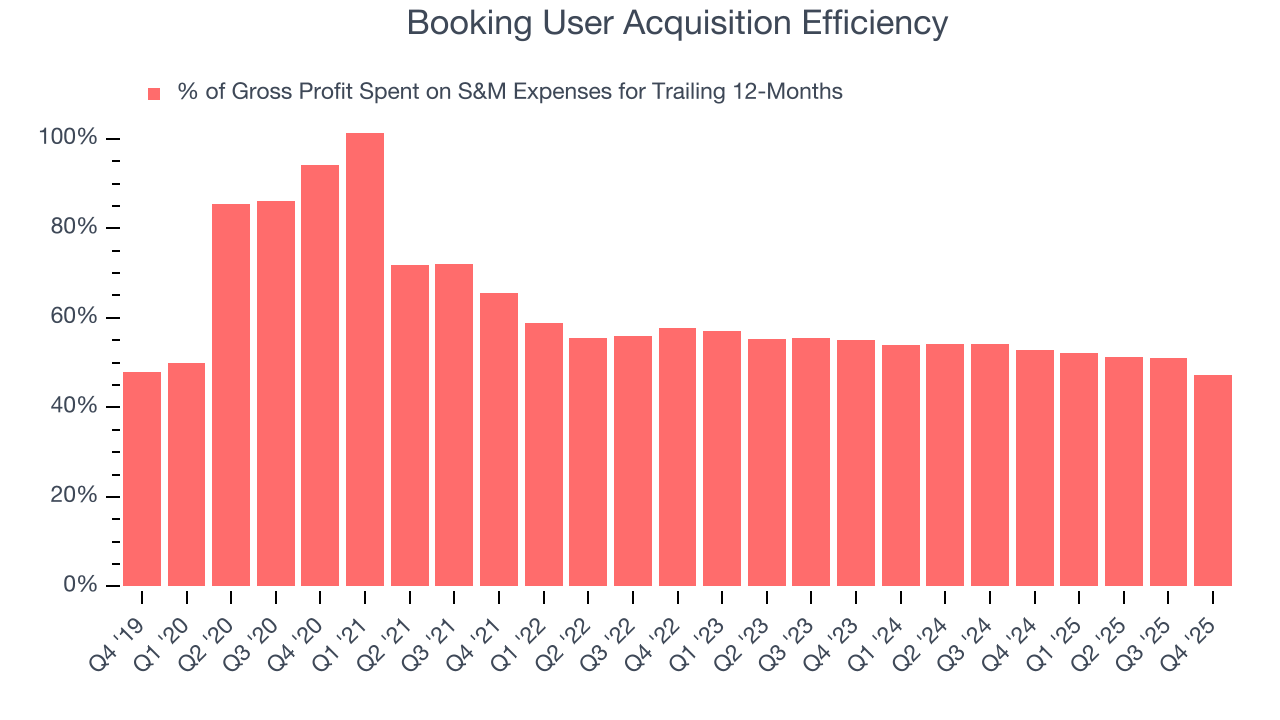
9. EBITDA
Booking has been a well-oiled machine over the last two years. It demonstrated elite profitability for a consumer internet business, boasting an average EBITDA margin of 36%. This result isn’t surprising as its high gross margin gives it a favorable starting point.
Analyzing the trend in its profitability, Booking’s EBITDA margin rose by 5.9 percentage points over the last few years, as its sales growth gave it operating leverage.
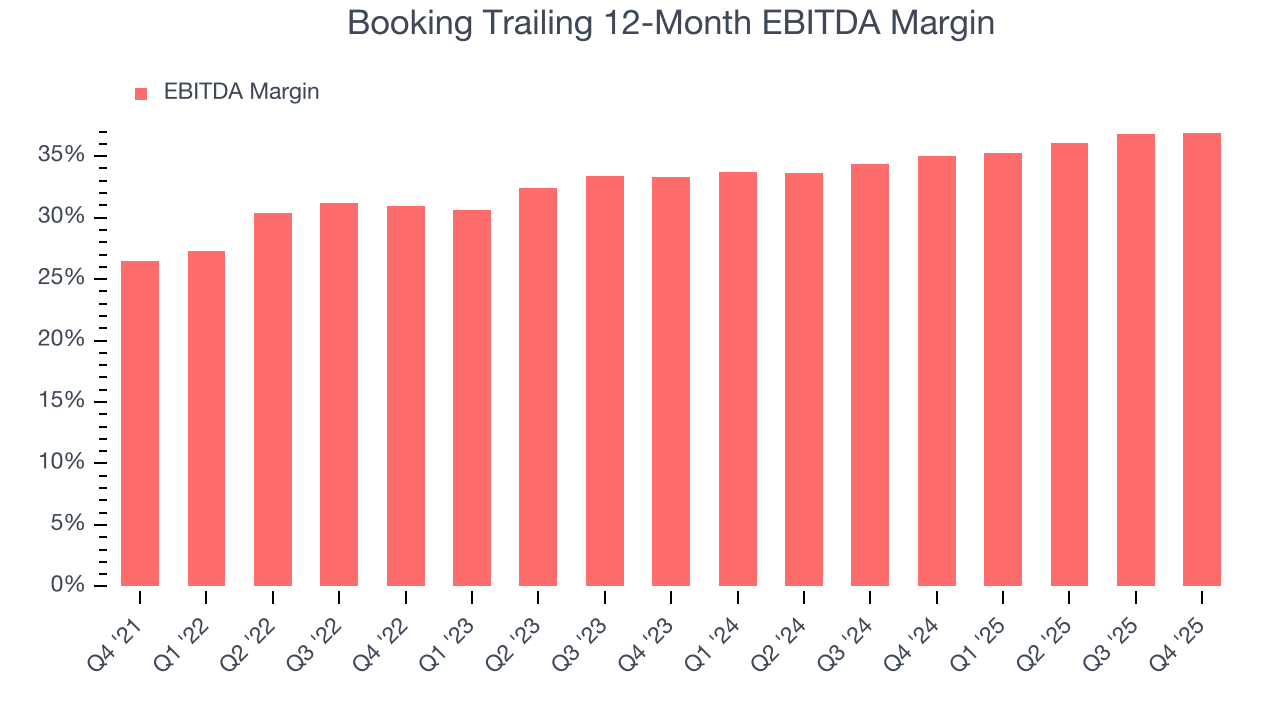
In Q4, Booking generated an EBITDA margin profit margin of 34.6%, in line with the same quarter last year. This indicates the company’s cost structure has recently been stable.
10. Earnings Per Share
Revenue trends explain a company’s historical growth, but the long-term change in earnings per share (EPS) points to the profitability of that growth – for example, a company could inflate its sales through excessive spending on advertising and promotions.
Booking’s EPS grew at an astounding 31.4% compounded annual growth rate over the last three years, higher than its 16.3% annualized revenue growth. This tells us the company became more profitable on a per-share basis as it expanded.
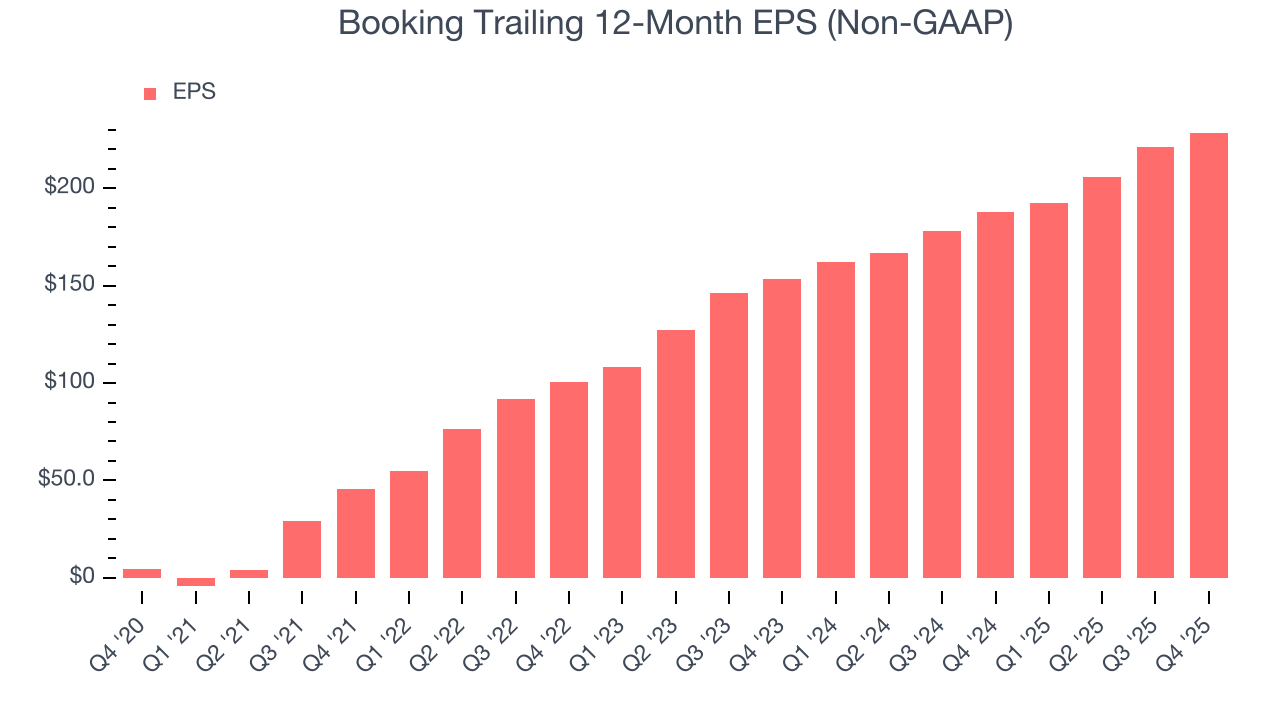
We can take a deeper look into Booking’s earnings quality to better understand the drivers of its performance. As we mentioned earlier, Booking’s EBITDA margin was flat this quarter but expanded by 5.9 percentage points over the last three years. On top of that, its share count shrank by 16.6%. These are positive signs for shareholders because improving profitability and share buybacks turbocharge EPS growth relative to revenue growth. 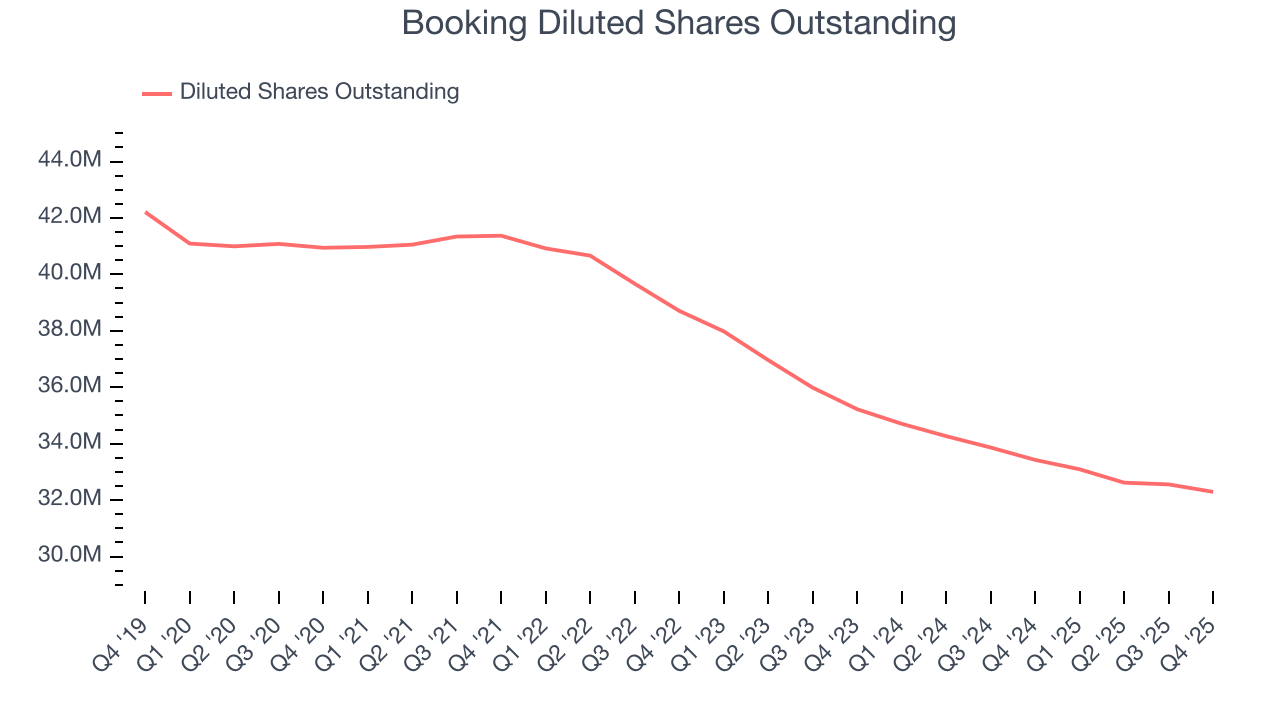
In Q4, Booking reported adjusted EPS of $48.80, up from $41.55 in the same quarter last year. This print was close to analysts’ estimates. Over the next 12 months, Wall Street expects Booking’s full-year EPS of $228.51 to grow 17.5%.
11. Cash Is King
If you’ve followed StockStory for a while, you know we emphasize free cash flow. Why, you ask? We believe that in the end, cash is king, and you can’t use accounting profits to pay the bills.
Booking has shown terrific cash profitability, driven by its lucrative business model that enables it to reinvest, return capital to investors, and stay ahead of the competition while maintaining an ample cushion. The company’s free cash flow margin was among the best in the consumer internet sector, averaging an eye-popping 33.5% over the last two years.
Taking a step back, we can see that Booking’s margin dropped by 2.4 percentage points over the last few years. Rising cash conversion would be ideal, but we’re willing to live with Booking’s performance for now because it’s still one of the more cash generative and investable businesses in its space. If its declines continue, it could signal increasing investment needs and capital intensity.
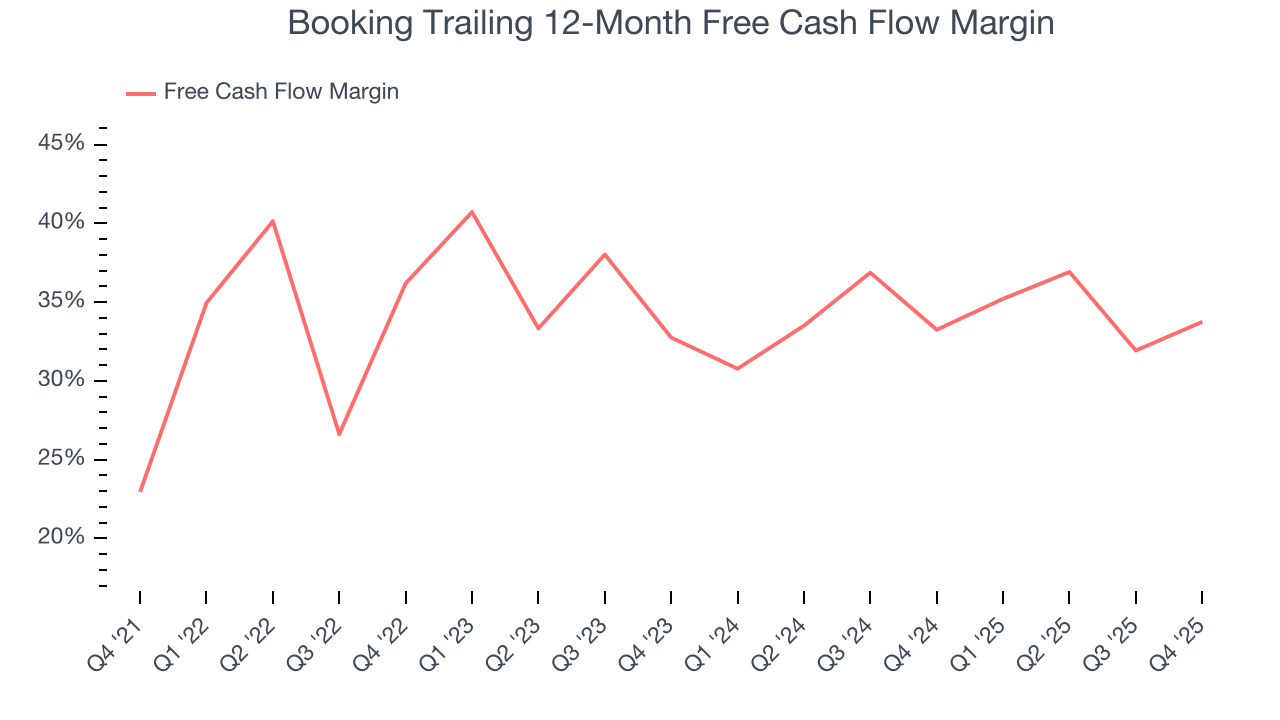
Booking’s free cash flow clocked in at $1.42 billion in Q4, equivalent to a 22.3% margin. This result was good as its margin was 10.5 percentage points higher than in the same quarter last year, but we note it was lower than its two-year cash profitability. Nevertheless, we wouldn’t put too much weight on a single quarter because investment needs can be seasonal, causing short-term swings. Long-term trends are more important.
12. Balance Sheet Assessment
Booking reported $17.2 billion of cash and $18.74 billion of debt on its balance sheet in the most recent quarter. As investors in high-quality companies, we primarily focus on two things: 1) that a company’s debt level isn’t too high and 2) that its interest payments are not excessively burdening the business.
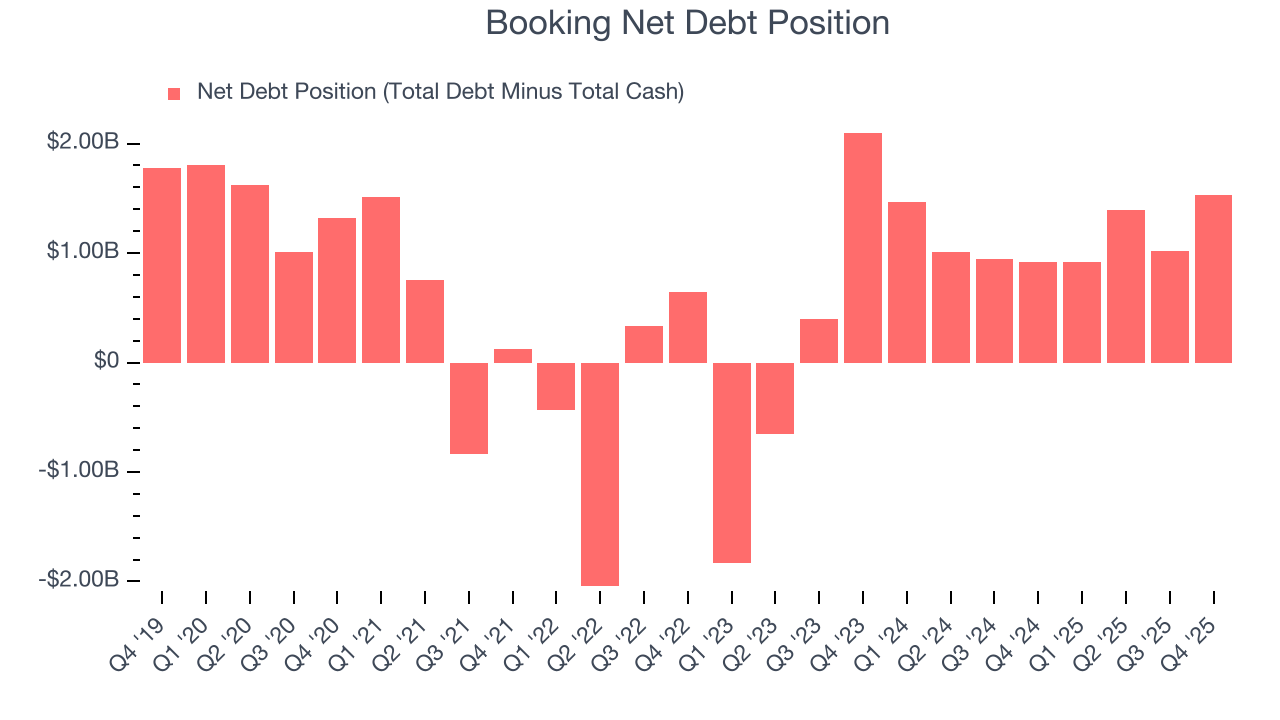
With $9.94 billion of EBITDA over the last 12 months, we view Booking’s 0.2× net-debt-to-EBITDA ratio as safe. We also see its $594 million of annual interest expenses as appropriate. The company’s profits give it plenty of breathing room, allowing it to continue investing in growth initiatives.
13. Key Takeaways from Booking’s Q4 Results
We enjoyed seeing Booking beat analysts’ EBITDA expectations this quarter. We were also happy its revenue outperformed Wall Street’s estimates. Overall, we think this was a decent quarter with some key metrics above expectations. Investors were likely hoping for more, and shares traded down 2.3% to $4,177 immediately following the results.
14. Is Now The Time To Buy Booking?
Updated: March 18, 2026 at 10:20 PM EDT
Before deciding whether to buy Booking or pass, we urge investors to consider business quality, valuation, and the latest quarterly results.
Booking is a fine business. To kick things off, its revenue growth was solid over the last three years. And while its sales and marketing efficiency is subpar, its admirable gross margins are a wonderful starting point for the overall profitability of the business. On top of that, its powerful free cash flow generation enables it to stay ahead of the competition through consistent reinvestment of profits.
Booking’s EV/EBITDA ratio based on the next 12 months is 13x. When scanning the consumer internet space, Booking trades at a fair valuation. For those confident in the business and its management team, this is a good time to invest.
Wall Street analysts have a consensus one-year price target of $5,802 on the company (compared to the current share price of $4,382), implying they see 32.4% upside in buying Booking in the short term.