
Dollar Tree (DLTR)
Dollar Tree is up against the odds. Its low returns on capital and plummeting sales suggest it struggles to generate demand and profits, a red flag.― StockStory Analyst Team


1. News
2. Summary
Why We Think Dollar Tree Will Underperform
A treasure hunt because there’s no guarantee of consistent product selection, Dollar Tree (NASDAQ:DLTR) is a discount retailer that sells general merchandise and select packaged food at extremely low prices.
- Annual sales declines of 11.9% for the past three years show its products struggled to connect with the market
- Underwhelming 6.6% return on capital reflects management’s difficulties in finding profitable growth opportunities, and its shrinking returns suggest its past profit sources are losing steam
- Poor expense management has led to an operating margin that is below the industry average
Dollar Tree is skating on thin ice. You should search for better opportunities.
Why There Are Better Opportunities Than Dollar Tree






Dollar Tree’s stock price of $107.74 implies a valuation ratio of 17.4x forward P/E. The current valuation may be appropriate, but we’re still not buyers of the stock.
There are stocks out there similarly priced with better business quality. We prefer owning these.
3. Dollar Tree (DLTR) Research Report: Q4 CY2025 Update
Discount treasure-hunt retailer Dollar Tree (NASDAQ:DLTR) met Wall Street’s revenue expectations in Q4 CY2025, with sales up 9% year on year to $5.45 billion. The company expects next quarter’s revenue to be around $4.95 billion, close to analysts’ estimates. Its non-GAAP profit of $2.56 per share was 1.1% above analysts’ consensus estimates.
Dollar Tree (DLTR) Q4 CY2025 Highlights:
- Revenue: $5.45 billion vs analyst estimates of $5.46 billion (9% year-on-year growth, in line)
- Adjusted EPS: $2.56 vs analyst estimates of $2.53 (1.1% beat)
- Adjusted EBITDA: $819.2 million vs analyst estimates of $880.7 million (15% margin, 7% miss)
- Revenue Guidance for Q1 CY2026 is $4.95 billion at the midpoint, roughly in line with what analysts were expecting
- Adjusted EPS guidance for the upcoming financial year 2026 is $6.70 at the midpoint, missing analyst estimates by 0.6%
- Operating Margin: 12.7%, in line with the same quarter last year
- Free Cash Flow Margin: 17.8%, up from 10.1% in the same quarter last year
- Same-Store Sales rose 5% year on year (2% in the same quarter last year)
- Market Capitalization: $21.37 billion
Company Overview
A treasure hunt because there’s no guarantee of consistent product selection, Dollar Tree (NASDAQ:DLTR) is a discount retailer that sells general merchandise and select packaged food at extremely low prices.
Founded in 1986 and initially selling items priced at $1 or less, the company has since expanded its selection and price points. However, most items are still under $5 with an extensive selection under $2.
While low prices are an obvious benefit to the consumer, the tradeoff is consistency of selection. One day, a shopper may find bottles of name-brand dish soap for $1 that would sell for much more elsewhere. However, that product may not be available weeks later. This is why the Dollar Tree experience is often called a treasure hunt. The company’s sourcing and logistics capabilities are a key reason prices are so low. Shorter-term deals and arbitrage opportunities are prioritized by the merchandising team over long-term supplier agreements.
Dollar Tree is known for party supplies, holiday décor, home goods, toys, and a limited snack selection, but the company also operates the Family Dollar banner. Acquired in 2015, Family Dollar focuses more on food and consistent selection to serve the grocery needs of lower-income households. The concept competes most directly with Dollar General and looks to locate stores in rural or suburban areas not served well by large regional grocery chains or general merchandise behemoths like Walmart.
4. Discount Grocery Store
Traditional grocery stores are go-tos for many families, but discount grocers serve those who may not have a traditional grocery store nearby or who may have different spending thresholds. Certain rural or lower-income areas simply don’t have a grocery store. Additionally, some lower-income families would prefer to buy in smaller quantities than available at most stores (think one or two paper towel rolls at a time). While online competition threatens all of retail, grocery is one of the least penetrated because of the nature of buying food. Furthermore, those buying small quantities for immediate need are even less likely to leverage e-commerce for these purposes.
Competitors that offer a treasure-hunt experience centered around general merchandise and/or snacks include Five Below (NASDAQ:FIVE), Dollarama (TSX:DOL), and TJX (NYSE:TJX).
5. Revenue Growth
A company’s long-term sales performance is one signal of its overall quality. Any business can experience short-term success, but top-performing ones enjoy sustained growth for years.
With $19.41 billion in revenue over the past 12 months, Dollar Tree is one of the larger companies in the consumer retail industry and benefits from a well-known brand that influences purchasing decisions. However, its scale is a double-edged sword because there is only so much real estate to build new stores, placing a ceiling on its growth. To expand meaningfully, Dollar Tree likely needs to tweak its prices or enter new markets.
As you can see below, Dollar Tree struggled to generate demand over the last three years. Its sales dropped by 11.8% annually as it didn’t open many new stores.
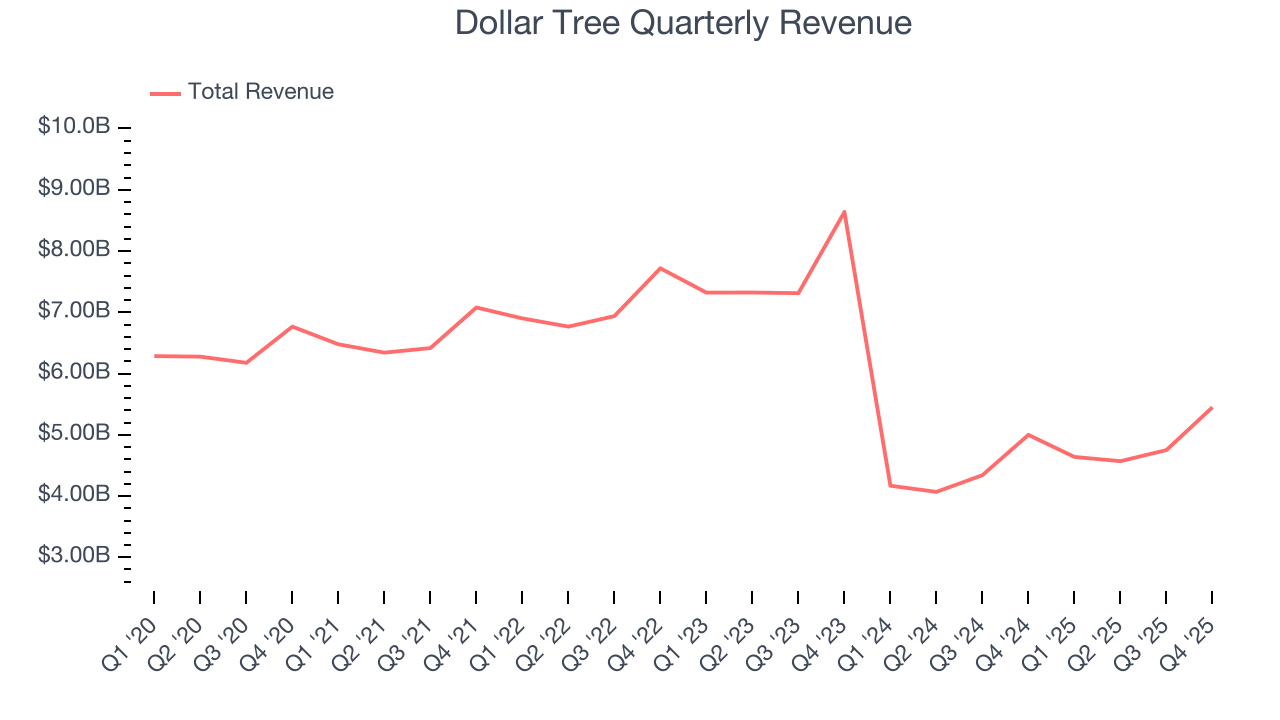
This quarter, Dollar Tree grew its revenue by 9% year on year, and its $5.45 billion of revenue was in line with Wall Street’s estimates. Company management is currently guiding for a 6.7% year-on-year increase in sales next quarter.
Looking further ahead, sell-side analysts expect revenue to grow 6.3% over the next 12 months, an acceleration versus the last three years. This projection is particularly noteworthy for a company of its scale and indicates its newer products will catalyze better top-line performance.
6. Store Performance
Number of Stores
The number of stores a retailer operates is a critical driver of how quickly company-level sales can grow.
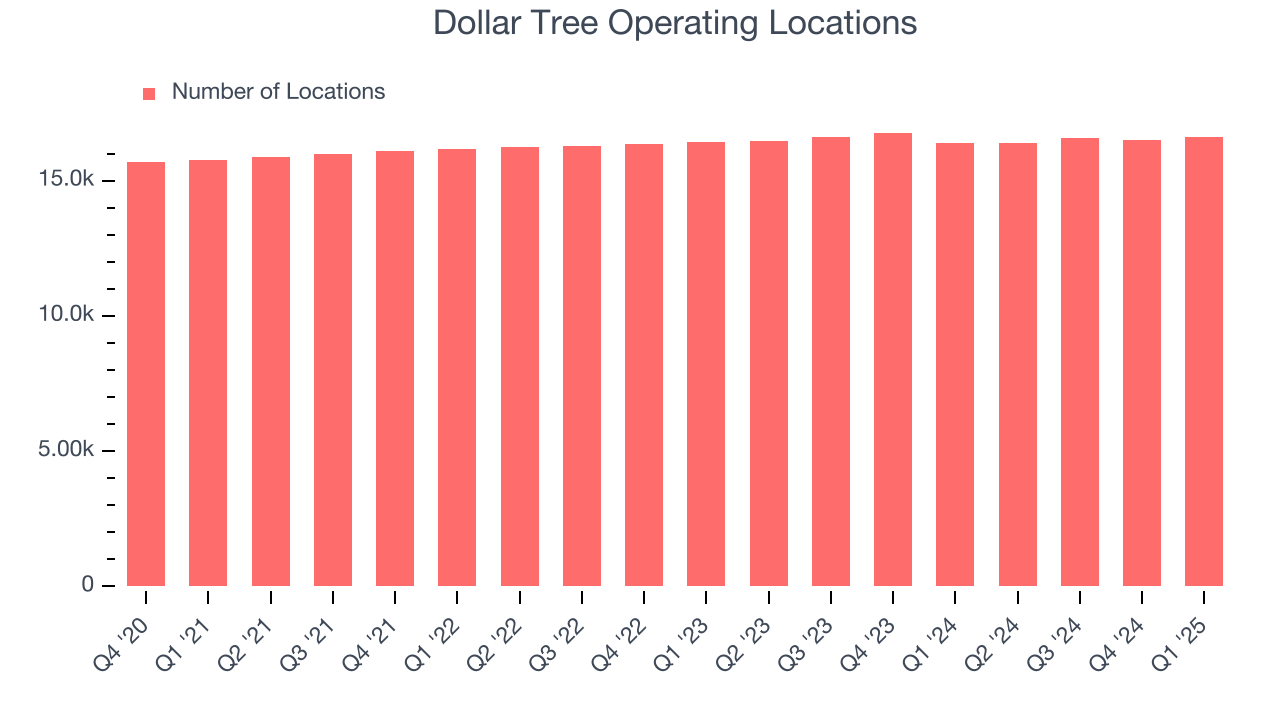
Dollar Tree has kept its store count flat over the last two years while other consumer retail businesses have opted for growth.
When a retailer keeps its store footprint steady, it usually means demand is stable and it’s focusing on operational efficiency to increase profitability.
Note that Dollar Tree reports its store count intermittently, so some data points are missing in the chart below.
Same-Store Sales
A company's store base only paints one part of the picture. When demand is high, it makes sense to open more. But when demand is low, it’s prudent to close some locations and use the money in other ways. Same-store sales provides a deeper understanding of this issue because it measures organic growth at brick-and-mortar shops for at least a year.
Dollar Tree’s demand has been spectacular for a retailer over the last two years. On average, the company has increased its same-store sales by an impressive 3.3% per year. Given its flat store base over the same period, this performance stems from not only increased foot traffic at existing locations but also higher e-commerce sales as demand shifts from in-store to online.
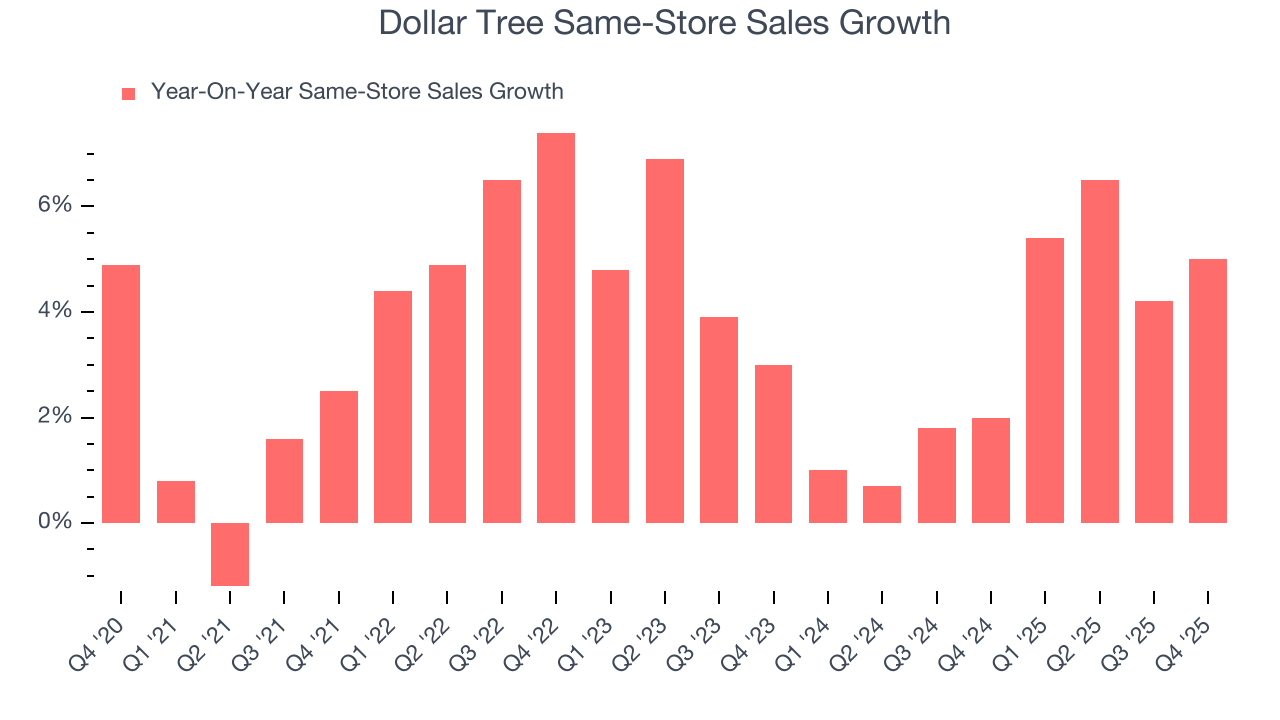
In the latest quarter, Dollar Tree’s same-store sales rose 5% year on year. This growth was an acceleration from its historical levels, which is always an encouraging sign.
7. Gross Margin & Pricing Power
Dollar Tree has bad unit economics for a retailer, giving it less room to reinvest and grow its presence. As you can see below, it averaged a 36.1% gross margin over the last two years.
When compared to other non-discretionary retailers, however, it’s a step above. That’s because non-discretionary retailers have structurally lower gross margins; they compete on the lowest price, sell products easily found elsewhere, and have high transportation costs to move goods. We believe the best metrics to assess these companies are free cash flow margin, operating leverage, and profit volatility, which account for their scale advantages and non-cyclical demand.
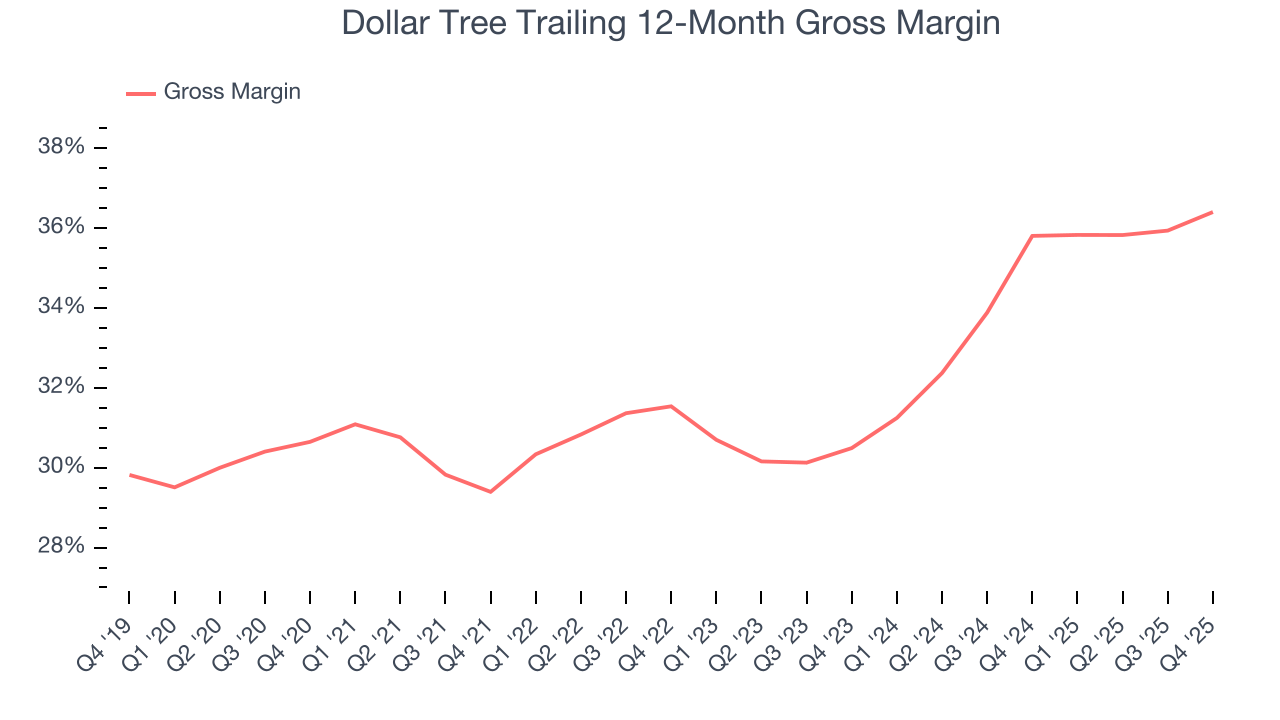
This quarter, Dollar Tree’s gross profit margin was 39.2% , marking a 1.5 percentage point increase from 37.7% in the same quarter last year. On a wider time horizon, the company’s full-year margin has remained steady over the past four quarters, suggesting it strives to keep prices low for customers and has stable input costs (such as labor and freight expenses to transport goods).
8. Operating Margin
Operating margin is an important measure of profitability as it shows the portion of revenue left after accounting for all core expenses – everything from the cost of goods sold to advertising and wages. It’s also useful for comparing profitability across companies with different levels of debt and tax rates because it excludes interest and taxes.
Dollar Tree’s operating margin has generally stayed the same over the last 12 months, averaging 8.5% over the last two years. This profitability was higher than the broader consumer retail sector, showing it did a decent job managing its expenses.
Looking at the trend in its profitability, Dollar Tree’s operating margin might fluctuated slightly but has generally stayed the same over the last year. Shareholders will want to see Dollar Tree grow its margin in the future.
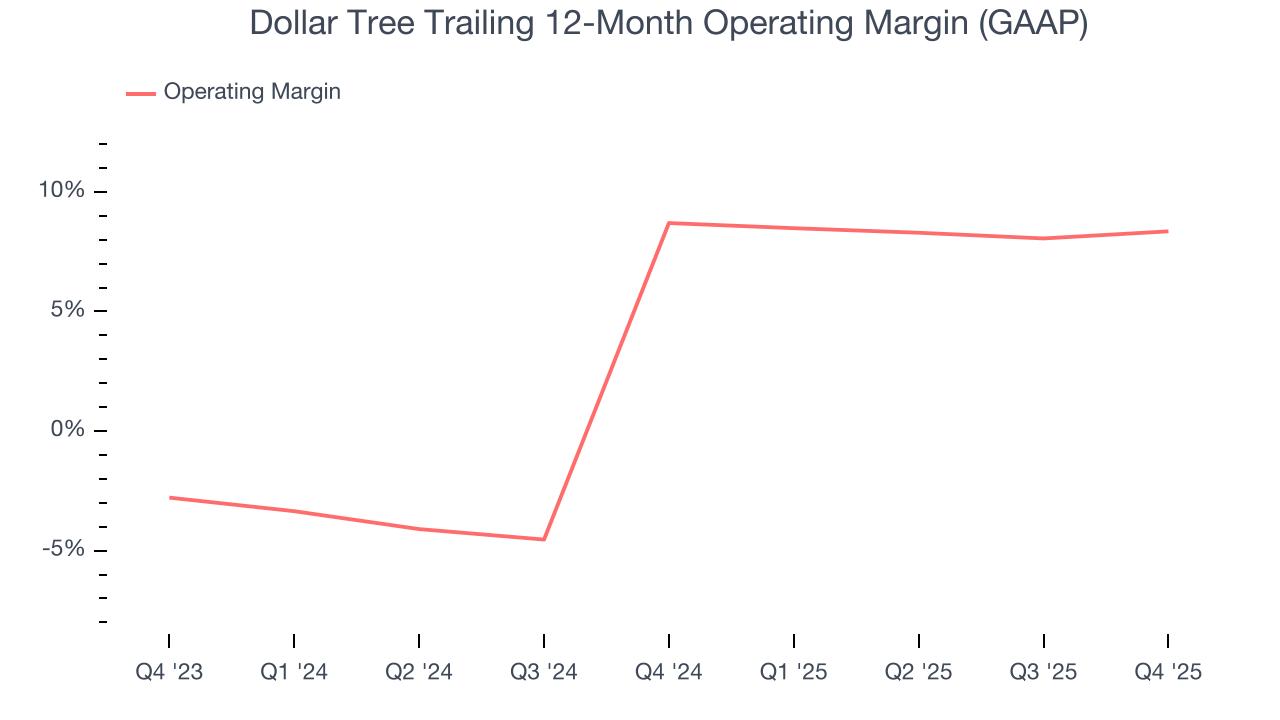
In Q4, Dollar Tree generated an operating margin profit margin of 12.7%, in line with the same quarter last year. This indicates the company’s cost structure has recently been stable.
9. Earnings Per Share
Revenue trends explain a company’s historical growth, but the long-term change in earnings per share (EPS) points to the profitability of that growth – for example, a company could inflate its sales through excessive spending on advertising and promotions.
Sadly for Dollar Tree, its EPS and revenue declined by 7% and 11.8% annually over the last three years. In a mature sector such as consumer retail, we tend to steer our readers away from companies with falling EPS because it could imply changing secular trends and preferences. If the tide turns unexpectedly, Dollar Tree’s low margin of safety could leave its stock price susceptible to large downswings.
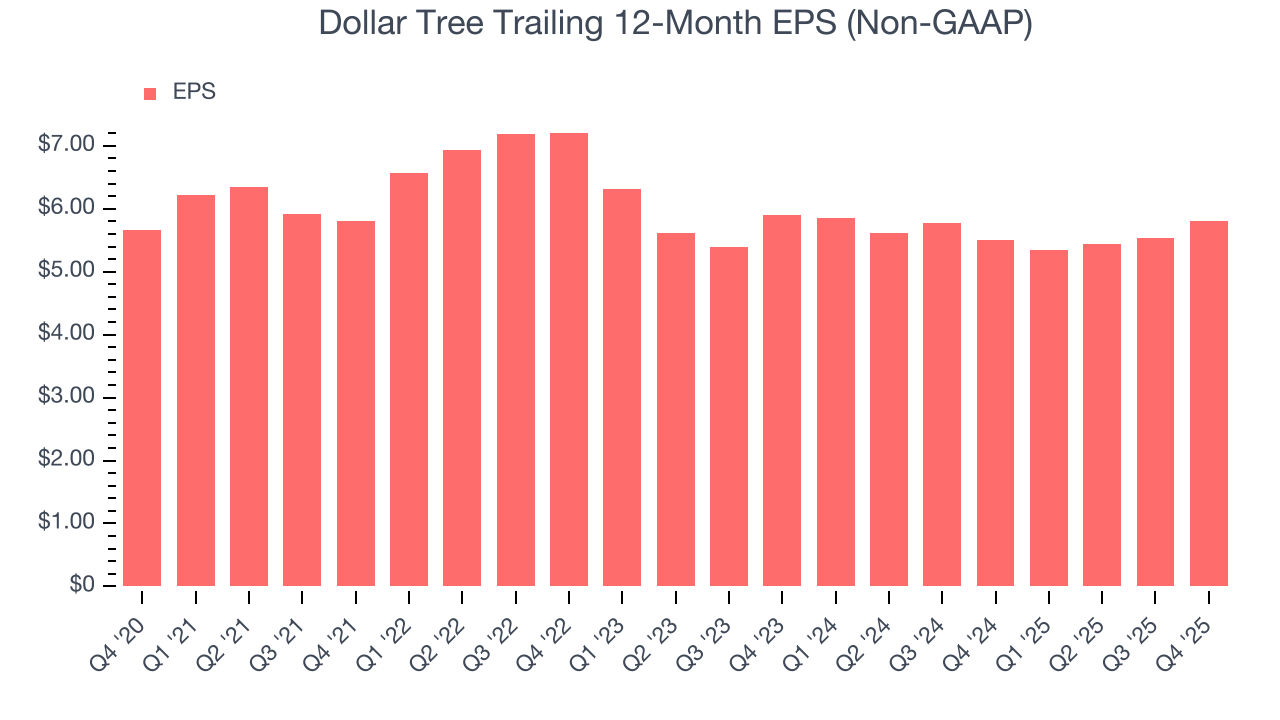
In Q4, Dollar Tree reported adjusted EPS of $2.56, up from $2.29 in the same quarter last year. This print beat analysts’ estimates by 1.1%. Over the next 12 months, Wall Street expects Dollar Tree’s full-year EPS of $5.80 to grow 14.3%.
10. Cash Is King
Free cash flow isn't a prominently featured metric in company financials and earnings releases, but we think it's telling because it accounts for all operating and capital expenses, making it tough to manipulate. Cash is king.
Dollar Tree has shown impressive cash profitability, giving it the option to reinvest or return capital to investors. The company’s free cash flow margin averaged 6% over the last two years, better than the broader consumer retail sector.
Taking a step back, we can see that Dollar Tree’s margin expanded by 1.7 percentage points over the last year. This shows the company is heading in the right direction, and we can see it became a less capital-intensive business because its free cash flow profitability rose while its operating profitability was flat.
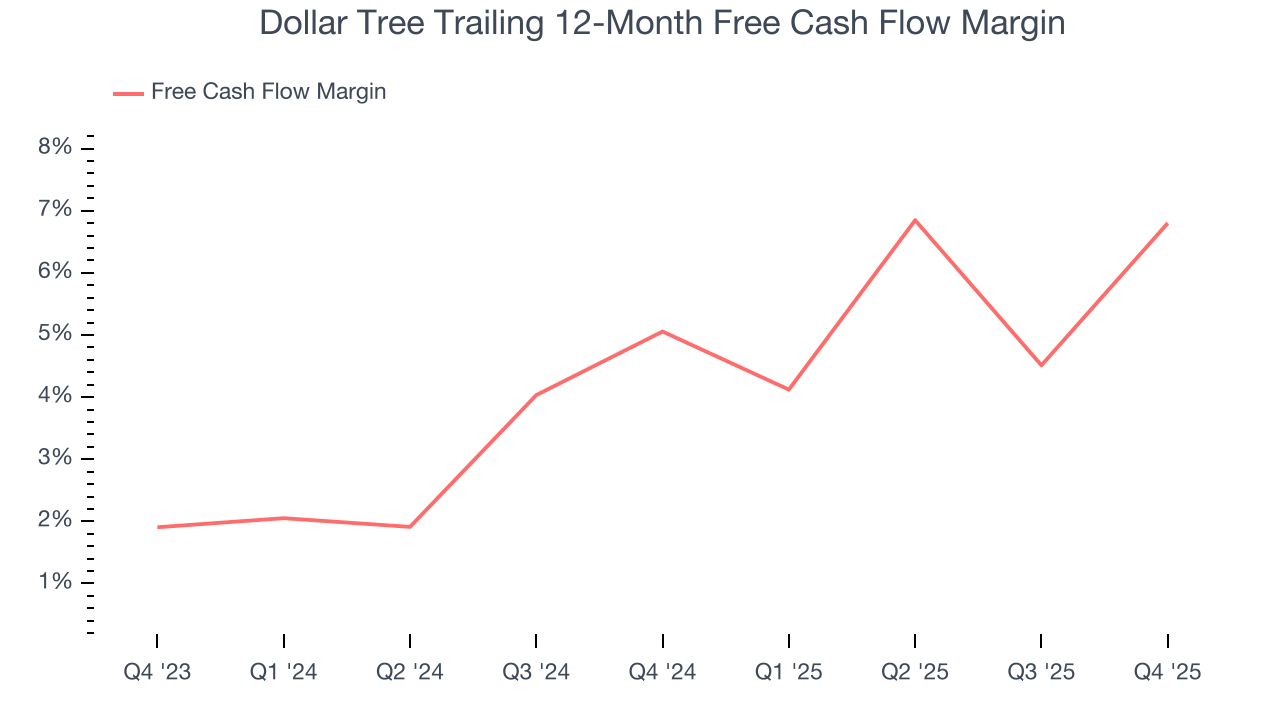
Dollar Tree’s free cash flow clocked in at $968.5 million in Q4, equivalent to a 17.8% margin. This result was good as its margin was 7.7 percentage points higher than in the same quarter last year, building on its favorable historical trend.
11. Return on Invested Capital (ROIC)
EPS and free cash flow tell us whether a company was profitable while growing its revenue. But was it capital-efficient? A company’s ROIC explains this by showing how much operating profit it makes compared to the money it has raised (debt and equity).
Dollar Tree historically did a mediocre job investing in profitable growth initiatives. Its five-year average ROIC was 6.9%, somewhat low compared to the best consumer retail companies that consistently pump out 25%+.
12. Balance Sheet Assessment
Dollar Tree reported $760.7 million of cash and $7.06 billion of debt on its balance sheet in the most recent quarter. As investors in high-quality companies, we primarily focus on two things: 1) that a company’s debt level isn’t too high and 2) that its interest payments are not excessively burdening the business.
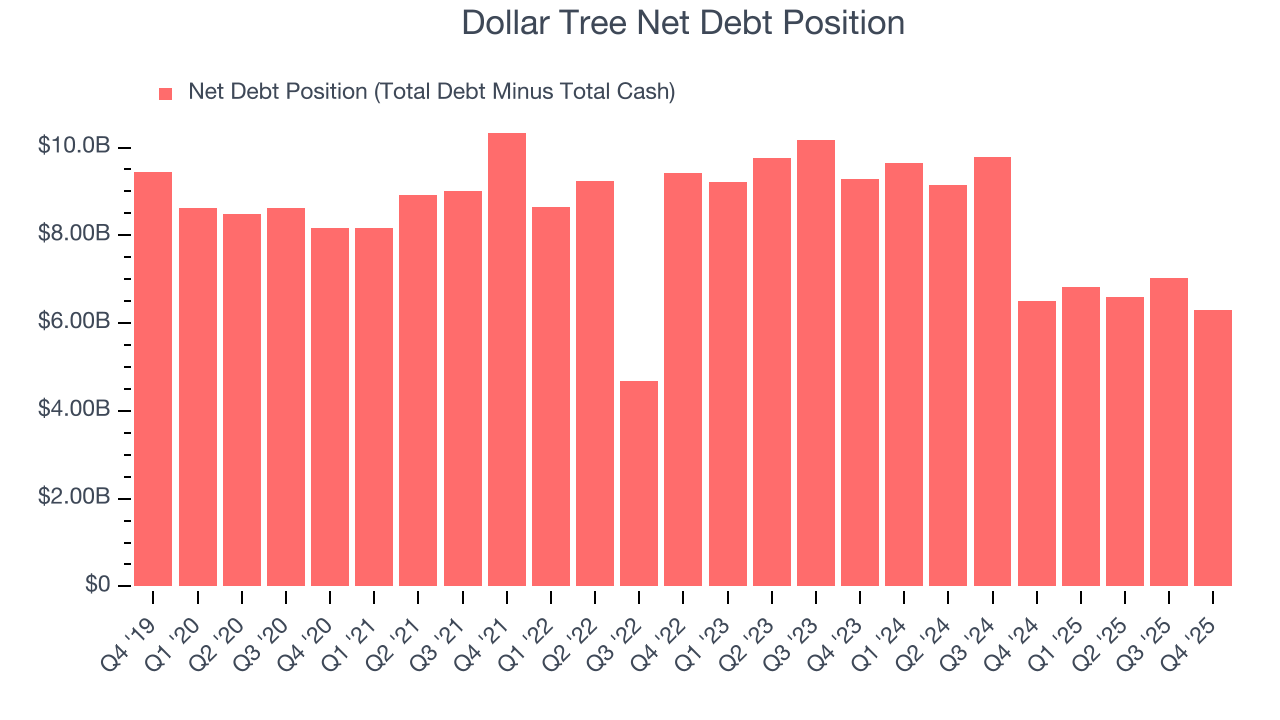
With $2.24 billion of EBITDA over the last 12 months, we view Dollar Tree’s 2.8× net-debt-to-EBITDA ratio as safe. We also see its $49.3 million of annual interest expenses as appropriate. The company’s profits give it plenty of breathing room, allowing it to continue investing in growth initiatives.
13. Key Takeaways from Dollar Tree’s Q4 Results
It was good to see Dollar Tree narrowly top analysts’ gross margin expectations this quarter. On the other hand, its EBITDA missed and its EPS guidance for next quarter fell short of Wall Street’s estimates. Overall, this was a softer quarter. The stock traded down 3% to $104.25 immediately following the results.
14. Is Now The Time To Buy Dollar Tree?
Updated: March 16, 2026 at 6:48 AM EDT
Are you wondering whether to buy Dollar Tree or pass? We urge investors to not only consider the latest earnings results but also longer-term business quality and valuation as well.
Dollar Tree isn’t a terrible business, but it isn’t one of our picks. To kick things off, its revenue has declined over the last three years. While its projected EPS for the next year implies the company’s fundamentals will improve, the downside is its relatively low ROIC suggests management has struggled to find compelling investment opportunities. On top of that, its declining EPS over the last three years makes it a less attractive asset to the public markets.
Dollar Tree’s P/E ratio based on the next 12 months is 16.2x. While this valuation is reasonable, we don’t really see a big opportunity at the moment. We're fairly confident there are better stocks to buy right now.
Wall Street analysts have a consensus one-year price target of $126.30 on the company (compared to the current share price of $104.25).
Although the price target is bullish, readers should exercise caution because analysts tend to be overly optimistic. The firms they work for, often big banks, have relationships with companies that extend into fundraising, M&A advisory, and other rewarding business lines. As a result, they typically hesitate to say bad things for fear they will lose out. We at StockStory do not suffer from such conflicts of interest, so we’ll always tell it like it is.