
First Watch (FWRG)
We aren’t fans of First Watch. Its weak returns on capital indicate management was inefficient with its resources and missed opportunities.― StockStory Analyst Team


1. News



2. Summary
Why We Think First Watch Will Underperform
Based on a nautical reference to the first work shift aboard a ship, First Watch (NASDAQ:FWRG) is a chain of breakfast and brunch restaurants whose menu is heavily-focused on eggs and griddle items such as pancakes.
- Long-term business health is up for debate as its cash burn has increased over the last year
- Underwhelming 5.2% return on capital reflects management’s difficulties in finding profitable growth opportunities
- Depletion of cash reserves could lead to a fundraising event that triggers shareholder dilution
First Watch falls below our quality standards. There are more rewarding stocks elsewhere.
Why There Are Better Opportunities Than First Watch






First Watch is trading at $12.29 per share, or 63.7x forward P/E. This valuation is extremely expensive, especially for the quality you get.
There are stocks out there similarly priced with better business quality. We prefer owning these.
3. First Watch (FWRG) Research Report: Q4 CY2025 Update
Breakfast restaurant chain First Watch Restaurant Group (NASDAQ:FWRG) met Wall Street’s revenue expectations in Q4 CY2025, with sales up 20.2% year on year to $316.4 million. Its GAAP profit of $0.24 per share was significantly above analysts’ consensus estimates.
First Watch (FWRG) Q4 CY2025 Highlights:
- Revenue: $316.4 million vs analyst estimates of $316.3 million (20.2% year-on-year growth, in line)
- EPS (GAAP): $0.24 vs analyst estimates of $0.07 (significant beat)
- Adjusted EBITDA: $33.69 million vs analyst estimates of $34.2 million (10.6% margin, 1.5% miss)
- EBITDA guidance for the upcoming financial year 2026 is $136 million at the midpoint, below analyst estimates of $145.2 million
- Operating Margin: 2.9%, up from 1.5% in the same quarter last year
- Locations: 633 at quarter end, up from 572 in the same quarter last year
- Same-Store Sales rose 3.1% year on year (-0.3% in the same quarter last year)
- Market Capitalization: $946 million
Company Overview
Based on a nautical reference to the first work shift aboard a ship, First Watch (NASDAQ:FWRG) is a chain of breakfast and brunch restaurants whose menu is heavily-focused on eggs and griddle items such as pancakes.
The first location was opened in 1983 in Pacific Grove, California. It gained a reputation for its tasty, made-to-order breakfast and brunch offerings. Freshness was also a differentiator. Unlike many traditional breakfast joints that relied on pre-made or frozen ingredients, First Watch emphasized fresh ingredients. The company grew in the ensuing decades through organic expansion as well as acquisitions of chains such as The Good Egg, which were converted into First Watch locations.
Today, diners at First Watch can select from a variety of omelettes, pancakes, salads, and even cocktails. Emphasizing its commitment to freshness, First Watch has a seasonable menu that may feature pumpkin pancakes or even butternut squash soup in the Fall.
The core First Watch customer is someone who appreciates breakfast and brunch fare but wants a bit more of an elevated experience compared to your traditional diner. This core customer also values fresh ingredients and appreciates healthier options such as salads and light sandwiches. Inside First Watch restaurants, the ambience exudes classiness. Rooms have plenty of natural light and feature greenery as well as tasteful artwork. Seating ranges from comfy booths to larger tables that can accommodate families or groups.
4. Sit-Down Dining
Sit-down restaurants offer a complete dining experience with table service. These establishments span various cuisines and are renowned for their warm hospitality and welcoming ambiance, making them perfect for family gatherings, special occasions, or simply unwinding. Their extensive menus range from appetizers to indulgent desserts and wines and cocktails. This space is extremely fragmented and competition includes everything from publicly-traded companies owning multiple chains to single-location mom-and-pop restaurants.
Competitors offering breakfast fare include IHOP owner Dine Brands (NYSE:DIN), Denny’s (NASDAQ:DENN), The Cheesecake Factory (NASDAQ:CAKE), and private company Waffle House.
5. Revenue Growth
A company’s long-term sales performance can indicate its overall quality. Any business can have short-term success, but a top-tier one grows for years.
With $1.22 billion in revenue over the past 12 months, First Watch is a mid-sized restaurant chain, which sometimes brings disadvantages compared to larger competitors benefiting from better brand awareness and economies of scale. On the bright side, it can still flex high growth rates because it’s working from a smaller revenue base.
As you can see below, First Watch grew its sales at an excellent 18.7% compounded annual growth rate over the last six years as it opened new restaurants and increased sales at existing, established dining locations.
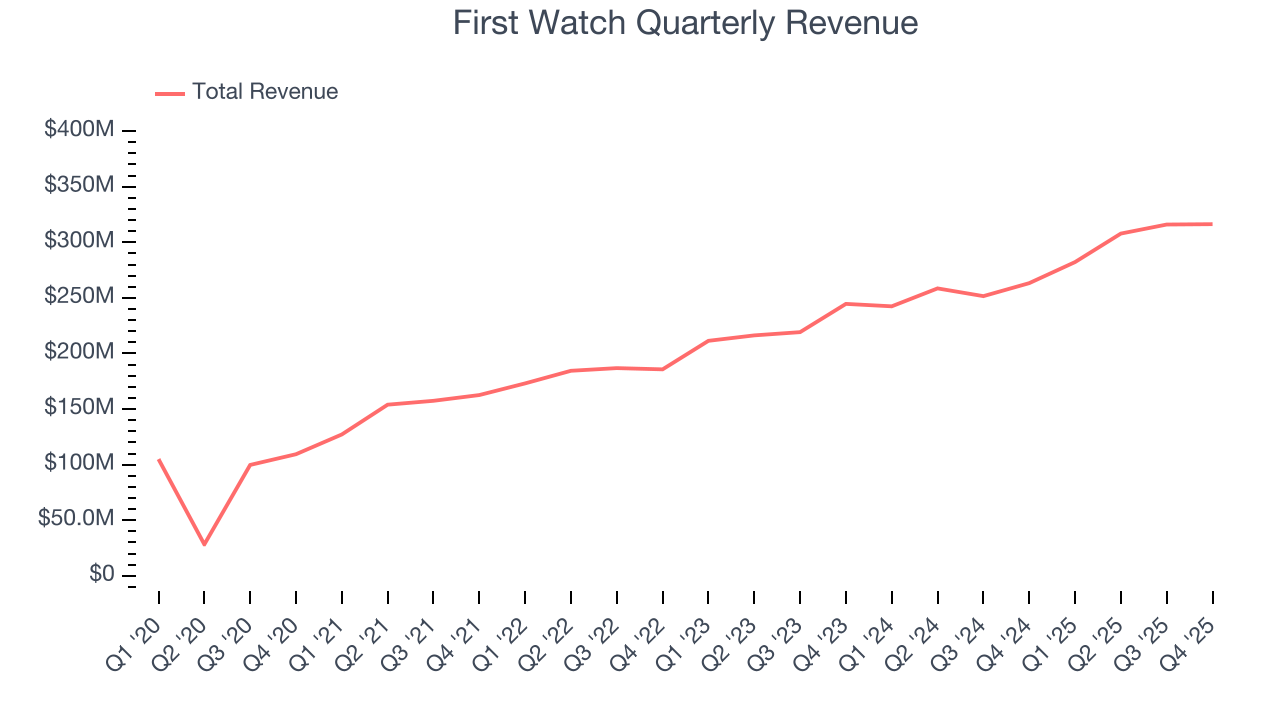
This quarter, First Watch’s year-on-year revenue growth of 20.2% was excellent, and its $316.4 million of revenue was in line with Wall Street’s estimates.
Looking ahead, sell-side analysts expect revenue to grow 15.1% over the next 12 months, a deceleration versus the last six years. Despite the slowdown, this projection is healthy and suggests the market is baking in success for its menu offerings.
6. Restaurant Performance
Number of Restaurants
A restaurant chain’s total number of dining locations often determines how much revenue it can generate.
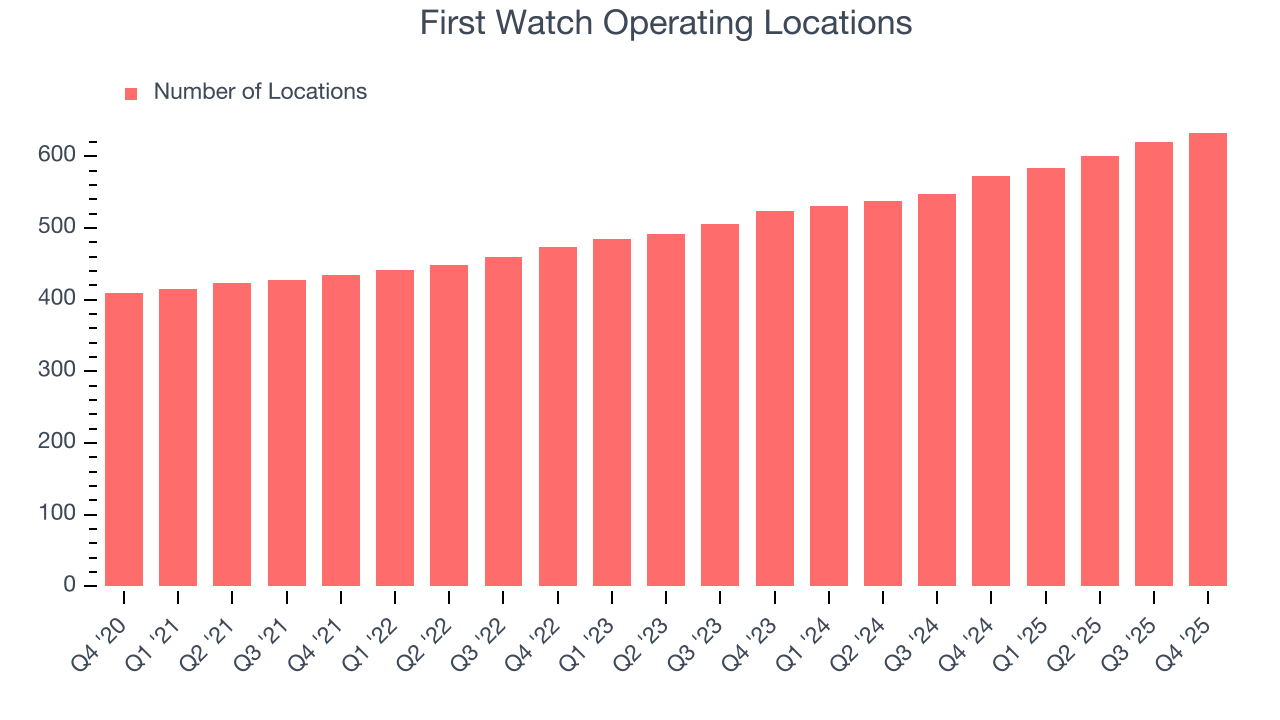
First Watch operated 633 locations in the latest quarter. It has opened new restaurants at a rapid clip over the last two years, averaging 10.3% annual growth, much faster than the broader restaurant sector. This gives it a chance to become a large, scaled business over time.
When a chain opens new restaurants, it usually means it’s investing for growth because there’s healthy demand for its meals and there are markets where its concepts have few or no locations.
Same-Store Sales
The change in a company's restaurant base only tells one side of the story. The other is the performance of its existing locations, which informs management teams whether they should expand or downsize their physical footprints. Same-store sales is an industry measure of whether revenue is growing at those existing restaurants and is driven by customer visits (often called traffic) and the average spending per customer (ticket).
First Watch’s demand within its existing dining locations has been relatively stable over the last two years but was below most restaurant chains. On average, the company’s same-store sales have grown by 1.6% per year. This performance suggests it should consider improving its foot traffic and efficiency before expanding its restaurant base.
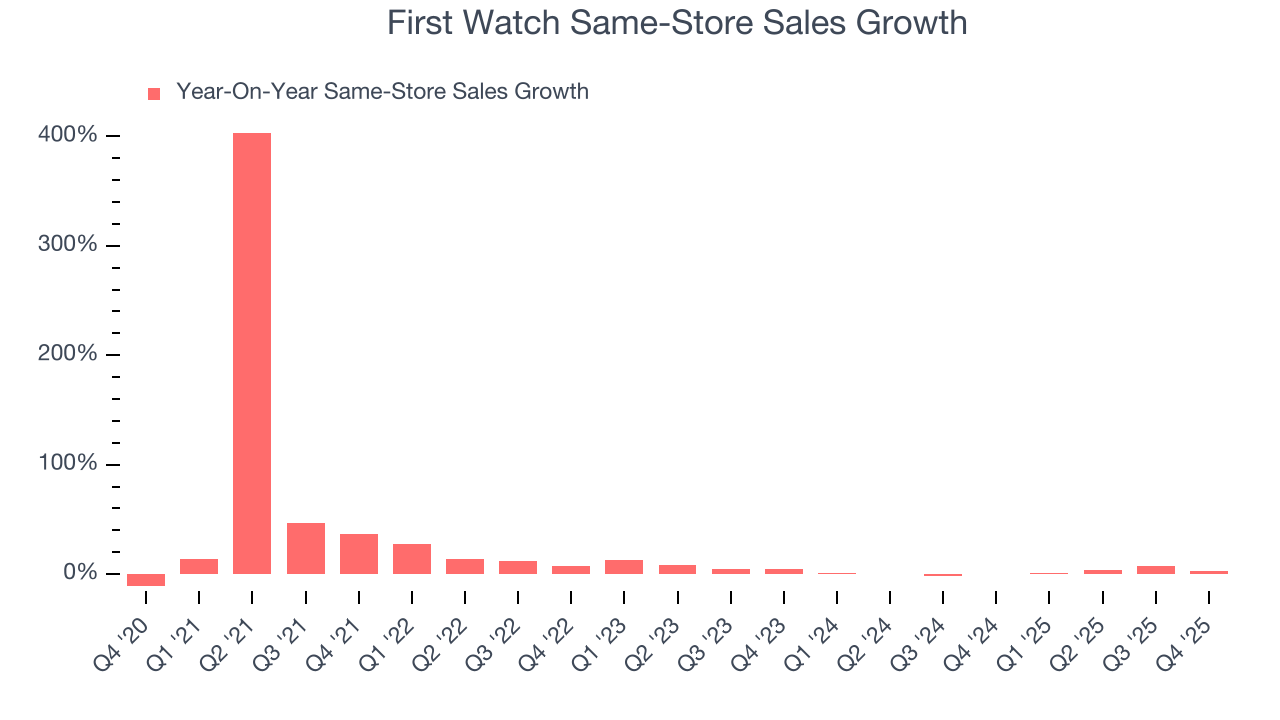
In the latest quarter, First Watch’s same-store sales rose 3.1% year on year. This growth was an acceleration from its historical levels, which is always an encouraging sign.
7. Gross Margin & Pricing Power
First Watch has bad unit economics for a restaurant company, giving it less room to reinvest and grow its presence. As you can see below, it averaged a 21% gross margin over the last two years. That means First Watch paid its suppliers a lot of money ($78.98 for every $100 in revenue) to run its business. 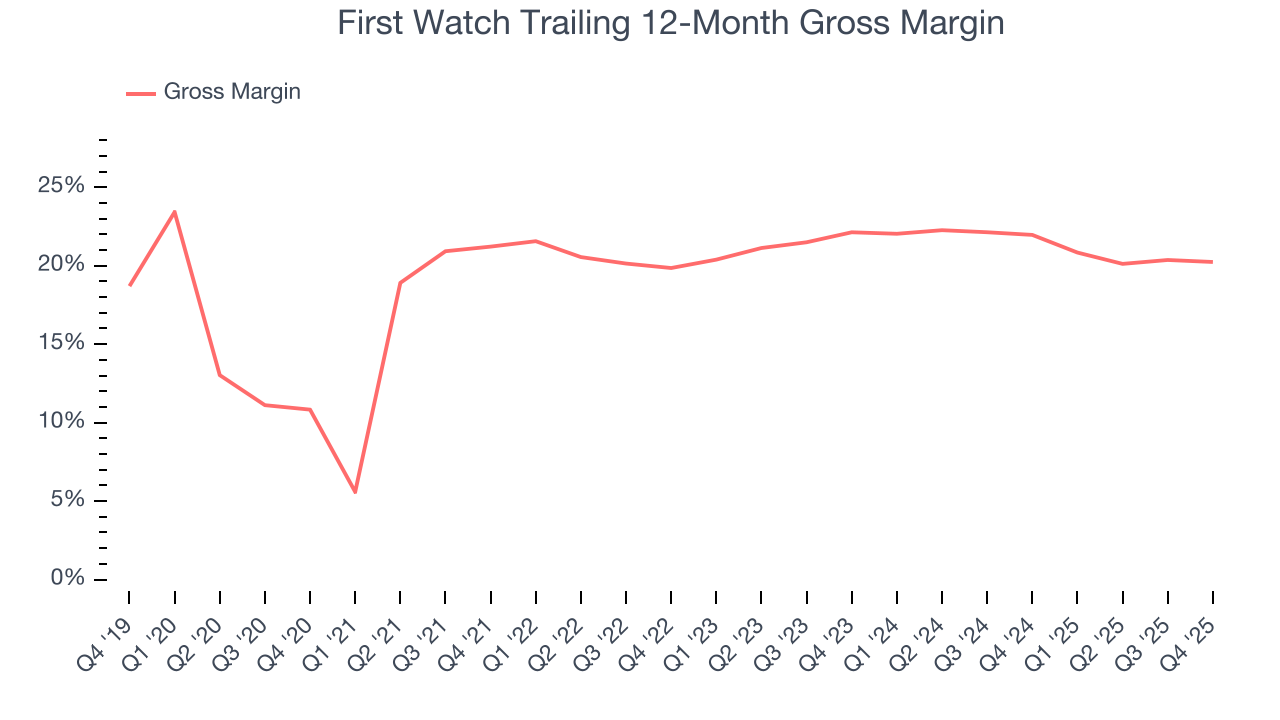
In Q4, First Watch produced a 20.5% gross profit margin, in line with the same quarter last year. On a wider time horizon, First Watch’s full-year margin has been trending down over the past 12 months, decreasing by 1.7 percentage points. If this move continues, it could suggest a more competitive environment with some pressure to lower prices and higher input costs (such as ingredients and transportation expenses).
8. Operating Margin
First Watch was profitable over the last two years but held back by its large cost base. Its average operating margin of 3% was weak for a restaurant business. This result isn’t too surprising given its low gross margin as a starting point.
Analyzing the trend in its profitability, First Watch’s operating margin decreased by 1.6 percentage points over the last year. This raises questions about the company’s expense base because its revenue growth should have given it leverage on its fixed costs, resulting in better economies of scale and profitability. First Watch’s performance was poor no matter how you look at it - it shows that costs were rising and it couldn’t pass them onto its customers.
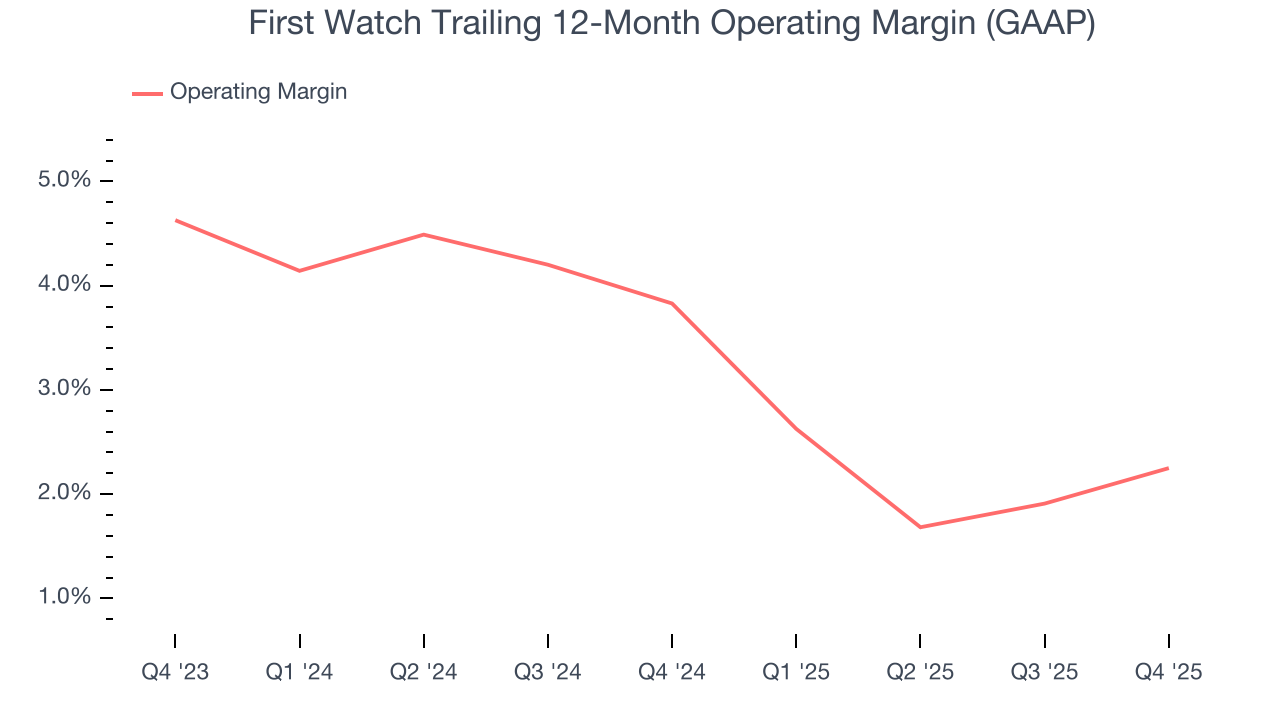
In Q4, First Watch generated an operating margin profit margin of 2.9%, up 1.4 percentage points year on year. The increase was encouraging, and because its operating margin rose more than its gross margin, we can infer it was more efficient with expenses such as marketing, and administrative overhead.
9. Earnings Per Share
We track the long-term change in earnings per share (EPS) for the same reason as long-term revenue growth. Compared to revenue, however, EPS highlights whether a company’s growth is profitable.
First Watch’s full-year EPS flipped from negative to positive over the last six years. This is encouraging and shows it’s at a critical moment in its life.
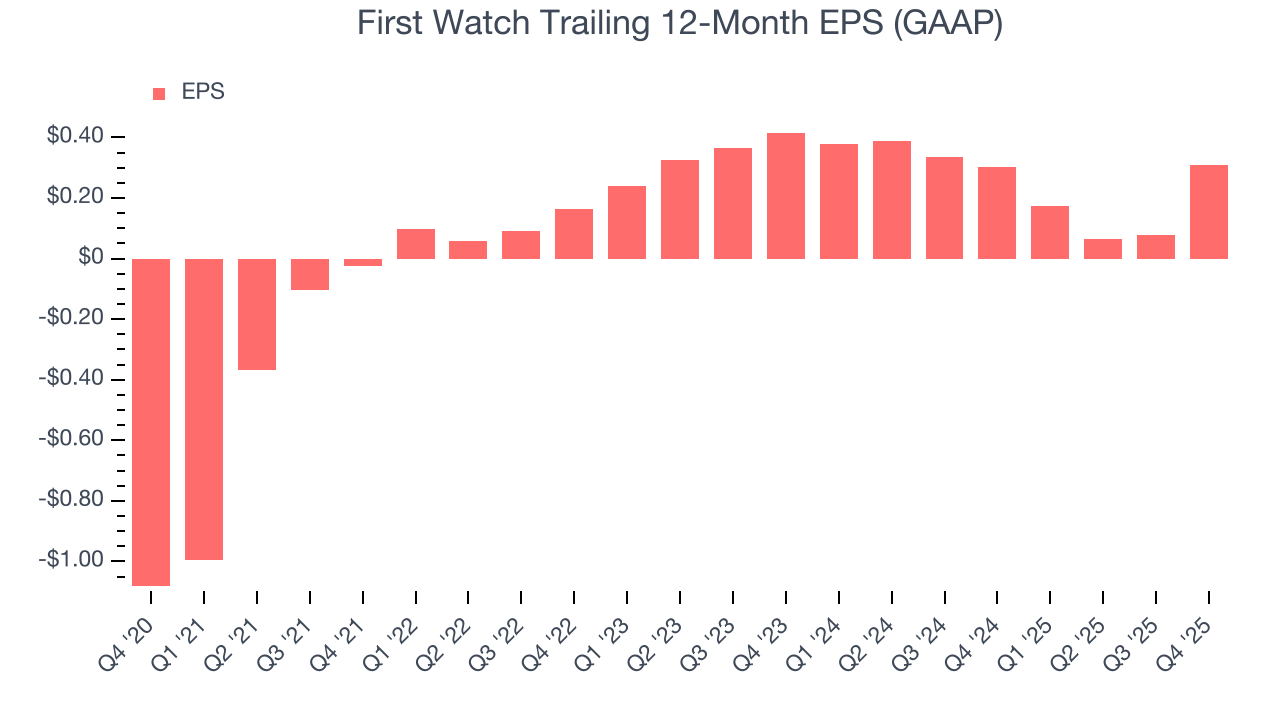
In Q4, First Watch reported EPS of $0.24, up from $0.01 in the same quarter last year. This print easily cleared analysts’ estimates, and shareholders should be content with the results. Over the next 12 months, Wall Street expects First Watch’s full-year EPS of $0.31 to shrink by 2.2%.
10. Cash Is King
Although earnings are undoubtedly valuable for assessing company performance, we believe cash is king because you can’t use accounting profits to pay the bills.
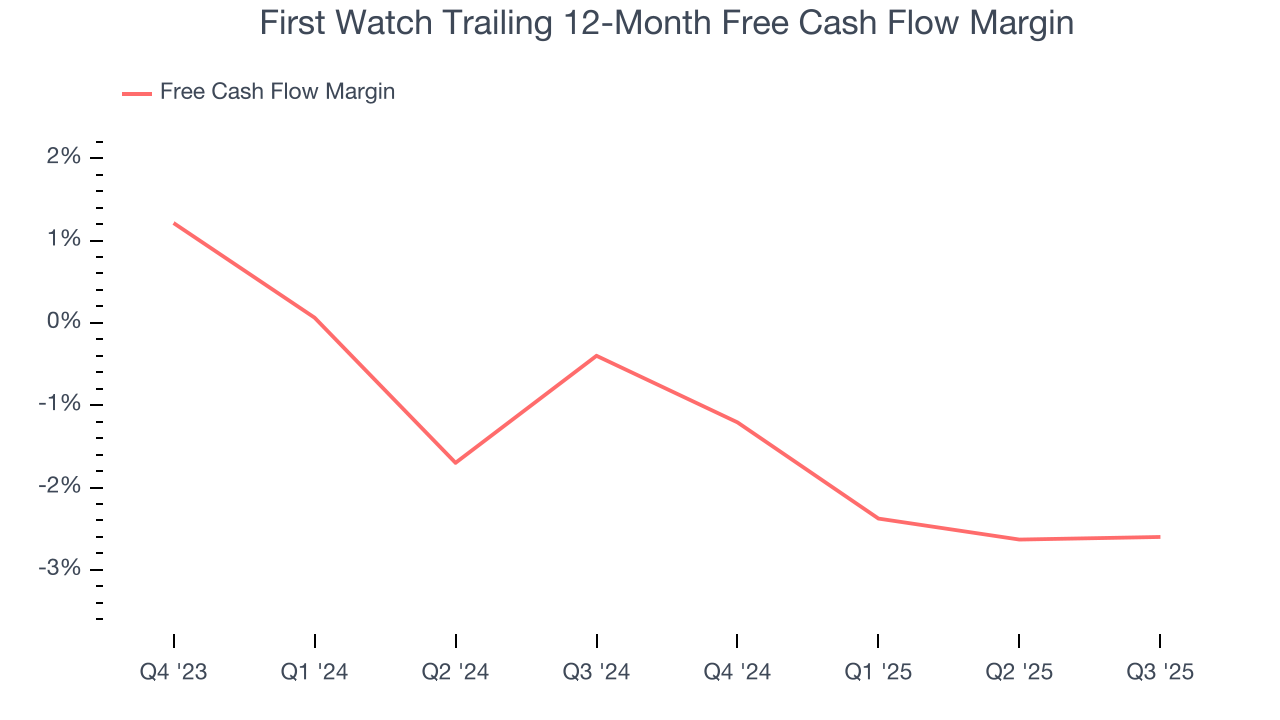
Over the last two years, First Watch’s capital-intensive business model and large investments in new physical locations have drained its resources, putting it in a pinch and limiting its ability to return capital to investors. Its free cash flow margin averaged negative 1.3%, meaning it lit $1.30 of cash on fire for every $100 in revenue.
11. Return on Invested Capital (ROIC)
EPS and free cash flow tell us whether a company was profitable while growing its revenue. But was it capital-efficient? Enter ROIC, a metric showing how much operating profit a company generates relative to the money it has raised (debt and equity).
First Watch historically did a mediocre job investing in profitable growth initiatives. Its five-year average ROIC was 5.1%, somewhat low compared to the best restaurant companies that consistently pump out 15%+.
12. Balance Sheet Risk
As long-term investors, the risk we care about most is the permanent loss of capital, which can happen when a company goes bankrupt or raises money from a disadvantaged position. This is separate from short-term stock price volatility, something we are much less bothered by.
First Watch burned through $30.99 million of cash over the last year, and its $1.01 billion of debt exceeds the $21.25 million of cash on its balance sheet. This is a deal breaker for us because indebted loss-making companies spell trouble.
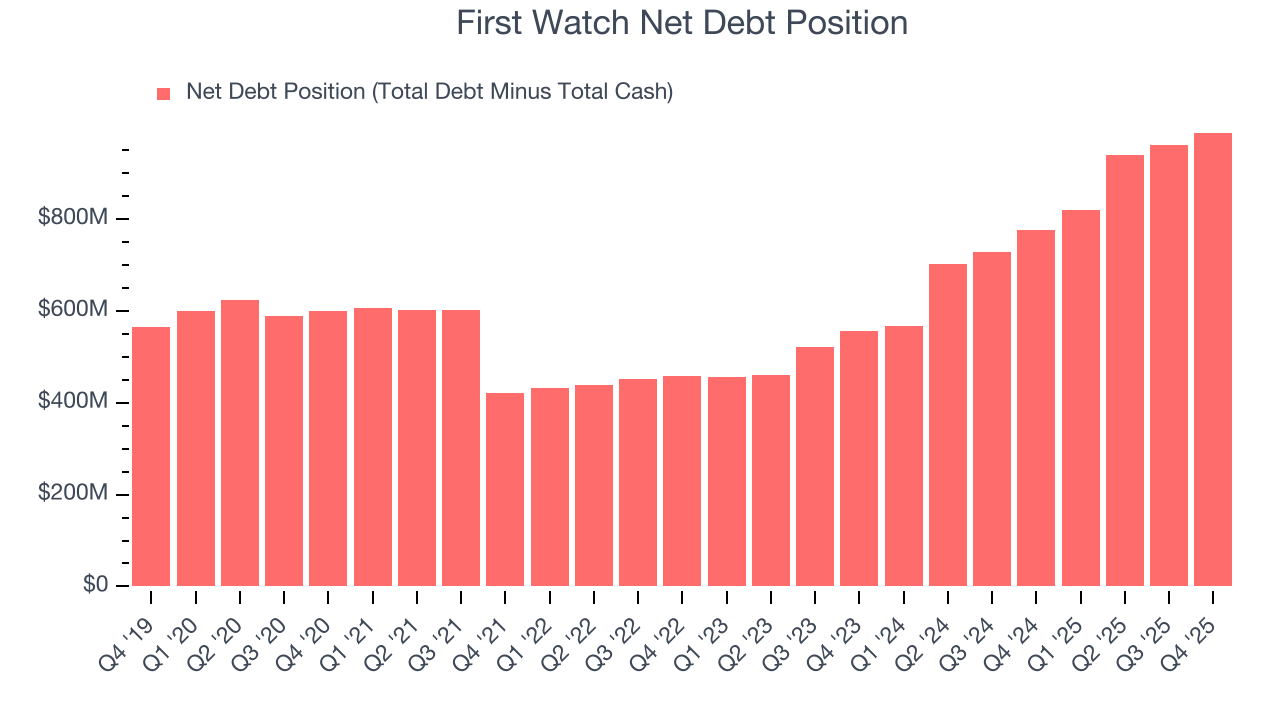
Unless the First Watch’s fundamentals change quickly, it might find itself in a position where it must raise capital from investors to continue operating. Whether that would be favorable is unclear because dilution is a headwind for shareholder returns.
We remain cautious of First Watch until it generates consistent free cash flow or any of its announced financing plans materialize on its balance sheet.
13. Key Takeaways from First Watch’s Q4 Results
It was good to see First Watch beat analysts’ EPS expectations this quarter. On the other hand, its full-year EBITDA guidance missed and its EBITDA fell slightly short of Wall Street’s estimates. Overall, this quarter could have been better. The stock traded down 1.8% to $15.23 immediately after reporting.
14. Is Now The Time To Buy First Watch?
Updated: March 22, 2026 at 10:36 PM EDT
Before investing in or passing on First Watch, we urge you to understand the company’s business quality (or lack thereof), valuation, and the latest quarterly results - in that order.
First Watch isn’t a terrible business, but it doesn’t pass our bar. Although its revenue growth was exceptional over the last six years, it’s expected to deteriorate over the next 12 months and its projected EPS for the next year is lacking. And while the company’s new restaurant openings have increased its brand equity, the downside is its cash burn raises the question of whether it can sustainably maintain growth.
First Watch’s P/E ratio based on the next 12 months is 63.7x. Investors with a higher risk tolerance might like the company, but we don’t really see a big opportunity at the moment. We're pretty confident there are superior stocks to buy right now.
Wall Street analysts have a consensus one-year price target of $19.50 on the company (compared to the current share price of $12.29).
Although the price target is bullish, readers should exercise caution because analysts tend to be overly optimistic. The firms they work for, often big banks, have relationships with companies that extend into fundraising, M&A advisory, and other rewarding business lines. As a result, they typically hesitate to say bad things for fear they will lose out. We at StockStory do not suffer from such conflicts of interest, so we’ll always tell it like it is.