
Perma-Fix (PESI)
We wouldn’t buy Perma-Fix. Its falling revenue and negative returns on capital suggest it’s destroying value as demand fizzles out.― StockStory Analyst Team


1. News

2. Summary
Why We Think Perma-Fix Will Underperform
Tackling hazardous waste challenges since 1990, Perma-Fix (NASDAQ:PESI) provides environmental waste treatment services.
- Annual sales declines of 9.4% for the past five years show its products and services struggled to connect with the market during this cycle
- Performance over the past two years shows each sale was less profitable as its earnings per share dropped by 31.1% annually, worse than its revenue
- Unfavorable liquidity position could lead to additional equity financing that dilutes shareholders
Perma-Fix doesn’t measure up to our expectations. There are more rewarding stocks elsewhere.
Why There Are Better Opportunities Than Perma-Fix





Perma-Fix is trading at $12.09 per share, or 393.2x forward P/E. This valuation multiple seems a bit much considering the tepid revenue growth profile.
We’d rather invest in similarly-priced but higher-quality companies with more reliable earnings growth.
3. Perma-Fix (PESI) Research Report: Q4 CY2025 Update
Environmental waste treatment and services provider Perma-Fix (NASDAQ:PESI) missed Wall Street’s revenue expectations in Q4 CY2025, but sales rose 6.9% year on year to $15.72 million. Its GAAP loss of $0.31 per share was significantly below analysts’ consensus estimates.
Perma-Fix (PESI) Q4 CY2025 Highlights:
- Revenue: $15.72 million vs analyst estimates of $17.7 million (6.9% year-on-year growth, 11.2% miss)
- EPS (GAAP): -$0.31 vs analyst estimates of -$0.09 (significant miss)
- Adjusted EBITDA: -$2.68 million (-17.1% margin, 11% year-on-year growth)
- Adjusted EBITDA Margin: -17.1%, up from -20.5% in the same quarter last year
- Market Capitalization: $223.1 million
Company Overview
Tackling hazardous waste challenges since 1990, Perma-Fix (NASDAQ:PESI) provides environmental waste treatment services.
Perma-Fix focuses on nuclear, low-level radioactive, mixed, hazardous, and non-hazardous waste treatment, processing, and disposal services. The company operates through two primary segments: Treatment and Services.
The Treatment Segment operates through four uniquely licensed and permitted facilities. These facilities provide various waste treatment and processing services, including research and development activities to identify waste processing techniques for problematic waste streams.
The Services Segment offers technical and nuclear services. These include radiological measurement, health physics services, safety and health assessments, waste management services, and decontamination and decommissioning of facilities. The segment also provides consulting, engineering, project management, and technical services to commercial and government customers.
Perma-Fix's customer base is primarily composed of U.S. government entities, particularly the Department of Energy and Department of Defense. In terms of international expansion, Perma-Fix has signed a joint venture term sheet with Springfields Fuels Limited to develop and manage a nuclear waste-materials treatment facility in the United Kingdom.
4. Waste Management
Waste management companies can possess licenses permitting them to handle hazardous materials. Furthermore, many services are performed through contracts and statutorily mandated, non-discretionary, or recurring, leading to more predictable revenue streams. However, regulation can be a headwind, rendering existing services obsolete or forcing companies to invest precious capital to comply with new, more environmentally-friendly rules. Lastly, waste management companies are at the whim of economic cycles. Interest rates, for example, can greatly impact industrial production or commercial projects that create waste and byproducts.
Competitors of Perma-Fix include US Ecology (NASDAQ:ECOL), Clean Harbors (NYSE:CLH), and Heritage-Crystal Clean (NASDAQ:HCCI).
5. Revenue Growth
Examining a company’s long-term performance can provide clues about its quality. Any business can put up a good quarter or two, but many enduring ones grow for years. Perma-Fix’s demand was weak over the last five years as its sales fell at a 10.2% annual rate. This wasn’t a great result and suggests it’s a low quality business.
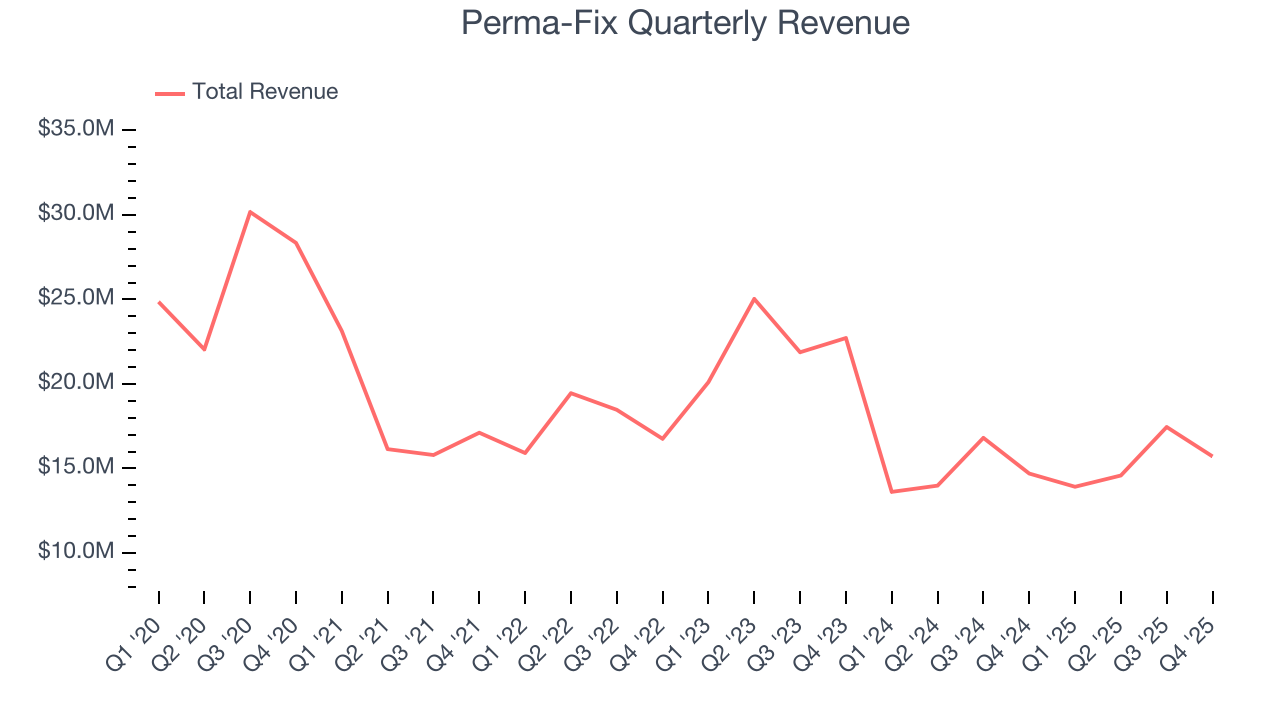
Long-term growth is the most important, but within industrials, a half-decade historical view may miss new industry trends or demand cycles. Perma-Fix’s recent performance shows its demand remained suppressed as its revenue has declined by 17.1% annually over the last two years. 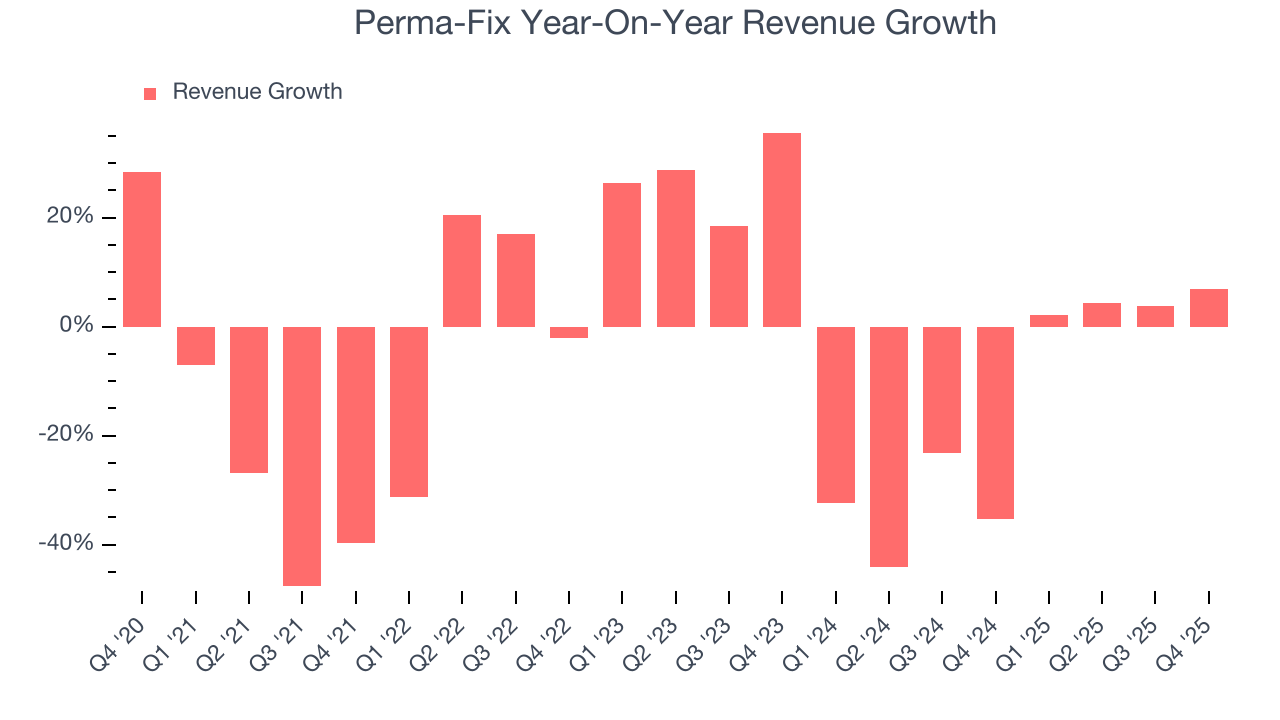
This quarter, Perma-Fix’s revenue grew by 6.9% year on year to $15.72 million, missing Wall Street’s estimates.
Looking ahead, sell-side analysts expect revenue to grow 68% over the next 12 months, an improvement versus the last two years. This projection is eye-popping and suggests its newer products and services will fuel better top-line performance.
6. Gross Margin & Pricing Power
At StockStory, we prefer high gross margin businesses because they indicate the company has pricing power or differentiated products, giving it a chance to generate higher operating profits.
Perma-Fix has bad unit economics for an industrials business, signaling it operates in a competitive market. As you can see below, it averaged a 11% gross margin over the last five years. That means Perma-Fix paid its suppliers a lot of money ($89.02 for every $100 in revenue) to run its business. 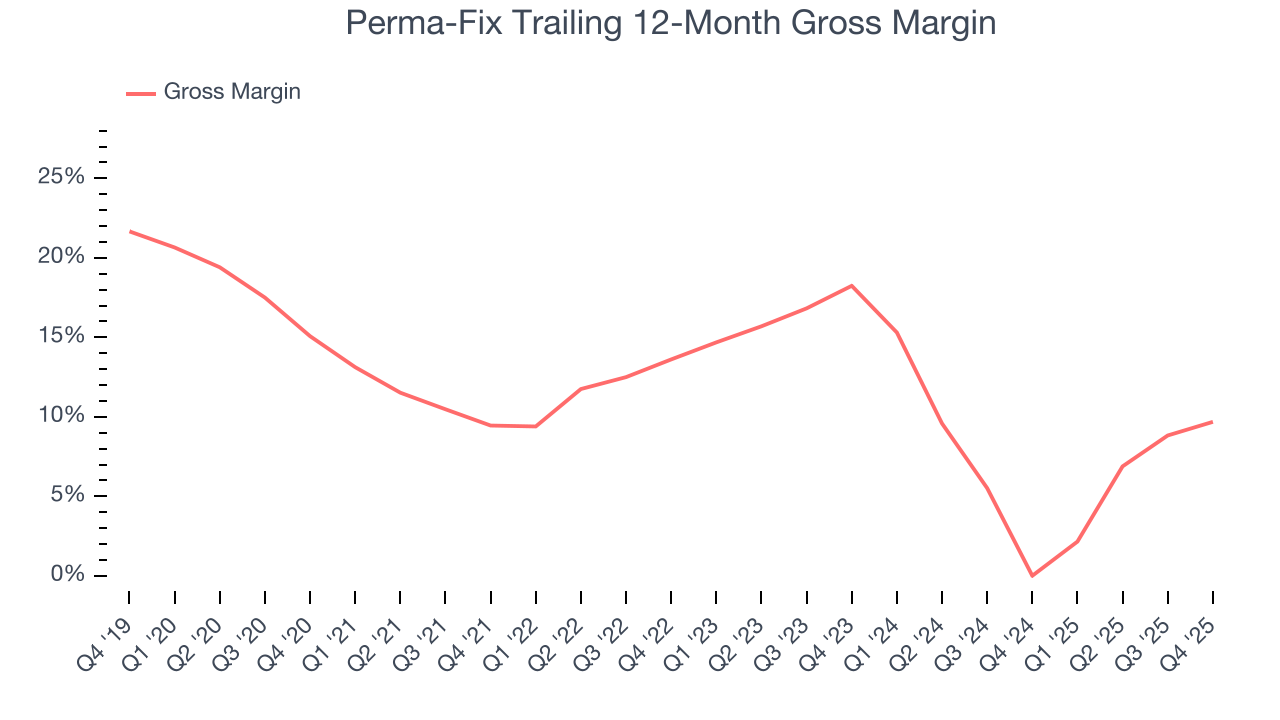
Perma-Fix produced a 7.7% gross profit margin in Q4, up 3.7 percentage points year on year. Perma-Fix’s full-year margin has also been trending up over the past 12 months, increasing by 9.7 percentage points. If this move continues, it could suggest a less competitive environment where the company has better pricing power and leverage from its growing sales on the fixed portion of its cost of goods sold (such as manufacturing expenses).
7. Operating Margin
Operating margin is an important measure of profitability as it shows the portion of revenue left after accounting for all core expenses – everything from the cost of goods sold to advertising and wages. It’s also useful for comparing profitability across companies with different levels of debt and tax rates because it excludes interest and taxes.
Perma-Fix’s high expenses have contributed to an average operating margin of negative 11% over the last five years. Unprofitable industrials companies require extra attention because they could get caught swimming naked when the tide goes out. It’s hard to trust that the business can endure a full cycle.
Looking at the trend in its profitability, Perma-Fix’s operating margin decreased by 9.7 percentage points over the last five years. Perma-Fix’s performance was poor no matter how you look at it - it shows that costs were rising and it couldn’t pass them onto its customers.
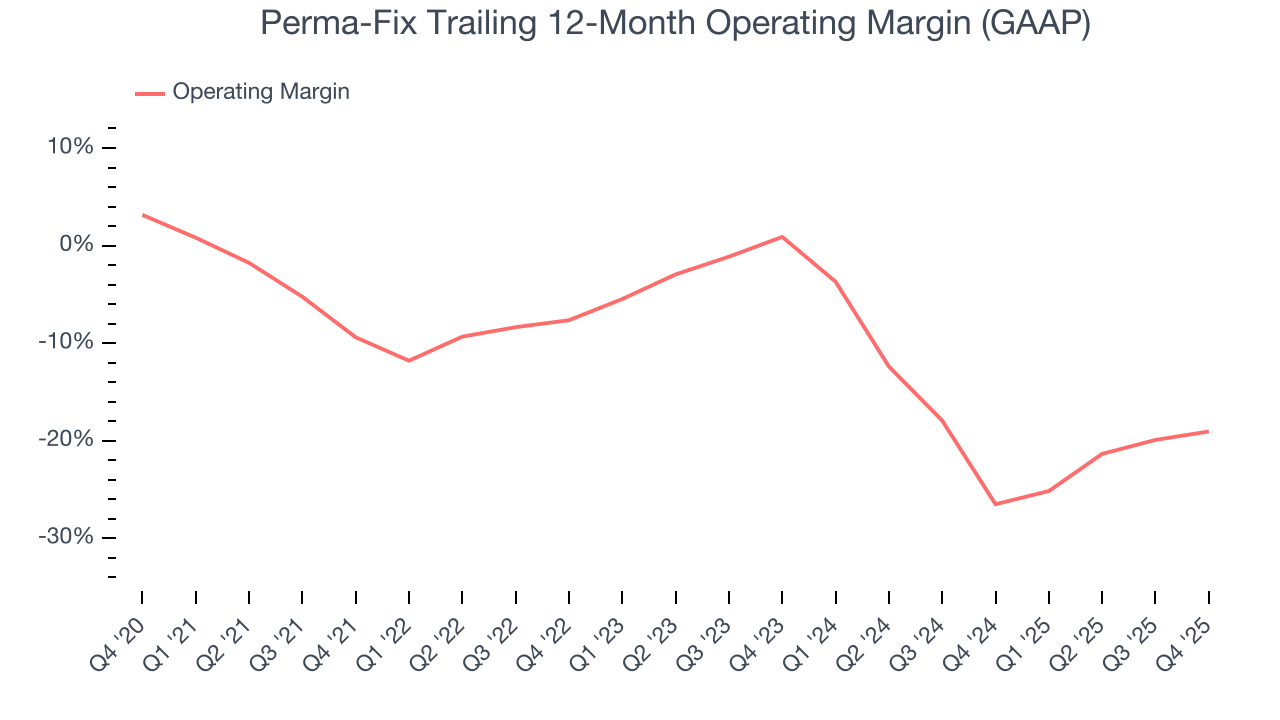
This quarter, Perma-Fix generated a negative 20.6% operating margin. The company's consistent lack of profits raise a flag.
8. Cash Is King
Free cash flow isn't a prominently featured metric in company financials and earnings releases, but we think it's telling because it accounts for all operating and capital expenses, making it tough to manipulate. Cash is king.
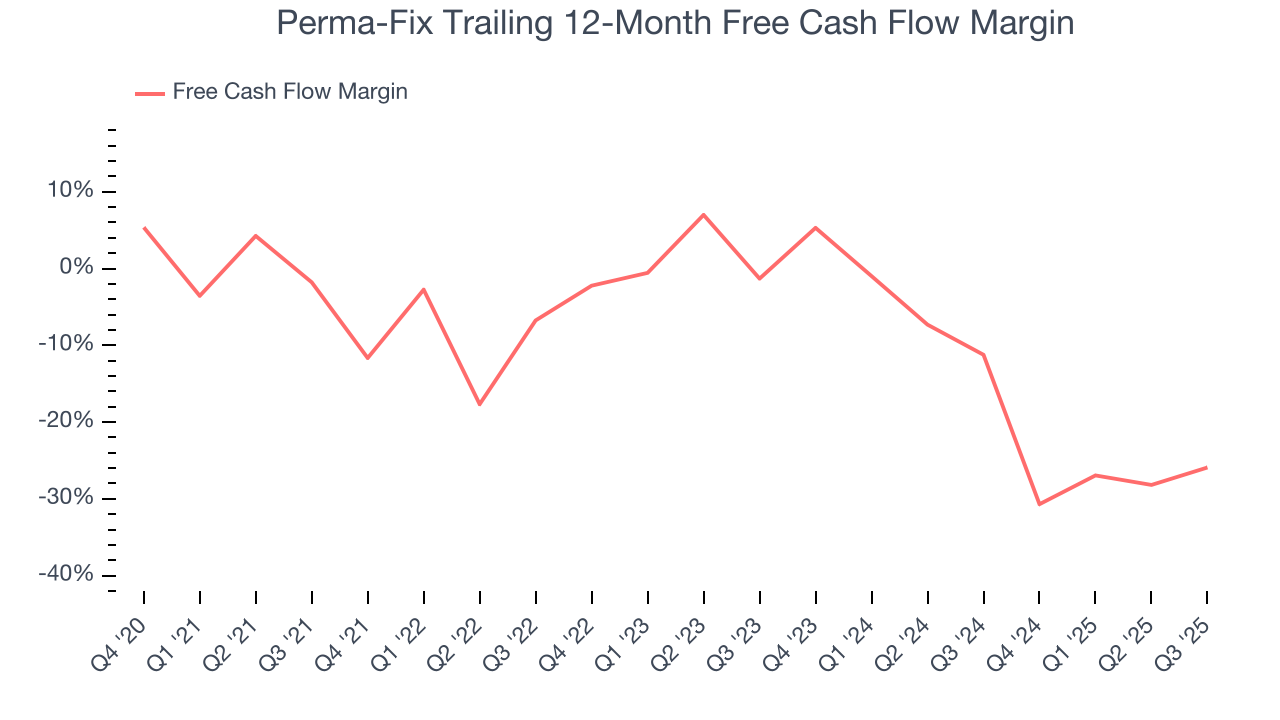
Perma-Fix’s demanding reinvestments have drained its resources over the last five years, putting it in a pinch and limiting its ability to return capital to investors. Its free cash flow margin averaged negative 10.3%, meaning it lit $10.25 of cash on fire for every $100 in revenue.
Taking a step back, we can see that Perma-Fix’s margin dropped by 14.5 percentage points during that time. Almost any movement in the wrong direction is undesirable because it is already burning cash. If the trend continues, it could signal it’s becoming a more capital-intensive business.
9. Key Takeaways from Perma-Fix’s Q4 Results
We struggled to find many positives in these results. Its revenue missed and its EBITDA fell short of Wall Street’s estimates. Overall, this quarter could have been better. The stock traded down 5.7% to $11.35 immediately after reporting.
10. Is Now The Time To Buy Perma-Fix?
Updated: March 24, 2026 at 7:31 AM EDT
The latest quarterly earnings matters, sure, but we actually think longer-term fundamentals and valuation matter more. Investors should consider all these pieces before deciding whether or not to invest in Perma-Fix.
We cheer for all companies making their customers lives easier, but in the case of Perma-Fix, we’ll be cheering from the sidelines. To kick things off, its revenue has declined over the last five years. While its projected EPS for the next year implies the company will start generating shareholder value, the downside is its diminishing returns show management's prior bets haven't worked out. On top of that, its relatively low ROIC suggests management has struggled to find compelling investment opportunities.
Perma-Fix’s P/E ratio based on the next 12 months is 36.5x. At this valuation, there’s a lot of good news priced in - we think other companies feature superior fundamentals at the moment.
Wall Street analysts have a consensus one-year price target of $20 on the company (compared to the current share price of $11.35).
Although the price target is bullish, readers should exercise caution because analysts tend to be overly optimistic. The firms they work for, often big banks, have relationships with companies that extend into fundraising, M&A advisory, and other rewarding business lines. As a result, they typically hesitate to say bad things for fear they will lose out. We at StockStory do not suffer from such conflicts of interest, so we’ll always tell it like it is.