
Visteon (VC)
Visteon is interesting. Its returns on capital are not only elite but also rising, suggesting its competitive moat is widening.― StockStory Analyst Team


1. News
2. Summary
Why Visteon Is Interesting
Originally spun off from Ford Motor Company in 2000, Visteon (NYSE:VC) designs and manufactures cockpit electronics for vehicles, including digital instrument clusters, displays, infotainment systems, and battery management systems.
- Market-beating returns on capital illustrate that management has a knack for investing in profitable ventures, and its rising returns show it’s making even more lucrative bets
- Performance over the past five years shows its incremental sales were extremely profitable, as its annual earnings per share growth of 55% outpaced its revenue gains
- On the flip side, its gross margin of 11.9% reflects its high production costs
Visteon shows some potential. If you like the company, the valuation seems fair.
Why Is Now The Time To Buy Visteon?







Visteon’s stock price of $106.18 implies a valuation ratio of 11.3x forward P/E. Visteon’s current valuation is below that of most industrials companies, but this doesn’t make it a bargain. Instead, the price is warranted for the quality you get.
Now could be a good time to invest if you believe in the story.
3. Visteon (VC) Research Report: Q4 CY2025 Update
Automotive technology company Visteon (NYSE:VC) beat Wall Street’s revenue expectations in Q4 CY2025, but sales were flat year on year at $948 million. On the other hand, the company’s full-year revenue guidance of $3.73 billion at the midpoint came in 3.7% below analysts’ estimates. Its non-GAAP profit of $1.77 per share was 15.6% below analysts’ consensus estimates.
Visteon (VC) Q4 CY2025 Highlights:
- Revenue: $948 million vs analyst estimates of $922.3 million (flat year on year, 2.8% beat)
- Adjusted EPS: $1.77 vs analyst expectations of $2.10 (15.6% miss)
- Adjusted EBITDA: $110 million vs analyst estimates of $116.3 million (11.6% margin, 5.4% miss)
- EBITDA guidance for the upcoming financial year 2026 is $475 million at the midpoint, below analyst estimates of $510.8 million
- Operating Margin: 7.2%, down from 8.3% in the same quarter last year
- Free Cash Flow Margin: 7.7%, down from 17.6% in the same quarter last year
- Market Capitalization: $2.90 billion
Company Overview
Originally spun off from Ford Motor Company in 2000, Visteon (NYSE:VC) designs and manufactures cockpit electronics for vehicles, including digital instrument clusters, displays, infotainment systems, and battery management systems.
Visteon operates at the intersection of digital innovation and automotive manufacturing, creating the technology that powers modern vehicle cockpits. Its product range spans from basic analog gauge clusters to sophisticated digital displays with curved surfaces and microZone technology that rivals smartphone visual quality. The company's SmartCore platform serves as a central brain for vehicle cockpits, allowing a single computer chip to manage multiple displays and functions simultaneously—reducing complexity and power consumption while enabling a more unified user experience.
As vehicles become increasingly electrified, Visteon has expanded into battery management systems that monitor and control the complex power systems in electric vehicles. Their wireless battery management technology eliminates the need for traditional wiring between battery modules, reducing weight and improving packaging efficiency—critical factors in EV design. A typical Visteon customer might be an automaker like Toyota or Volkswagen that needs high-resolution, customizable digital dashboards integrated with their infotainment systems.
Visteon generates revenue by selling these systems directly to global automakers through purchase orders based on vehicle production schedules. With manufacturing and engineering operations across ten countries including Brazil, China, India, and Mexico, Visteon maintains a global footprint aligned with the international nature of the automotive supply chain.
4. Automobile Manufacturing
Much capital investment and technical know-how are needed to manufacture functional, safe, and aesthetically pleasing automobiles for the mass market. Barriers to entry are therefore high, and auto manufacturers with economies of scale can boast strong economic moats. However, this doesn’t insulate them from new entrants, as electric vehicles (EVs) have entered the market and are upending it. This has forced established manufacturers to not only contend with emerging EV-first competitors but also decide how much they want to invest in these disruptive technologies, which will likely cannibalize their legacy offerings.
Visteon competes with established automotive suppliers like Continental AG, Denso Corporation, Forvia (formerly Faurecia), Aptiv PLC, and Harman International (a Samsung subsidiary), as well as electronics companies expanding into automotive markets such as LG Electronics and Panasonic Corporation.
5. Revenue Growth
Reviewing a company’s long-term sales performance reveals insights into its quality. Any business can experience short-term success, but top-performing ones enjoy sustained growth for years. Over the last five years, Visteon grew its sales at a decent 8.1% compounded annual growth rate. Its growth was slightly above the average industrials company and shows its offerings resonate with customers.
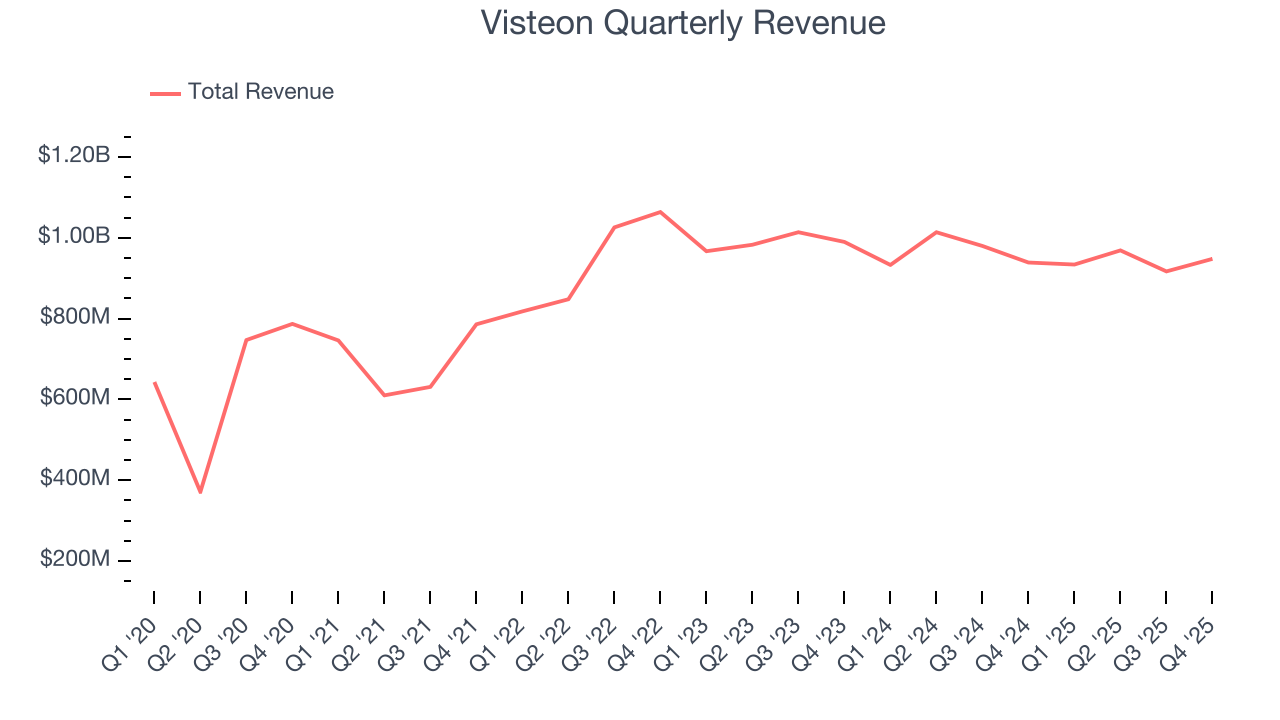
We at StockStory place the most emphasis on long-term growth, but within industrials, a half-decade historical view may miss cycles, industry trends, or a company capitalizing on catalysts such as a new contract win or a successful product line. Visteon’s recent performance marks a sharp pivot from its five-year trend as its revenue has shown annualized declines of 2.4% over the last two years. Visteon isn’t alone in its struggles as the Automobile Manufacturing industry experienced a cyclical downturn, with many similar businesses observing lower sales at this time. 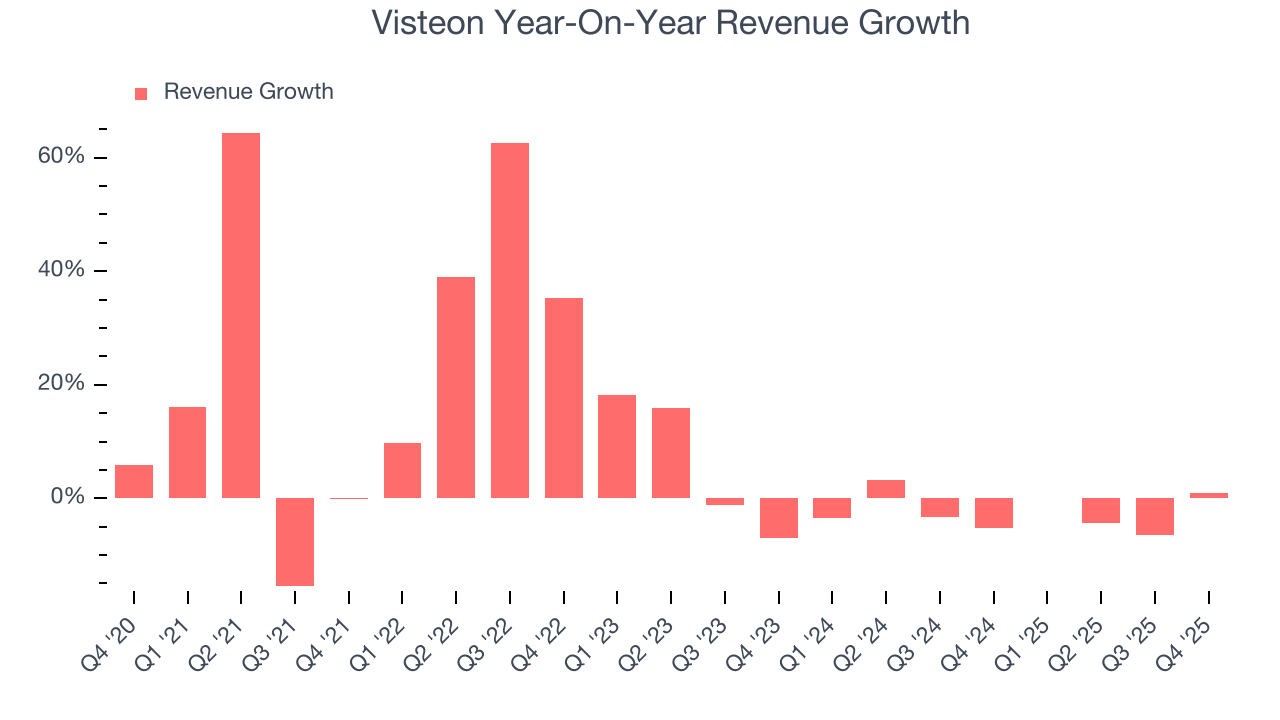
This quarter, Visteon’s $948 million of revenue was flat year on year but beat Wall Street’s estimates by 2.8%.
Looking ahead, sell-side analysts expect revenue to grow 2.9% over the next 12 months. While this projection suggests its newer products and services will catalyze better top-line performance, it is still below average for the sector. At least the company is tracking well in other measures of financial health.
6. Gross Margin & Pricing Power
Gross profit margin is a critical metric to track because it sheds light on its pricing power, complexity of products, and ability to procure raw materials, equipment, and labor.
Visteon has bad unit economics for an industrials business, signaling it operates in a competitive market. This is also because it’s an automobile manufacturer.
Automobile manufacturers have structurally lower profitability as they often break even on the initial sale of vehicles and instead make money on parts and servicing, which come many years later - this explains why new entrants such as Rivian, Lucid, and Nikola have negative gross margins. As you can see below, these dynamics culminated in an average 12% gross margin for Visteon over the last five years.
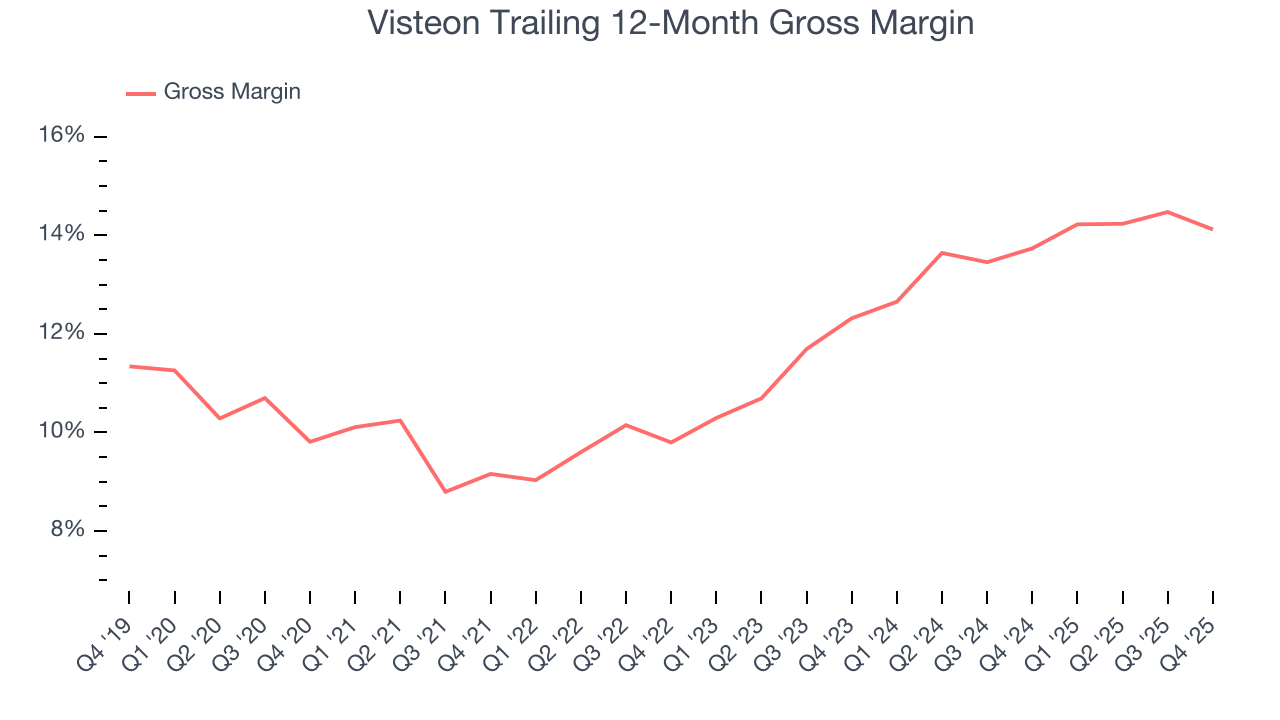
Visteon produced a 12.9% gross profit margin in Q4, down 1.4 percentage points year on year. On a wider time horizon, the company’s full-year margin has remained steady over the past four quarters, suggesting its input costs (such as raw materials and manufacturing expenses) have been stable and it isn’t under pressure to lower prices.
7. Operating Margin
Visteon was profitable over the last five years but held back by its large cost base. Its average operating margin of 6.2% was weak for an industrials business. This result isn’t too surprising given its low gross margin as a starting point.
On the plus side, Visteon’s operating margin rose by 6.3 percentage points over the last five years, as its sales growth gave it immense operating leverage. We’ll take Visteon’s improvement as many Automobile Manufacturing companies saw their margins fall (along with revenue, as mentioned above) because the cycle turned in the wrong direction.
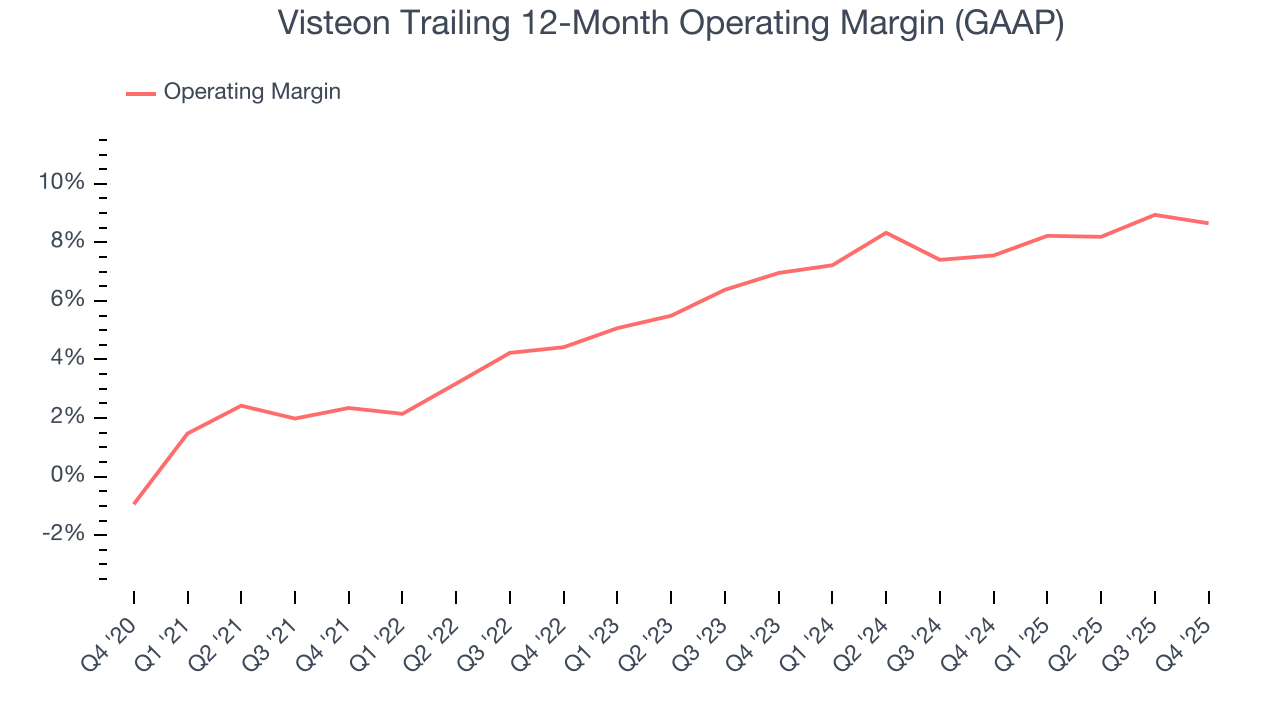
In Q4, Visteon generated an operating margin profit margin of 7.2%, down 1.1 percentage points year on year. Since Visteon’s gross margin decreased more than its operating margin, we can assume its recent inefficiencies were driven more by weaker leverage on its cost of sales rather than increased marketing, R&D, and administrative overhead expenses.
8. Earnings Per Share
Revenue trends explain a company’s historical growth, but the long-term change in earnings per share (EPS) points to the profitability of that growth – for example, a company could inflate its sales through excessive spending on advertising and promotions.
Visteon’s EPS grew at an astounding 57.1% compounded annual growth rate over the last five years, higher than its 8.1% annualized revenue growth. This tells us the company became more profitable on a per-share basis as it expanded.
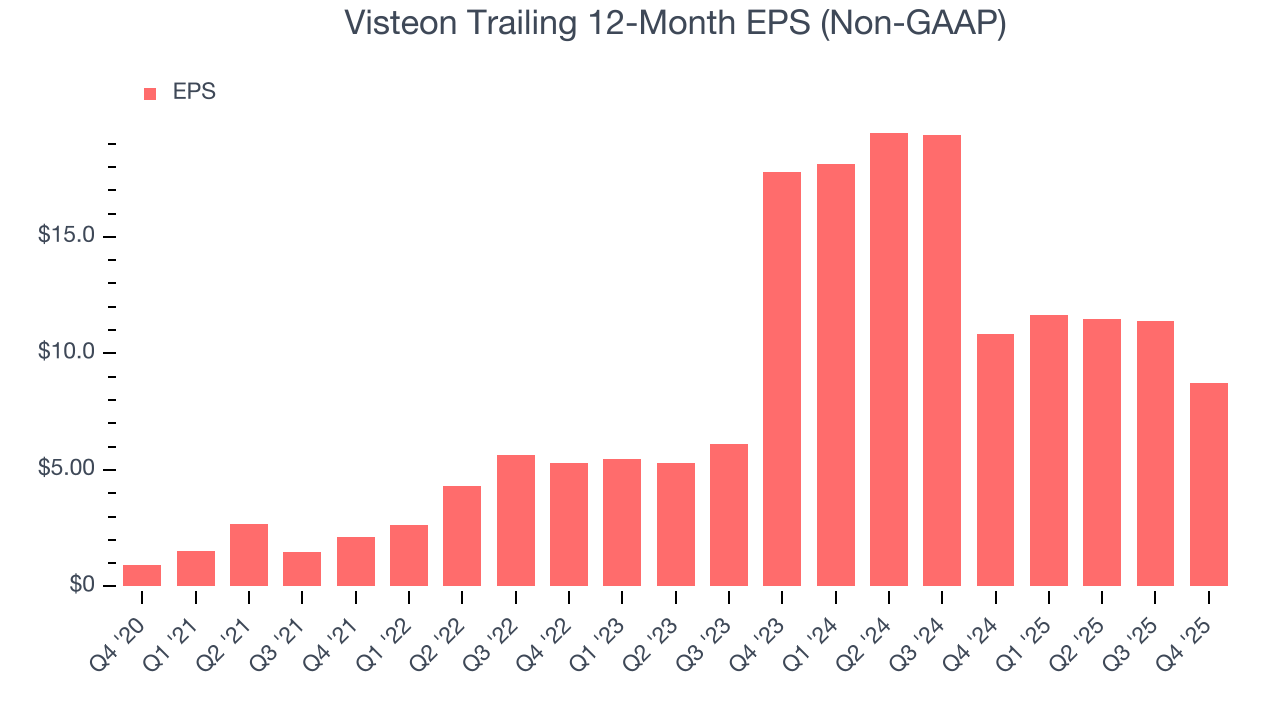
Diving into the nuances of Visteon’s earnings can give us a better understanding of its performance. As we mentioned earlier, Visteon’s operating margin declined this quarter but expanded by 6.3 percentage points over the last five years. Its share count also shrank by 1.8%, and these factors together are positive signs for shareholders because improving profitability and share buybacks turbocharge EPS growth relative to revenue growth. 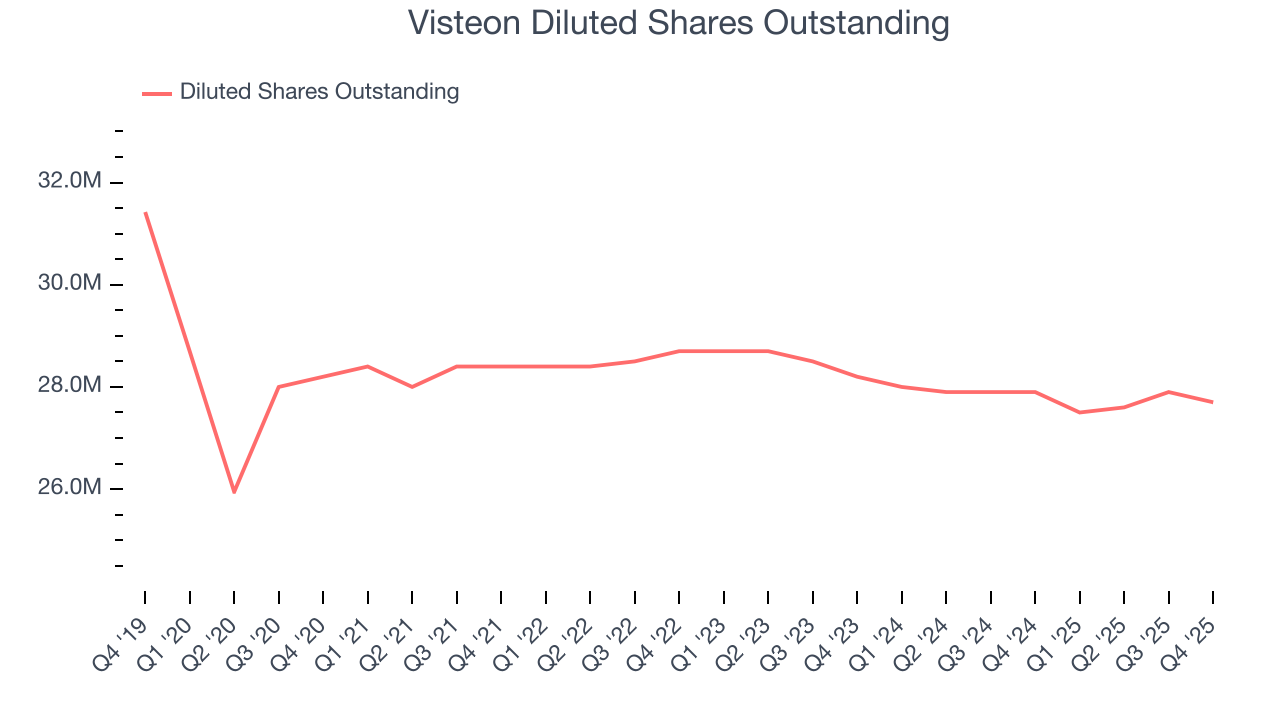
Like with revenue, we analyze EPS over a shorter period to see if we are missing a change in the business.
For Visteon, its two-year annual EPS declines of 30% mark a reversal from its (seemingly) healthy five-year trend. We hope Visteon can return to earnings growth in the future.
In Q4, Visteon reported adjusted EPS of $1.77, down from $4.44 in the same quarter last year. This print missed analysts’ estimates, but we care more about long-term adjusted EPS growth than short-term movements. Over the next 12 months, Wall Street expects Visteon’s full-year EPS of $8.71 to grow 11.6%.
9. Cash Is King
If you’ve followed StockStory for a while, you know we emphasize free cash flow. Why, you ask? We believe that in the end, cash is king, and you can’t use accounting profits to pay the bills.
Visteon has shown weak cash profitability over the last five years, giving the company limited opportunities to return capital to shareholders. Its free cash flow margin averaged 4.8%, subpar for an industrials business.
Taking a step back, an encouraging sign is that Visteon’s margin expanded by 6.8 percentage points during that time. We have no doubt shareholders would like to continue seeing its cash conversion rise as it gives the company more optionality.
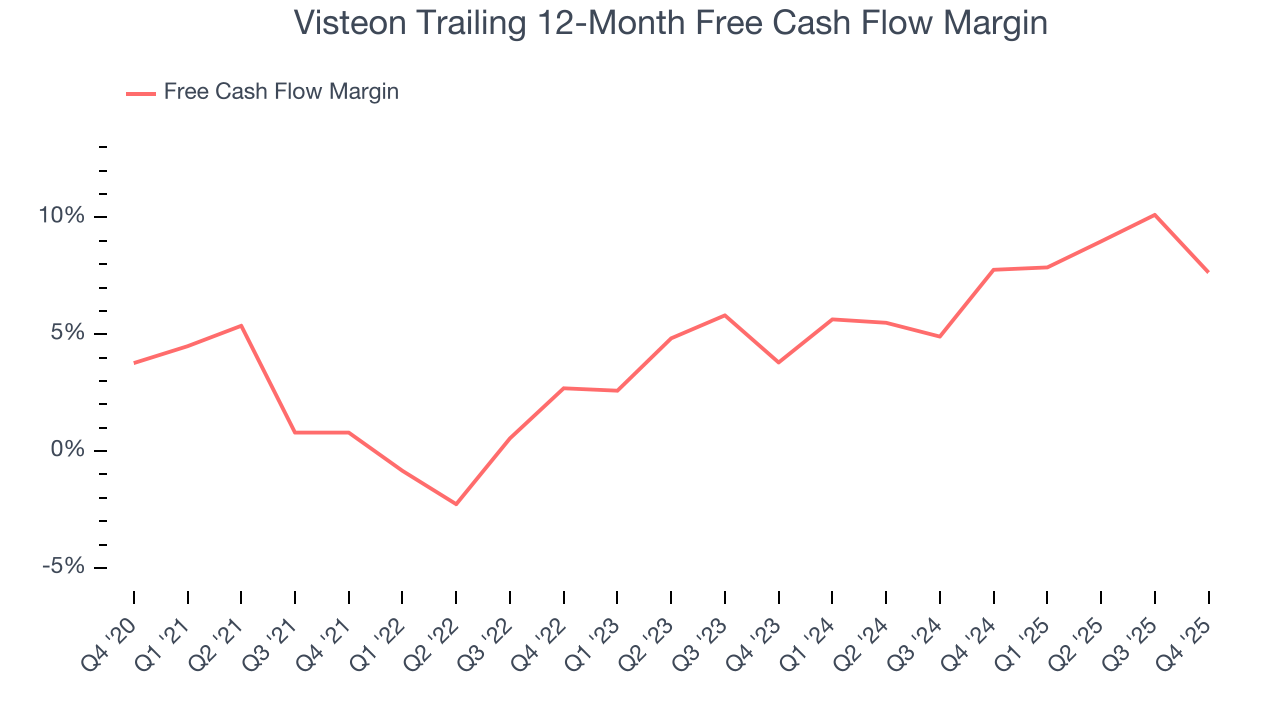
Visteon’s free cash flow clocked in at $73 million in Q4, equivalent to a 7.7% margin. The company’s cash profitability regressed as it was 9.9 percentage points lower than in the same quarter last year, but it’s still above its five-year average. We wouldn’t read too much into this quarter’s decline because investment needs can be seasonal, leading to short-term swings. Long-term trends trump temporary fluctuations.
10. Return on Invested Capital (ROIC)
EPS and free cash flow tell us whether a company was profitable while growing its revenue. But was it capital-efficient? Enter ROIC, a metric showing how much operating profit a company generates relative to the money it has raised (debt and equity).
Visteon’s five-year average ROIC was 28%, placing it among the best industrials companies. This illustrates its management team’s ability to invest in highly profitable ventures and produce tangible results for shareholders.
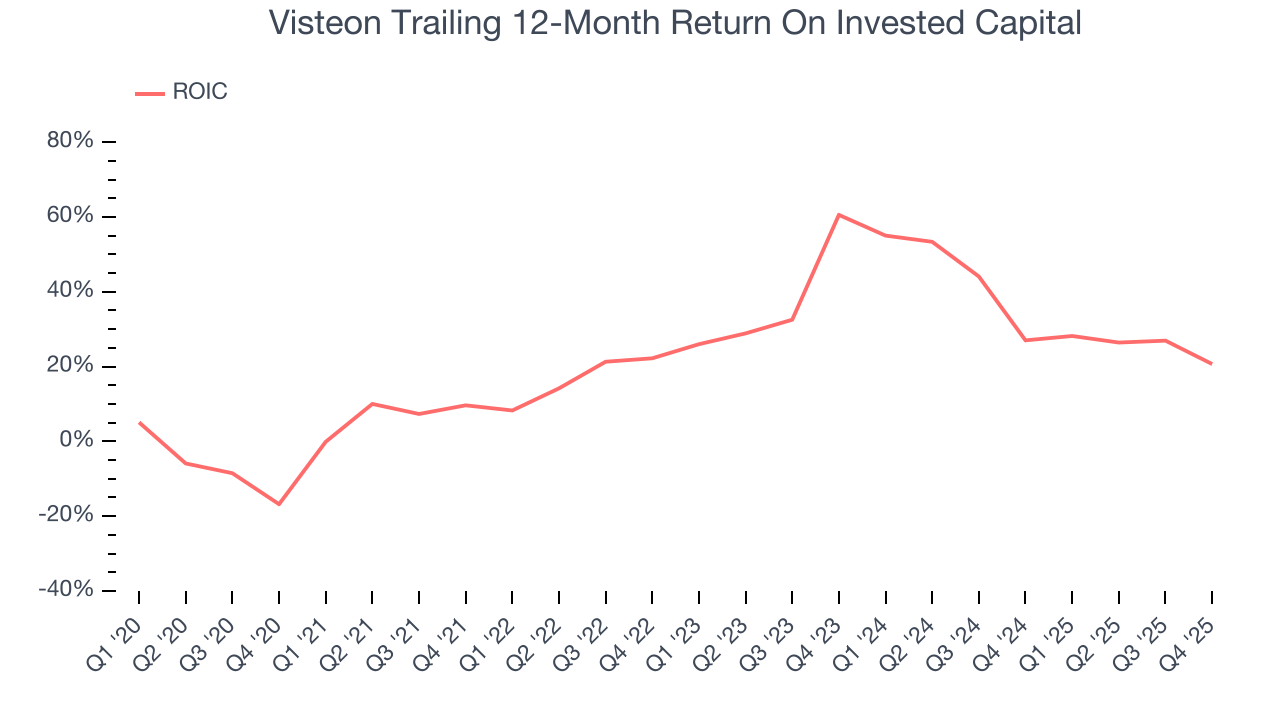
We like to invest in businesses with high returns, but the trend in a company’s ROIC is what often surprises the market and moves the stock price. Visteon’s ROIC has increased over the last few years. This is a great sign when paired with its already strong returns. It could suggest its competitive advantage or profitable growth opportunities are expanding.
11. Balance Sheet Assessment
One of the best ways to mitigate bankruptcy risk is to hold more cash than debt.
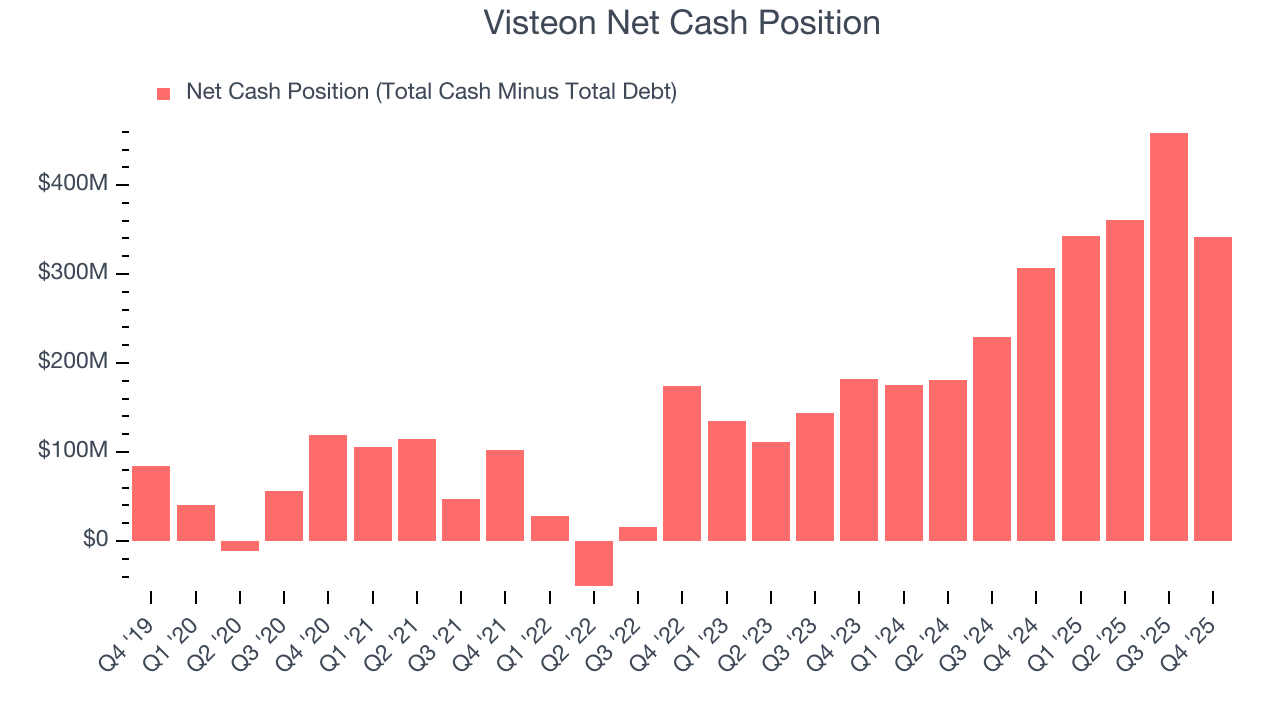
Visteon is a profitable, well-capitalized company with $773 million of cash and $431 million of debt on its balance sheet. This $342 million net cash position is 11.8% of its market cap and gives it the freedom to borrow money, return capital to shareholders, or invest in growth initiatives. Leverage is not an issue here.
12. Key Takeaways from Visteon’s Q4 Results
We enjoyed seeing Visteon beat analysts’ revenue expectations this quarter. On the other hand, its full-year revenue guidance missed and its full-year EBITDA guidance fell short of Wall Street’s estimates. Overall, this was a softer quarter. The stock traded down 6.5% to $99.26 immediately following the results.
13. Is Now The Time To Buy Visteon?
Updated: February 19, 2026 at 7:06 AM EST
The latest quarterly earnings matters, sure, but we actually think longer-term fundamentals and valuation matter more. Investors should consider all these pieces before deciding whether or not to invest in Visteon.
Visteon isn’t a terrible business, but it doesn’t pass our quality test. Although its revenue growth was decent over the last five years, it’s expected to deteriorate over the next 12 months and its low gross margins indicate some combination of competitive pressures and high production costs. And while the company’s rising cash profitability gives it more optionality, the downside is its operating margins are low compared to other industrials companies.
Visteon’s P/E ratio based on the next 12 months is 10.9x. Looking at the industrials landscape right now, Visteon trades at a pretty interesting price. If you trust the business and its direction, this is an ideal time to buy.
Wall Street analysts have a consensus one-year price target of $126.36 on the company (compared to the current share price of $99.26), implying they see 27.3% upside in buying Visteon in the short term.
Although the price target is bullish, readers should exercise caution because analysts tend to be overly optimistic. The firms they work for, often big banks, have relationships with companies that extend into fundraising, M&A advisory, and other rewarding business lines. As a result, they typically hesitate to say bad things for fear they will lose out. We at StockStory do not suffer from such conflicts of interest, so we’ll always tell it like it is.