
Custom Truck One Source (CTOS)
Custom Truck One Source doesn’t excite us. Its weak returns on capital suggest it doesn’t generate sufficient profits, a sign of value destruction.― StockStory Analyst Team


1. News


2. Summary
Why We Think Custom Truck One Source Will Underperform
Inspired by a family gas station, Custom Truck One Source (NYSE:CTOS) is a distributor of trucks and heavy equipment.
- Cash burn makes us question whether it can achieve sustainable long-term growth
- Below-average returns on capital indicate management struggled to find compelling investment opportunities
- A bright spot is that its earnings growth has beaten its peers over the last four years as its EPS has compounded at 43.9% annually
Custom Truck One Source’s quality isn’t great. We see more attractive opportunities in the market.
Why There Are Better Opportunities Than Custom Truck One Source







At $6.38 per share, Custom Truck One Source trades at 7.8x forward EV-to-EBITDA. While valuation is appropriate for the quality you get, we’re still not buyers.
It’s better to pay up for high-quality businesses with strong long-term earnings potential rather than buy lower-quality stocks because they appear cheap. These challenged businesses often don’t re-rate, a phenomenon known as a “value trap”.
3. Custom Truck One Source (CTOS) Research Report: Q4 CY2025 Update
Heavy equipment distributor Custom Truck One Source (NYSE:CTOS) missed Wall Street’s revenue expectations in Q4 CY2025 as sales only rose 1.4% year on year to $528.2 million. The company’s full-year revenue guidance of $2.06 billion at the midpoint came in 1.9% below analysts’ estimates. Its GAAP profit of $0.09 per share was 32.9% above analysts’ consensus estimates.
Custom Truck One Source (CTOS) Q4 CY2025 Highlights:
- Revenue: $528.2 million vs analyst estimates of $581 million (1.4% year-on-year growth, 9.1% miss)
- EPS (GAAP): $0.09 vs analyst estimates of $0.07 (32.9% beat)
- Adjusted EBITDA: $120.7 million vs analyst estimates of $115.8 million (22.9% margin, 4.2% beat)
- EBITDA guidance for the upcoming financial year 2026 is $422.5 million at the midpoint, in line with analyst expectations
- Operating Margin: 9.8%, down from 12.9% in the same quarter last year
- Free Cash Flow was -$60.75 million compared to -$37.76 million in the same quarter last year
- Backlog: $335.3 million at quarter end, down 9.1% year on year
- Market Capitalization: $1.45 billion
Company Overview
Inspired by a family gas station, Custom Truck One Source (NYSE:CTOS) is a distributor of trucks and heavy equipment.
The company provides equipment for sectors such as construction, utility, forestry, and rail. For example, Custom Truck One Source supplies utility companies with bucket trucks and digger derricks, while construction firms rely on their specialized cranes and heavy equipment. Additionally, the company offers custom modifications to tailor equipment to unique project needs for optimal performance.
The primary revenue sources for Custom Truck One Source include equipment sales, rental fees, and service charges for custom modifications. Its business model focuses on providing its offerings through a network of locations across the United States.
Recurring revenue is a meaningful part of the revenue base and generated through long-term rental agreements that include maintenance. Sales and ongoing custom modification services are more one-time in nature.
4. Specialty Equipment Distributors
Historically, specialty equipment distributors have boasted deep selection and expertise in sometimes narrow areas like single-use packaging or unique lighting equipment. Additionally, the industry has evolved to include more automated industrial equipment and machinery over the last decade, driving efficiencies and enabling valuable data collection. Specialty equipment distributors whose offerings keep up with these trends can take share in a still-fragmented market, but like the broader industrials sector, this space is at the whim of economic cycles that impact the capital spending and manufacturing propelling industry volumes.
Competitors in the equipment rental industry include WillScot (NASDAQ:WSC), Herc Holdings (NYSE:HRI), and United Rentals (NYSE:URI).
5. Revenue Growth
A company’s long-term sales performance is one signal of its overall quality. Any business can put up a good quarter or two, but many enduring ones grow for years. Over the last five years, Custom Truck One Source grew its sales at a decent 7.9% compounded annual growth rate. Its growth was slightly above the average industrials company and shows its offerings resonate with customers.
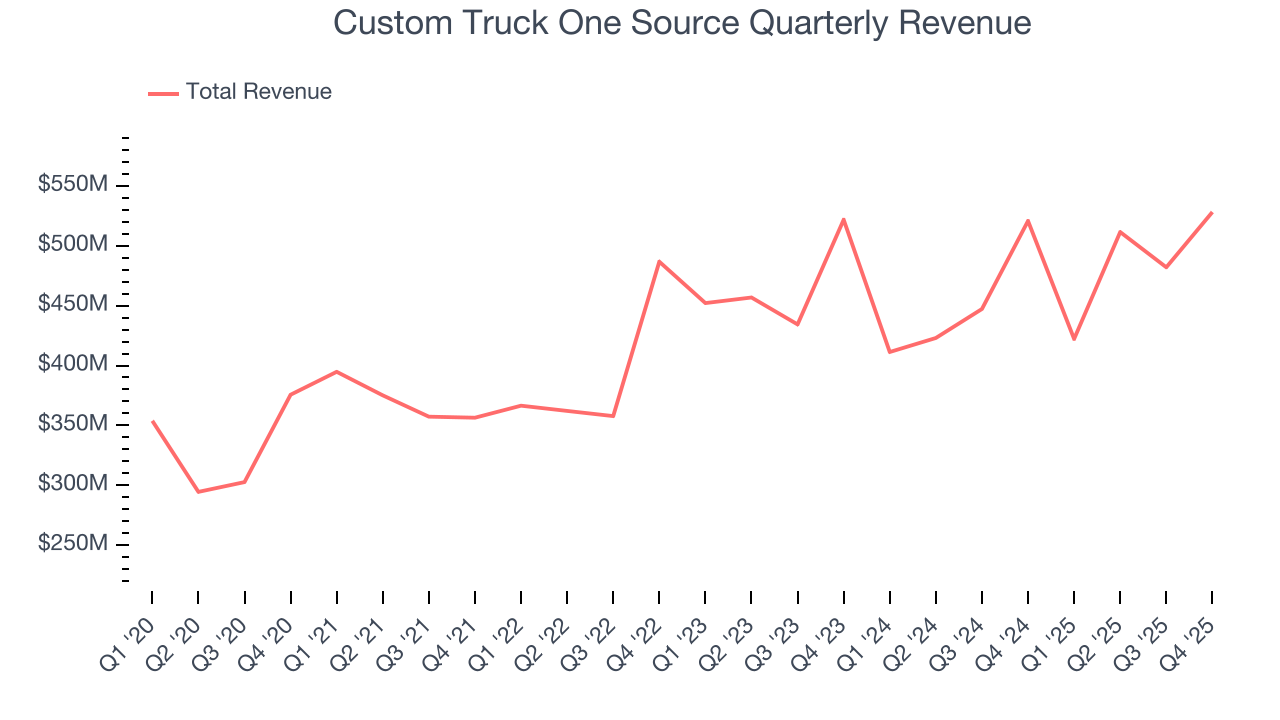
Long-term growth is the most important, but within industrials, a half-decade historical view may miss new industry trends or demand cycles. Custom Truck One Source’s recent performance shows its demand has slowed as its annualized revenue growth of 2.1% over the last two years was below its five-year trend. We’re wary when companies in the sector see decelerations in revenue growth, as it could signal changing consumer tastes aided by low switching costs. 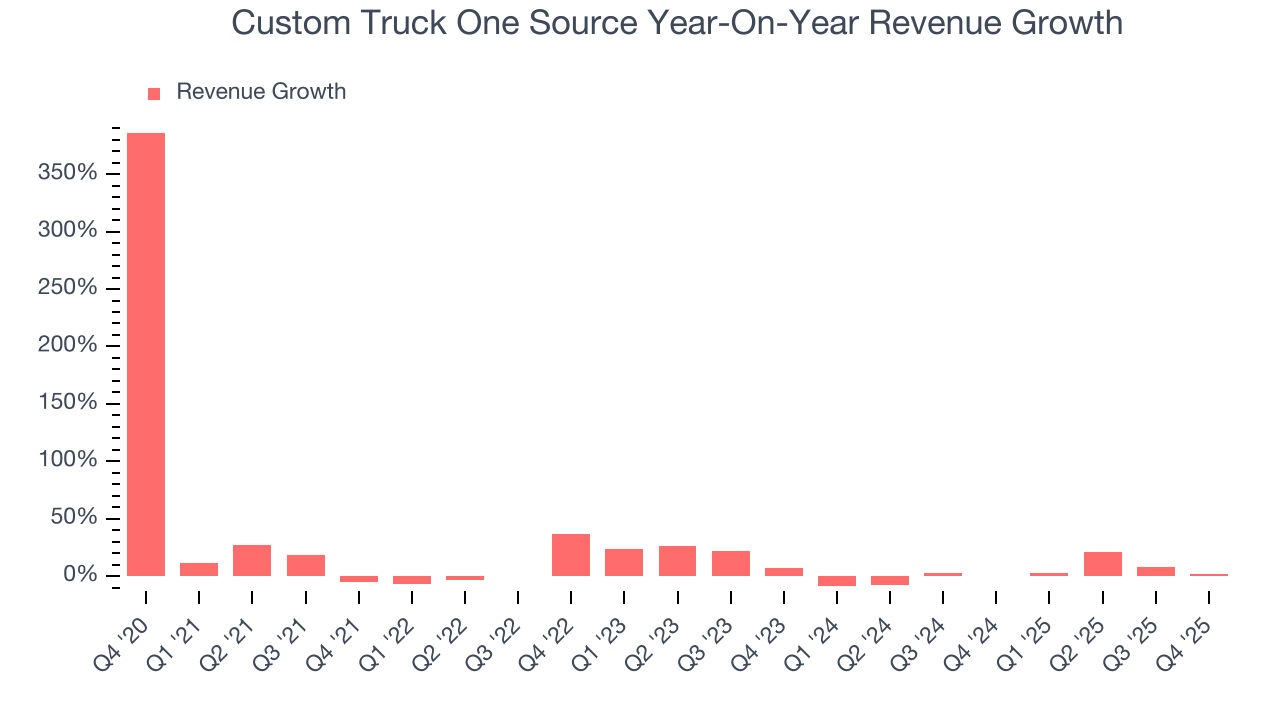
We can better understand the company’s revenue dynamics by analyzing its backlog, or the value of its outstanding orders that have not yet been executed or delivered. Custom Truck One Source’s backlog reached $335.3 million in the latest quarter and averaged 9.1% year-on-year declines over the last two years. Because this number is lower than its revenue growth, we can see the company hasn’t secured enough new orders to maintain its growth rate in the future. 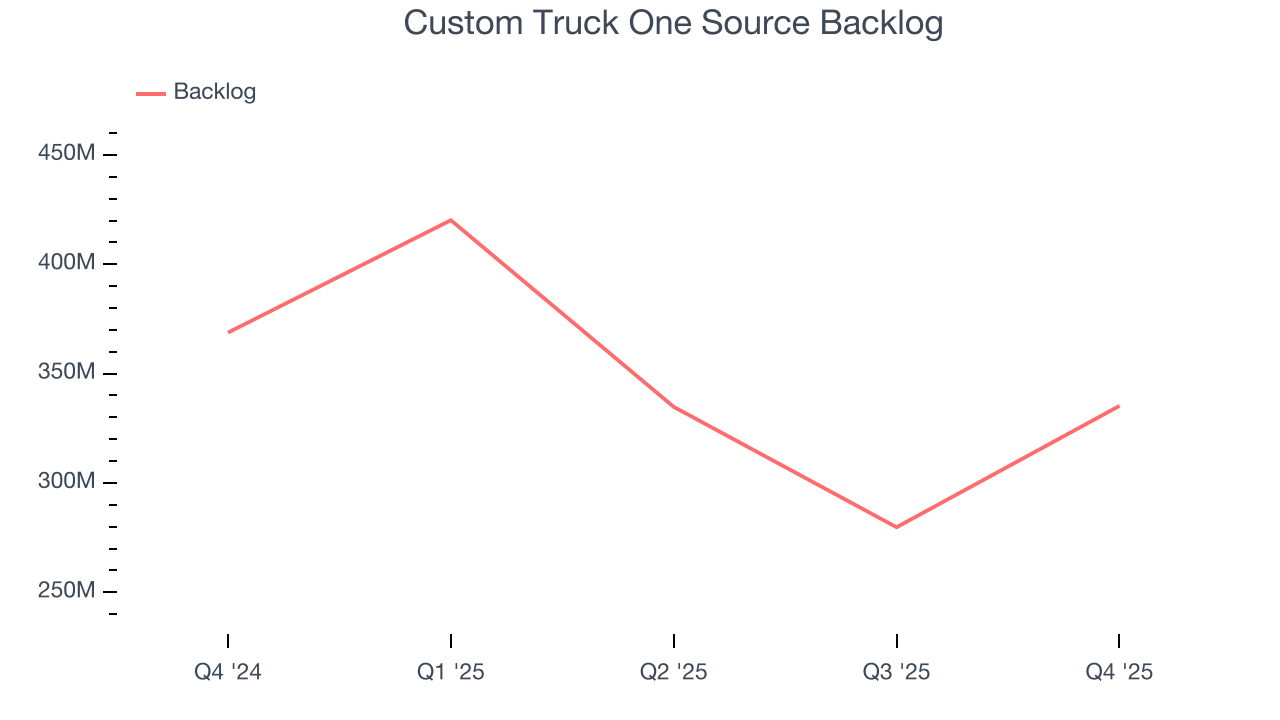
This quarter, Custom Truck One Source’s revenue grew by 1.4% year on year to $528.2 million, falling short of Wall Street’s estimates.
Looking ahead, sell-side analysts expect revenue to grow 7.5% over the next 12 months. Although this projection suggests its newer products and services will catalyze better top-line performance, it is still below average for the sector.
6. Gross Margin & Pricing Power
Custom Truck One Source has bad unit economics for an industrials company, giving it less room to reinvest and develop new offerings. As you can see below, it averaged a 25% gross margin over the last five years. That means Custom Truck One Source paid its suppliers a lot of money ($75.00 for every $100 in revenue) to run its business. 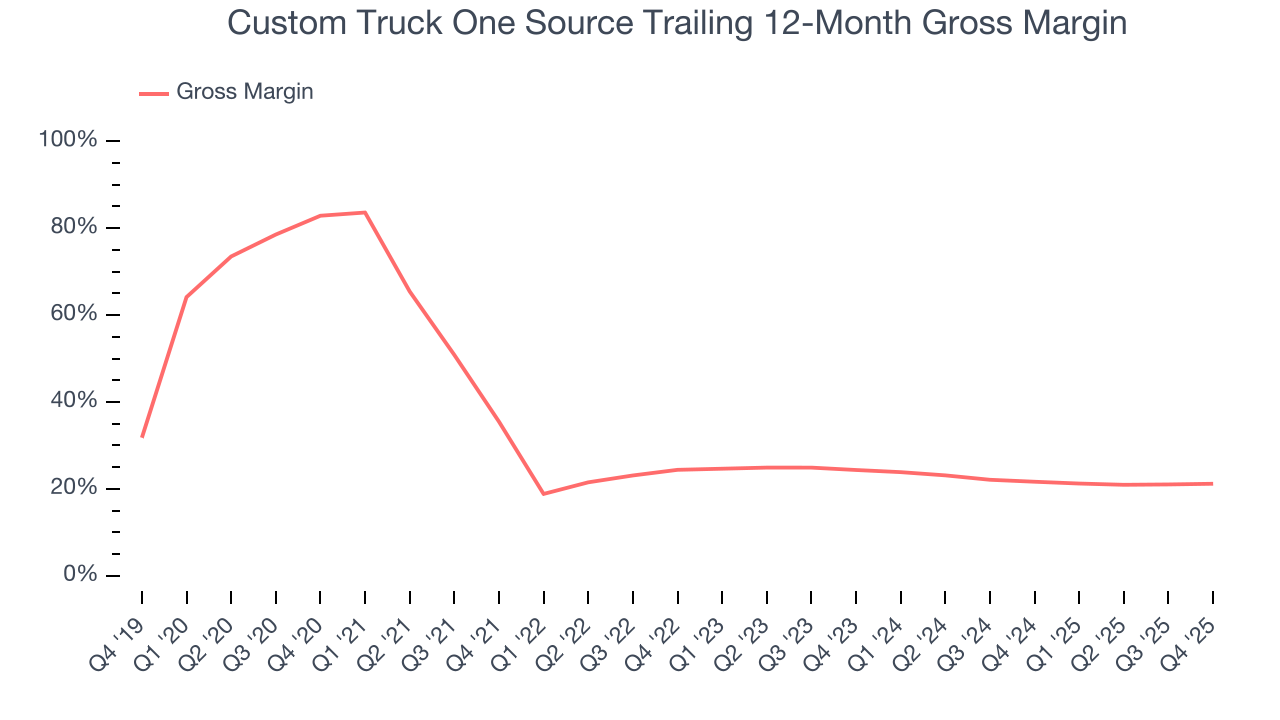
Custom Truck One Source produced a 23.3% gross profit margin in Q4, in line with the same quarter last year. Zooming out, the company’s full-year margin has remained steady over the past 12 months, suggesting its input costs (such as raw materials and manufacturing expenses) have been stable and it isn’t under pressure to lower prices.
7. Operating Margin
Custom Truck One Source was profitable over the last five years but held back by its large cost base. Its average operating margin of 5.9% was weak for an industrials business. This result isn’t too surprising given its low gross margin as a starting point.
On the plus side, Custom Truck One Source’s operating margin rose by 7.4 percentage points over the last five years, as its sales growth gave it immense operating leverage.
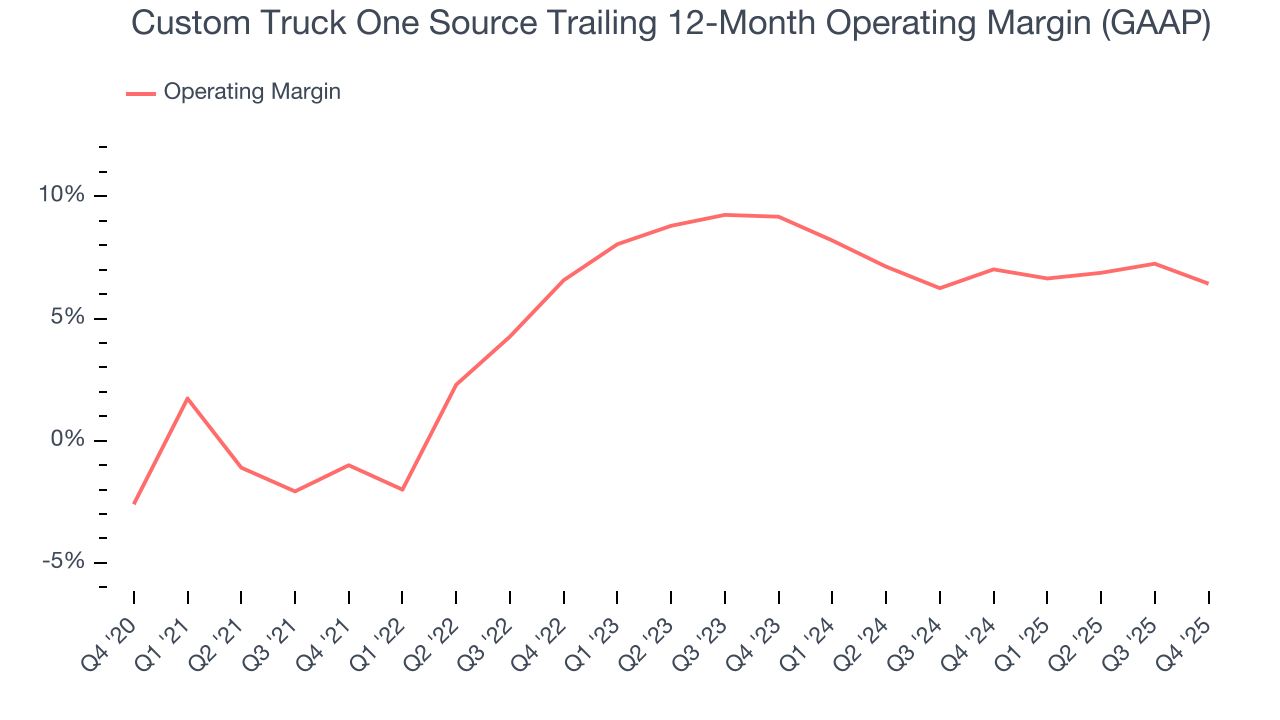
In Q4, Custom Truck One Source generated an operating margin profit margin of 9.8%, down 3.1 percentage points year on year. Since Custom Truck One Source’s operating margin decreased more than its gross margin, we can assume it was less efficient because expenses such as marketing, R&D, and administrative overhead increased.
8. Earnings Per Share
We track the long-term change in earnings per share (EPS) for the same reason as long-term revenue growth. Compared to revenue, however, EPS highlights whether a company’s growth is profitable.
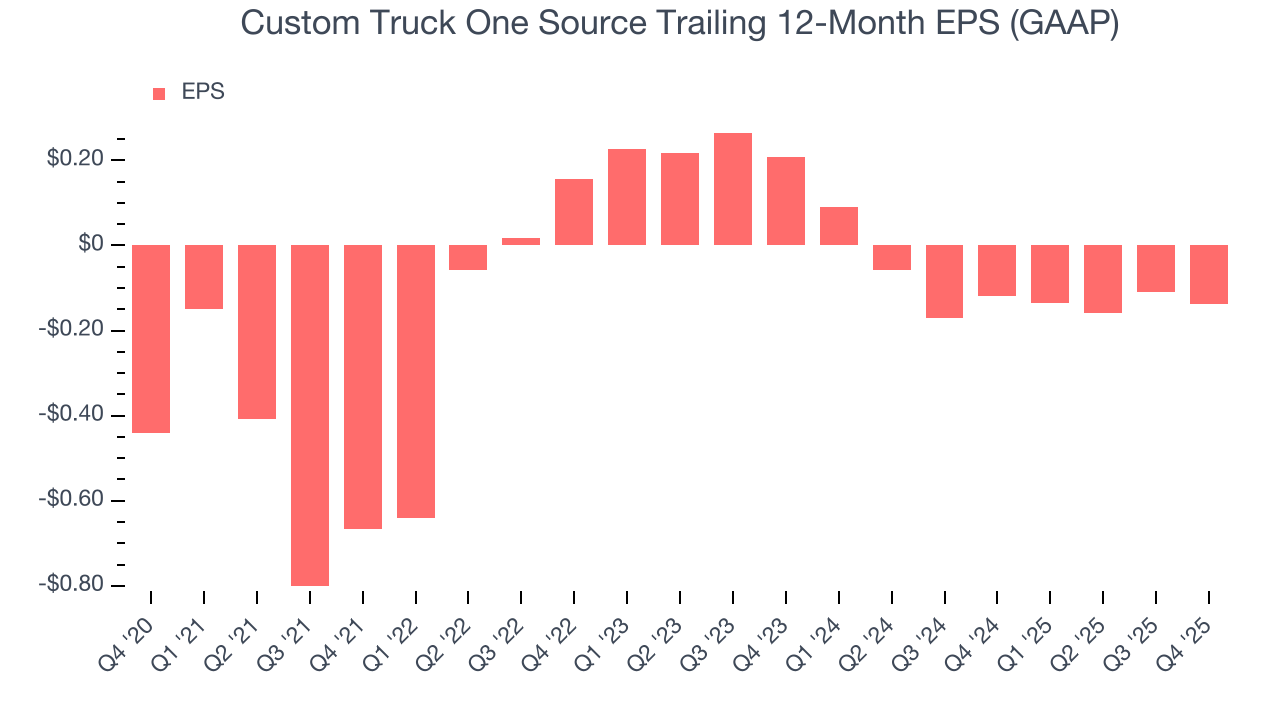
Although Custom Truck One Source’s full-year earnings are still negative, it reduced its losses and improved its EPS by 20.6% annually over the last five years. The next few quarters will be critical for assessing its long-term profitability.
Like with revenue, we analyze EPS over a shorter period to see if we are missing a change in the business.
Sadly for Custom Truck One Source, its EPS declined by 63.4% annually over the last two years while its revenue grew by 2.1%. This tells us the company became less profitable on a per-share basis as it expanded.
In Q4, Custom Truck One Source reported EPS of $0.09, down from $0.12 in the same quarter last year. Despite falling year on year, this print easily cleared analysts’ estimates. Over the next 12 months, Wall Street is optimistic. Analysts forecast Custom Truck One Source’s full-year EPS of negative $0.14 will flip to positive $0.03.
9. Cash Is King
If you’ve followed StockStory for a while, you know we emphasize free cash flow. Why, you ask? We believe that in the end, cash is king, and you can’t use accounting profits to pay the bills.
Custom Truck One Source’s demanding reinvestments have drained its resources over the last five years, putting it in a pinch and limiting its ability to return capital to investors. Its free cash flow margin averaged negative 13%, meaning it lit $12.97 of cash on fire for every $100 in revenue.
Taking a step back, we can see that Custom Truck One Source’s margin dropped by 6.8 percentage points during that time. It may have ticked higher more recently, but shareholders are likely hoping for its margin to at least revert to its historical level. Almost any movement in the wrong direction is undesirable because it’s already burning cash. If the longer-term trend returns, it could signal it’s becoming a more capital-intensive business.
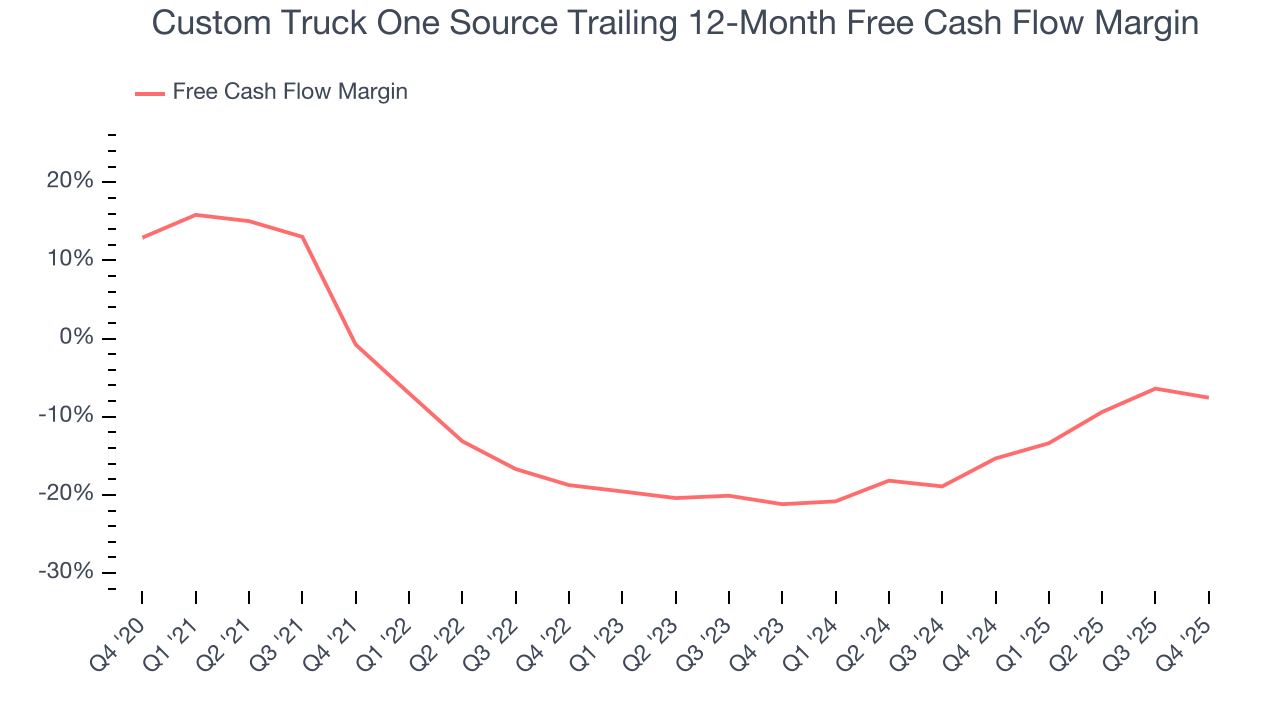
Custom Truck One Source burned through $60.75 million of cash in Q4, equivalent to a negative 11.5% margin. The company’s cash burn increased from $37.76 million of lost cash in the same quarter last year.
10. Return on Invested Capital (ROIC)
EPS and free cash flow tell us whether a company was profitable while growing its revenue. But was it capital-efficient? A company’s ROIC explains this by showing how much operating profit it makes compared to the money it has raised (debt and equity).
Custom Truck One Source historically did a mediocre job investing in profitable growth initiatives. Its five-year average ROIC was 2.7%, lower than the typical cost of capital (how much it costs to raise money) for industrials companies.
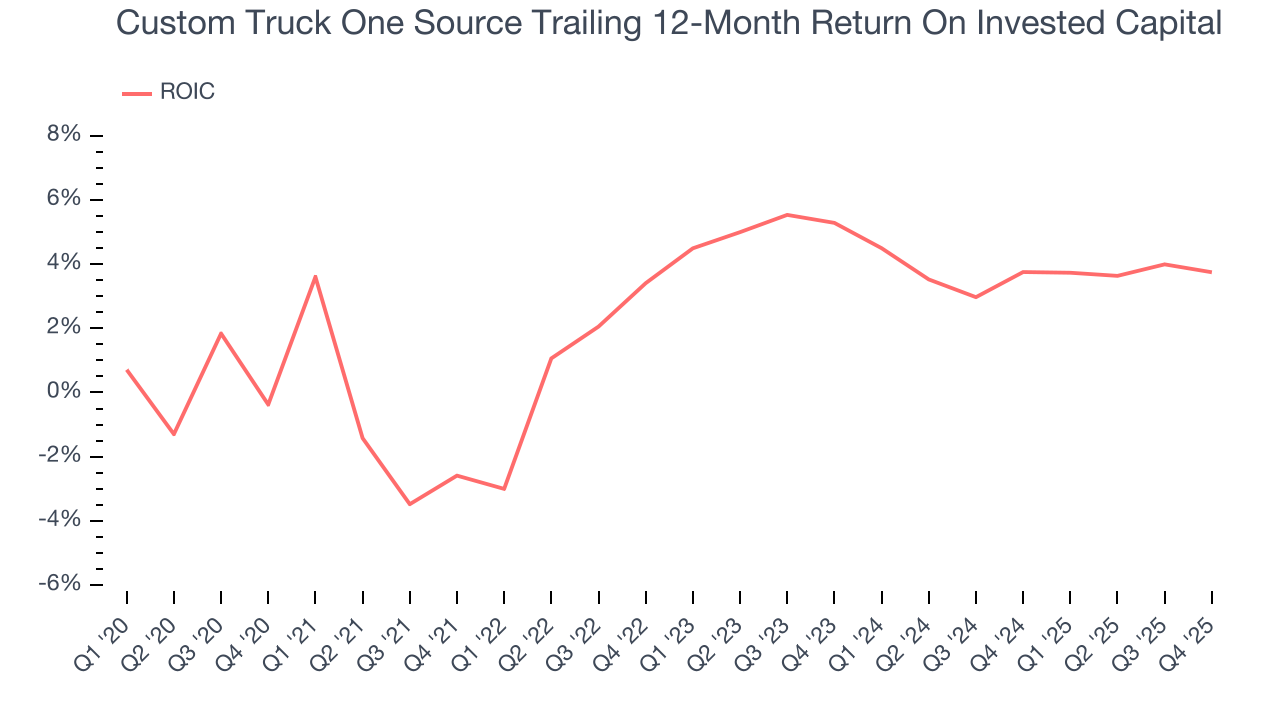
We like to invest in businesses with high returns, but the trend in a company’s ROIC is what often surprises the market and moves the stock price. On average, Custom Truck One Source’s ROIC increased by 3.3 percentage points annually each year over the last few years. This is a good sign, and we hope the company can continue improving.
11. Balance Sheet Assessment
Custom Truck One Source reported $6.27 million of cash and $1.76 billion of debt on its balance sheet in the most recent quarter. As investors in high-quality companies, we primarily focus on two things: 1) that a company’s debt level isn’t too high and 2) that its interest payments are not excessively burdening the business.
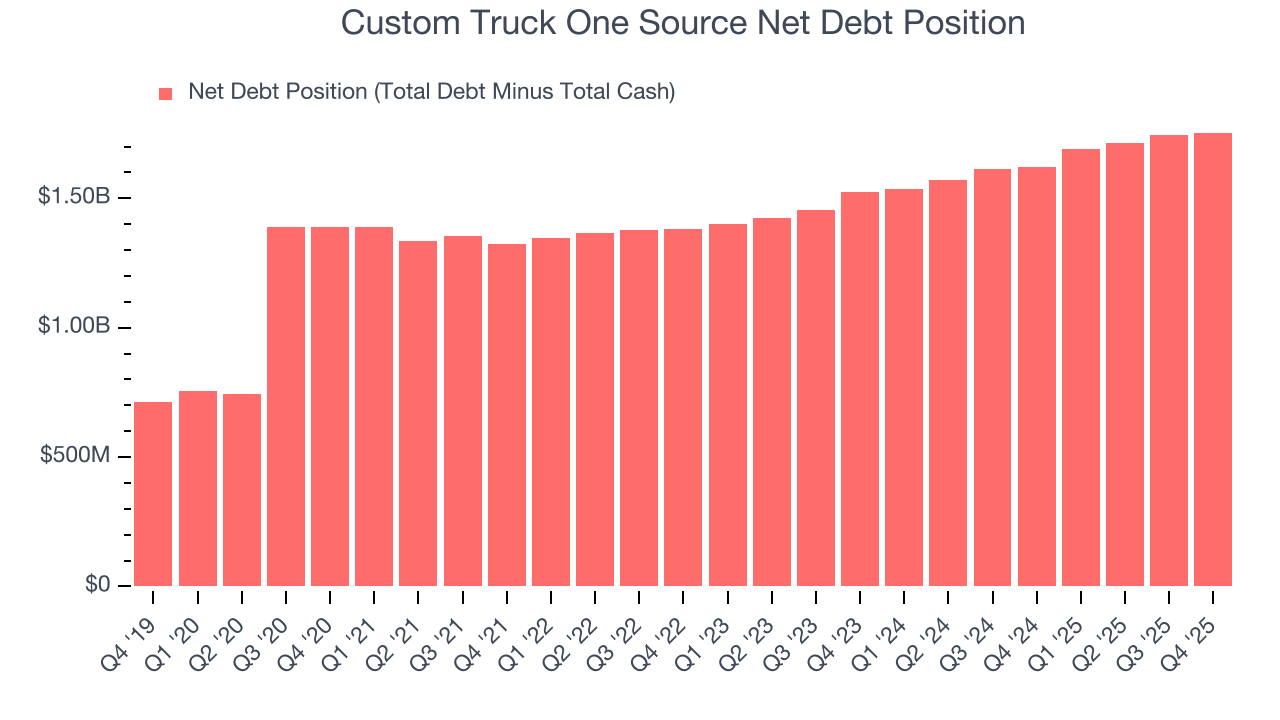
With $383.6 million of EBITDA over the last 12 months, we view Custom Truck One Source’s 4.6× net-debt-to-EBITDA ratio as safe. We also see its $81.11 million of annual interest expenses as appropriate. The company’s profits give it plenty of breathing room, allowing it to continue investing in growth initiatives.
12. Key Takeaways from Custom Truck One Source’s Q4 Results
It was good to see Custom Truck One Source beat analysts’ EPS expectations this quarter. We were also glad its EBITDA outperformed Wall Street’s estimates. On the other hand, its revenue missed and its full-year revenue guidance fell short of Wall Street’s estimates. Overall, this was a weaker quarter. The stock remained flat at $6.38 immediately after reporting.
13. Is Now The Time To Buy Custom Truck One Source?
Updated: March 10, 2026 at 7:09 AM EDT
Are you wondering whether to buy Custom Truck One Source or pass? We urge investors to not only consider the latest earnings results but also longer-term business quality and valuation as well.
Custom Truck One Source falls short of our quality standards. Although its revenue growth was decent over the last five years and Wall Street believes it will continue to grow, its relatively low ROIC suggests management has struggled to find compelling investment opportunities. And while the company’s expanding operating margin shows the business has become more efficient, the downside is its cash profitability fell over the last five years.
Custom Truck One Source’s P/E ratio based on the next 12 months is 159.5x. This valuation tells us it’s a bit of a market darling with a lot of good news priced in - you can find more timely opportunities elsewhere.
Wall Street analysts have a consensus one-year price target of $7.75 on the company (compared to the current share price of $6.38).
Although the price target is bullish, readers should exercise caution because analysts tend to be overly optimistic. The firms they work for, often big banks, have relationships with companies that extend into fundraising, M&A advisory, and other rewarding business lines. As a result, they typically hesitate to say bad things for fear they will lose out. We at StockStory do not suffer from such conflicts of interest, so we’ll always tell it like it is.