
Enviri (NVRI)
Enviri faces an uphill battle. Its weak sales growth and low returns on capital show it struggled to generate demand and profits.― StockStory Analyst Team


1. News



2. Summary
Why We Think Enviri Will Underperform
Cooling America’s first indoor ice rink in the 19th century, Enviri (NYSE:NVRI) offers steel and waste handling services.
- Falling earnings per share over the last five years has some investors worried as stock prices ultimately follow EPS over the long term
- Cash burn makes us question whether it can achieve sustainable long-term growth
- High net-debt-to-EBITDA ratio of 5× could force the company to raise capital at unfavorable terms if market conditions deteriorate
Enviri’s quality doesn’t meet our expectations. We see more attractive opportunities in the market.
Why There Are Better Opportunities Than Enviri





Enviri’s stock price of $18.83 implies a valuation ratio of 10.6x forward EV-to-EBITDA. Yes, this valuation multiple is lower than that of other industrials peers, but we’ll remind you that you often get what you pay for.
We’d rather pay up for companies with elite fundamentals than get a bargain on weak ones. Cheap stocks can be value traps, and as their performance deteriorates, they will stay cheap or get even cheaper.
3. Enviri (NVRI) Research Report: Q3 CY2025 Update
Steel and waste handling company Enviri (NYSE:NVRI) met Wall Streets revenue expectations in Q3 CY2025, but sales were flat year on year at $574.8 million. Its non-GAAP loss of $0.08 per share was significantly below analysts’ consensus estimates.
Enviri (NVRI) Q3 CY2025 Highlights:
- Revenue: $574.8 million vs analyst estimates of $573.2 million (flat year on year, in line)
- Adjusted EPS: -$0.08 vs analyst estimates of -$0.03 (significant miss)
- Adjusted EBITDA: $74.41 million vs analyst estimates of $82.17 million (12.9% margin, 9.4% miss)
- Management lowered its full-year Adjusted EPS guidance to -$0.68 at the midpoint, a 65.9% decrease
- EBITDA guidance for the full year is $273 million at the midpoint, below analyst estimates of $297 million
- Operating Margin: 2.9%, down from 4.3% in the same quarter last year
- Free Cash Flow was $2.68 million, up from -$40.19 million in the same quarter last year
- Market Capitalization: $983.1 million
Company Overview
Cooling America’s first indoor ice rink in the 19th century, Enviri (NYSE:NVRI) offers steel and waste handling services.
Enviri, formerly known as Harsco, was established in 1853 as a car manufacturing company sparked by the growth of the U.S. railroad system. The company transitioned into the steel industry prior to World War II to forge iron and steel products, and through several acquisitions over the next few decades, propelled itself into the steel and waste handling industry. Two important deals in recent history were ALTEK in 2018 and Clean Earth in 2019, which enabled Enviri to offer metal recovery services and handling solutions for contaminated materials.
In the steel industry, Enviri provides services to recover valuable metals from slag, a leftover material from making steel. This process not only helps reduce waste but also makes steel production more efficient. Additionally, Enviri inspects, repairs, and renews tracks which is crucial for both passenger and freight trains to run smoothly without delays.
Enviri also helps industries like construction and energy with managing waste in an environmentally friendly way. It treats and recycles industrial waste, helping companies follow environmental laws and reduce impact on the planet. These services can handle many different types of waste, making it easier for companies to manage waste responsibly.
4. Waste Management
Waste management companies can possess licenses permitting them to handle hazardous materials. Furthermore, many services are performed through contracts and statutorily mandated, non-discretionary, or recurring, leading to more predictable revenue streams. However, regulation can be a headwind, rendering existing services obsolete or forcing companies to invest precious capital to comply with new, more environmentally-friendly rules. Lastly, waste management companies are at the whim of economic cycles. Interest rates, for example, can greatly impact industrial production or commercial projects that create waste and byproducts.
Competitors offering similar products include Waste Management (NYSE:WM), Clean Harbors (NYSE:CLH), and Schnitzer Steel (NASDAQ:SCHN).
5. Revenue Growth
Reviewing a company’s long-term sales performance reveals insights into its quality. Any business can have short-term success, but a top-tier one grows for years. Regrettably, Enviri’s sales grew at a tepid 5% compounded annual growth rate over the last five years. This fell short of our benchmark for the industrials sector and is a rough starting point for our analysis.
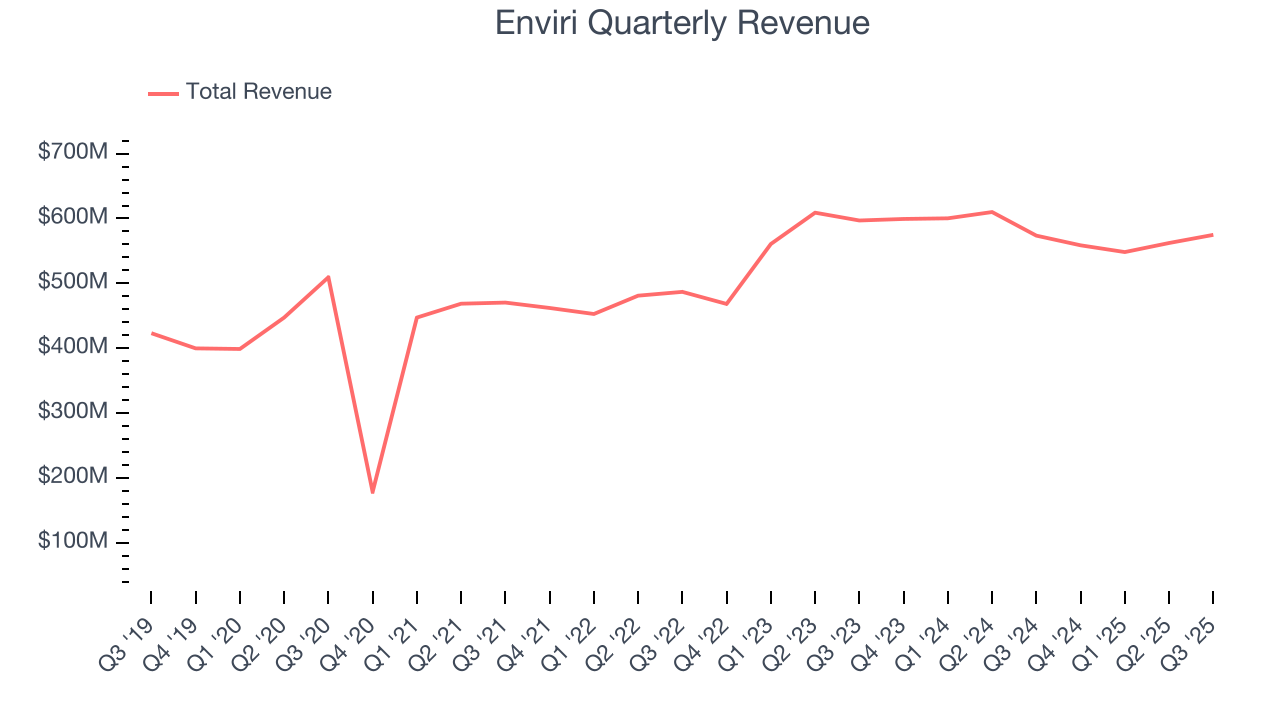
Long-term growth is the most important, but within industrials, a half-decade historical view may miss new industry trends or demand cycles. Enviri’s recent performance shows its demand has slowed as its revenue was flat over the last two years. 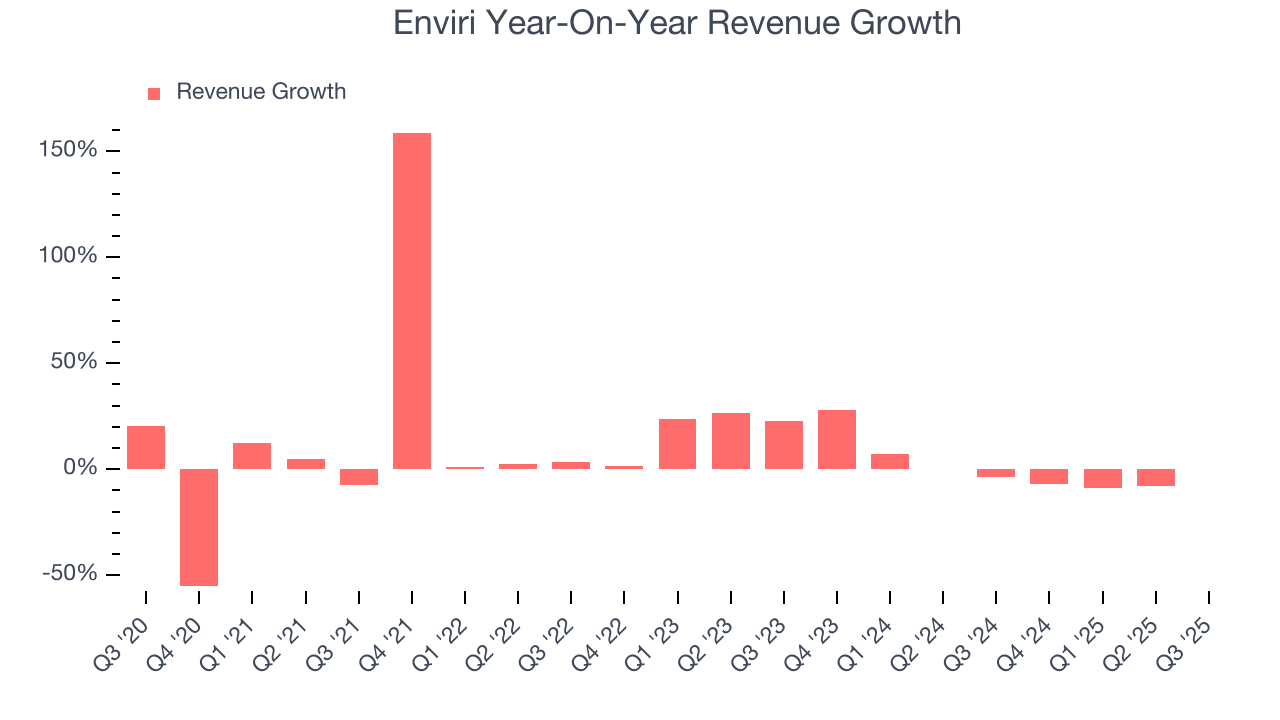
This quarter, Enviri’s $574.8 million of revenue was flat year on year and in line with Wall Street’s estimates.
Looking ahead, sell-side analysts expect revenue to grow 3.3% over the next 12 months. Although this projection suggests its newer products and services will spur better top-line performance, it is still below average for the sector.
6. Gross Margin & Pricing Power
All else equal, we prefer higher gross margins because they make it easier to generate more operating profits and indicate that a company commands pricing power by offering more differentiated products.
Enviri has bad unit economics for an industrials business, signaling it operates in a competitive market. As you can see below, it averaged a 19% gross margin over the last five years. That means Enviri paid its suppliers a lot of money ($81.02 for every $100 in revenue) to run its business. 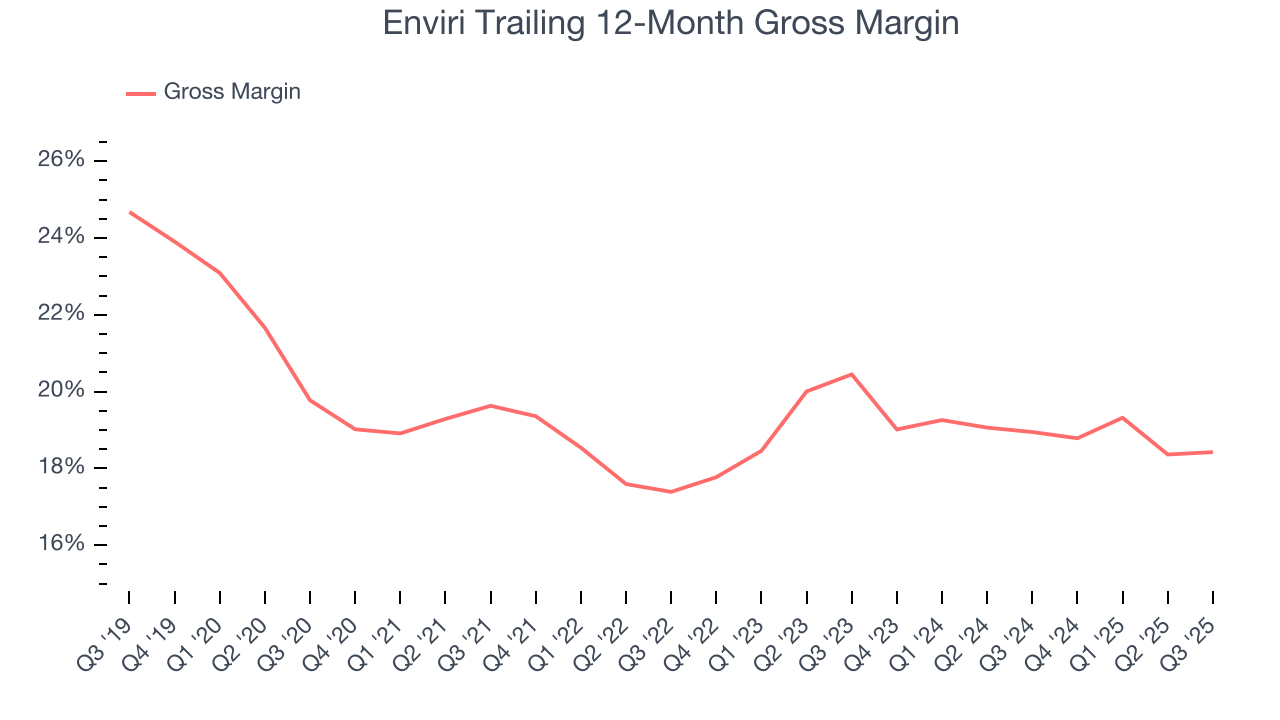
Enviri’s gross profit margin came in at 21% this quarter, in line with the same quarter last year. Zooming out, the company’s full-year margin has remained steady over the past 12 months, suggesting its input costs (such as raw materials and manufacturing expenses) have been stable and it isn’t under pressure to lower prices.
7. Operating Margin
Enviri was profitable over the last five years but held back by its large cost base. Its average operating margin of 3.4% was weak for an industrials business. This result isn’t too surprising given its low gross margin as a starting point.
Looking at the trend in its profitability, Enviri’s operating margin decreased by 4.1 percentage points over the last five years. This raises questions about the company’s expense base because its revenue growth should have given it leverage on its fixed costs, resulting in better economies of scale and profitability. Enviri’s performance was poor no matter how you look at it - it shows that costs were rising and it couldn’t pass them onto its customers.
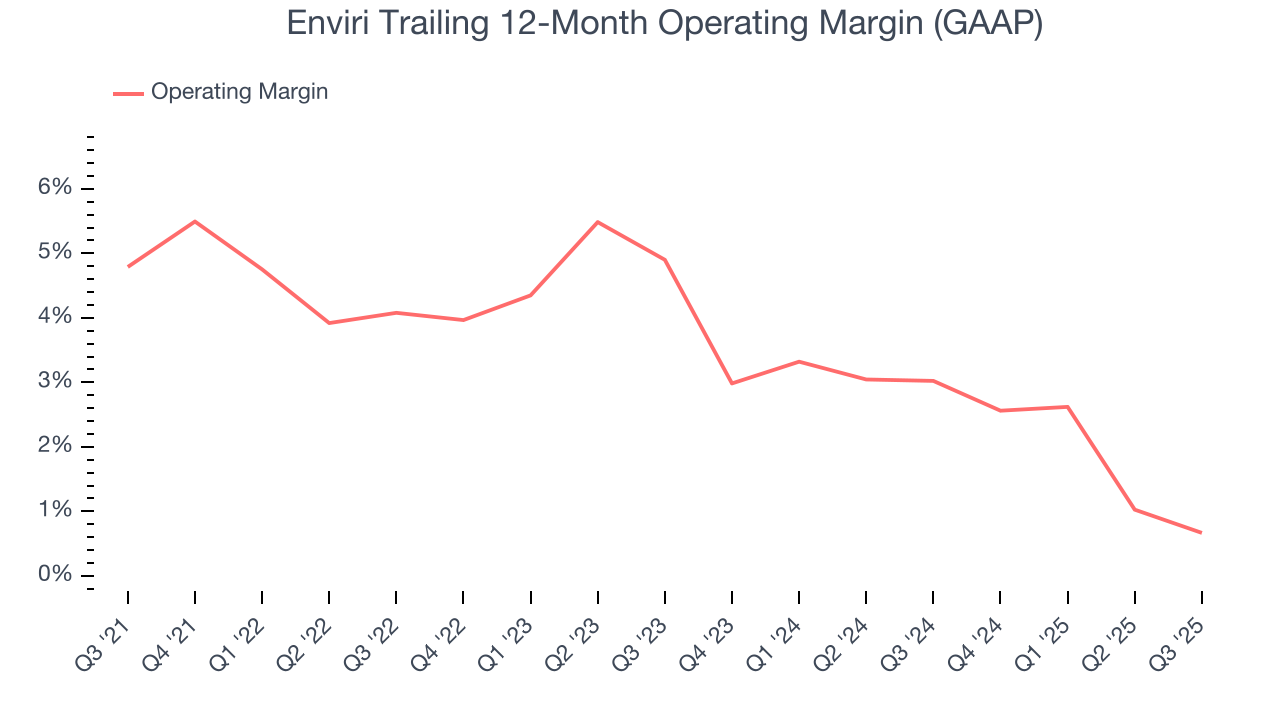
In Q3, Enviri generated an operating margin profit margin of 2.9%, down 1.4 percentage points year on year. Since Enviri’s operating margin decreased more than its gross margin, we can assume it was less efficient because expenses such as marketing, R&D, and administrative overhead increased.
8. Earnings Per Share
We track the long-term change in earnings per share (EPS) for the same reason as long-term revenue growth. Compared to revenue, however, EPS highlights whether a company’s growth is profitable.
Sadly for Enviri, its EPS declined by 24.6% annually over the last five years while its revenue grew by 5%. This tells us the company became less profitable on a per-share basis as it expanded.
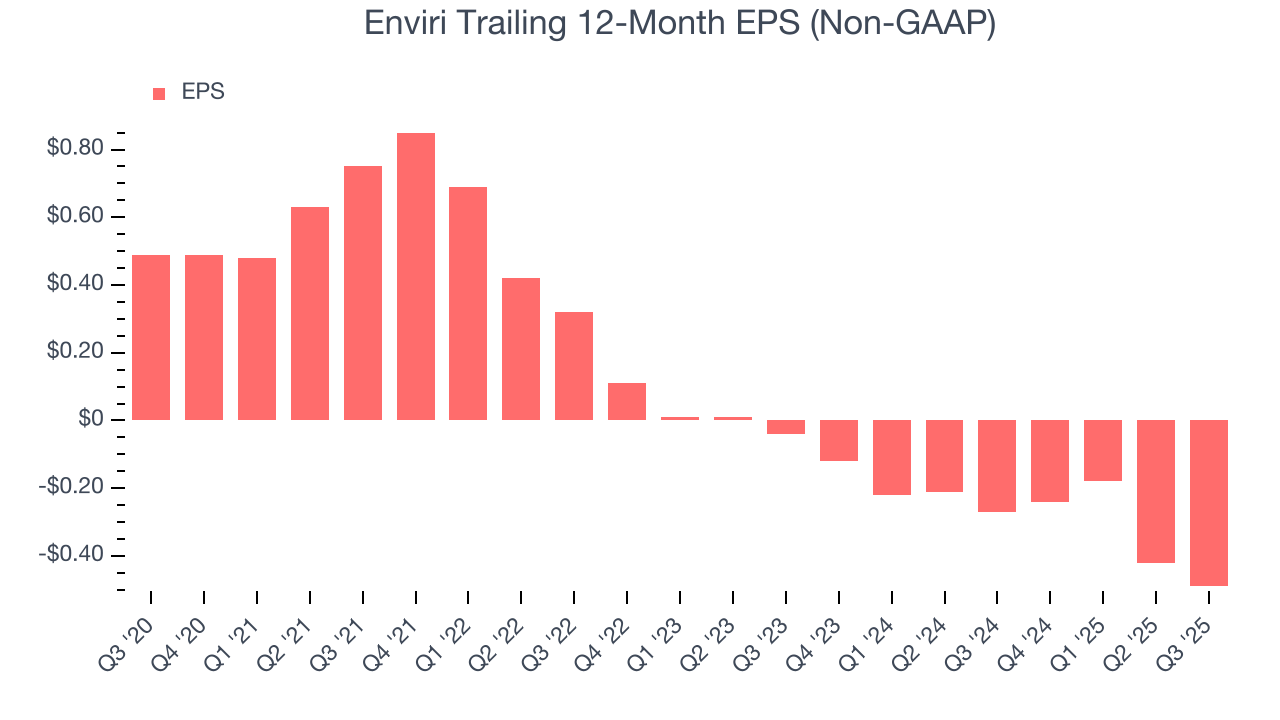
We can take a deeper look into Enviri’s earnings to better understand the drivers of its performance. As we mentioned earlier, Enviri’s operating margin declined by 4.1 percentage points over the last five years. Its share count also grew by 2.1%, meaning the company not only became less efficient with its operating expenses but also diluted its shareholders. 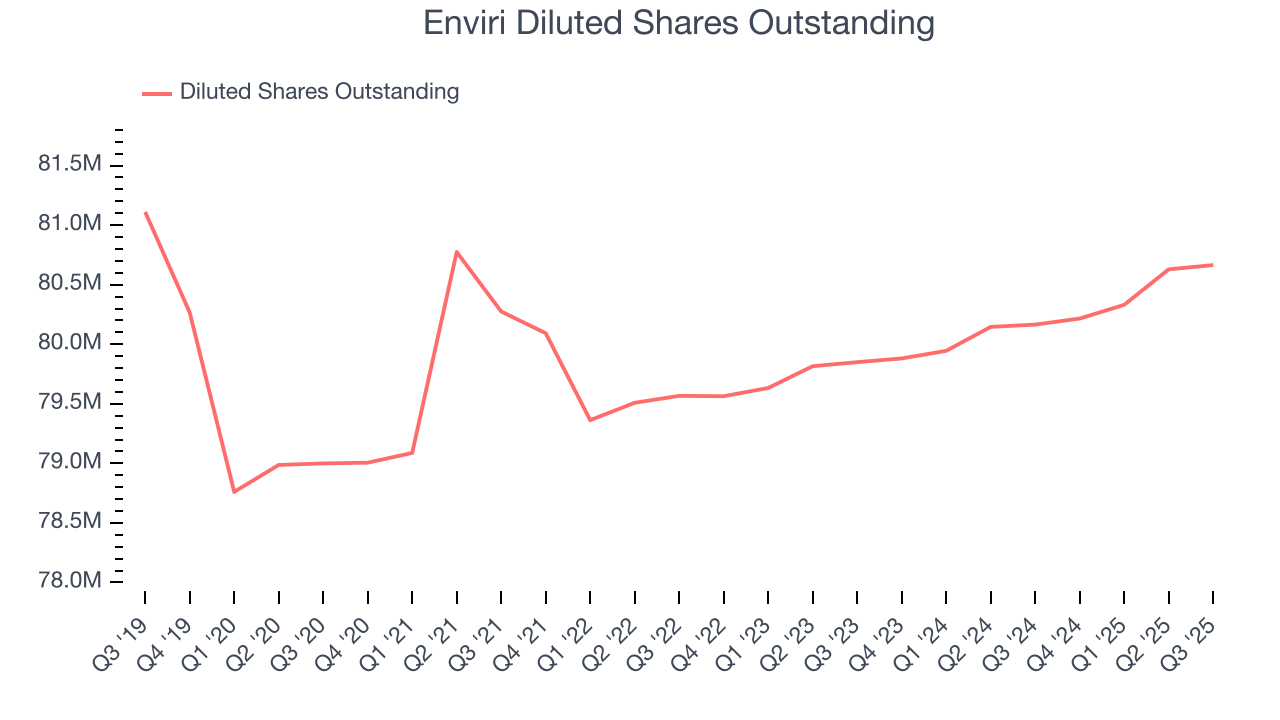
Like with revenue, we analyze EPS over a more recent period because it can provide insight into an emerging theme or development for the business.
For Enviri, its two-year annual EPS declines of 250% show it’s continued to underperform. These results were bad no matter how you slice the data.
In Q3, Enviri reported adjusted EPS of negative $0.08, down from negative $0.01 in the same quarter last year. This print missed analysts’ estimates. Over the next 12 months, Wall Street expects Enviri to improve its earnings losses. Analysts forecast its full-year EPS of negative $0.49 will advance to negative $0.07.
9. Cash Is King
Although earnings are undoubtedly valuable for assessing company performance, we believe cash is king because you can’t use accounting profits to pay the bills.
While Enviri’s free cash flow broke even this quarter, the broader story hasn’t been so clean. Enviri’s demanding reinvestments have drained its resources over the last five years, putting it in a pinch and limiting its ability to return capital to investors. Its free cash flow margin averaged negative 2.1%, meaning it lit $2.08 of cash on fire for every $100 in revenue.
Taking a step back, an encouraging sign is that Enviri’s margin expanded by 4.7 percentage points during that time. We have no doubt shareholders would like to continue seeing its cash conversion rise.
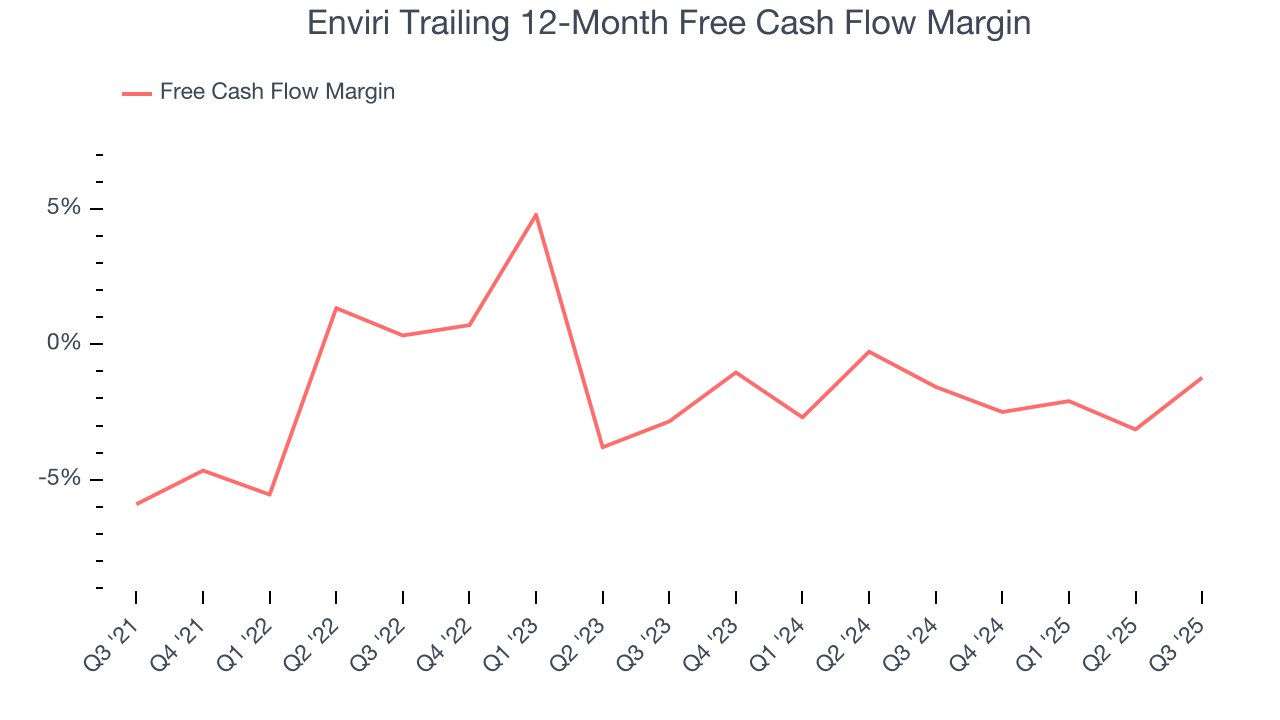
Enviri broke even from a free cash flow perspective in Q3. This result was good as its margin was 7.5 percentage points higher than in the same quarter last year, building on its favorable historical trend.
10. Return on Invested Capital (ROIC)
EPS and free cash flow tell us whether a company was profitable while growing its revenue. But was it capital-efficient? Enter ROIC, a metric showing how much operating profit a company generates relative to the money it has raised (debt and equity).
Enviri historically did a mediocre job investing in profitable growth initiatives. Its five-year average ROIC was 2.9%, lower than the typical cost of capital (how much it costs to raise money) for industrials companies.
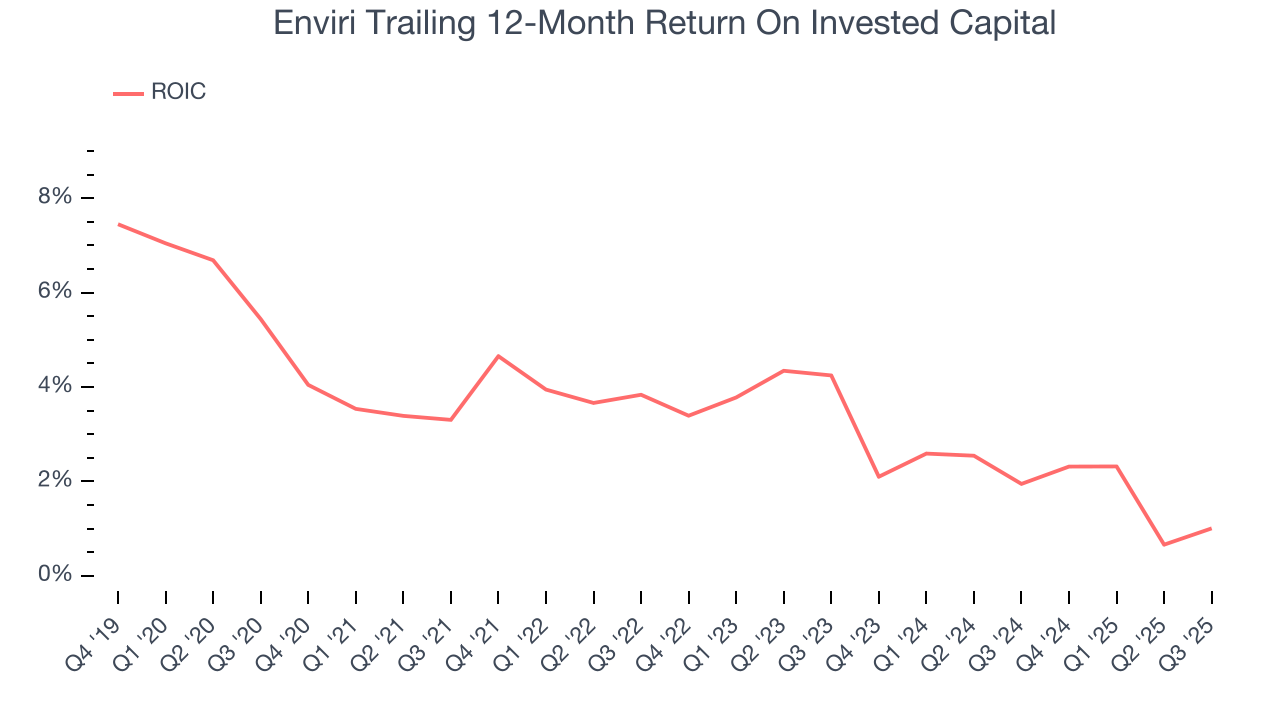
We like to invest in businesses with high returns, but the trend in a company’s ROIC is what often surprises the market and moves the stock price. Unfortunately, Enviri’s ROIC averaged 2.1 percentage point decreases over the last few years. Paired with its already low returns, these declines suggest its profitable growth opportunities are few and far between.
11. Balance Sheet Risk
Debt is a tool that can boost company returns but presents risks if used irresponsibly. As long-term investors, we aim to avoid companies taking excessive advantage of this instrument because it could lead to insolvency.
Enviri’s $1.67 billion of debt exceeds the $131 million of cash on its balance sheet. Furthermore, its 6× net-debt-to-EBITDA ratio (based on its EBITDA of $276.2 million over the last 12 months) shows the company is overleveraged.
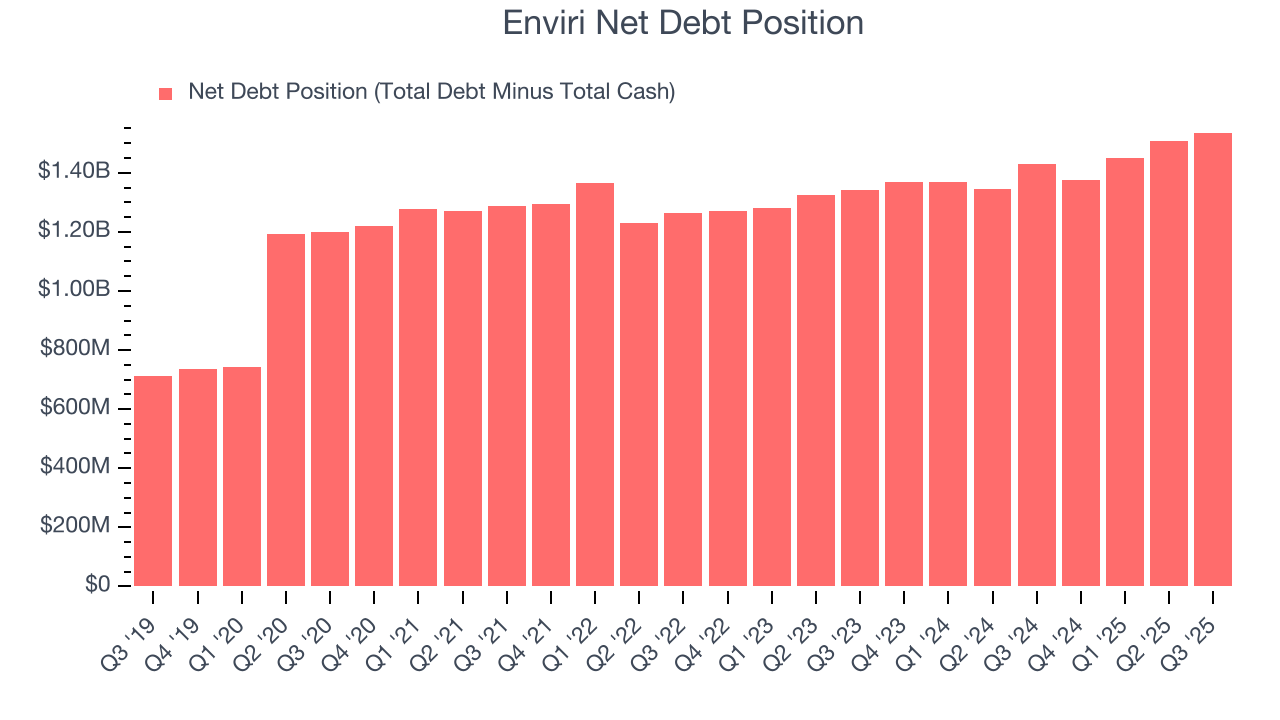
At this level of debt, incremental borrowing becomes increasingly expensive and credit agencies could downgrade the company’s rating if profitability falls. Enviri could also be backed into a corner if the market turns unexpectedly – a situation we seek to avoid as investors in high-quality companies.
We hope Enviri can improve its balance sheet and remain cautious until it increases its profitability or pays down its debt.
12. Key Takeaways from Enviri’s Q3 Results
We struggled to find many positives in these results. Its full-year EBITDA guidance missed and its EBITDA fell short of Wall Street’s estimates. Overall, this quarter could have been better. The stock traded down 7.7% to $11.25 immediately after reporting.
13. Is Now The Time To Buy Enviri?
Updated: January 24, 2026 at 10:06 PM EST
Before making an investment decision, investors should account for Enviri’s business fundamentals and valuation in addition to what happened in the latest quarter.
Enviri falls short of our quality standards. To begin with, its revenue growth was uninspiring over the last five years, and analysts expect its demand to deteriorate over the next 12 months. And while its rising cash profitability gives it more optionality, the downside is its relatively low ROIC suggests management has struggled to find compelling investment opportunities. On top of that, its projected EPS for the next year is lacking.
Enviri’s EV-to-EBITDA ratio based on the next 12 months is 10.6x. This multiple tells us a lot of good news is priced in - you can find more timely opportunities elsewhere.
Wall Street analysts have a consensus one-year price target of $21.33 on the company (compared to the current share price of $18.83).