
Solventum (SOLV)
Solventum faces an uphill battle. Not only has it failed to grow sales but also its profitability has shrunk, suggesting it’s struggling to adapt.― StockStory Analyst Team


1. News



2. Summary
Why We Think Solventum Will Underperform
Founded in 1985, Solventum (NYSE:SOLV) develops, manufactures, and commercializes a portfolio of healthcare products and services addressing critical customer and therapeutic patient needs.
- Performance over the past three years shows each sale was less profitable, as its earnings per share fell by 31.6% annually
- Sales are projected to tank by 1.9% over the next 12 months as demand evaporates further
- Sales stagnated over the last two years and signal the need for new growth strategies
Solventum fails to meet our quality criteria. We’d rather invest in businesses with stronger moats.
Why There Are Better Opportunities Than Solventum





Solventum’s stock price of $66.43 implies a valuation ratio of 10.2x forward P/E. Solventum’s valuation may seem like a bargain, especially when stacked up against other healthcare companies. We remind you that you often get what you pay for, though.
We’d rather pay up for companies with elite fundamentals than get a bargain on weak ones. Cheap stocks can be value traps, and as their performance deteriorates, they will stay cheap or get even cheaper.
3. Solventum (SOLV) Research Report: Q4 CY2025 Update
Healthcare solutions provider Solventum (NYSE:SOLV) reported Q4 CY2025 results beating Wall Street’s revenue expectations, but sales fell by 3.7% year on year to $2.00 billion. Its GAAP profit of $0.36 per share was 37.3% below analysts’ consensus estimates.
Solventum (SOLV) Q4 CY2025 Highlights:
- Revenue: $2.00 billion vs analyst estimates of $1.96 billion (3.7% year-on-year decline, 1.9% beat)
- EPS (GAAP): $0.36 vs analyst expectations of $0.57 (37.3% miss)
- Operating Margin: 6.2%, in line with the same quarter last year
- Free Cash Flow Margin: 1.7%, down from 4.4% in the same quarter last year
- Organic Revenue rose 3.5% year on year (beat)
- Market Capitalization: $13.02 billion
Company Overview
Founded in 1985, Solventum (NYSE:SOLV) develops, manufactures, and commercializes a portfolio of healthcare products and services addressing critical customer and therapeutic patient needs.
Key offerings include advanced drug delivery systems, which are devices designed to ensure precise and controlled administration of medications as well as therapeutic devices such as dialysis and respiratory machines.
Services include clinical trial services to assist pharmaceutical companies or healthcare providers in designing and managing development of new drugs and therapies. The company serves hospitals, clinics, and specialty care providers, generating revenue through product sales and service contracts.
4. Surgical Equipment & Consumables - Diversified
The surgical equipment and consumables industry provides tools, devices, and disposable products essential for surgeries and medical procedures. These companies therefore benefit from relatively consistent demand, driven by the ongoing need for medical interventions, recurring revenue from consumables, and long-term contracts with hospitals and healthcare providers. However, the high costs of R&D and regulatory compliance, coupled with intense competition and pricing pressures from cost-conscious customers, can constrain profitability. Over the next few years, tailwinds include aging populations, which tend to need surgical interventions at higher rates. The increasing integration of AI and robotics into surgical procedures could also create opportunities for differentiation and innovation. However, the industry faces headwinds including potential supply chain vulnerabilities, evolving regulatory requirements, and more widespread efforts to make healthcare less costly.
Healthcare industry competitors include Baxter International (NYSE:BAX), Becton Dickinson (NYSE:BDX), Edwards Lifesciences (NYSE:EW), and Medtronic (NYSE:MDT).
5. Economies of Scale
Larger companies benefit from economies of scale, where fixed costs like infrastructure, technology, and administration are spread over a higher volume of goods or services, reducing the cost per unit. Scale can also lead to bargaining power with suppliers, greater brand recognition, and more investment firepower. A virtuous cycle can ensue if a scaled company plays its cards right.
With $8.33 billion in revenue over the past 12 months, Solventum has decent scale. This is important as it gives the company more leverage in a heavily regulated, competitive environment that is complex and resource-intensive.
6. Revenue Growth
A company’s long-term performance is an indicator of its overall quality. Any business can have short-term success, but a top-tier one grows for years. Unfortunately, Solventum struggled to consistently increase demand as its $8.33 billion of sales for the trailing 12 months was close to its revenue three years ago. This was below our standards and is a sign of lacking business quality.
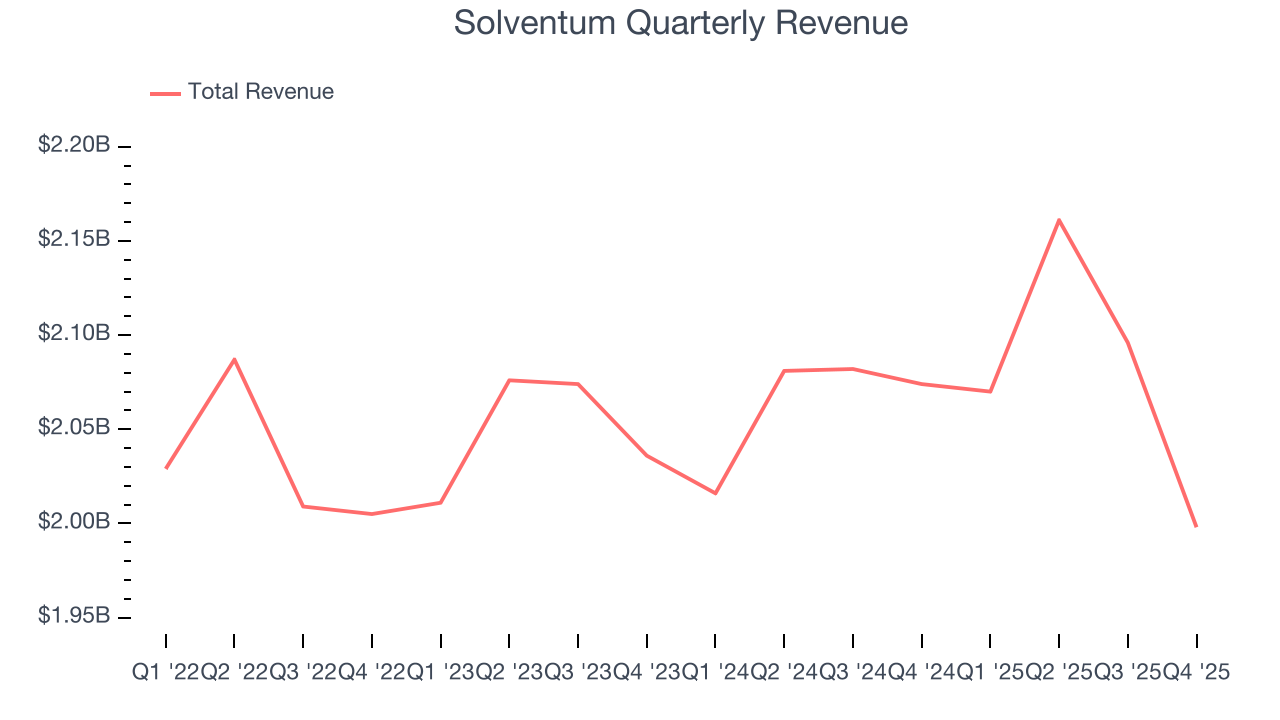
Long-term growth is the most important, but within healthcare, a stretched historical view may miss new innovations or demand cycles. Just like its three-year trend, Solventum’s revenue over the last two years was flat, suggesting it is in a slump. 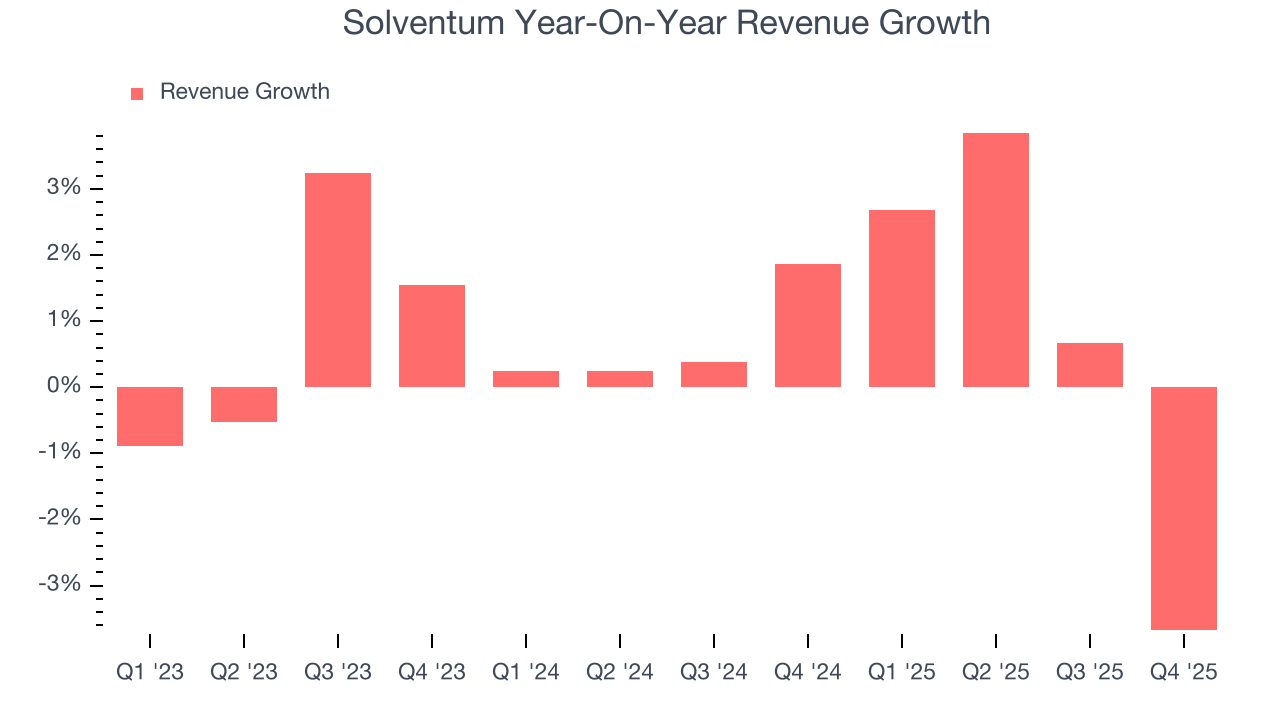
We can dig further into the company’s sales dynamics by analyzing its organic revenue, which strips out one-time events like acquisitions and currency fluctuations that don’t accurately reflect its fundamentals. Over the last two years, Solventum’s organic revenue averaged 2.3% year-on-year growth. Because this number aligns with its two-year revenue growth, we can see the company’s core operations (not acquisitions and divestitures) drove most of its results. 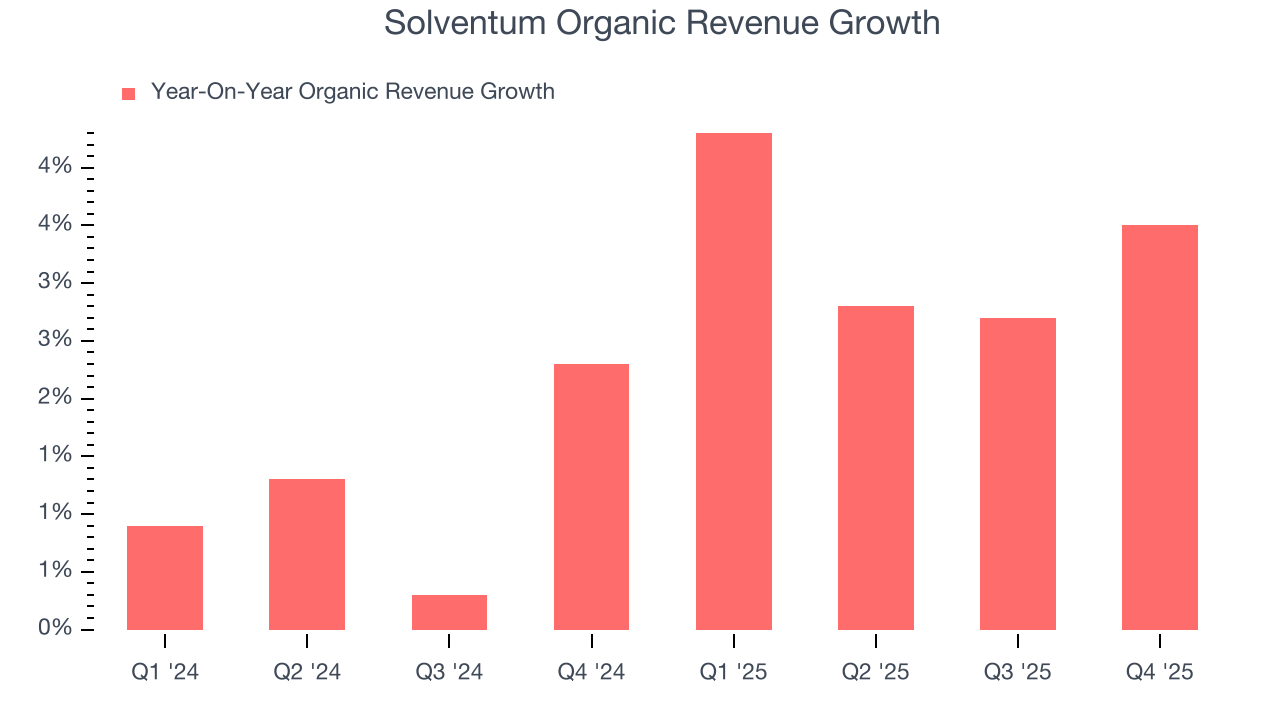
This quarter, Solventum’s revenue fell by 3.7% year on year to $2.00 billion but beat Wall Street’s estimates by 1.9%.
Looking ahead, sell-side analysts expect revenue to decline by 3.3% over the next 12 months, a deceleration versus the last two years. This projection is underwhelming and implies its products and services will face some demand challenges.
7. Operating Margin
Operating margin is an important measure of profitability as it shows the portion of revenue left after accounting for all core expenses – everything from the cost of goods sold to advertising and wages. It’s also useful for comparing profitability across companies with different levels of debt and tax rates because it excludes interest and taxes.
Solventum has been an efficient company over the last four years. It was one of the more profitable businesses in the healthcare sector, boasting an average operating margin of 20.1%.
Looking at the trend in its profitability, Solventum’s operating margin rose by 5.4 percentage points over the last four years. The company’s two-year trajectory shows its performance was mostly driven by its recent improvements.
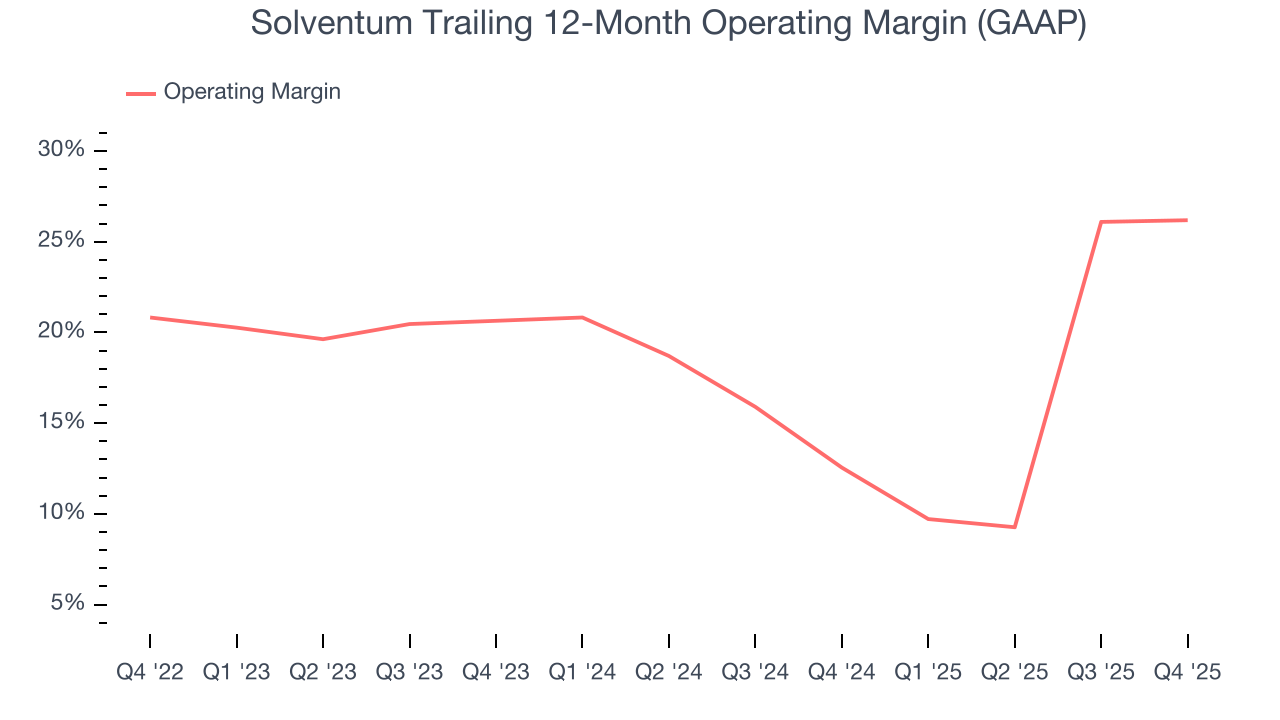
In Q4, Solventum generated an operating margin profit margin of 6.2%, in line with the same quarter last year. This indicates the company’s overall cost structure has been relatively stable.
8. Earnings Per Share
We track the long-term change in earnings per share (EPS) for the same reason as long-term revenue growth. Compared to revenue, however, EPS highlights whether a company’s growth is profitable.
Sadly for Solventum, its EPS declined by 31.6% annually over the last three years while its revenue was flat. We can see the difference stemmed from higher interest expenses or taxes as the company actually improved its operating margin and repurchased its shares during this time.
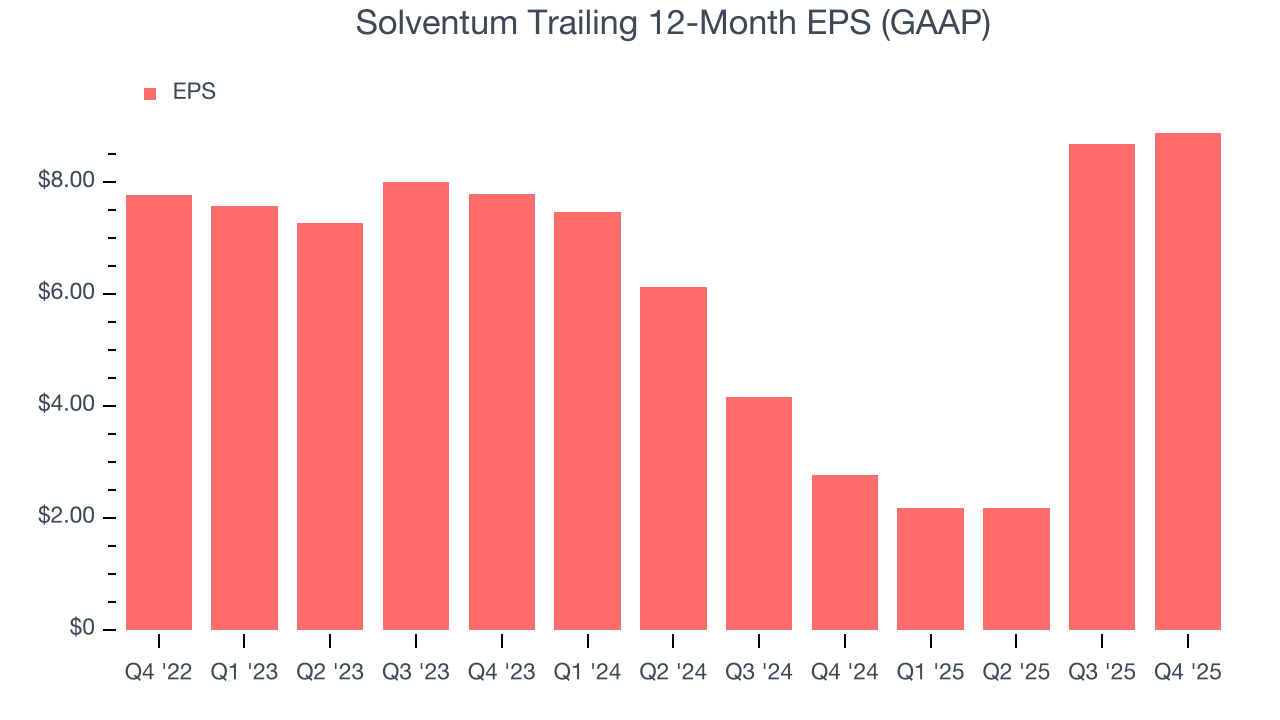
In Q4, Solventum reported EPS of $0.36, up from $0.17 in the same quarter last year. Despite growing year on year, this print missed analysts’ estimates. Over the next 12 months, Wall Street expects Solventum’s full-year EPS of $8.88 to shrink by 64.1%.
9. Cash Is King
If you’ve followed StockStory for a while, you know we emphasize free cash flow. Why, you ask? We believe that in the end, cash is king, and you can’t use accounting profits to pay the bills.
Solventum has shown impressive cash profitability, giving it the option to reinvest or return capital to investors. The company’s free cash flow margin averaged 13.9% over the last four years, better than the broader healthcare sector.
Taking a step back, we can see that Solventum’s margin dropped by 26.7 percentage points during that time. If its declines continue, it could signal increasing investment needs and capital intensity.
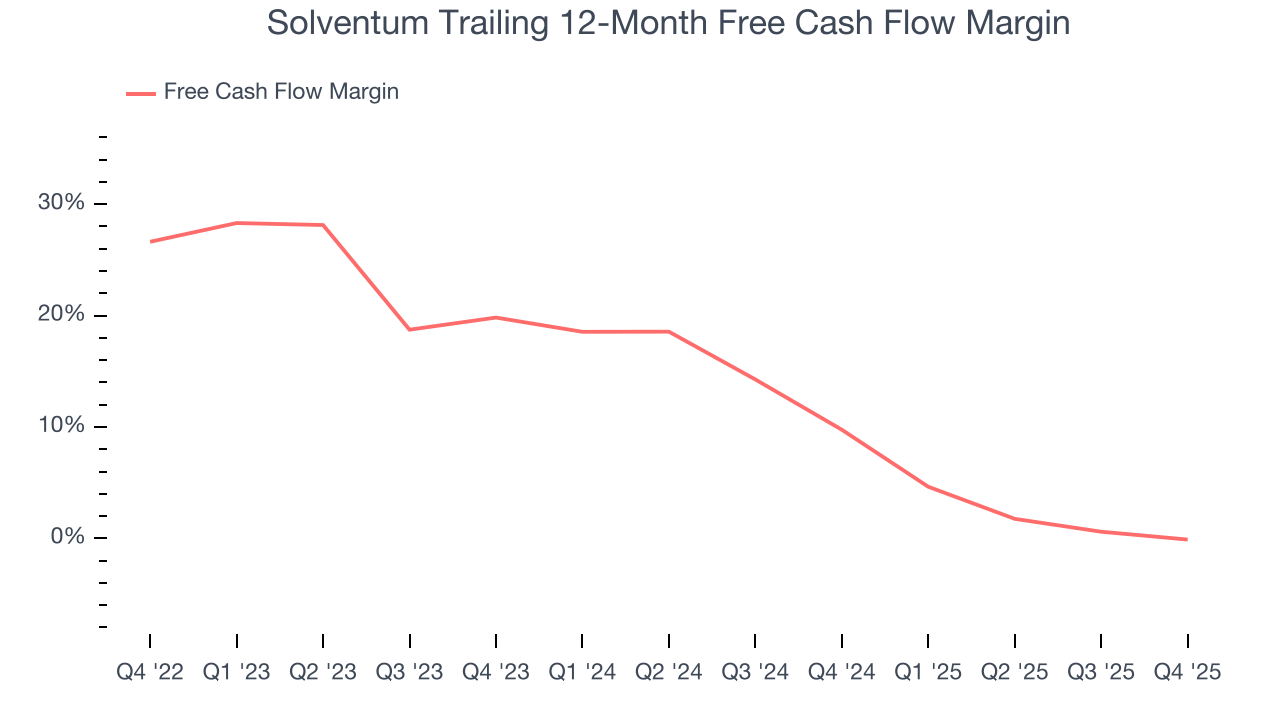
Solventum’s free cash flow clocked in at $33 million in Q4, equivalent to a 1.7% margin. The company’s cash profitability regressed as it was 2.8 percentage points lower than in the same quarter last year, suggesting its historical struggles have dragged on.
10. Balance Sheet Assessment
Solventum reported $878 million of cash and $5.04 billion of debt on its balance sheet in the most recent quarter. As investors in high-quality companies, we primarily focus on two things: 1) that a company’s debt level isn’t too high and 2) that its interest payments are not excessively burdening the business.
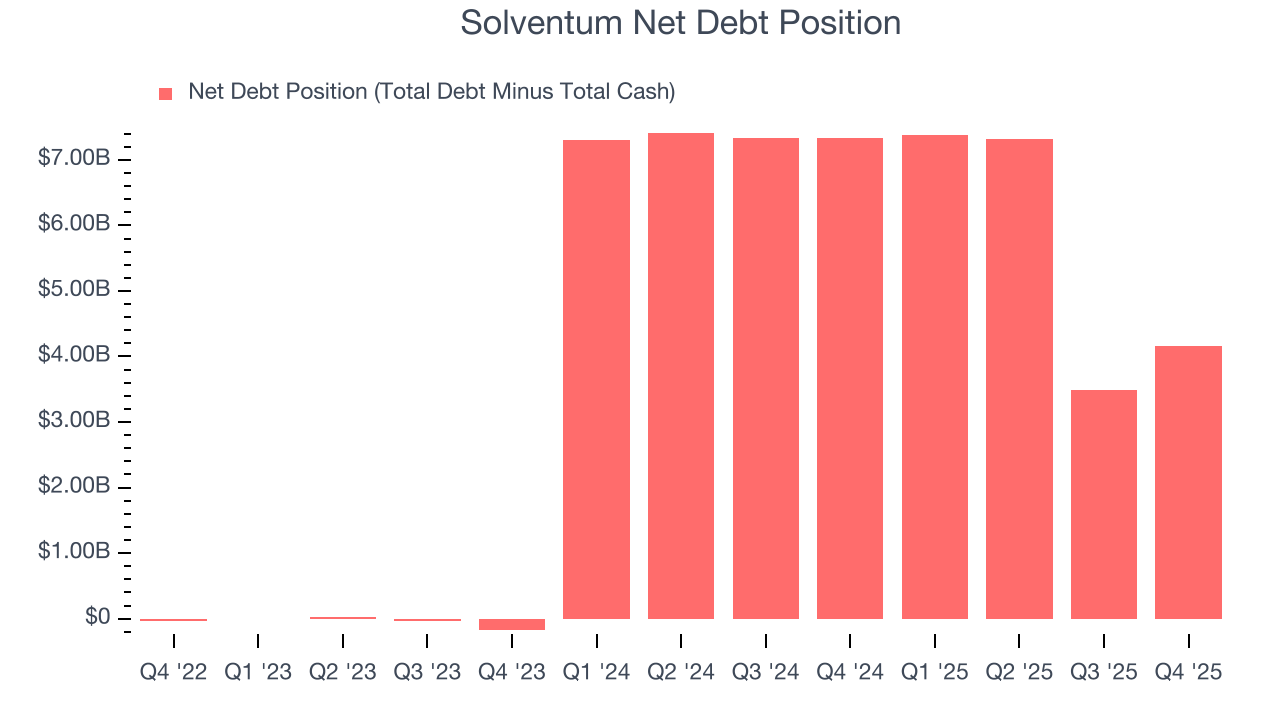
With $1.97 billion of EBITDA over the last 12 months, we view Solventum’s 2.1× net-debt-to-EBITDA ratio as safe. We also see its $347 million of annual interest expenses as appropriate. The company’s profits give it plenty of breathing room, allowing it to continue investing in growth initiatives.
11. Key Takeaways from Solventum’s Q4 Results
It was good to see Solventum narrowly top analysts’ organic revenue expectations this quarter. We were also happy its revenue outperformed Wall Street’s estimates. On the other hand, its EPS missed. Overall, this was a softer quarter. The stock remained flat at $77.00 immediately after reporting.
12. Is Now The Time To Buy Solventum?
Updated: March 14, 2026 at 11:48 PM EDT
A common mistake we notice when investors are deciding whether to buy a stock or not is that they simply look at the latest earnings results. Business quality and valuation matter more, so we urge you to understand these dynamics as well.
Solventum falls short of our quality standards. To begin with, its revenue growth was uninspiring over the last three years, and analysts expect its demand to deteriorate over the next 12 months. While its strong operating margins show it’s a well-run business, the downside is its declining EPS over the last three years makes it a less attractive asset to the public markets. On top of that, its cash profitability fell over the last four years.
Solventum’s P/E ratio based on the next 12 months is 10.2x. While this valuation is reasonable, we don’t see a big opportunity at the moment. There are better stocks to buy right now.
Wall Street analysts have a consensus one-year price target of $90.17 on the company (compared to the current share price of $66.43).
Although the price target is bullish, readers should exercise caution because analysts tend to be overly optimistic. The firms they work for, often big banks, have relationships with companies that extend into fundraising, M&A advisory, and other rewarding business lines. As a result, they typically hesitate to say bad things for fear they will lose out. We at StockStory do not suffer from such conflicts of interest, so we’ll always tell it like it is.