
Select Water Solutions (WTTR)
We’re skeptical of Select Water Solutions. Its negative returns on capital show it destroyed value by losing money on unprofitable business ventures.― StockStory Analyst Team


1. News
2. Summary
Why Select Water Solutions Is Not Exciting
Managing over 24 billion barrels of produced water annually across major U.S. shale plays, Select Water Solutions (NYSE:WTTR) provides water sourcing, recycling, disposal, and treatment services for oil and gas producers.
- Subpar EBITDA margin constrains its ability to invest in process improvements or effectively respond to new competitive threats
- poor earning stability in the sector may keep investors up at night
- A consolation is that its annual revenue growth of 18.6% over the last nine years was superb and indicates its market share increased during this cycle
Select Water Solutions doesn’t meet our quality standards. We’re hunting for superior stocks elsewhere.
Why There Are Better Opportunities Than Select Water Solutions








Select Water Solutions is trading at $14.24 per share, or 41.4x forward P/E. The current multiple is quite expensive, especially for the fundamentals of the business.
There are stocks out there similarly priced with better business quality. We prefer owning these.
3. Select Water Solutions (WTTR) Research Report: Q4 CY2025 Update
Oilfield water management company Select Water Solutions (NYSE:WTTR) reported revenue ahead of Wall Street’s expectations in Q4 CY2025, but sales were flat year on year at $346.5 million. Its non-GAAP profit of $0.02 per share was in line with analysts’ consensus estimates.
Select Water Solutions (WTTR) Q4 CY2025 Highlights:
- Revenue: $346.5 million vs analyst estimates of $324.9 million (flat year on year, 6.7% beat)
- Adjusted EPS: $0.02 vs analyst estimates of $0.02 (in line)
- Adjusted EBITDA: $64.16 million vs analyst estimates of $61.54 million (18.5% margin, 4.3% beat)
- Operating Margin: -0.1%, in line with the same quarter last year
- Free Cash Flow was -$5.3 million, down from $14.46 million in the same quarter last year
- Market Capitalization: $1.64 billion
Company Overview
Managing over 24 billion barrels of produced water annually across major U.S. shale plays, Select Water Solutions (NYSE:WTTR) provides water sourcing, recycling, disposal, and treatment services for oil and gas producers.
The company operates through three segments that address different aspects of the water lifecycle in energy production. Water Infrastructure builds and operates permanent pipeline networks, recycling facilities, and saltwater disposal wells (SWDs) that handle produced water—the naturally occurring water that comes up with oil and gas during production. Water Services provides temporary solutions like layflat hose systems that transfer water to drilling sites, along with storage tanks, fluid hauling trucks, and flowback services that manage the initial water that returns after hydraulic fracturing. Chemical Technologies manufactures friction reducers and other specialty chemicals used in hydraulic fracturing fluids, along with customized water treatment solutions.
An oil and gas producer drilling a new well in the Permian Basin might use Select's services throughout the entire process: sourcing water through Select's permitted water sources, transferring it via temporary layflat hose to the wellsite, treating it with Select's friction reducers during hydraulic fracturing, managing the flowback water that returns, then handling the produced water that comes up during ongoing production by either recycling it for future completions or disposing it through Select's network of saltwater disposal wells and pipelines.
The company generates revenue through service fees for water transfer and hauling, volumetric charges for water disposal and recycling based on barrels processed, sales of completion chemicals to both exploration and production companies and pressure pumping service providers, and long-term contracts with minimum volume commitments for its permanent infrastructure assets. Select operates over 1,000 miles of pipeline infrastructure in the Permian Basin, more than 2.2 million barrels per day of permitted disposal capacity across its operational footprint, and maintains daily recycling capacity of approximately 3.2 million barrels. The company has secured water rights for approximately two billion barrels annually from hundreds of sources and operates facilities across the Permian, Bakken, Haynesville, Marcellus/Utica, and other major unconventional basins.
4. Oilfield Services
Oilfield services companies provide equipment, technology, and services enabling exploration and production activities, including drilling, completion, well intervention, and reservoir evaluation. Their fortunes closely track upstream capital spending cycles. Tailwinds include increased drilling activity during favorable commodity environments, demand for efficiency-enhancing technologies, and growing offshore and unconventional resource development. Headwinds include significant revenue volatility tied to oil and gas price swings and producer spending discipline. Intense competition pressures pricing and margins, while the energy transition may structurally reduce long-term demand. Workforce availability and technological disruption require continuous adaptation.
Select Water Solutions' competitors include diversified oilfield service companies like Schlumberger (NYSE:SLB) and Halliburton (NYSE:HAL), along with specialized water management providers like Solaris Oilfield Infrastructure (NYSE:SOI) and NGL Energy Partners (NYSE:NGL).
5. Revenue Scale
In Energy, scale separates fragile single-asset producers from platform-style businesses that generate revenue across entire basins and infrastructure networks. Select Water Solutions’s $1.41 billion of revenue in the last year is pretty small for the industry, suggesting the company hasn’t hit a level of diversification where investors can sleep easy at night. is a small company in an industry where scale matters.
6. Revenue Growth
Cyclical industries such as Energy can make mediocre companies look great for a time, but a long-term view reveals which businesses can actually withstand and adapt to changing conditions. Over the last five years, Select Water Solutions grew its sales at an impressive 18.4% compounded annual growth rate. Its growth beat the average energy upstream and integrated energy company and shows its offerings resonate with customers.
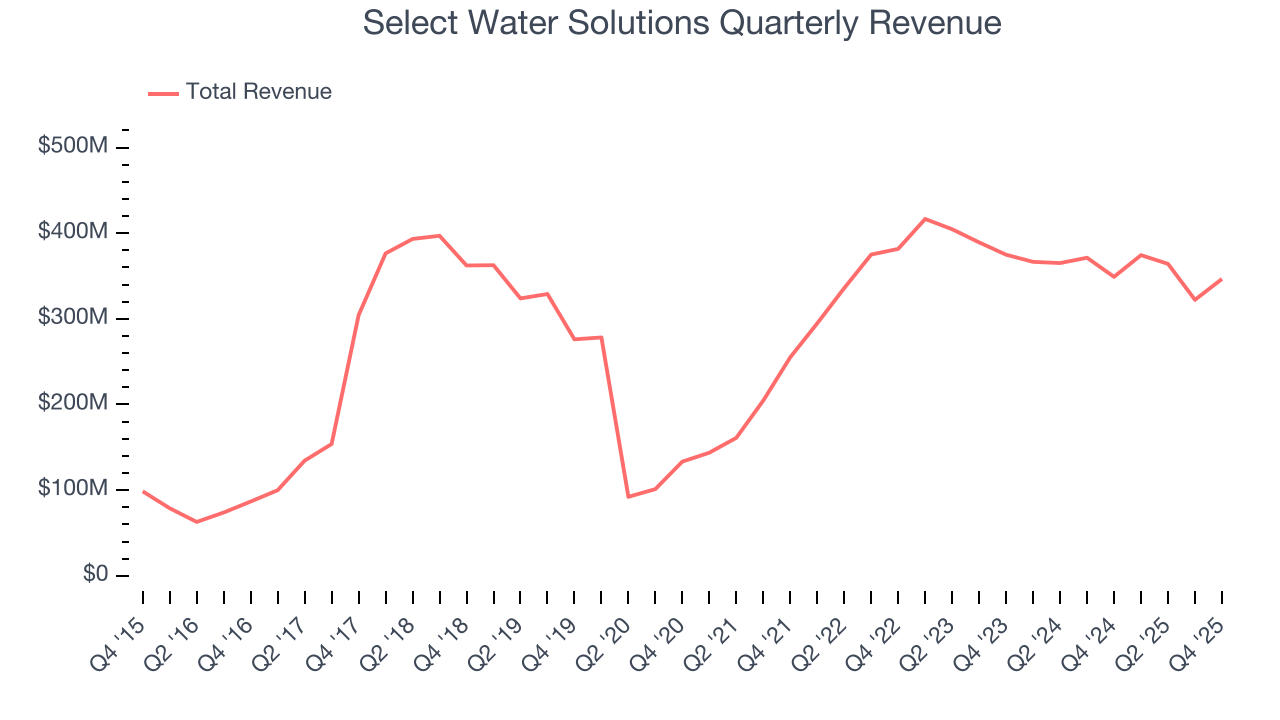
Even a long stretch in Energy can be shaped by a single commodity cycle, so extending the view to ten years adds another perspective and reveals which companies are built to grow regardless of the pricing regime. Select Water Solutions’s annualized revenue growth of 18.6% over the last nine years aligns with its five-year trend, suggesting its demand was predictably strong.
This quarter, Select Water Solutions’s $346.5 million of revenue was flat year on year but beat Wall Street’s estimates by 6.7%.
7. Gross Margin
While energy gross margins can be distorted by commodity prices, hedging, and short-term cost swings, sustained margins across a full cycle reflect a producer’s underlying asset quality, infrastructure position, and cost structure.
Select Water Solutions, which averaged 22.8% gross margin over the last five years, exhibits bottom-tier unit economics in the sector. It means the company will struggle at higher commodity prices than peers with better gross margins. 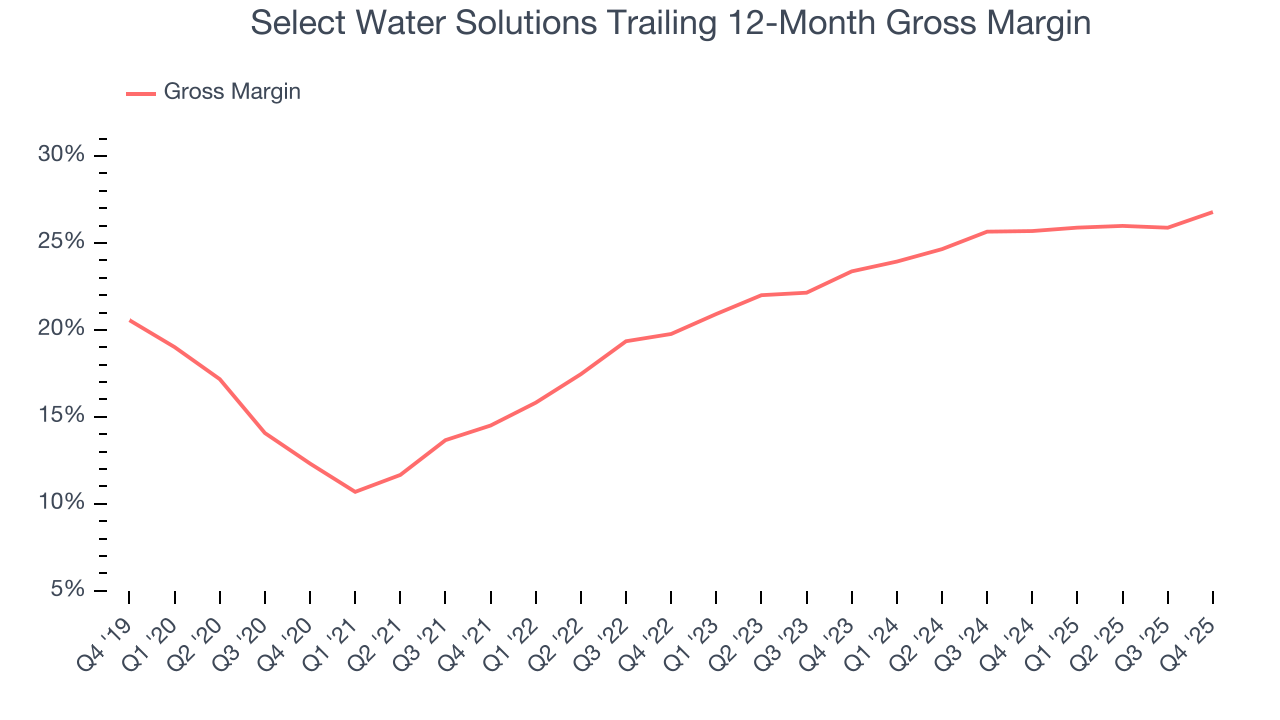
In Q4, Select Water Solutions produced a 27.9% gross profit margin , marking a 3.6 percentage point increase from 24.2% in the same quarter last year. Note that energy margins can be volatile due to commodity price changes.
8. Adjusted EBITDA Margin
Select Water Solutions was profitable over the last five years but held back by its large cost base. Its average EBITDA margin of 15.5% was among the worst in the energy upstream and integrated energy sector.
On the plus side, Select Water Solutions’s EBITDA margin rose by 12 percentage points over the last year, as its sales growth gave it immense operating leverage.
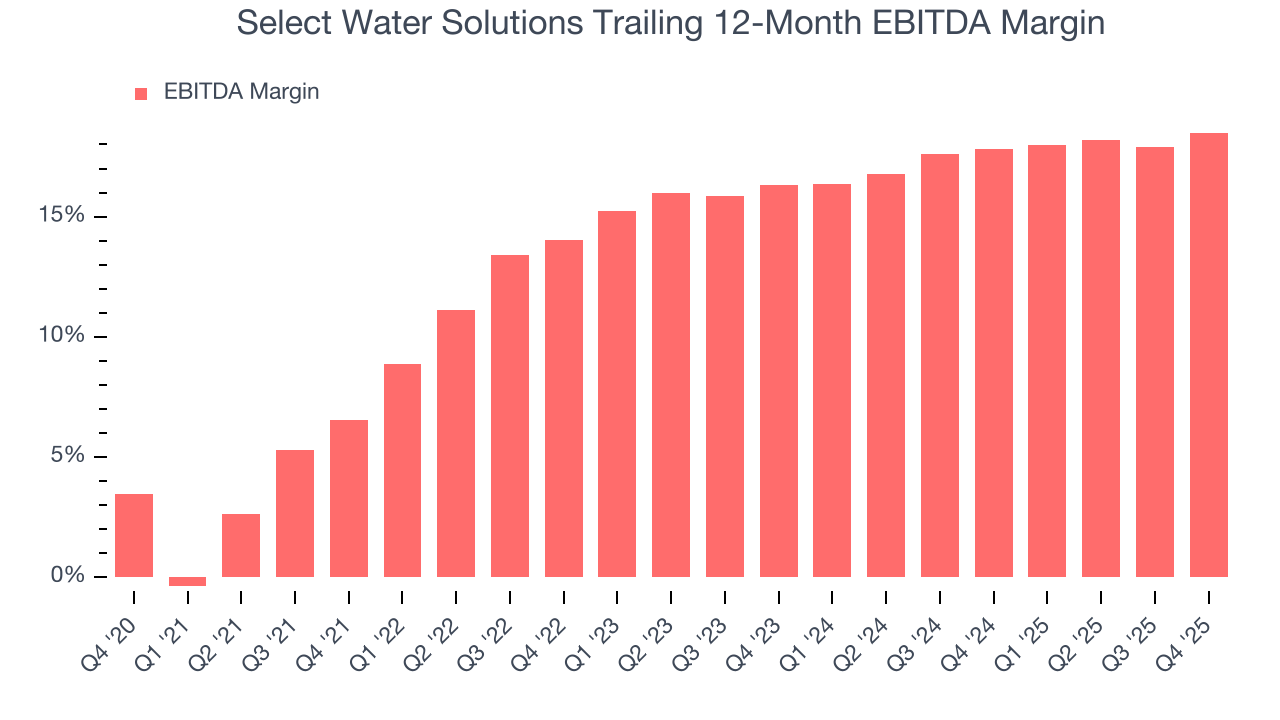
This quarter, Select Water Solutions generated an EBITDA margin profit margin of 18.5%, up 2.4 percentage points year on year. This increase was a welcome development and shows it was more efficient. This adjusted EBITDA beat Wall Street’s estimates by 4.3%.
9. Cash Is King
As mentioned above, adjusted EBITDA ignores capital structure and drilling expenditure decisions. These are two huge aspects of an Energy producer, so in order to understand a comprehensive picture of business quality, an investor needs to account for these. Said differently, adjusted EBITDA margins could be solid but free cash flow is abysmal because decline rates of the asset are extreme and the drilling is expensive. Free cash flow tells you about not only the economics of the production that has happened but how much it costs to stay in business as well (further drilling or extraction).
Select Water Solutions has shown poor cash profitability relative to peers over the last five years, giving the company fewer opportunities to return capital to shareholders. Its free cash flow margin averaged 1.2%, below what we’d expect for an upstream and integrated energy business.
While the level of free cash flow margins is important, their consistency matters just as much.
Select Water Solutions’s ratio of quarterly free cash flow volatility to WTI crude price volatility over the past five years was 55.9 (lower is better), indicating that its cash generation is far more sensitive to commodity-price swings than most peers. This elevated volatility limits its access to capital in downturns and makes it unlikely to act as a consolidator when weaker competitors come under pressure.
You may be asking why we wait until the free cash flow line to perform this stability analysis versus commodity prices. Why not compare revenue or EBITDA to WTI Crude prices in the case of Select Water Solutions? Because what ultimately matters is not how much revenue or profit you earn when prices are high but how much cash you can generate when prices are low. Free cash flow is the superior metric because it includes everything from hedging prowess to growth and maintenance capex to management behavior during good times and bad.
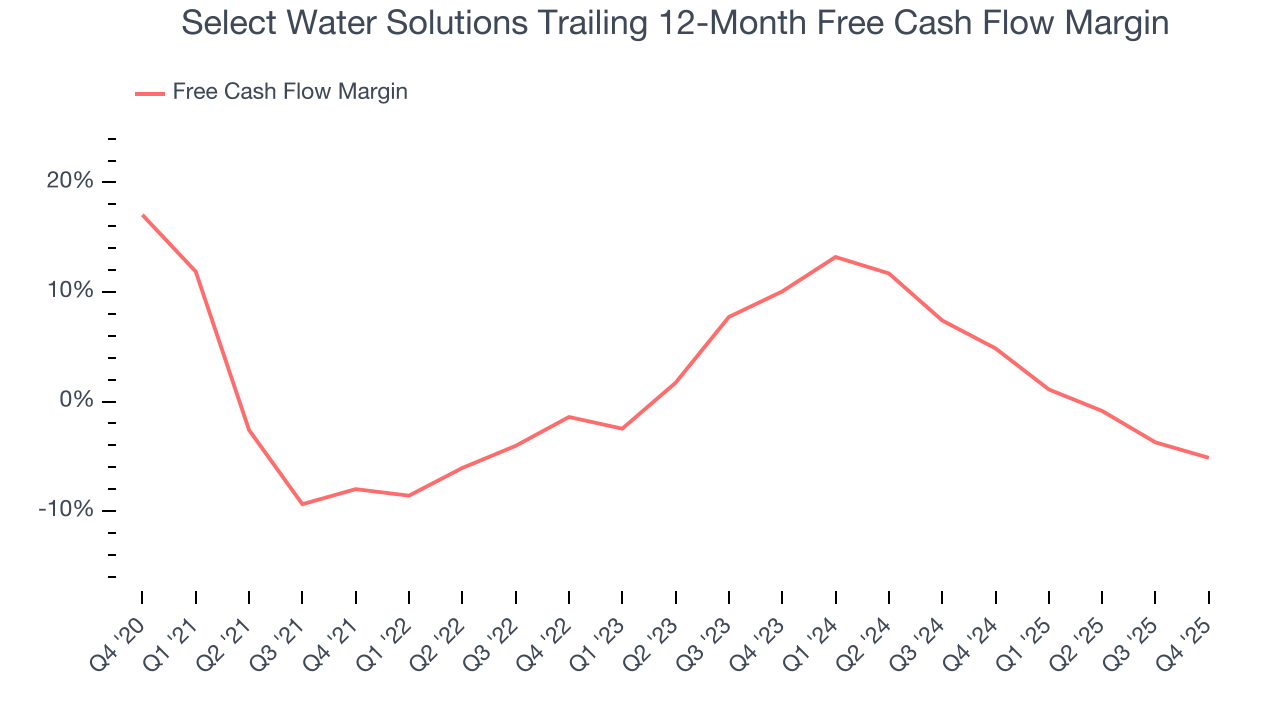
Select Water Solutions burned through $5.3 million of cash in Q4, equivalent to a negative 1.5% margin. The company’s cash flow turned negative after being positive in the same quarter last year, prompting us to pay closer attention. Short-term fluctuations typically aren’t a big deal because investment needs can be seasonal, but we’ll be watching to see if the trend extrapolates into future quarters.
10. Return on Invested Capital (ROIC)
Free cash flow shows how much money a producer generated, while ROIC shows how efficiently that money was earned. ROIC measures the operating profit produced for each dollar of capital invested, whether from debt or equity. Cash generation measures quantity while ROIC measures the quality of value creation.
We at StockStory like to look at ROIC over a ten-year period because energy investment cycles can involve up to five years of ramping production and another five years of harvesting. A decade view captures buying, extracting, and monetizing rather than just part of that picture. Select Water Solutions’s nine-year average ROIC was negative 8%, meaning management lost money while trying to expand the business. Its returns were among the worst in the energy upstream and integrated energy sector.
We like to invest in businesses with high returns, but the trend in a company’s ROIC is what often surprises the market and moves the stock price. Select Water Solutions’s ROIC has increased over the last few years. This is a good sign, and if its returns keep rising, there’s a chance it could evolve into an investable business.
11. Balance Sheet Assessment
Select Water Solutions reported $18.08 million of cash and $330.5 million of debt on its balance sheet in the most recent quarter. As investors in high-quality companies, we primarily focus on two things: 1) that a company’s debt level isn’t too high and 2) that its interest payments are not excessively burdening the business.
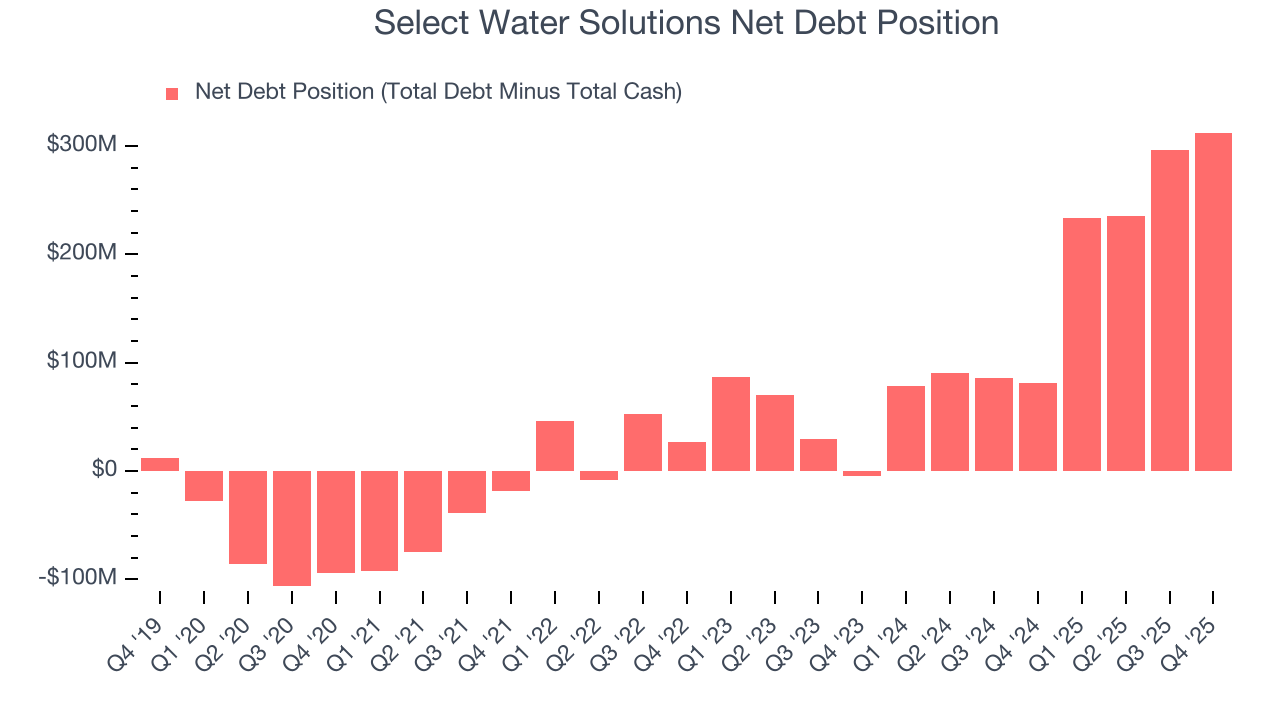
With $260.3 million of EBITDA over the last 12 months, we view Select Water Solutions’s 1.2× net-debt-to-EBITDA ratio as safe. We also see its $23.18 million of annual interest expenses as appropriate. The company’s profits give it plenty of breathing room, allowing it to continue investing in growth initiatives.
12. Key Takeaways from Select Water Solutions’s Q4 Results
We were impressed by how significantly Select Water Solutions blew past analysts’ revenue expectations this quarter. We were also glad its EPS was in line with Wall Street’s estimates. Zooming out, we think this quarter featured some important positives. The stock remained flat at $13.79 immediately after reporting.
13. Is Now The Time To Buy Select Water Solutions?
Updated: March 16, 2026 at 1:18 AM EDT
A common mistake we notice when investors are deciding whether to buy a stock or not is that they simply look at the latest earnings results. Business quality and valuation matter more, so we urge you to understand these dynamics as well.
Select Water Solutions isn’t a terrible business, but it doesn’t pass our quality test. Although its revenue growth over the last five years was impressive for the sector, it’s expected to deteriorate over the next 12 months and its relatively low ROIC suggests management has struggled to find compelling investment opportunities. And while the company’s revenue growth over the last nine years was top-tier for the sector, the downside is its free cash flow volatility compared to commodity price volatility is bottom-tier in the sector, leading to highly volatile free cash flow.
Select Water Solutions’s P/E ratio based on the next 12 months is 41.4x. This valuation tells us it’s a bit of a market darling with a lot of good news priced in - we think there are better stocks to buy right now.
Wall Street analysts have a consensus one-year price target of $17.30 on the company (compared to the current share price of $14.24).
Although the price target is bullish, readers should exercise caution because analysts tend to be overly optimistic. The firms they work for, often big banks, have relationships with companies that extend into fundraising, M&A advisory, and other rewarding business lines. As a result, they typically hesitate to say bad things for fear they will lose out. We at StockStory do not suffer from such conflicts of interest, so we’ll always tell it like it is.