
Expro (XPRO)
We’re wary of Expro. Its negative returns on capital suggest it eroded shareholder value by squandering business opportunities.― StockStory Analyst Team


1. News
2. Summary
Why We Think Expro Will Underperform
Operating in over 50 countries from deepwater offshore platforms to remote onshore fields, Expro (NYSE:XPRO) provides equipment and services that help oil and gas companies drill wells, measure production, and maintain well integrity.
- High extraction costs and unfavorable asset economics are reflected in its low gross margin of 19.9%
- poor earning stability in the sector may keep investors up at night
- A positive is that its impressive 29.1% annual revenue growth over the last five years indicates it’s winning market share this cycle
Expro doesn’t live up to our standards. We see more attractive opportunities in the market.
Why There Are Better Opportunities Than Expro








Expro is trading at $15.84 per share, or 16.5x forward P/E. This multiple is lower than most energy upstream and integrated energy companies, but for good reason.
We’d rather pay up for companies with elite fundamentals than get a bargain on weak ones. Cheap stocks can be value traps, and as their performance deteriorates, they will stay cheap or get even cheaper.
3. Expro (XPRO) Research Report: Q4 CY2025 Update
Oilfield services provider Expro (NYSE:XPRO) missed Wall Street’s revenue expectations in Q4 CY2025, with sales falling 12.5% year on year to $382.1 million. Its non-GAAP profit of $0.21 per share was 12.1% below analysts’ consensus estimates.
Expro (XPRO) Q4 CY2025 Highlights:
- Revenue: $382.1 million vs analyst estimates of $403.6 million (12.5% year-on-year decline, 5.3% miss)
- Adjusted EPS: $0.21 vs analyst expectations of $0.24 (12.1% miss)
- Adjusted EBITDA: $88.37 million vs analyst estimates of $92.65 million (23.1% margin, 4.6% miss)
- Operating Margin: 3.1%, down from 7.3% in the same quarter last year
- Free Cash Flow Margin: 6.1%, down from 12.1% in the same quarter last year
- Market Capitalization: $1.94 billion
Company Overview
Operating in over 50 countries from deepwater offshore platforms to remote onshore fields, Expro (NYSE:XPRO) provides equipment and services that help oil and gas companies drill wells, measure production, and maintain well integrity.
Expro operates across the full lifecycle of an oil or gas well, from initial drilling through production and eventual abandonment. The company's offerings span three main areas: well construction, well flow management, and well intervention.
In well construction, Expro specializes in tubular running services—the process of safely installing the steel pipes that line a wellbore. This is particularly critical in deepwater environments where the company has established a leadership position. For instance, when an operator drills a new well thousands of feet below the ocean surface, Expro provides the specialized equipment and crews to run casing strings into the wellbore and cement them in place, ensuring structural integrity. The company also offers drilling tools designed to improve efficiency and reduce risks during the drilling process.
The well flow management business focuses on measuring and testing hydrocarbon production. When an exploration company discovers a new reservoir and needs to understand its characteristics before committing to full development, Expro deploys well testing equipment that safely produces, measures, and samples the oil or gas at the surface. This data helps operators determine whether a discovery is commercially viable. The company also provides subsea well access systems—essentially specialized tree assemblies and handling equipment that allow safe intervention on wells located on the seafloor.
For well intervention and integrity, Expro uses wireline units and other technologies to perform maintenance, gather downhole data, and restore production in existing wells. This might include deploying sensors to monitor reservoir performance or using expandable metal patches to repair damaged well casing, extending the productive life of aging wells. The company generates revenue by charging for equipment rentals, service personnel, and integrated project solutions across its global customer base of exploration and production companies.
4. Oilfield Services
Oilfield services companies provide equipment, technology, and services enabling exploration and production activities, including drilling, completion, well intervention, and reservoir evaluation. Their fortunes closely track upstream capital spending cycles. Tailwinds include increased drilling activity during favorable commodity environments, demand for efficiency-enhancing technologies, and growing offshore and unconventional resource development. Headwinds include significant revenue volatility tied to oil and gas price swings and producer spending discipline. Intense competition pressures pricing and margins, while the energy transition may structurally reduce long-term demand. Workforce availability and technological disruption require continuous adaptation.
Expro competes with diversified oilfield service giants like Schlumberger (NYSE:SLB), Halliburton (NYSE:HAL), and Baker Hughes (NASDAQ:BKR), as well as specialized players like Weatherford International (NASDAQ:WFRD) and Core Laboratories (NYSE:CLB) in various service lines.
5. Revenue Scale
The scale of a company’s revenue base is an important lens through which to view the topline, as it signals whether a producer has gone from a vulnerable commodity taker into a durable operating platform. Larger producers generate revenue across many wells, pads, takeaway routes, and geographies rather than relying on a single field or drilling program. Expro’s $1.61 billion of revenue in the last year is pretty small for the industry, suggesting the company is subscale business in an industry where scale matters.
6. Revenue Growth
Cyclical industries such as Energy can make mediocre companies look great for a time, but a long-term view reveals which businesses can actually withstand and adapt to changing conditions. Thankfully, Expro’s 29.1% annualized revenue growth over the last five years was incredible. Its growth beat the average energy upstream and integrated energy company and shows its offerings resonate with customers.
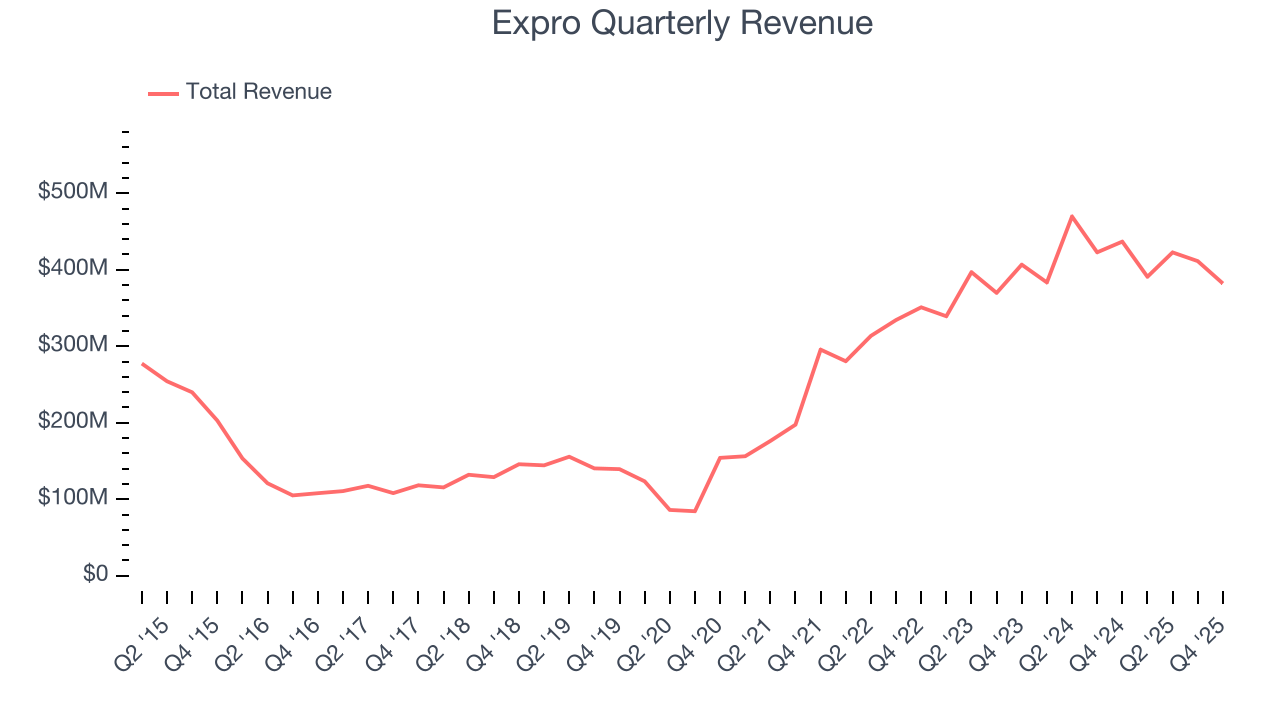
Even a long stretch in Energy can be shaped by a single commodity cycle, so extending the view to ten years adds another perspective and reveals which companies are built to grow regardless of the pricing regime. Expro’s annualized revenue growth of 5.1% over the last ten years is below its five-year trend, but we still think the results suggest decent demand.
This quarter, Expro missed Wall Street’s estimates and reported a rather uninspiring 12.5% year-on-year revenue decline, generating $382.1 million of revenue.
7. Gross Margin
In a single quarter or year, gross margins in the sector can swing wildly due to commodity prices, hedging, or changes in labor costs. Over a multi-year period across different points in the cycle, gross margin differences can signal whether a company is a structurally-advantaged producer (“rock” quality, takeaway, operating costs) or not.
Expro, which averaged 19.9% gross margin over the last five years, exhibiting bottom-tier unit economics in the sector. It means the company will struggle at higher commodity prices than peers with better gross margins. 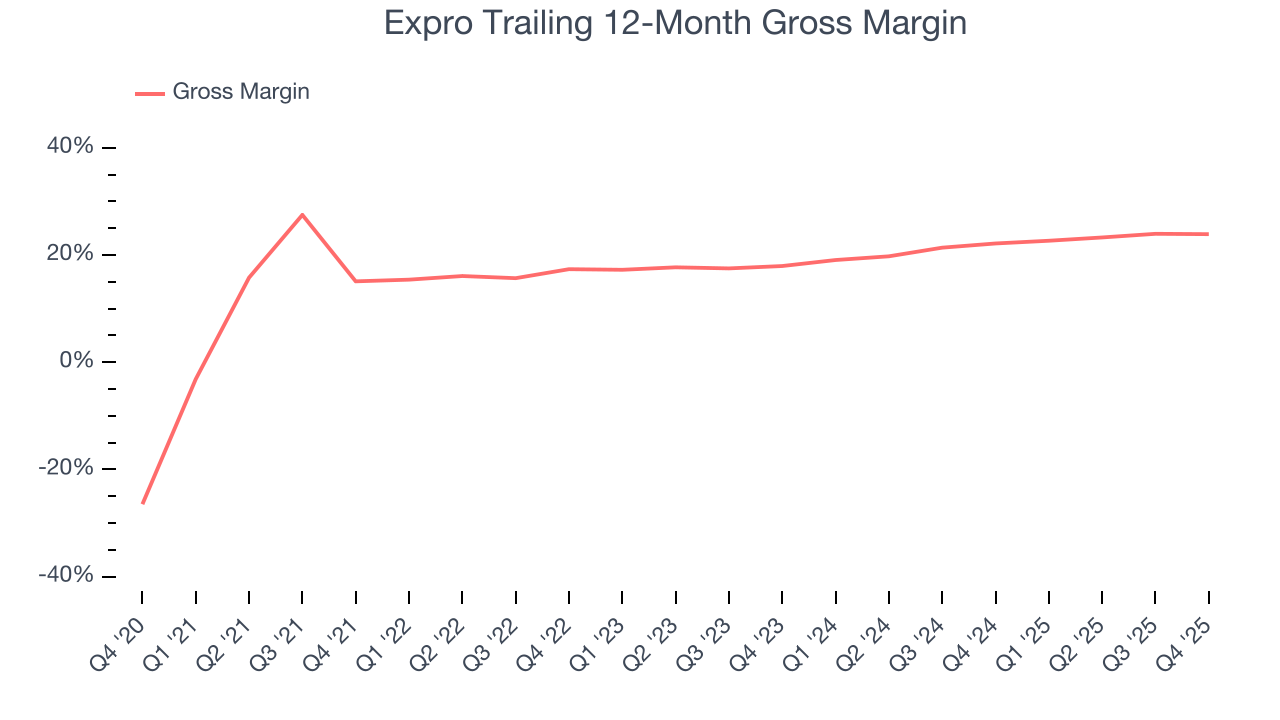
Expro produced a 25% gross profit margin in Q4, in line with the same quarter last year.
8. Adjusted EBITDA Margin
Adjusted EBITDA margin strips out accounting distortions tied to depletion and historical drilling spend, providing a clearer view of the cash-generating power of the underlying asset base before financing and reinvestment decisions.
Expro was profitable over the last five years but held back by its large cost base. Its average EBITDA margin of 18.5% was weak for an upstream and integrated energy business.
On the plus side, Expro’s EBITDA margin rose by 6.7 percentage points over the last year, as its sales growth gave it operating leverage.
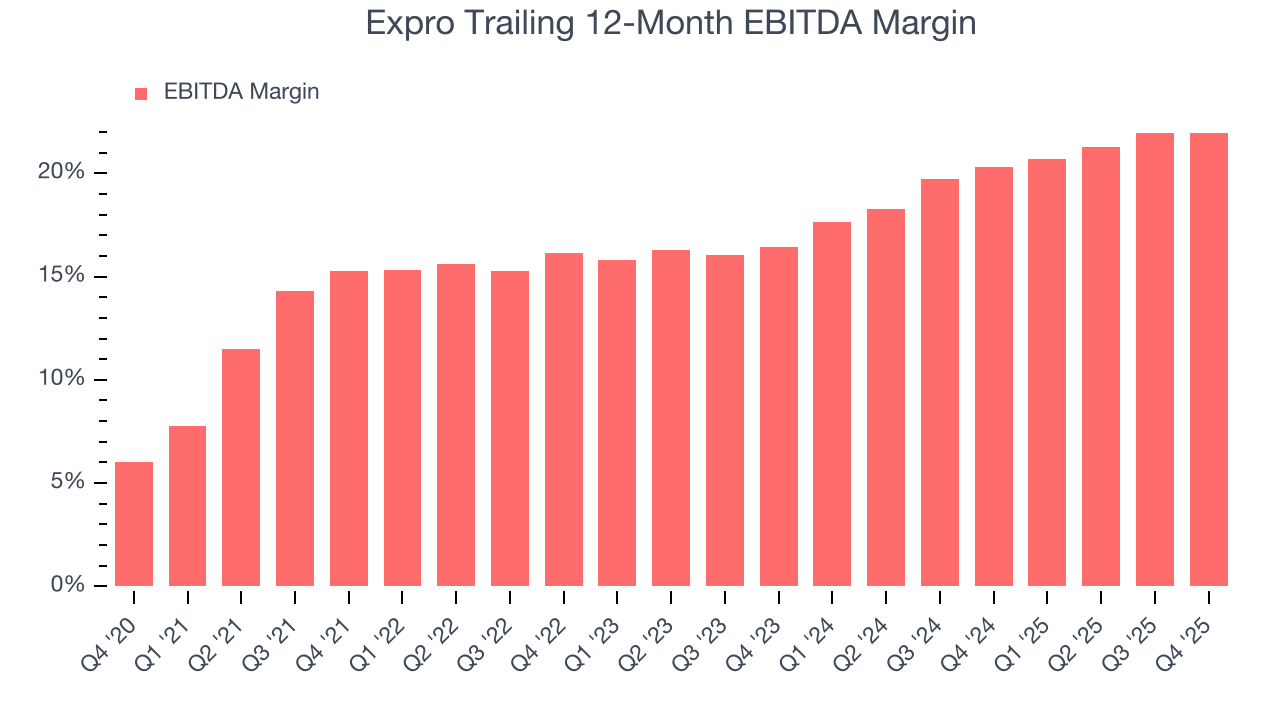
This quarter, Expro generated an EBITDA margin profit margin of 23.1%, in line with the same quarter last year. This indicates the company’s overall cost structure has been relatively stable. This adjusted EBITDA fell short of Wall Street’s estimates.
9. Cash Is King
As mentioned above, adjusted EBITDA ignores capital structure and drilling expenditure decisions. These are two huge aspects of an Energy producer, so in order to understand a comprehensive picture of business quality, an investor needs to account for these. Said differently, adjusted EBITDA margins could be solid but free cash flow is abysmal because decline rates of the asset are extreme and the drilling is expensive. Free cash flow tells you about not only the economics of the production that has happened but how much it costs to stay in business as well (further drilling or extraction).
Expro has shown poor cash profitability relative to peers over the last five years, giving the company fewer opportunities to return capital to shareholders. Its free cash flow margin averaged 1%, below what we’d expect for an upstream and integrated energy business.
Absolute FCF margin levels matter but so does stability of free cash flow. All else equal, we’d prefer a 25.0% average free cash flow margin that is quite steady no matter how commodity prices behave rather than extremely high margins when times are good and negative ones when they’re tough.
Expro’s ratio of quarterly free cash flow volatility to WTI crude price volatility over the past five years was 49.4 (lower is better), indicating that its cash generation is far more sensitive to commodity-price swings than most peers. This elevated volatility limits its access to capital in downturns and makes it unlikely to act as a consolidator when weaker competitors come under pressure.
You may be asking why we wait until the free cash flow line to perform this stability analysis versus commodity prices. Why not compare revenue or EBITDA to WTI Crude prices in the case of Expro? Because what ultimately matters is not how much revenue or profit you earn when prices are high but how much cash you can generate when prices are low. Free cash flow is the superior metric because it includes everything from hedging prowess to growth and maintenance capex to management behavior during good times and bad.
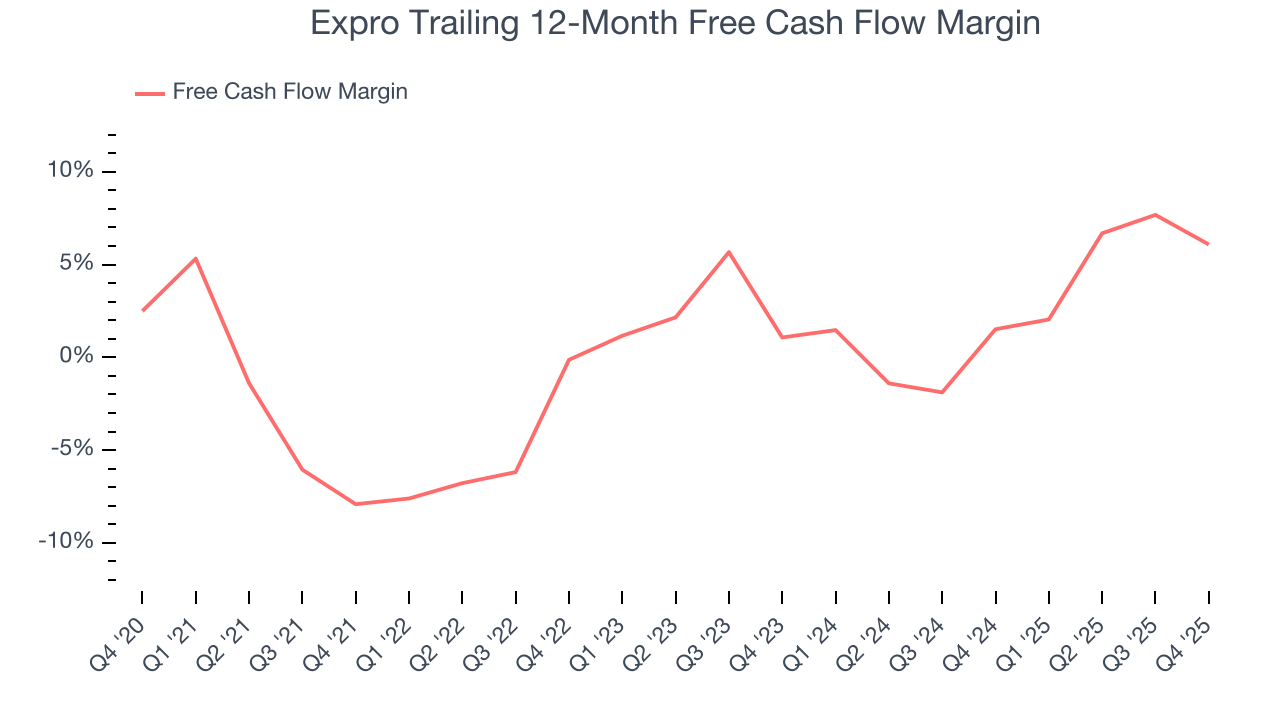
Expro’s free cash flow clocked in at $23.2 million in Q4, equivalent to a 6.1% margin. The company’s cash profitability regressed as it was 6.1 percentage points lower than in the same quarter last year, but it’s still above its five-year average. We wouldn’t read too much into this quarter’s decline because investment needs can be seasonal, leading to short-term swings. Long-term trends carry greater meaning.
10. Return on Invested Capital (ROIC)
Free cash flow tells investors how much money an Energy producer made, and ROIC takes this one step further by telling investors how well and effectively the business made it. ROIC illustrates how much operating profit a producer generated relative to the money it has raised (debt and equity).
We at StockStory like to look at ROIC over a ten-year period because energy investment cycles can involve up to five years of ramping production and another five years of harvesting. A decade view captures buying, extracting, and monetizing rather than just part of that picture. Expro’s seven-year average ROIC was negative 7.1%, meaning management lost money while trying to expand the business. Its returns were among the worst in the energy upstream and integrated energy sector.
11. Balance Sheet Assessment
Businesses that maintain a cash surplus face reduced bankruptcy risk.
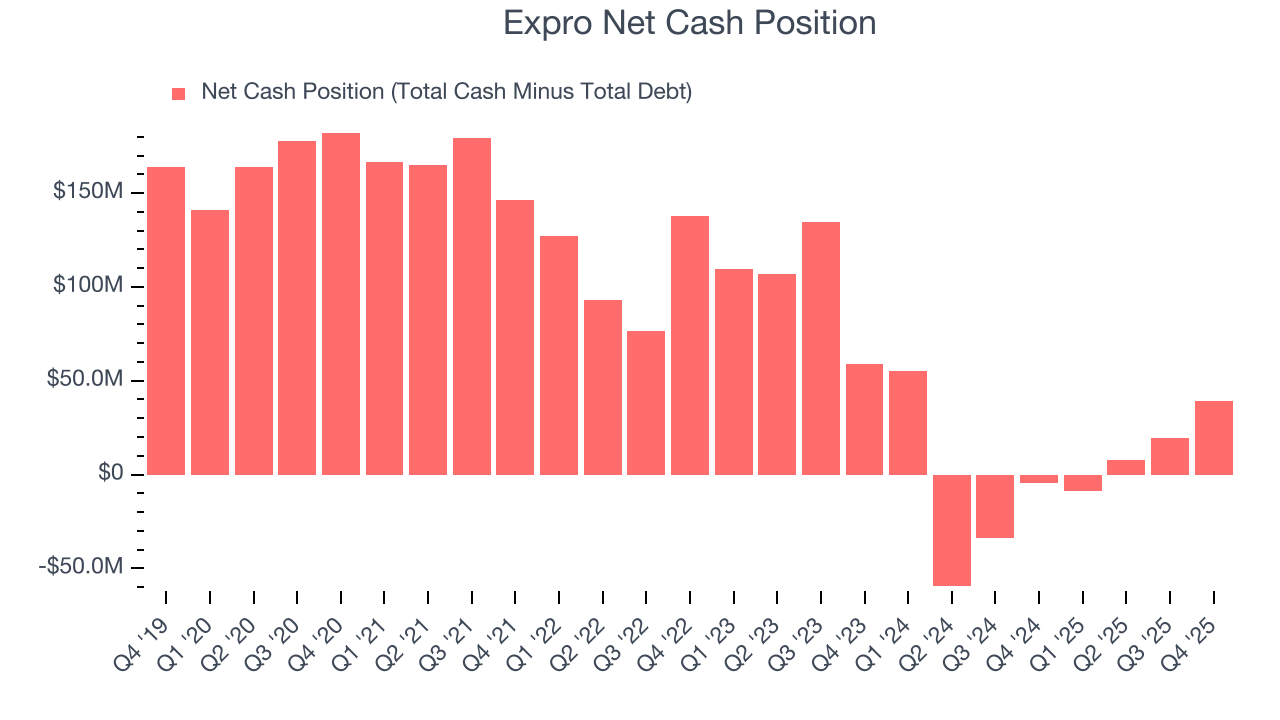
Expro is a profitable, well-capitalized company with $197.5 million of cash and $158.1 million of debt on its balance sheet. This $39.36 million net cash position is 2% of its market cap and gives it the freedom to borrow money, return capital to shareholders, or invest in growth initiatives. Leverage is not an issue here.
12. Key Takeaways from Expro’s Q4 Results
We struggled to find many positives in these results. Its revenue missed and its EBITDA fell short of Wall Street’s estimates. Overall, this was a softer quarter. The stock traded down 1.4% to $16.86 immediately following the results.
13. Is Now The Time To Buy Expro?
Updated: March 15, 2026 at 1:04 AM EDT
The latest quarterly earnings matters, sure, but we actually think longer-term fundamentals and valuation matter more. Investors should consider all these pieces before deciding whether or not to invest in Expro.
Expro isn’t a terrible business, but it isn’t one of our picks. Although its revenue growth over the last five years was top-tier for the sector, it’s expected to deteriorate over the next 12 months and its relatively low ROIC suggests management has struggled to find compelling investment opportunities. And while the company’s expanding EBITDA margin shows the business has become more efficient, the downside is its free cash flow volatility compared to commodity price volatility is bottom-tier in the sector, leading to highly volatile free cash flow.
Expro’s P/E ratio based on the next 12 months is 16.5x. Investors with a higher risk tolerance might like the company, but we think the potential downside is too great. We're pretty confident there are superior stocks to buy right now.
Wall Street analysts have a consensus one-year price target of $16.80 on the company (compared to the current share price of $15.84).