
Academy Sports (ASO)
We’re wary of Academy Sports. Its plummeting sales and returns on capital show its profits are shrinking as demand fizzles out.― StockStory Analyst Team


1. News






2. Summary
Why We Think Academy Sports Will Underperform
Founded in 1938 as a tire shop before expanding into fishing equipment, Academy Sports & Outdoor (NASDAQ:ASO) sells a broad selection of sporting goods but is still known for its outdoor activity merchandise.
- Sales tumbled by 2.4% annually over the last three years, showing consumer trends are working against its favor
- Widely-available products (and therefore stiff competition) result in an inferior gross margin of 34.3% that must be offset through higher volumes
- Ambitious expansion strategy seems risky considering the weak same-store sales performance at existing locations
Academy Sports is in the doghouse. We’re on the lookout for more interesting opportunities.
Why There Are Better Opportunities Than Academy Sports






At $55.58 per share, Academy Sports trades at 9.1x forward P/E. Academy Sports’s valuation may seem like a bargain, but we think there are valid reasons why it’s so cheap.
We’d rather pay up for companies with elite fundamentals than get a bargain on weak ones. Cheap stocks can be value traps, and as their performance deteriorates, they will stay cheap or get even cheaper.
3. Academy Sports (ASO) Research Report: Q3 CY2025 Update
Sporting goods retailer Academy Sports & Outdoor (NASDAQ:ASO) fell short of the markets revenue expectations in Q3 CY2025 as sales rose 3% year on year to $1.38 billion. On the other hand, the company’s outlook for the full year was close to analysts’ estimates with revenue guided to $6.11 billion at the midpoint. Its non-GAAP profit of $1.14 per share was 7.5% above analysts’ consensus estimates.
Academy Sports (ASO) Q3 CY2025 Highlights:
- Revenue: $1.38 billion vs analyst estimates of $1.40 billion (3% year-on-year growth, 1.3% miss)
- Adjusted EPS: $1.14 vs analyst estimates of $1.06 (7.5% beat)
- Adjusted EBITDA: $141.5 million vs analyst estimates of $136.4 million (10.2% margin, 3.8% beat)
- The company reconfirmed its revenue guidance for the full year of $6.11 billion at the midpoint
- Management lowered its full-year Adjusted EPS guidance to $5.90 at the midpoint, a 0.8% decrease
- Operating Margin: 7.3%, in line with the same quarter last year
- Free Cash Flow was -$9.11 million, down from $34.45 million in the same quarter last year
- Locations: 317 at quarter end, up from 293 in the same quarter last year
- Same-Store Sales were flat year on year (-4.9% in the same quarter last year)
- Market Capitalization: $3.25 billion
Company Overview
Founded in 1938 as a tire shop before expanding into fishing equipment, Academy Sports & Outdoor (NASDAQ:ASO) sells a broad selection of sporting goods but is still known for its outdoor activity merchandise.
The core customer is anyone in need of products for fishing, hunting, camping, or hiking. Despite its heritage in outdoor merchandise, Academy Sports also sells equipment for traditional sports such as baseball, soccer, or football as well as sneakers, apparel, and accessories. It is very much a one-stop shop for sports. The breadth of sporting goods and the depth of product in each category is what differentiates Academy Sports. Sporting goods can be large and cumbersome, so general merchandise retailers who devote limited space have limited selection.
Academy Sports has a strong presence in the Southern and Midwestern US, areas with strong outdoor activity affinity and traditions. Stores are 70,000 square feet on average and located in suburban or rural shopping centers alongside other retailers. The store is divided into sections based on sports with additional sections for footwear and apparel. Academy Sports also has an e-commerce presence, which the company launched in 2011 as a somewhat late adopter of online shopping. Many customers choose to order online and pick up at their nearest store since shipping is not available or overly costly for large items such as camping tents, canoes, and outdoor grills.
4. Sports & Outdoor Equipment Retailer
Some of us spend our leisure time vegging out, but many others take to the courts, fields, beaches, and campsites; sports equipment retailers cater to the avid sportsman as well as the weekend warrior. Shoppers can find everything from tents to lawn games to baseball bats to satisfy their athletic and leisure needs along with competitive prices and helpful store associates that can talk through brands, sizing, and product quality. This is a category that has moved rapidly online over the last few decades, so these sports and outdoor equipment retailers have needed to be nimble and aggressive with their e-commerce and omnichannel presences.
Retailers offering sporting and outdoor goods include Dick’s Sporting Goods (NYSE:DKS), Sportsman’s Warehouse (NASDAQ:SPWH), and Hibbett (NASDAQ:HIBB).
5. Revenue Growth
A company’s long-term sales performance can indicate its overall quality. Any business can put up a good quarter or two, but the best consistently grow over the long haul.
With $6.01 billion in revenue over the past 12 months, Academy Sports is a mid-sized retailer, which sometimes brings disadvantages compared to larger competitors benefiting from better economies of scale.
As you can see below, Academy Sports struggled to generate demand over the last three years (we compare to 2019 to normalize for COVID-19 impacts). Its sales dropped by 2.4% annually despite opening new stores. This implies its underperformance was driven by lower sales at existing, established locations.
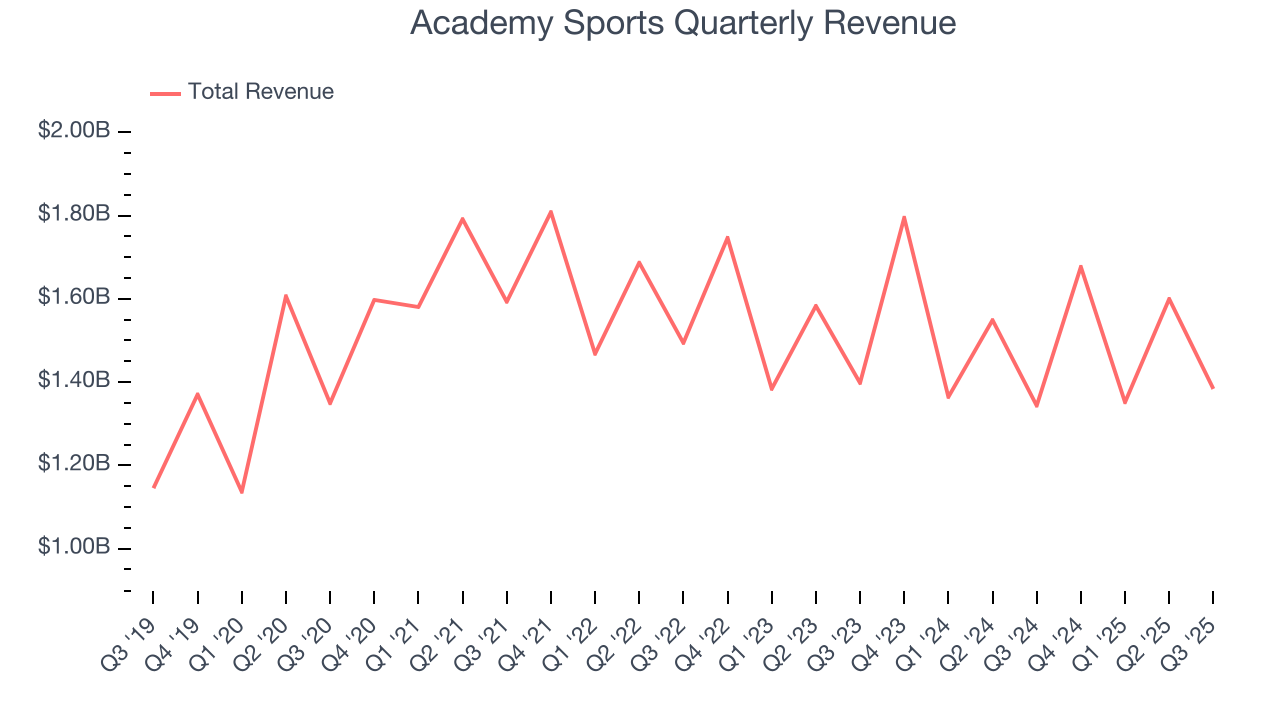
This quarter, Academy Sports’s revenue grew by 3% year on year to $1.38 billion, falling short of Wall Street’s estimates.
Looking ahead, sell-side analysts expect revenue to grow 6.5% over the next 12 months, an acceleration versus the last three years. This projection is admirable and indicates its newer products will spur better top-line performance.
6. Store Performance
Number of Stores
A retailer’s store count often determines how much revenue it can generate.
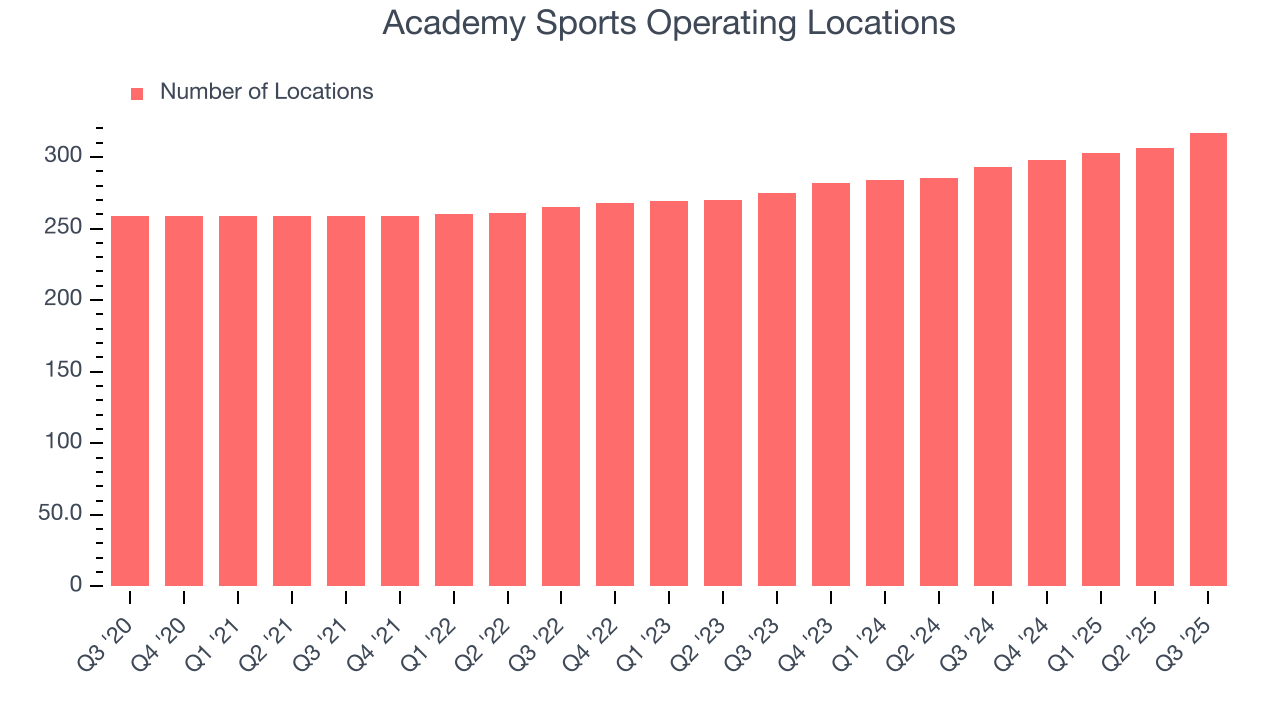
Academy Sports operated 317 locations in the latest quarter. It has opened new stores at a rapid clip over the last two years, averaging 6.4% annual growth, much faster than the broader consumer retail sector. This gives it a chance to become a large, scaled business over time.
When a retailer opens new stores, it usually means it’s investing for growth because demand is greater than supply, especially in areas where consumers may not have a store within reasonable driving distance.
Same-Store Sales
The change in a company's store base only tells one side of the story. The other is the performance of its existing locations and e-commerce sales, which informs management teams whether they should expand or downsize their physical footprints. Same-store sales provides a deeper understanding of this issue because it measures organic growth at brick-and-mortar shops for at least a year.
Academy Sports’s demand has been shrinking over the last two years as its same-store sales have averaged 3.6% annual declines. This performance is concerning - it shows Academy Sports artificially boosts its revenue by building new stores. We’d like to see a company’s same-store sales rise before it takes on the costly, capital-intensive endeavor of expanding its store base.
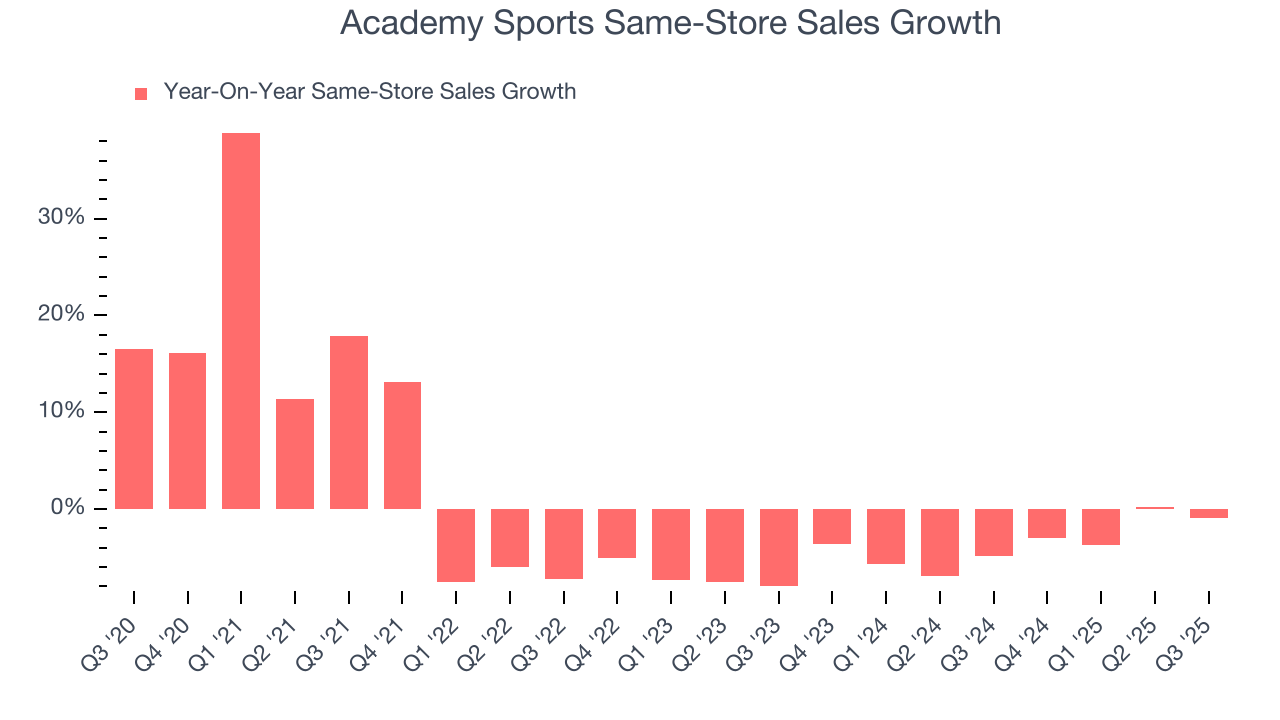
In the latest quarter, Academy Sports’s year on year same-store sales were flat. This performance was a well-appreciated turnaround from its historical levels, showing the business is improving.
7. Gross Margin & Pricing Power
At StockStory, we prefer high gross margin businesses because they indicate pricing power or differentiated products, giving the company a chance to generate higher operating profits.
Academy Sports has bad unit economics for a retailer, signaling it operates in a competitive market and lacks pricing power because its inventory is sold in many places. As you can see below, it averaged a 34.3% gross margin over the last two years. That means Academy Sports paid its suppliers a lot of money ($65.70 for every $100 in revenue) to run its business. 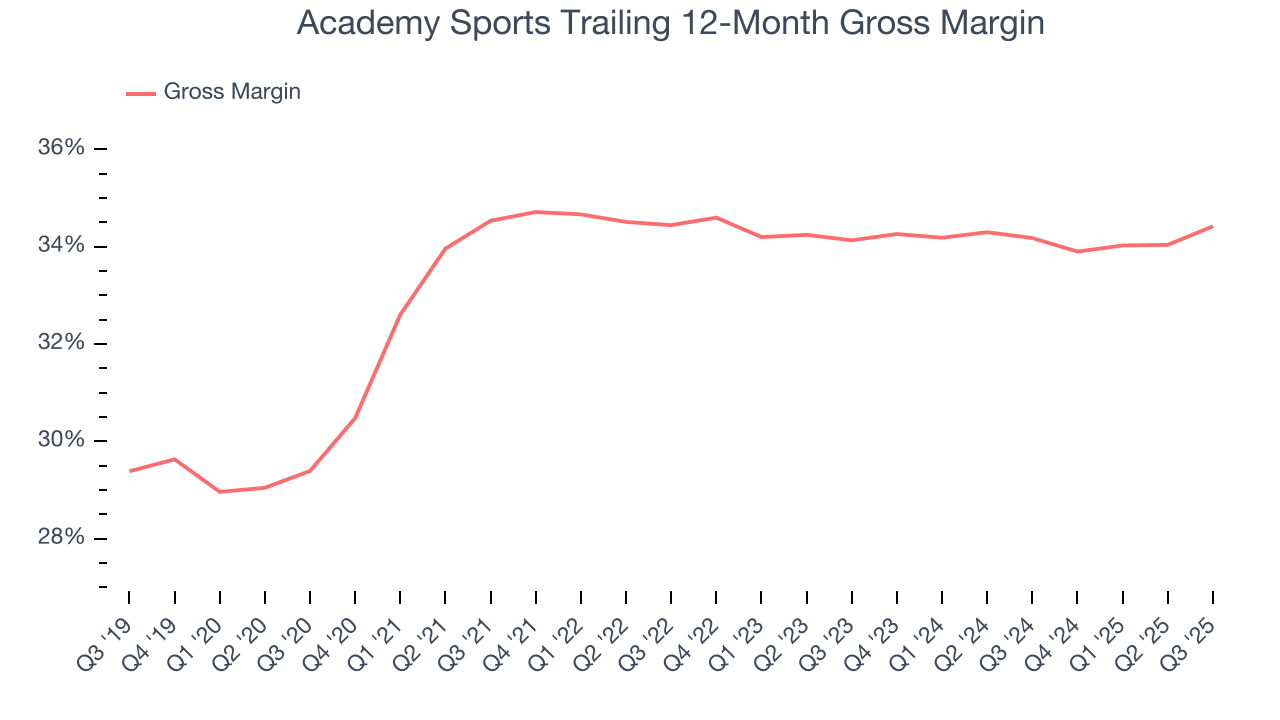
Academy Sports’s gross profit margin came in at 35.7% this quarter, marking a 1.7 percentage point increase from 34% in the same quarter last year. Zooming out, the company’s full-year margin has remained steady over the past 12 months, suggesting it strives to keep prices low for customers and has stable input costs (such as labor and freight expenses to transport goods).
8. Operating Margin
Operating margin is an important measure of profitability as it shows the portion of revenue left after accounting for all core expenses – everything from the cost of goods sold to advertising and wages. It’s also useful for comparing profitability across companies with different levels of debt and tax rates because it excludes interest and taxes.
Academy Sports has done a decent job managing its cost base over the last two years. The company has produced an average operating margin of 9%, higher than the broader consumer retail sector.
Looking at the trend in its profitability, Academy Sports’s operating margin decreased by 1.5 percentage points over the last year. Even though its historical margin was healthy, shareholders will want to see Academy Sports become more profitable in the future.
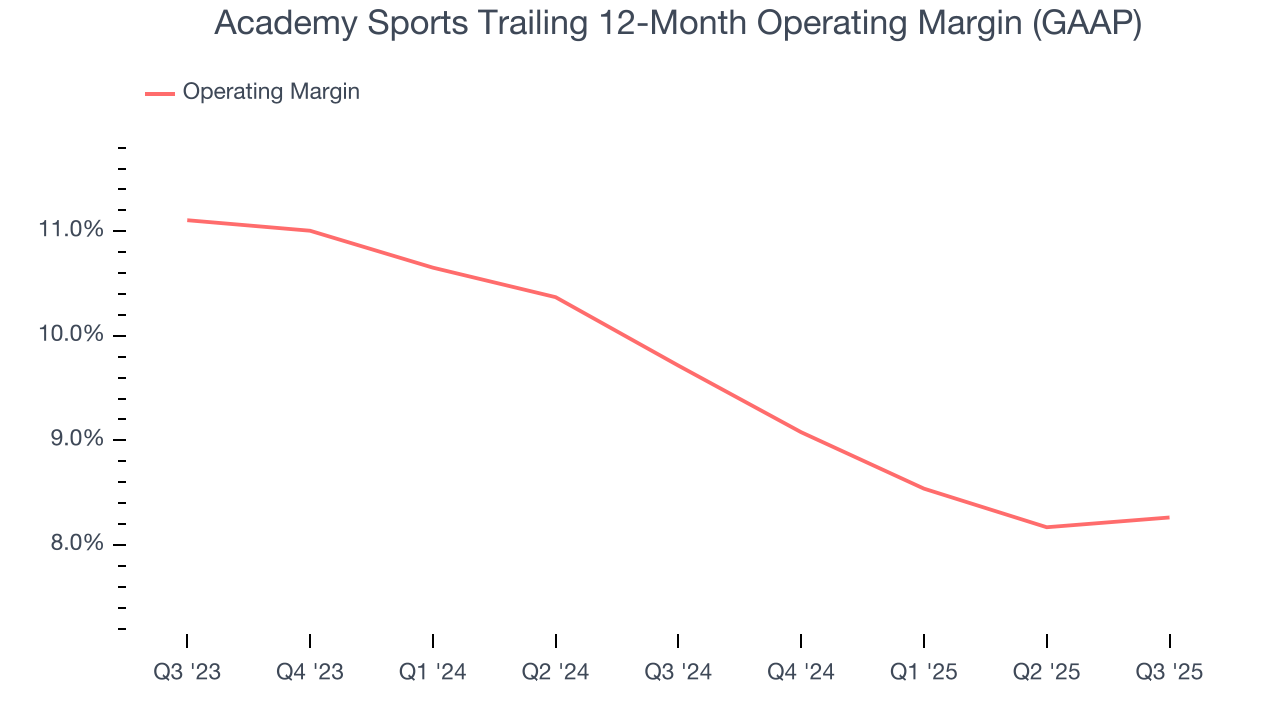
In Q3, Academy Sports generated an operating margin profit margin of 7.3%, in line with the same quarter last year. This indicates the company’s cost structure has recently been stable.
9. Earnings Per Share
Revenue trends explain a company’s historical growth, but the long-term change in earnings per share (EPS) points to the profitability of that growth – for example, a company could inflate its sales through excessive spending on advertising and promotions.
Sadly for Academy Sports, its EPS declined by 7.5% annually over the last three years, more than its revenue. This tells us the company struggled because its fixed cost base made it difficult to adjust to shrinking demand.
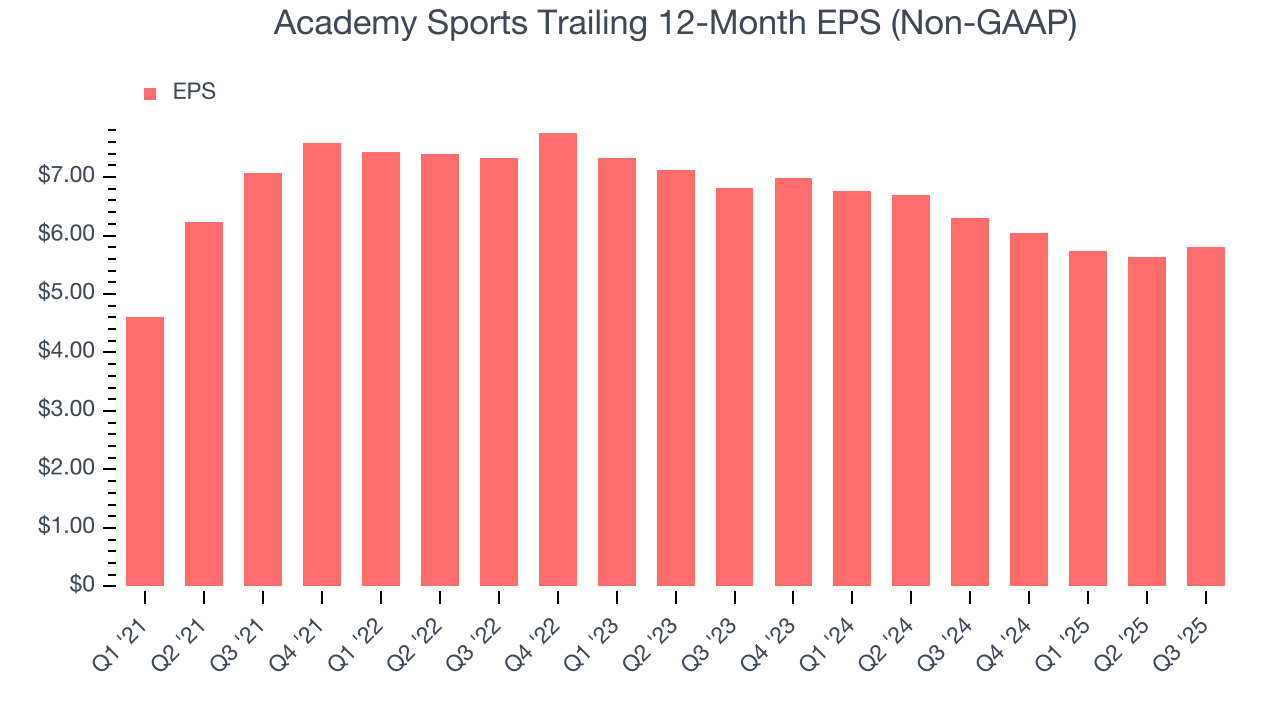
In Q3, Academy Sports reported adjusted EPS of $1.14, up from $0.98 in the same quarter last year. This print beat analysts’ estimates by 7.5%. Over the next 12 months, Wall Street expects Academy Sports’s full-year EPS of $5.80 to grow 10%.
10. Cash Is King
If you’ve followed StockStory for a while, you know we emphasize free cash flow. Why, you ask? We believe that in the end, cash is king, and you can’t use accounting profits to pay the bills.
Academy Sports has shown impressive cash profitability, giving it the option to reinvest or return capital to investors. The company’s free cash flow margin averaged 5.2% over the last two years, better than the broader consumer retail sector.
Taking a step back, we can see that Academy Sports’s margin dropped by 3.9 percentage points over the last year. This decrease came from the higher costs associated with opening more stores.
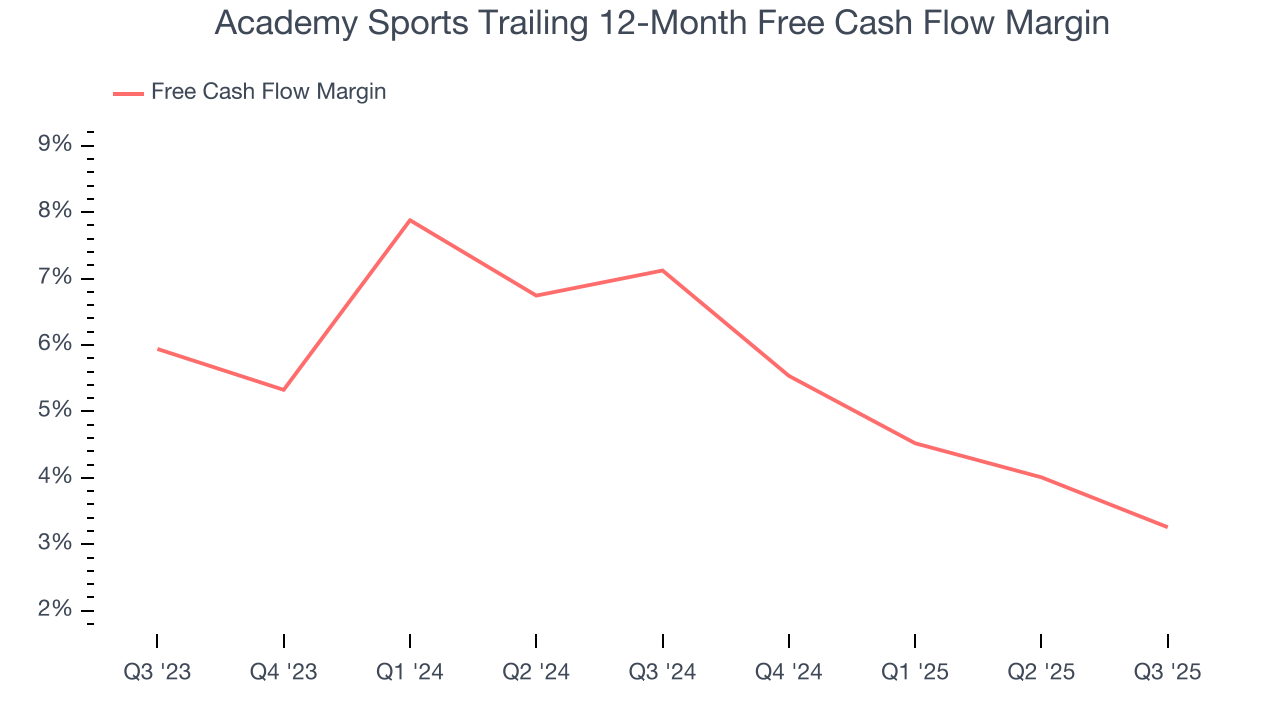
Academy Sports broke even from a free cash flow perspective in Q3. The company’s cash profitability regressed as it was 3.2 percentage points lower than in the same quarter last year, suggesting its historical struggles have dragged on.
11. Return on Invested Capital (ROIC)
EPS and free cash flow tell us whether a company was profitable while growing its revenue. But was it capital-efficient? Enter ROIC, a metric showing how much operating profit a company generates relative to the money it has raised (debt and equity).
Academy Sports’s management team makes decent investment decisions and generates value for shareholders. Its five-year average ROIC was 17.3%, slightly better than typical consumer retail business.
12. Balance Sheet Assessment
Academy Sports reported $289.5 million of cash and $1.87 billion of debt on its balance sheet in the most recent quarter. As investors in high-quality companies, we primarily focus on two things: 1) that a company’s debt level isn’t too high and 2) that its interest payments are not excessively burdening the business.
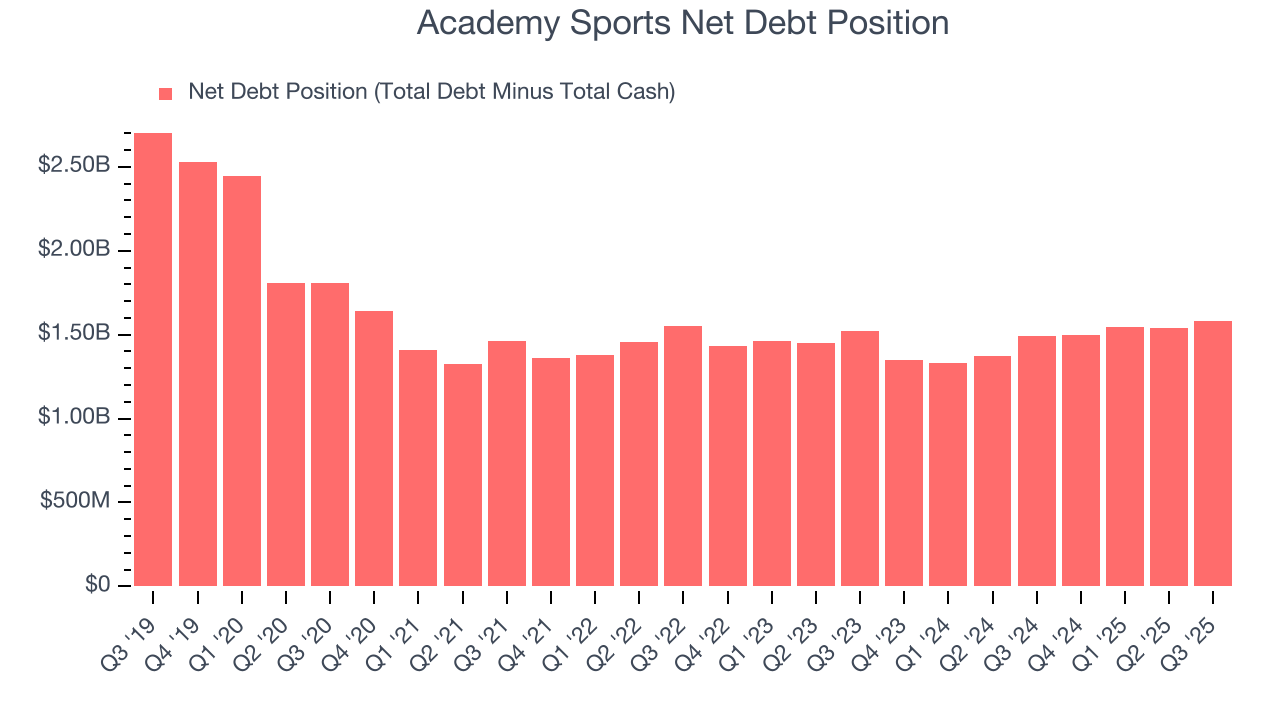
With $675.4 million of EBITDA over the last 12 months, we view Academy Sports’s 2.3× net-debt-to-EBITDA ratio as safe. We also see its $18.26 million of annual interest expenses as appropriate. The company’s profits give it plenty of breathing room, allowing it to continue investing in growth initiatives.
13. Key Takeaways from Academy Sports’s Q3 Results
We enjoyed seeing Academy Sports beat analysts’ gross margin expectations this quarter. We were also glad its EBITDA outperformed Wall Street’s estimates. On the other hand, its revenue slightly missed. Overall, this print had some key positives. The stock remained flat at $48.77 immediately after reporting.
14. Is Now The Time To Buy Academy Sports?
Updated: March 12, 2026 at 10:48 PM EDT
When considering an investment in Academy Sports, investors should account for its valuation and business qualities as well as what’s happened in the latest quarter.
Academy Sports isn’t a terrible business, but it isn’t one of our picks. To kick things off, its revenue has declined over the last three years. While its new store openings have increased its brand equity, the downside is its shrinking same-store sales tell us it will need to change its strategy to succeed. On top of that, its gross margins make it more challenging to reach positive operating profits compared to other consumer retail businesses.
Academy Sports’s P/E ratio based on the next 12 months is 9.1x. While this valuation is optically cheap, the potential downside is big given its shaky fundamentals. We're pretty confident there are more exciting stocks to buy at the moment.
Wall Street analysts have a consensus one-year price target of $60.56 on the company (compared to the current share price of $55.58).