
United Rentals (URI)
United Rentals is intriguing. Its combination of high growth and robust profitability makes it a unique asset.― StockStory Analyst Team


1. News




2. Summary
Why United Rentals Is Interesting
Owning the largest rental fleet in the world, United Rentals (NYSE:URI) provides equipment rental and related services to construction, industrial, and infrastructure industries.
- Excellent operating margin highlights the strength of its business model, and its operating leverage amplified its profits over the last five years
- Earnings per share have massively outperformed its peers over the last five years, increasing by 19.2% annually
- One pitfall is its projected sales growth of 6.1% for the next 12 months suggests sluggish demand
United Rentals almost passes our quality test. If you like the story, the valuation looks reasonable.
Why Is Now The Time To Buy United Rentals?






United Rentals is trading at $726.99 per share, or 15.9x forward P/E. Many industrials companies may feature a higher valuation multiple, but that doesn’t make United Rentals a great deal. We think the current multiple fairly reflects the revenue characteristics.
It could be a good time to invest if you see something the market doesn’t.
3. United Rentals (URI) Research Report: Q4 CY2025 Update
Equipment rental company United Rentals (NYSE:URI) missed Wall Street’s revenue expectations in Q4 CY2025 as sales rose 2.8% year on year to $4.21 billion. On the other hand, the company’s outlook for the full year was close to analysts’ estimates with revenue guided to $17.05 billion at the midpoint. Its non-GAAP profit of $11.09 per share was 6.1% below analysts’ consensus estimates.
United Rentals (URI) Q4 CY2025 Highlights:
- Revenue: $4.21 billion vs analyst estimates of $4.24 billion (2.8% year-on-year growth, 0.7% miss)
- Adjusted EPS: $11.09 vs analyst expectations of $11.80 (6.1% miss)
- Adjusted EBITDA: $1.90 billion vs analyst estimates of $1.93 billion (45.2% margin, 1.6% miss)
- EBITDA guidance for the upcoming financial year 2026 is $7.7 billion at the midpoint, in line with analyst expectations
- Operating Margin: 25%, down from 26.5% in the same quarter last year
- Free Cash Flow Margin: 23.5%, up from 20.4% in the same quarter last year
- Market Capitalization: $57.74 billion
Company Overview
Owning the largest rental fleet in the world, United Rentals (NYSE:URI) provides equipment rental and related services to construction, industrial, and infrastructure industries.
Founded in 1997, United Rentals was established to address the increasing demand for equipment rentals, which make economic sense for companies of all types. Renting enables businesses to manage their projects efficiently without the significant capital investment required for equipment ownership. In essence, renting heavy equipment instead of buying it means customers can incur predictable, smooth operating expenses rather than lumpy, capital expenditures. Additionally, obsolescence risk is much lower when renting.
A customer can rent earthmoving, material handling, and site preparation equipment from United Rentals. For instance, construction companies rely on United Rentals excavators, backhoes, and aerial work platforms, while industrial clients utilize their fleet of forklifts, generators, and compressors to maintain operations and ensure productivity.
The primary revenue sources for United Rentals come from equipment rental fees and related services. The company's business model focuses on providing well-maintained equipment through a network of rental locations and an easy-to-use online platform. Unlike companies that sell this equipment, United Rentals earns more predictable and recurring revenue due to long-term rental agreements with price escalators to account for inflation and with maintenance and repair as add-on services to help the company earn more on each unit.
4. Specialty Equipment Distributors
Historically, specialty equipment distributors have boasted deep selection and expertise in sometimes narrow areas like single-use packaging or unique lighting equipment. Additionally, the industry has evolved to include more automated industrial equipment and machinery over the last decade, driving efficiencies and enabling valuable data collection. Specialty equipment distributors whose offerings keep up with these trends can take share in a still-fragmented market, but like the broader industrials sector, this space is at the whim of economic cycles that impact the capital spending and manufacturing propelling industry volumes.
Competitors in the equipment rental industry include Sunbelt Rentals (LSE:AHT), Herc Holdings (NYSE:HRI), and H&E Equipment Services (NASDAQ:HEES).
5. Revenue Growth
A company’s long-term sales performance is one signal of its overall quality. Even a bad business can shine for one or two quarters, but a top-tier one grows for years. Over the last five years, United Rentals grew its sales at an exceptional 13.5% compounded annual growth rate. Its growth beat the average industrials company and shows its offerings resonate with customers.
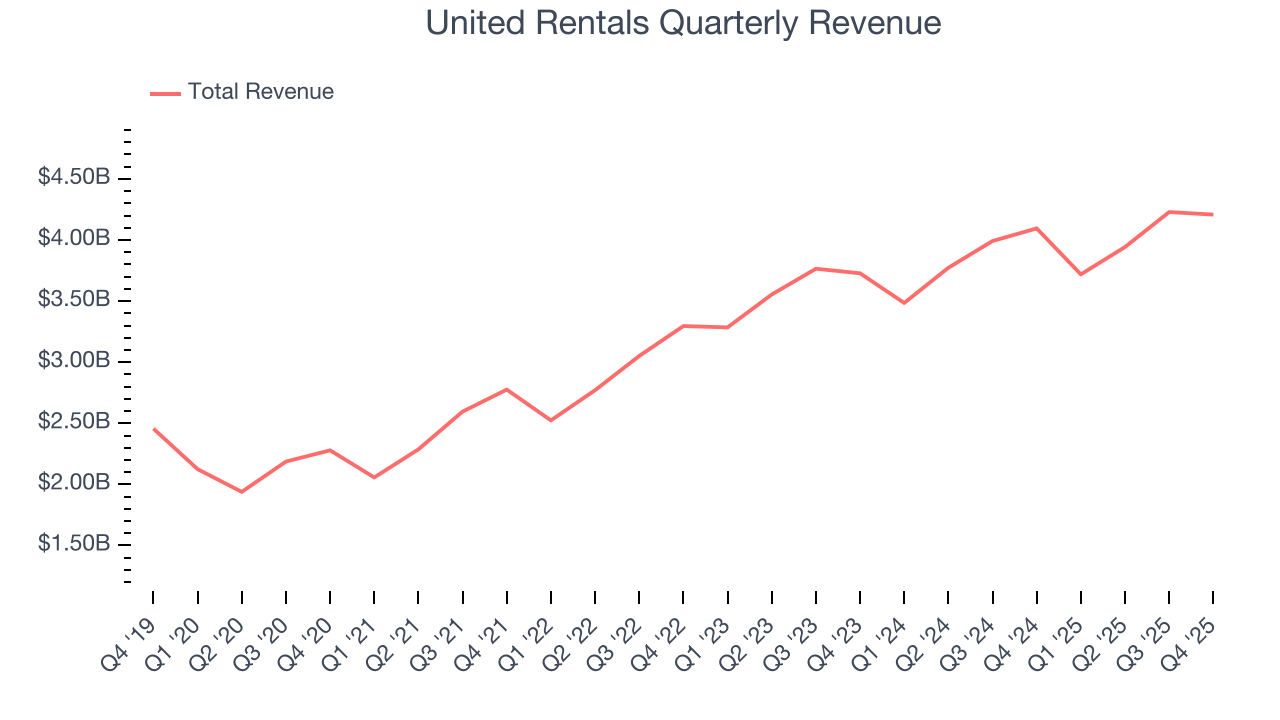
We at StockStory place the most emphasis on long-term growth, but within industrials, a half-decade historical view may miss cycles, industry trends, or a company capitalizing on catalysts such as a new contract win or a successful product line. United Rentals’s recent performance shows its demand has slowed significantly as its annualized revenue growth of 6% over the last two years was well below its five-year trend. 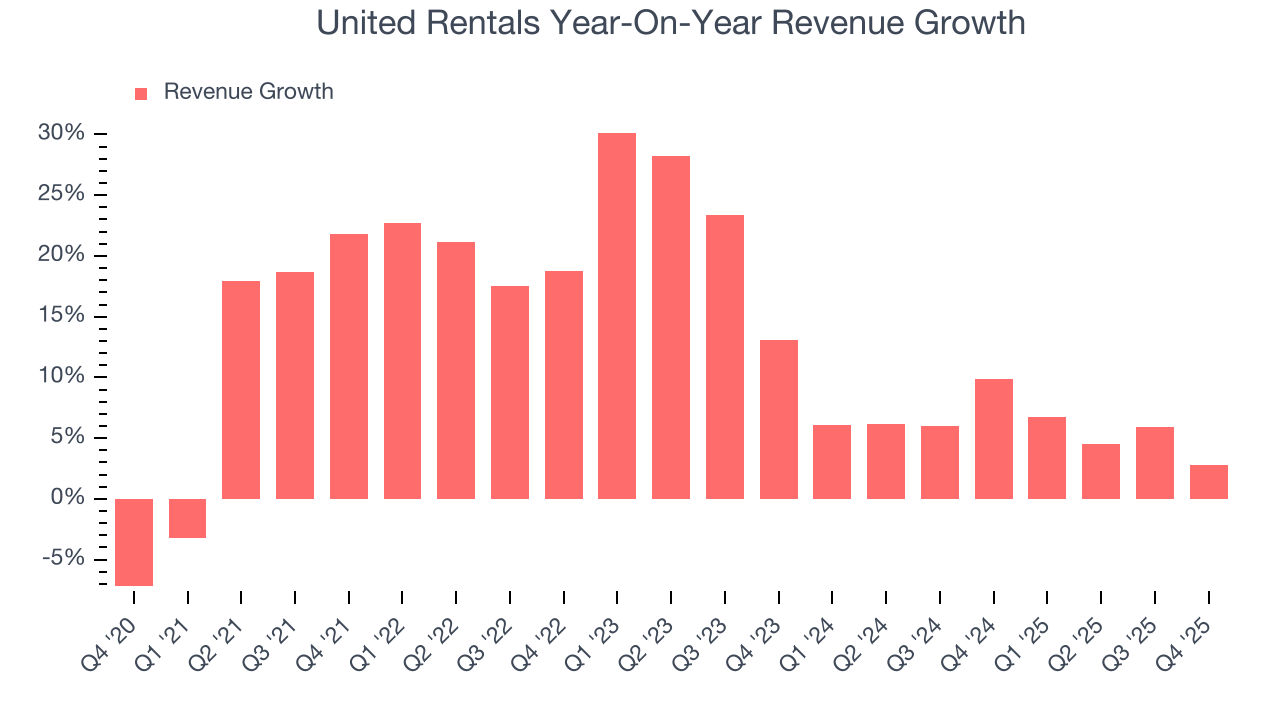
This quarter, United Rentals’s revenue grew by 2.8% year on year to $4.21 billion, falling short of Wall Street’s estimates.
Looking ahead, sell-side analysts expect revenue to grow 5.5% over the next 12 months, similar to its two-year rate. This projection doesn't excite us and indicates its newer products and services will not accelerate its top-line performance yet.
6. Gross Margin & Pricing Power
United Rentals’s unit economics are great compared to the broader industrials sector and signal that it enjoys product differentiation through quality or brand. As you can see below, it averaged an excellent 40.5% gross margin over the last five years. Said differently, roughly $40.54 was left to spend on selling, marketing, R&D, and general administrative overhead for every $100 in revenue. 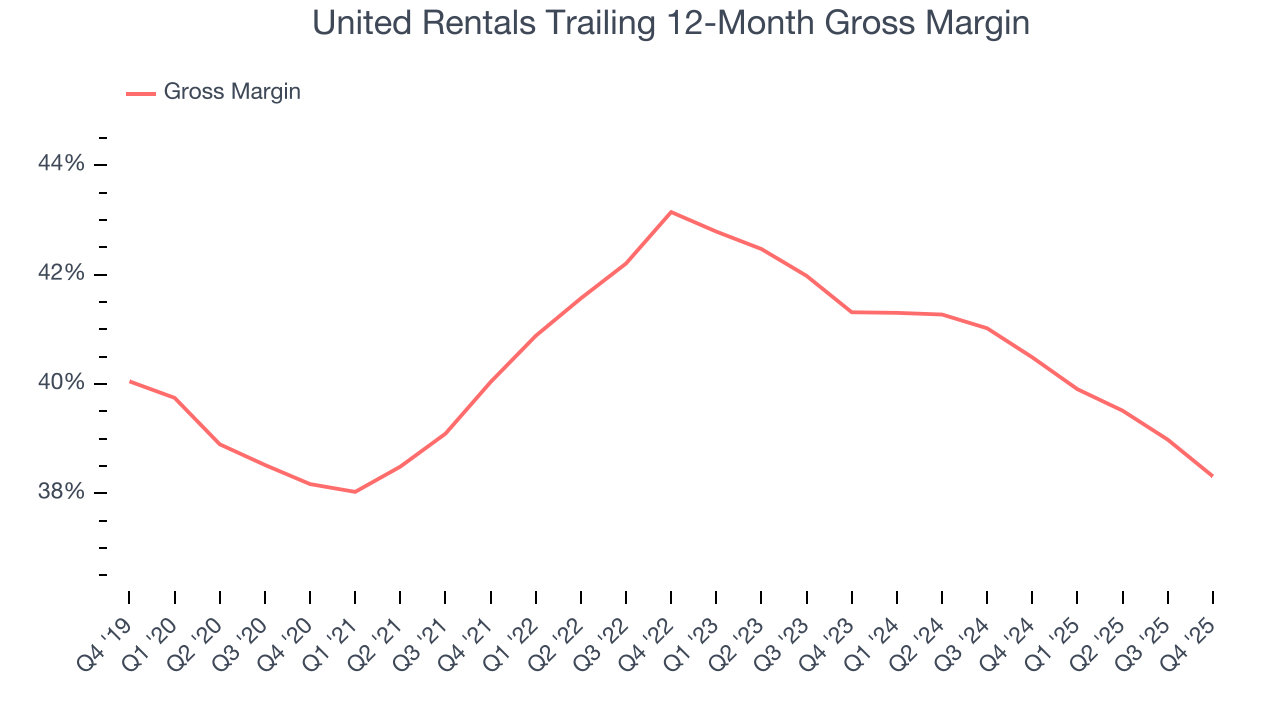
United Rentals’s gross profit margin came in at 37.8% this quarter, marking a 2.6 percentage point decrease from 40.4% in the same quarter last year. United Rentals’s full-year margin has also been trending down over the past 12 months, decreasing by 2.2 percentage points. If this move continues, it could suggest a more competitive environment with some pressure to lower prices and higher input costs (such as raw materials and manufacturing expenses).
7. Operating Margin
United Rentals has been a well-oiled machine over the last five years. It demonstrated elite profitability for an industrials business, boasting an average operating margin of 25.9%. This result isn’t surprising as its high gross margin gives it a favorable starting point.
Looking at the trend in its profitability, United Rentals’s operating margin rose by 1.2 percentage points over the last five years, as its sales growth gave it operating leverage.
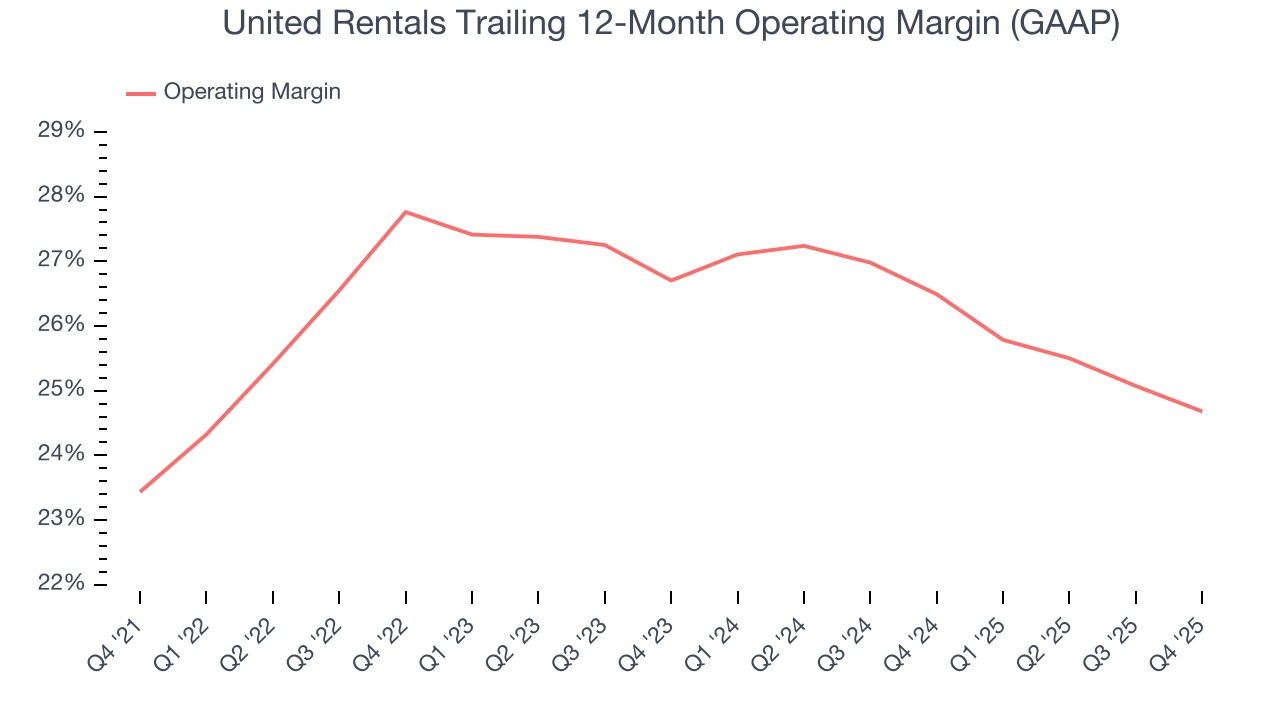
This quarter, United Rentals generated an operating margin profit margin of 25%, down 1.5 percentage points year on year. Since United Rentals’s gross margin decreased more than its operating margin, we can assume its recent inefficiencies were driven more by weaker leverage on its cost of sales rather than increased marketing, R&D, and administrative overhead expenses.
8. Earnings Per Share
Revenue trends explain a company’s historical growth, but the long-term change in earnings per share (EPS) points to the profitability of that growth – for example, a company could inflate its sales through excessive spending on advertising and promotions.
United Rentals’s EPS grew at an astounding 19.2% compounded annual growth rate over the last five years, higher than its 13.5% annualized revenue growth. This tells us the company became more profitable on a per-share basis as it expanded.
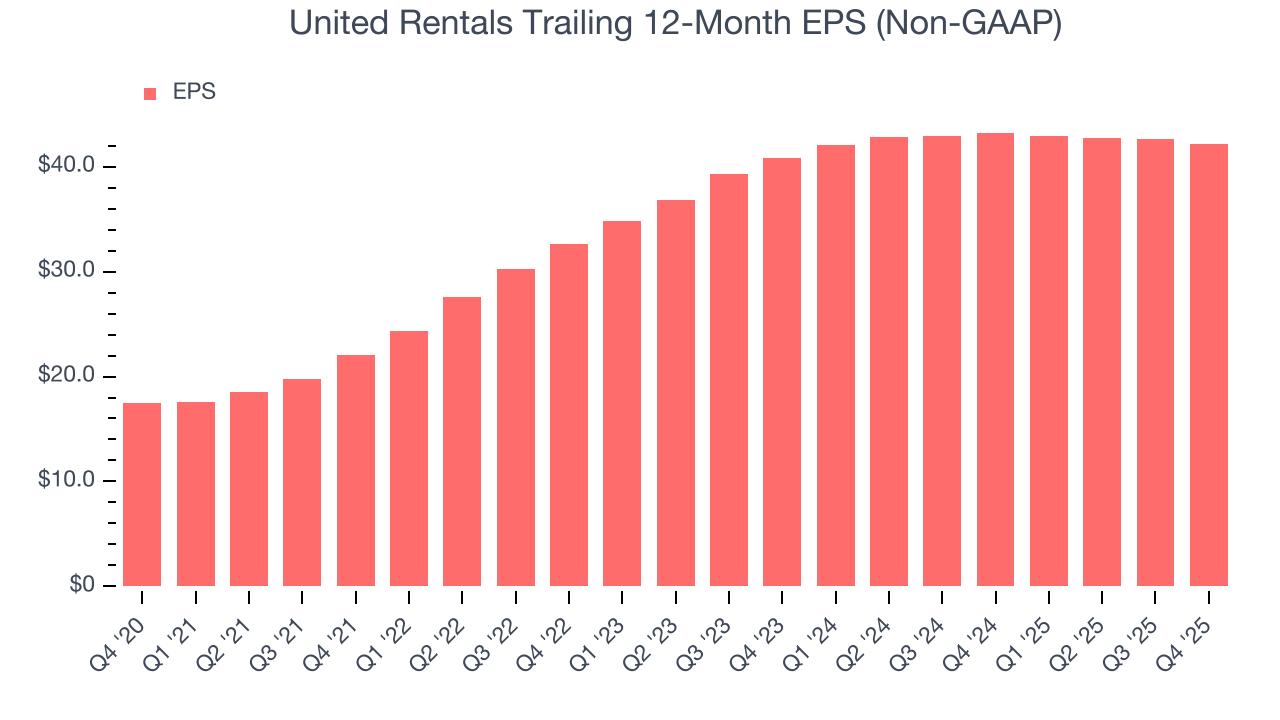
We can take a deeper look into United Rentals’s earnings quality to better understand the drivers of its performance. As we mentioned earlier, United Rentals’s operating margin declined this quarter but expanded by 1.2 percentage points over the last five years. Its share count also shrank by 12.4%, and these factors together are positive signs for shareholders because improving profitability and share buybacks turbocharge EPS growth relative to revenue growth. 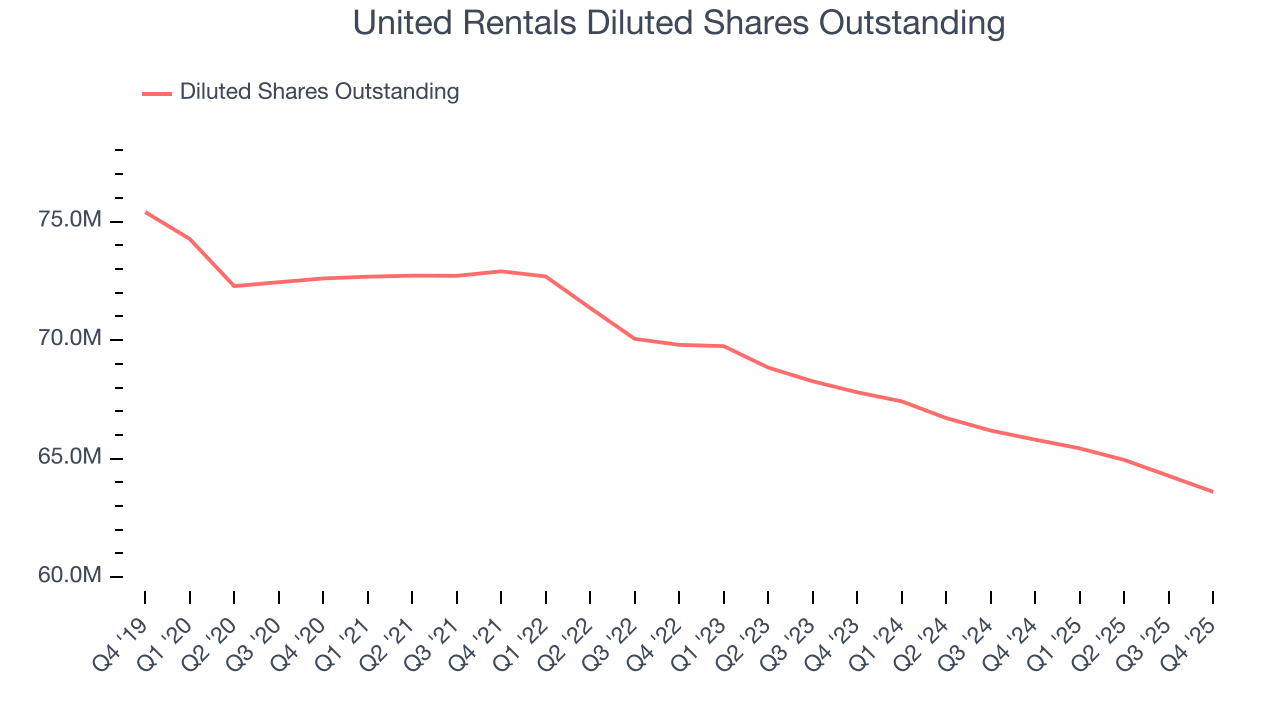
Like with revenue, we analyze EPS over a shorter period to see if we are missing a change in the business.
For United Rentals, its two-year annual EPS growth of 1.6% was lower than its five-year trend. We hope its growth can accelerate in the future.
In Q4, United Rentals reported adjusted EPS of $11.09, down from $11.59 in the same quarter last year. This print missed analysts’ estimates, but we care more about long-term adjusted EPS growth than short-term movements. Over the next 12 months, Wall Street expects United Rentals’s full-year EPS of $42.12 to grow 12.5%.
9. Cash Is King
Although earnings are undoubtedly valuable for assessing company performance, we believe cash is king because you can’t use accounting profits to pay the bills.
United Rentals has shown terrific cash profitability, putting it in an advantageous position to invest in new products, return capital to investors, and consolidate the market during industry downturns. The company’s free cash flow margin was among the best in the industrials sector, averaging 14.5% over the last five years.
Taking a step back, we can see that United Rentals’s margin dropped by 2 percentage points during that time. If its declines continue, it could signal increasing investment needs and capital intensity.
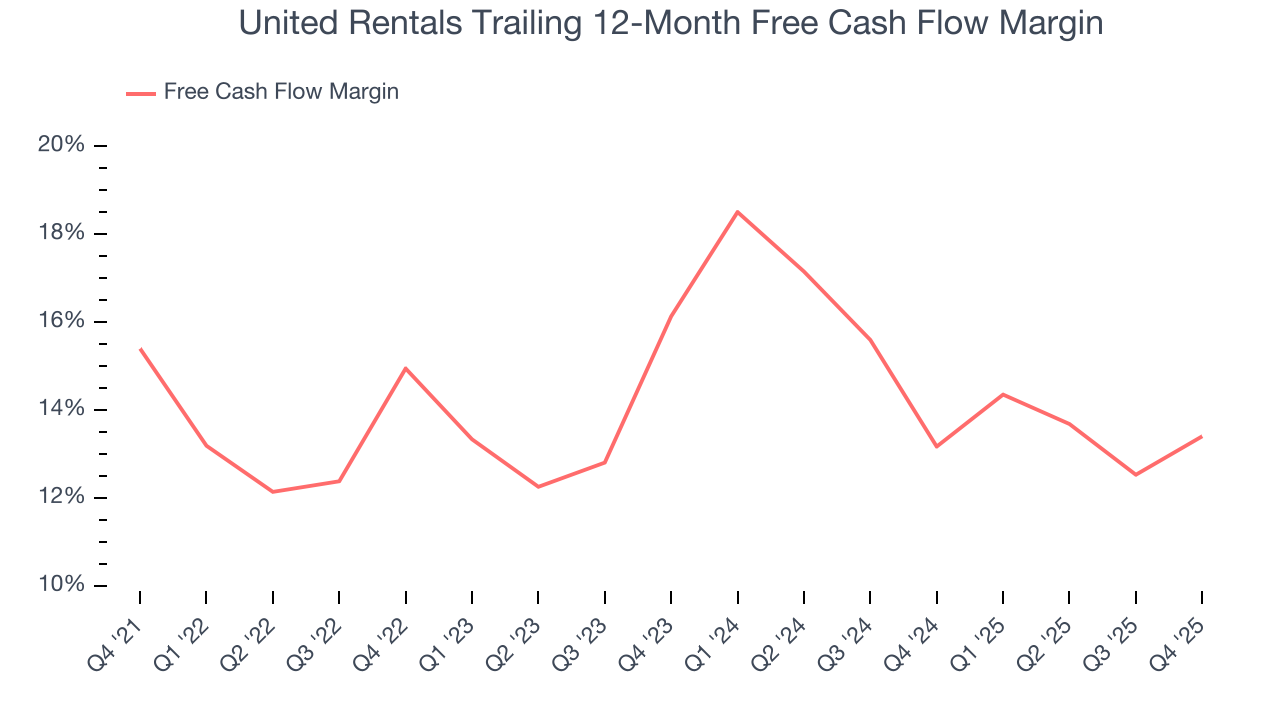
United Rentals’s free cash flow clocked in at $989 million in Q4, equivalent to a 23.5% margin. This result was good as its margin was 3.1 percentage points higher than in the same quarter last year, but we wouldn’t put too much weight on the short term because investment needs can be seasonal, causing temporary swings. Long-term trends trump fluctuations.
10. Return on Invested Capital (ROIC)
EPS and free cash flow tell us whether a company was profitable while growing its revenue. But was it capital-efficient? Enter ROIC, a metric showing how much operating profit a company generates relative to the money it has raised (debt and equity).
Although United Rentals hasn’t been the highest-quality company lately, it historically found a few growth initiatives that worked out well. Its five-year average ROIC was 14.3%, impressive for an industrials business.
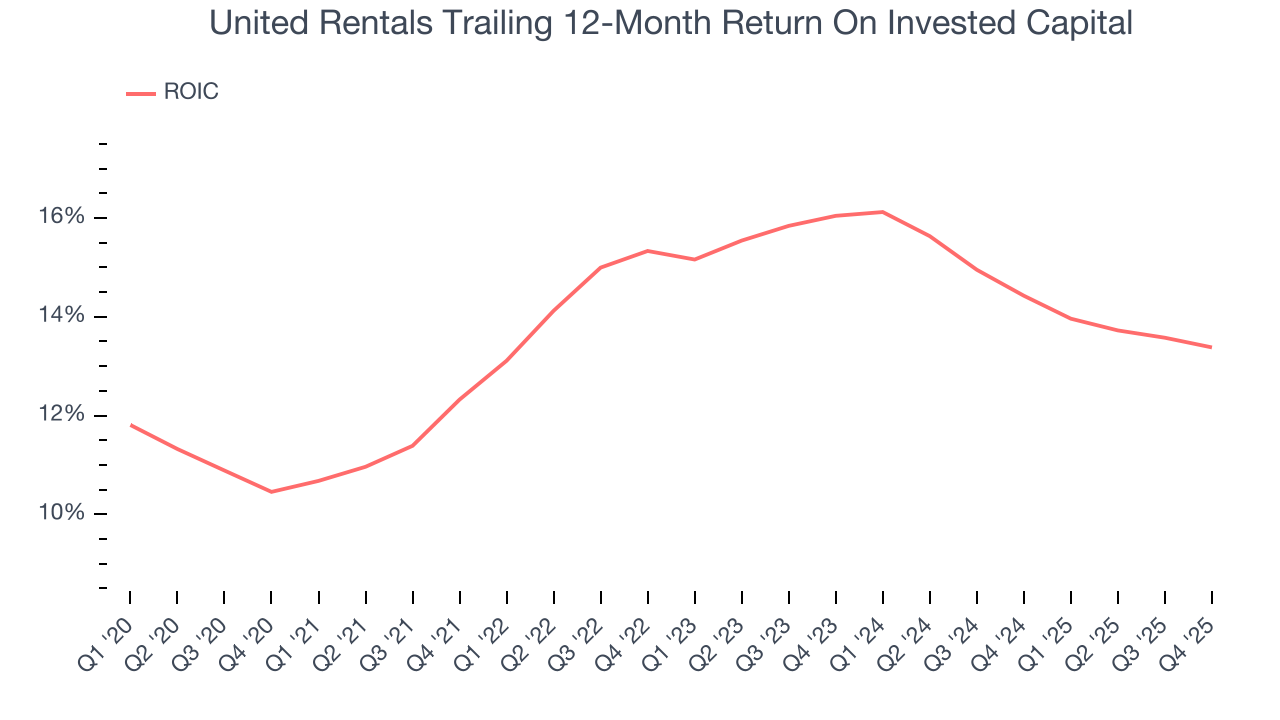
We like to invest in businesses with high returns, but the trend in a company’s ROIC is what often surprises the market and moves the stock price. Uneventfully, United Rentals’s ROIC has stayed the same over the last few years. Given the company’s underwhelming financial performance in other areas, we’d like to see its returns improve before recommending the stock.
11. Balance Sheet Assessment
United Rentals reported $459 million of cash and $15.35 billion of debt on its balance sheet in the most recent quarter. As investors in high-quality companies, we primarily focus on two things: 1) that a company’s debt level isn’t too high and 2) that its interest payments are not excessively burdening the business.
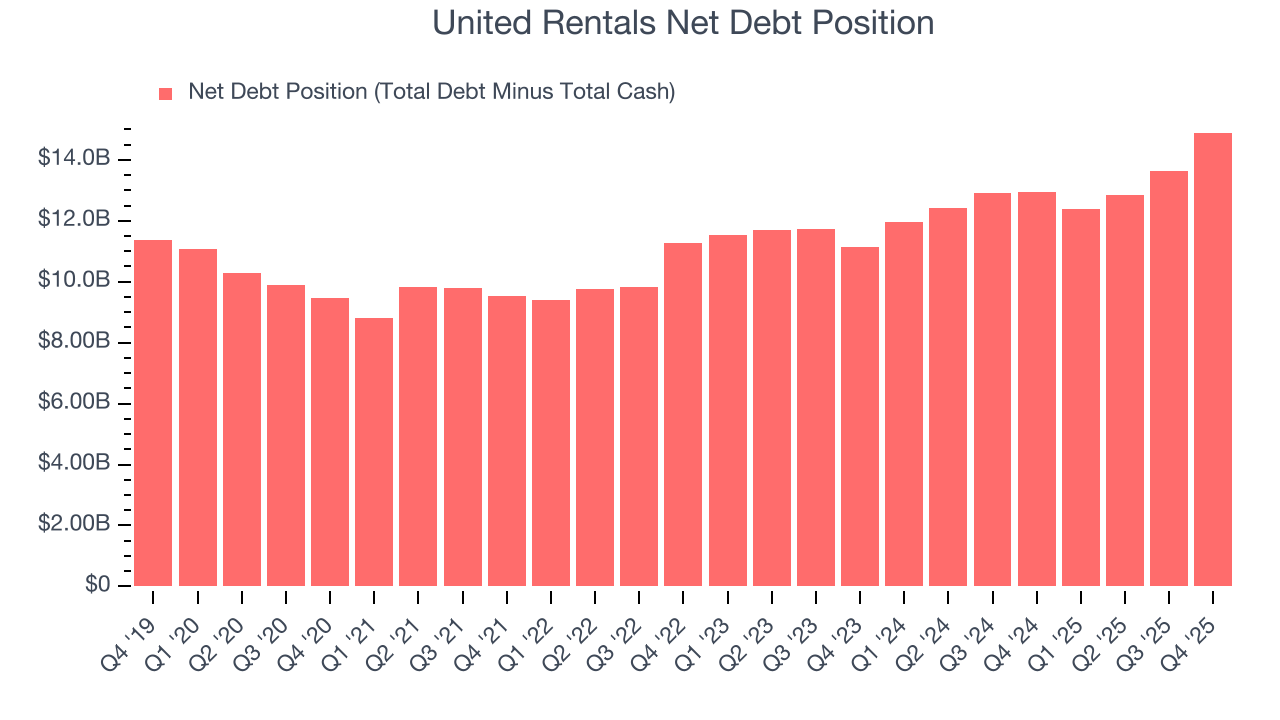
With $7.33 billion of EBITDA over the last 12 months, we view United Rentals’s 2.0× net-debt-to-EBITDA ratio as safe. We also see its $350 million of annual interest expenses as appropriate. The company’s profits give it plenty of breathing room, allowing it to continue investing in growth initiatives.
12. Key Takeaways from United Rentals’s Q4 Results
We struggled to find many positives in these results. Its EPS missed and its revenue fell slightly short of Wall Street’s estimates. Overall, this quarter could have been better. The stock traded down 5.1% to $857.50 immediately following the results.
13. Is Now The Time To Buy United Rentals?
Updated: March 28, 2026 at 10:09 PM EDT
We think that the latest earnings result is only one piece of the bigger puzzle. If you’re deciding whether to own United Rentals, you should also grasp the company’s longer-term business quality and valuation.
In our opinion, United Rentals is a good company. To kick things off, its revenue growth was exceptional over the last five years. And while its cash profitability fell over the last five years, its impressive operating margins show it has a highly efficient business model. On top of that, its astounding EPS growth over the last five years shows its profits are trickling down to shareholders.
United Rentals’s P/E ratio based on the next 12 months is 15.9x. Looking at the industrials landscape right now, United Rentals trades at a pretty interesting price. For those confident in the business and its management team, this is a good time to invest.
Wall Street analysts have a consensus one-year price target of $985.89 on the company (compared to the current share price of $726.99), implying they see 35.6% upside in buying United Rentals in the short term.