
Patterson-UTI (PTEN)
Patterson-UTI is a sound business. Its superb revenue growth indicates its market share is increasing.― StockStory Analyst Team


1. News
2. Summary
Why Patterson-UTI Is Interesting
Operating 135 Tier-1 super-spec rigs that can handle the industry's most demanding drilling projects, Patterson-UTI (NASDAQ:PTEN) provides contract drilling rigs, hydraulic fracturing, and drill bits to oil and gas operators.
- Annual revenue growth of 34.1% over the past five years was outstanding, reflecting market share gains this cycle
- Annual revenue growth of 10.2% over the last ten years was superb and indicates its market share increased during this cycle
- On the other hand, its negative returns on capital show that some of its growth strategies have backfired
Patterson-UTI is close to becoming a high-quality business. If you like the company, the price seems fair.
Why Is Now The Time To Buy Patterson-UTI?








Patterson-UTI is trading at $10.73 per share, or 5.9x forward EV-to-EBITDA. Patterson-UTI’s valuation seems like a good deal for the revenue momentum you get.
It could be a good time to invest if you see something the market doesn’t.
3. Patterson-UTI (PTEN) Research Report: Q4 CY2025 Update
Oilfield services company Patterson-UTI (NASDAQ:PTEN) beat Wall Street’s revenue expectations in Q4 CY2025, but sales were flat year on year at $1.15 billion. Its non-GAAP loss of $0.02 per share was 75.8% above analysts’ consensus estimates.
Patterson-UTI (PTEN) Q4 CY2025 Highlights:
- Revenue: $1.15 billion vs analyst estimates of $1.12 billion (flat year on year, 3.2% beat)
- Adjusted EPS: -$0.02 vs analyst estimates of -$0.10 (75.8% beat)
- Adjusted EBITDA: $221.1 million vs analyst estimates of $193.7 million (19.2% margin, 14.1% beat)
- Operating Margin: 0%, up from -2.7% in the same quarter last year
- Free Cash Flow Margin: 22.5%, up from 15.1% in the same quarter last year
- Market Capitalization: $3.61 billion
Company Overview
Operating 135 Tier-1 super-spec rigs that can handle the industry's most demanding drilling projects, Patterson-UTI (NASDAQ:PTEN) provides contract drilling rigs, hydraulic fracturing, and drill bits to oil and gas operators.
The company operates through three main business segments that serve different stages of the oil and gas extraction process. Its drilling services segment deploys land-based drilling rigs primarily across the continental United States, with additional operations in Colombia and Ecuador. These rigs drill wells for oil and gas operators who lease the equipment on either a well-by-well basis or for multi-month term contracts. The company's fleet includes specialized "Tier-1, super-spec" rigs—high-specification electric rigs capable of at least 1,500 horsepower with 750,000-pound hookload capacity and 7,500-psi circulating systems, designed to drill the complex horizontal wells that have become standard in shale formations. This segment also provides directional drilling services, which use downhole motors and measurement-while-drilling (MWD) technology to guide the drill bit along a planned path rather than drilling straight down.
The completion services segment takes over after a well is drilled. Its primary service is hydraulic fracturing—pumping pressurized fluid mixed with sand (proppant) and chemicals into underground rock formations to create fractures that release trapped oil and gas. For example, an operator that has drilled a horizontal well in the Permian Basin might contract Patterson-UTI to perform a multi-stage hydraulic fracturing operation, using wireline equipment to place plugs at intervals along the wellbore and then fracturing each section sequentially. This segment also offers cementing services to seal the well casing, wireline services for perforating and pipe recovery, and natural gas fueling solutions that supply treated natural gas to power oilfield equipment.
The drilling products segment, operating under the Ulterra brand, manufactures and rents polycrystalline diamond compact (PDC) drill bits used in drilling operations. These specialized bits feature synthetic diamond cutters and are designed for specific rock formations and drilling conditions. The company maintains manufacturing facilities in Texas, Alberta, and Saudi Arabia, and distributes bits to oil and gas operators and drilling contractors in over 30 countries. Revenue comes from rental fees in North America and outright sales in international markets, with used bits often refurbished for subsequent customers.
4. Oilfield Services
Oilfield services companies provide equipment, technology, and services enabling exploration and production activities, including drilling, completion, well intervention, and reservoir evaluation. Their fortunes closely track upstream capital spending cycles. Tailwinds include increased drilling activity during favorable commodity environments, demand for efficiency-enhancing technologies, and growing offshore and unconventional resource development. Headwinds include significant revenue volatility tied to oil and gas price swings and producer spending discipline. Intense competition pressures pricing and margins, while the energy transition may structurally reduce long-term demand. Workforce availability and technological disruption require continuous adaptation.
Patterson-UTI competes with Helmerich & Payne (NYSE:HP) and Precision Drilling (NYSE:PDS) in contract drilling, with Liberty Energy (NYSE:LBRT) and ProFrac (NASDAQ:ACDC) in hydraulic fracturing, and with various drill bit manufacturers in its drilling products segment.
5. Economies of Scale
The size of the revenue base is a way to assess topline, and it tells an investor whether an Energy producer has crossed the line between being a more vulnerable commodity taker and a durable operating platform. Scaled businesses tend to produce and generate revenue from many wells, pads, takeaway routes, and geographies, not just a single field or drilling program. Patterson-UTI’s $4.83 billion of revenue in the last year is mid-sized for the industry.
6. Revenue Growth
Cyclical industries such as Energy can make mediocre companies look great for a time, but a long-term view reveals which businesses can actually withstand and adapt to changing conditions. Thankfully, Patterson-UTI’s 34.1% annualized revenue growth over the last five years was incredible. Its growth beat the average energy upstream and integrated energy company and shows its offerings resonate with customers.
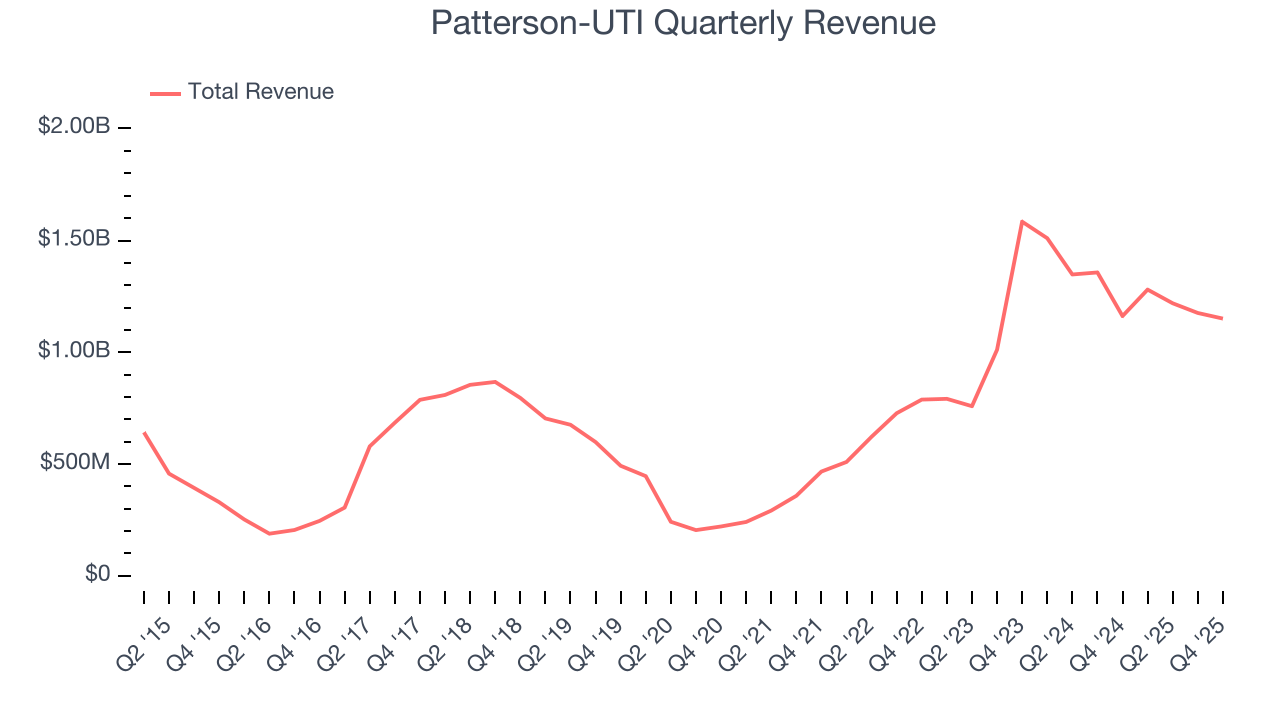
Even a long stretch in Energy can be shaped by a single commodity cycle, so extending the view to ten years adds another perspective and reveals which companies are built to grow regardless of the pricing regime. Patterson-UTI’s annualized revenue growth of 10.2% over the last ten years is below its five-year trend, but we still think the results suggest decent demand.
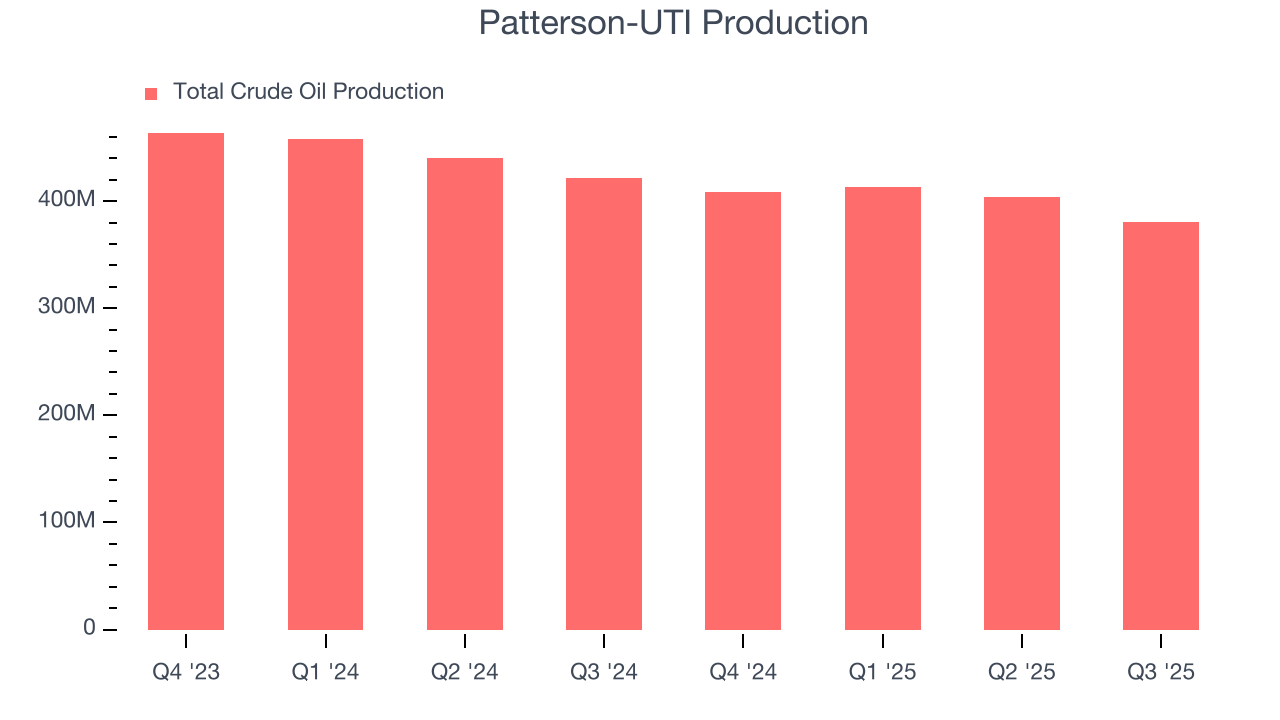
This quarter, Patterson-UTI’s $1.15 billion of revenue was flat year on year but beat Wall Street’s estimates by 3.2%.
7. Gross Margin
In a single quarter or year, gross margins in the sector can swing wildly due to commodity prices, hedging, or changes in labor costs. Over a multi-year period across different points in the cycle, gross margin differences can signal whether a company is a structurally-advantaged producer (“rock” quality, takeaway, operating costs) or not.
Patterson-UTI, which averaged 27.5% gross margin over the last five years, exhibiting bottom-tier unit economics in the sector. It means the company will struggle at higher commodity prices than peers with better gross margins. 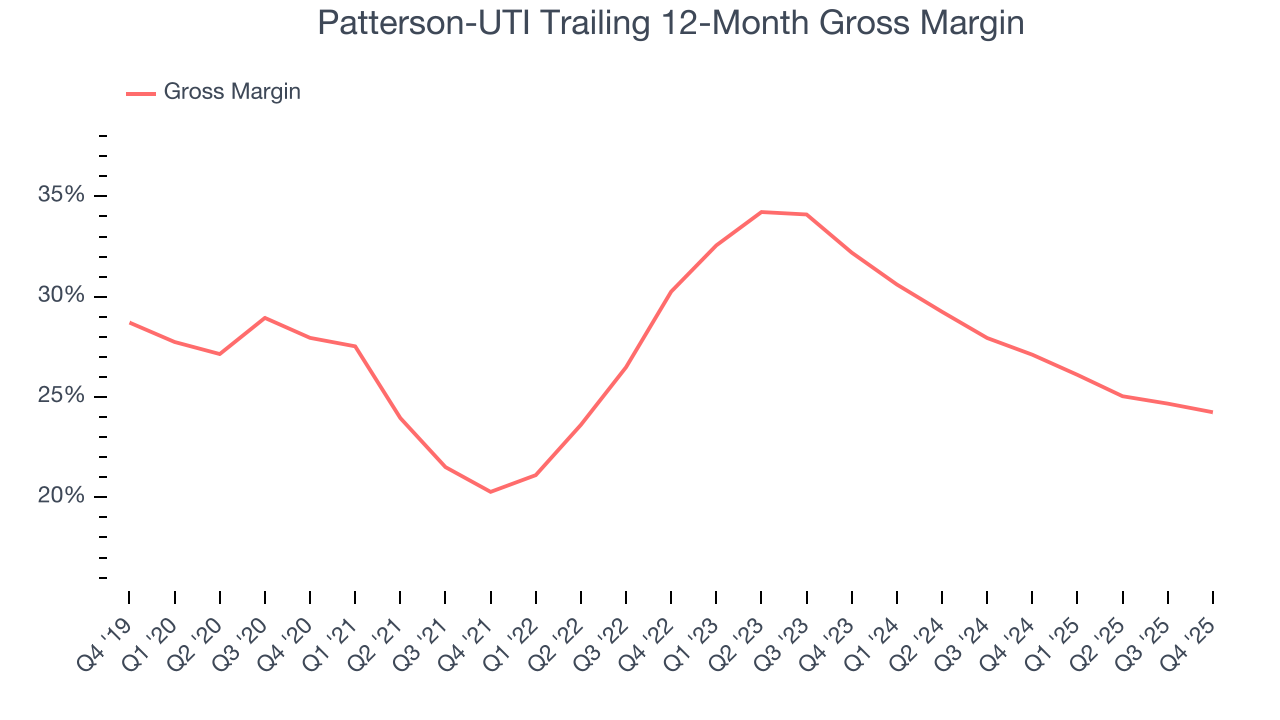
In Q4, Patterson-UTI produced a 24.2% gross profit margin , marking a 1.8 percentage point decrease from 26% in the same quarter last year. Note that energy margins can be volatile due to commodity price changes.
8. Adjusted EBITDA Margin
Adjusted EBITDA margin strips out accounting distortions tied to depletion and historical drilling spend, providing a clearer view of the cash-generating power of the underlying asset base before financing and reinvestment decisions.
Patterson-UTI was profitable over the last five years but held back by its large cost base. Its average EBITDA margin of 22.8% was weak for an upstream and integrated energy business.
On the plus side, Patterson-UTI’s EBITDA margin rose by 5.5 percentage points over the last year, as its sales growth gave it operating leverage.
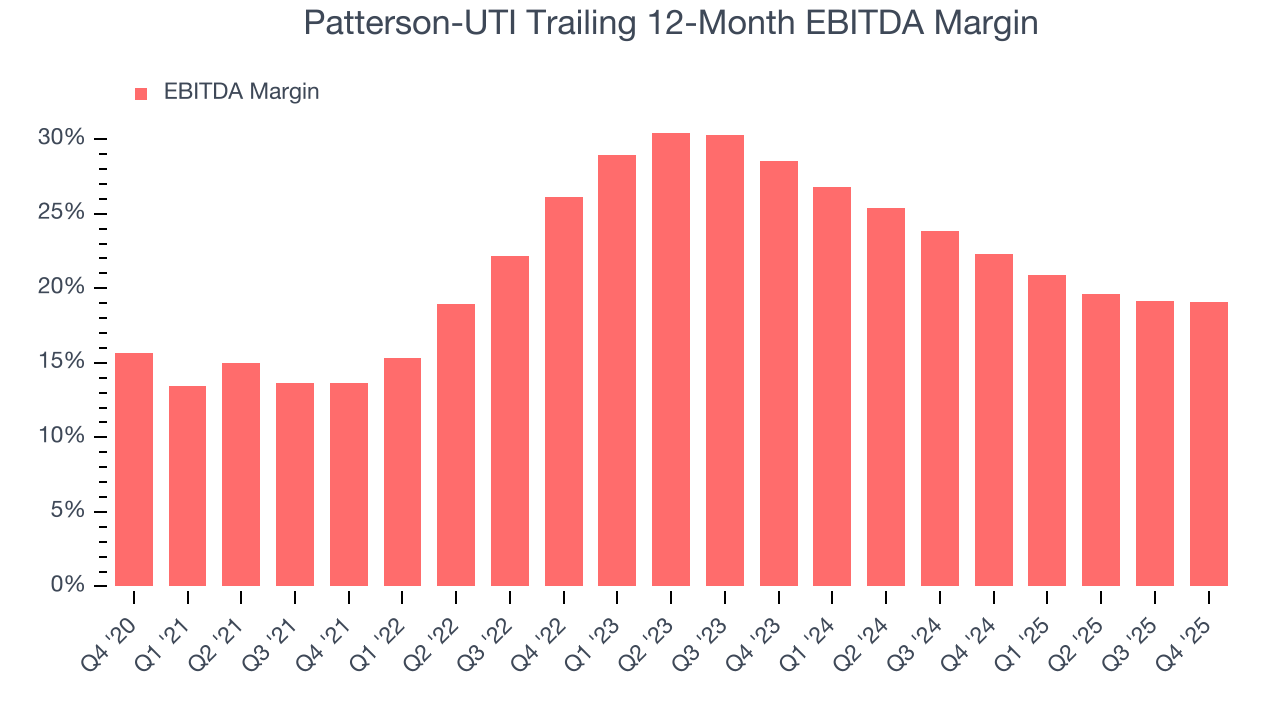
In Q4, Patterson-UTI generated an EBITDA margin profit margin of 19.2%, in line with the same quarter last year. This indicates the company’s overall cost structure has been relatively stable. This adjusted EBITDA beat Wall Street’s estimates by 14.1%.
9. Cash Is King
Adjusted EBITDA shows how profitable a company’s existing “rock” is before financing and reinvestment, while free cash flow shows how much value remains after paying to replace those wells. Because production declines over time, strong EBITDA can coexist with weak FCF if drilling is expensive or declines are steep. FCF therefore captures both operating efficiency and the cost of sustaining production.
Patterson-UTI has shown mediocre cash profitability relative to peers over the last five years, giving the company fewer opportunities to return capital to shareholders. Its free cash flow margin averaged 7.2%, below what we’d expect for an upstream and integrated energy business.
The level of free cash flow is important, but its durability across cycles is just as critical. Consistent margins are far more valuable than volatile swings driven by commodity prices.
Patterson-UTI’s ratio of quarterly free cash flow volatility to WTI crude price volatility over the past five years was 9.1 (lower is better), indicating reasonable insulation from commodity swings.
You may be asking why we wait until the free cash flow line to perform this stability analysis versus commodity prices. Why not compare revenue or EBITDA to WTI Crude prices in the case of Patterson-UTI? Because what ultimately matters is not how much revenue or profit you earn when prices are high but how much cash you can generate when prices are low. Free cash flow is the superior metric because it includes everything from hedging prowess to growth and maintenance capex to management behavior during good times and bad.
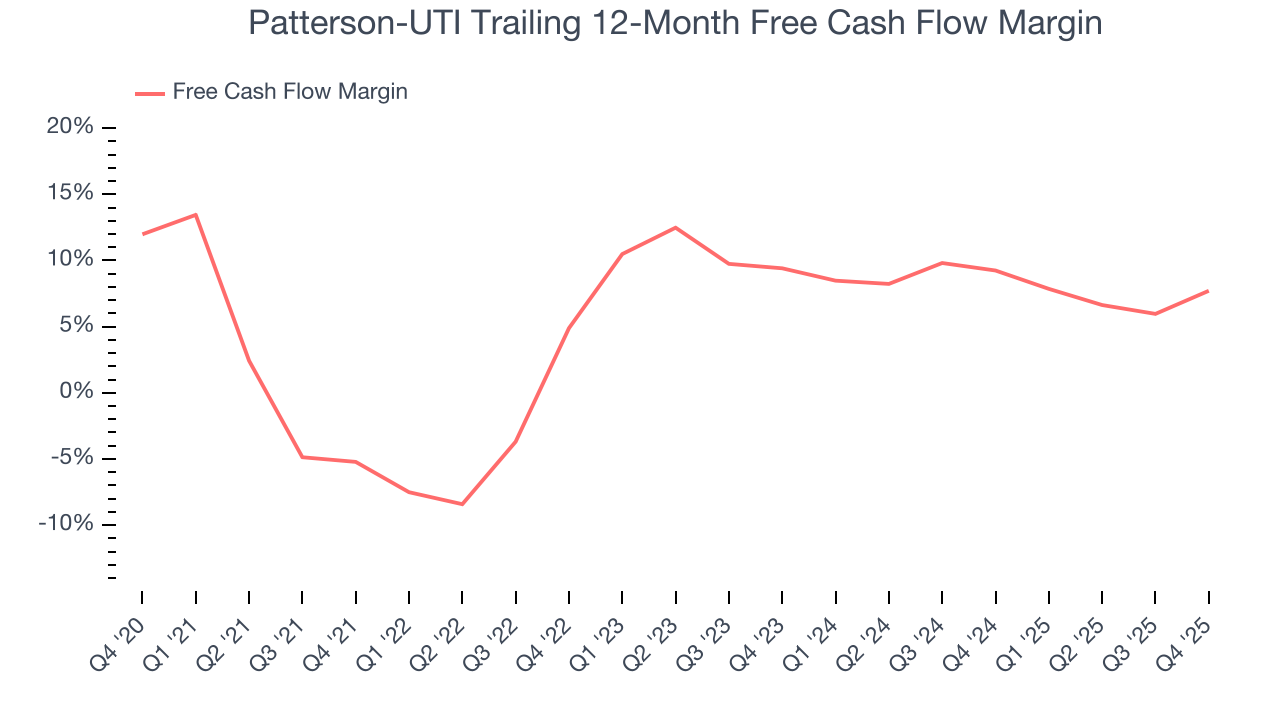
Patterson-UTI’s free cash flow clocked in at $259 million in Q4, equivalent to a 22.5% margin. This result was good as its margin was 7.4 percentage points higher than in the same quarter last year, building on its favorable historical trend.
10. Return on Invested Capital (ROIC)
Free cash flow shows how much money a producer generated, while ROIC shows how efficiently that money was earned. ROIC measures the operating profit produced for each dollar of capital invested, whether from debt or equity. Cash generation measures quantity while ROIC measures the quality of value creation.
We at StockStory like to look at ROIC over a ten-year period because energy investment cycles can involve up to five years of ramping production and another five years of harvesting. A decade view captures buying, extracting, and monetizing rather than just part of that picture. Patterson-UTI’s ten-year average ROIC was negative 8.9%, meaning management lost money while trying to expand the business. Its returns were among the worst in the energy upstream and integrated energy sector.
We like to invest in businesses with high returns, but the trend in a company’s ROIC is what often surprises the market and moves the stock price. Unfortunately, Patterson-UTI’s ROIC has stayed the same over the last few years. If the company wants to become an investable business, it must improve its returns by generating more profitable growth.
11. Balance Sheet Assessment
Patterson-UTI reported $420.6 million of cash and $1.25 billion of debt on its balance sheet in the most recent quarter. As investors in high-quality companies, we primarily focus on two things: 1) that a company’s debt level isn’t too high and 2) that its interest payments are not excessively burdening the business.
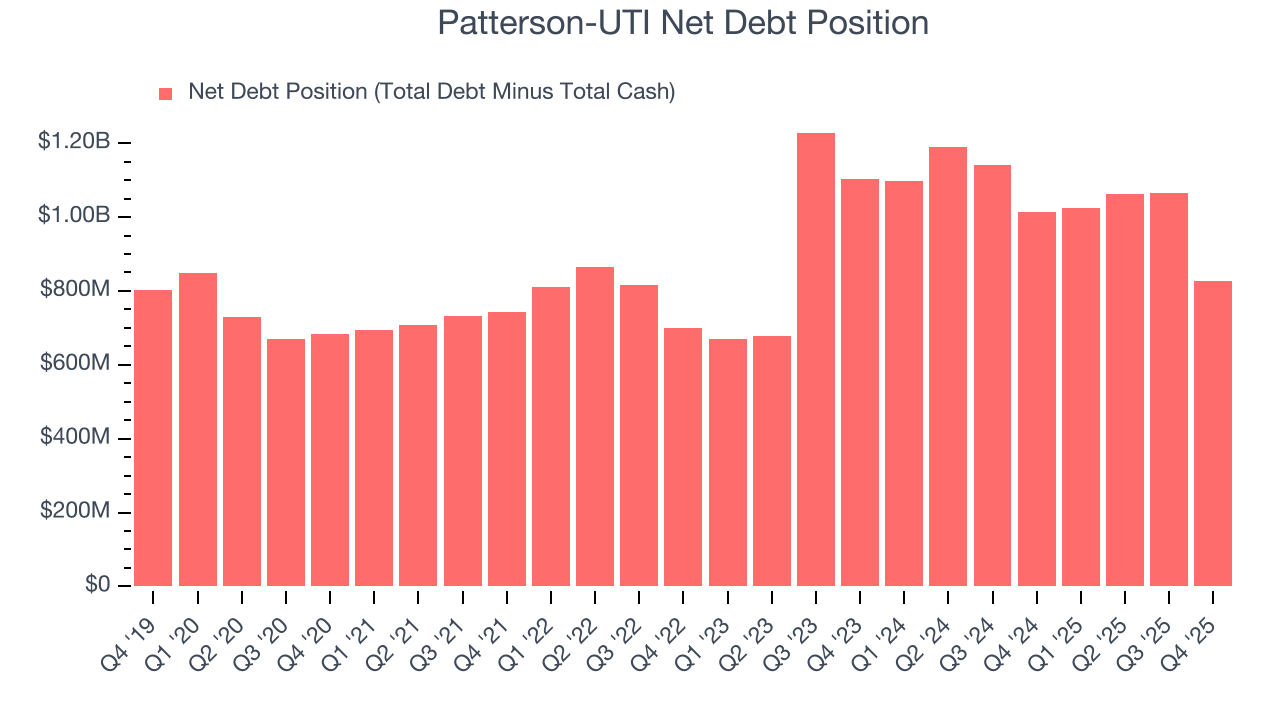
With $922.1 million of EBITDA over the last 12 months, we view Patterson-UTI’s 0.9× net-debt-to-EBITDA ratio as safe. We also see its $63.86 million of annual interest expenses as appropriate. The company’s profits give it plenty of breathing room, allowing it to continue investing in growth initiatives.
12. Key Takeaways from Patterson-UTI’s Q4 Results
It was good to see Patterson-UTI beat analysts’ EPS expectations this quarter. We were also glad its EBITDA outperformed Wall Street’s estimates. Zooming out, we think this quarter featured some important positives. The stock traded up 3.8% to $9.86 immediately after reporting.
13. Is Now The Time To Buy Patterson-UTI?
Updated: March 18, 2026 at 1:04 AM EDT
A common mistake we notice when investors are deciding whether to buy a stock or not is that they simply look at the latest earnings results. Business quality and valuation matter more, so we urge you to understand these dynamics as well.
In our opinion, Patterson-UTI is a good company. To kick things off, its revenue growth over the last five years was top-tier for the sector. And while its relatively low ROIC suggests management has struggled to find compelling investment opportunities, its revenue growth over the last ten years was top-tier for the sector. On top of that, its scale enables operational efficiencies, capital market access, and investment in advanced technologies.
Patterson-UTI’s EV-to-EBITDA ratio based on the next 12 months is 5.9x. When scanning the energy upstream and integrated energy space, Patterson-UTI trades at a fair valuation. If you’re a fan of the business and management team, now is a good time to scoop up some shares.
Wall Street analysts have a consensus one-year price target of $8.84 on the company (compared to the current share price of $10.73).