Chevron (CVX)
Chevron is intriguing. Its strong earning stability positions it as a consolidator during commodity price downturns.― StockStory Analyst Team


1. News
2. Summary
Why Chevron Is Interesting
Operating everything from deepwater drilling rigs to corner gas stations, Chevron (NYSE:CVX) explores for, produces, and transports crude oil and natural gas, then refines that crude oil into gasoline, diesel, and other petroleum products.
- Unparalleled revenue scale of $189 billion gives it advantageous pricing and terms with suppliers
- exceptional earning stability allow investors to sleep easy at night, positioning as a consolidator during commodity price downturns
- On the flip side, its EBITDA margin decreased from an already low base, demonstrating the tradeoff between growth and profitability
Chevron shows some promise. If you’re a believer, the price looks fair.
Why Is Now The Time To Buy Chevron?



Chevron’s stock price of $197.96 implies a valuation ratio of 24.8x forward P/E. Yes, this is a premium multiple among energy upstream and integrated energy companies. However, we still think the valuation is warranted given the top-line growth.
Now could be a good time to invest if you believe in the story.
3. Chevron (CVX) Research Report: Q4 CY2025 Update
Integrated energy company Chevron (NYSE:CVX) reported Q4 CY2025 results exceeding the market’s revenue expectations, but sales fell by 10.2% year on year to $46.87 billion. Its non-GAAP profit of $1.52 per share was 5.2% above analysts’ consensus estimates.
Chevron (CVX) Q4 CY2025 Highlights:
- Revenue: $46.87 billion vs analyst estimates of $45.81 billion (10.2% year-on-year decline, 2.3% beat)
- Adjusted EPS: $1.52 vs analyst estimates of $1.44 (5.2% beat)
- Adjusted EBITDA: $10.84 billion vs analyst estimates of $10.76 billion (23.1% margin, 0.8% beat)
- Operating Margin: 10.6%, down from 12% in the same quarter last year
- Free Cash Flow Margin: 11.8%, up from 8.3% in the same quarter last year
- Market Capitalization: $371.7 billion
Company Overview
Operating everything from deepwater drilling rigs to corner gas stations, Chevron (NYSE:CVX) explores for, produces, and transports crude oil and natural gas, then refines that crude oil into gasoline, diesel, and other petroleum products.
Chevron's operations span two main segments. The upstream business involves finding and extracting hydrocarbons from underground reservoirs. This includes drilling wells in locations ranging from the Permian Basin in Texas and New Mexico to deepwater offshore fields in the Gulf of Mexico, Australia, and West Africa. In these operations, Chevron uses techniques like hydraulic fracturing in shale formations and complex subsea production systems in deepwater environments. For natural gas, the company also operates liquefaction facilities in Australia that cool the gas to negative 260 degrees Fahrenheit, transforming it into liquefied natural gas (LNG) that can be shipped globally. A power plant in Jordan, for example, might receive LNG from Chevron's Gorgon facility in Western Australia to generate electricity for the country's grid.
The downstream business takes the crude oil produced by Chevron and others and processes it into usable products. At refineries in places like California, Mississippi, and Texas, crude oil undergoes heating and distillation to separate it into components like gasoline, jet fuel, diesel, and lubricants. These facilities also include equipment to remove sulfur and convert heavy oil molecules into lighter, more valuable products. Chevron then markets these refined products through various channels, including its own branded retail stations, wholesale distribution to independent retailers, industrial customers, and aviation fuel sales to airlines.
Chevron generates revenue by selling crude oil, natural gas, and NGLs (natural gas liquids like propane and butane) from its production operations, as well as selling refined petroleum products and petrochemicals. The company operates major projects through joint ventures and affiliates, including a 50 percent stake in Tengizchevroil in Kazakhstan, interests in LNG facilities in Angola and Australia, and refining partnerships in South Korea and Singapore.
4. Diversified Upstream E&P
Large cap diversified exploration and production (E&P) companies operate global portfolios spanning multiple basins and resource types, providing geographic and commodity diversification. Scale enables operational efficiencies, capital market access, and investment in advanced technologies. Tailwinds include disciplined capital allocation improving shareholder returns, diversified production bases reducing single-asset risk, and strong balance sheets supporting dividend programs. Headwinds include commodity price volatility affecting earnings, regulatory and geopolitical risks across operating regions, and ESG pressures challenging long-term investment theses. The energy transition creates strategic uncertainty around reserve life and future demand trajectories.
Chevron's competitors in the integrated energy sector include ExxonMobil (NYSE:XOM), Shell (NYSE:SHEL), BP (NYSE:BP), TotalEnergies (NYSE:TTE), and ConocoPhillips (NYSE:COP).
5. Economies of Scale
The scale of a company’s revenue base is an important lens through which to view the topline, as it signals whether a producer has gone from a vulnerable commodity taker into a durable operating platform. Larger producers generate revenue across many wells, pads, takeaway routes, and geographies rather than relying on a single field or drilling program. Chevron’s $189 billion of revenue in the last year is top-tier for the industry, suggesting the type of diversification that reduces operational risk.
6. Revenue Growth
Cyclical industries such as Energy can make mediocre companies look great for a time, but a long-term view reveals which businesses can actually withstand and adapt to changing conditions. Over the last five years, Chevron grew its sales at a solid 14.8% compounded annual growth rate. Its growth beat the average energy upstream and integrated energy company and shows its offerings resonate with customers.
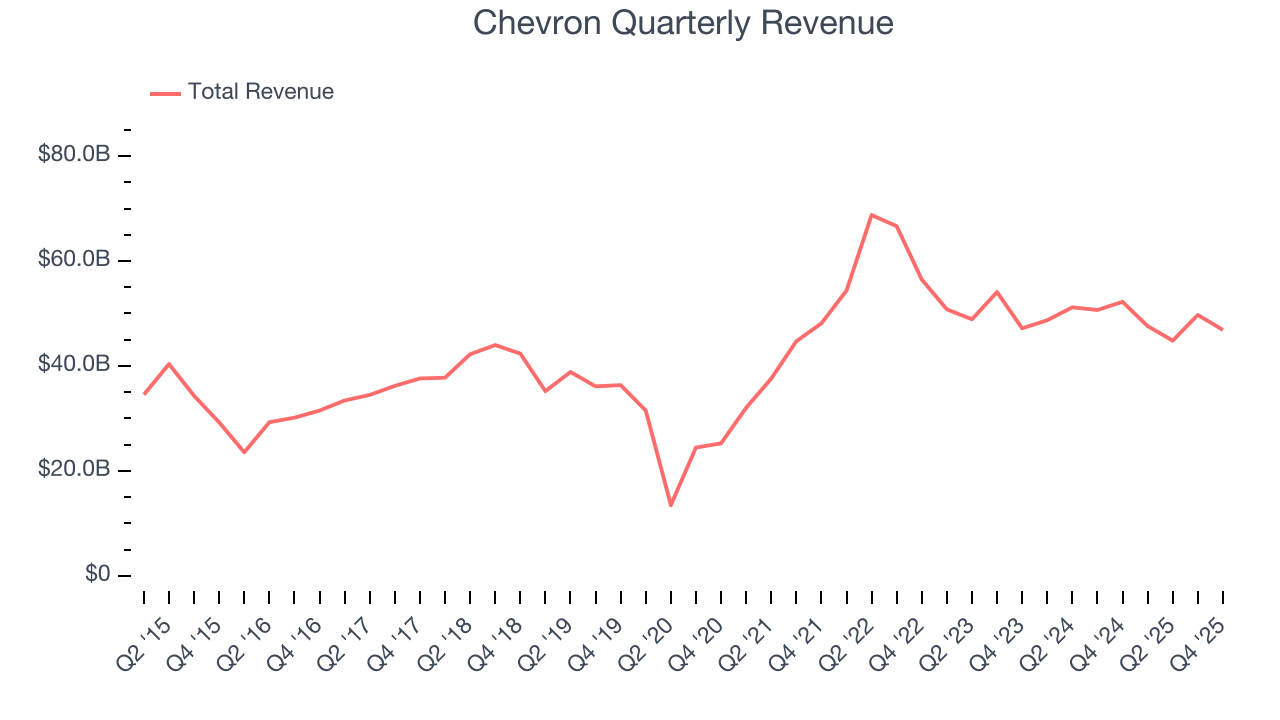
Within Energy, a singular timeframe, even if it’s quite long-term, only sheds light on how well a company rode the last commodity cycle. To better assess whether a company compounds through cycles, we validate our view with an even longer, ten-year view. Chevron’s annualized revenue growth of 3.2% over the last ten years is below its five-year trend, but we still think the results suggest decent demand.
This quarter, Chevron’s revenue fell by 10.2% year on year to $46.87 billion but beat Wall Street’s estimates by 2.3%.
7. Gross Margin
In a single quarter or year, gross margins in the sector can swing wildly due to commodity prices, hedging, or changes in labor costs. Over a multi-year period across different points in the cycle, gross margin differences can signal whether a company is a structurally-advantaged producer (“rock” quality, takeaway, operating costs) or not.
Chevron, which averaged 42.1% gross margin over the last five years, exhibits subpar unit economics in the sector. It means the company will struggle more at lower commodity prices than peers with better gross margins. 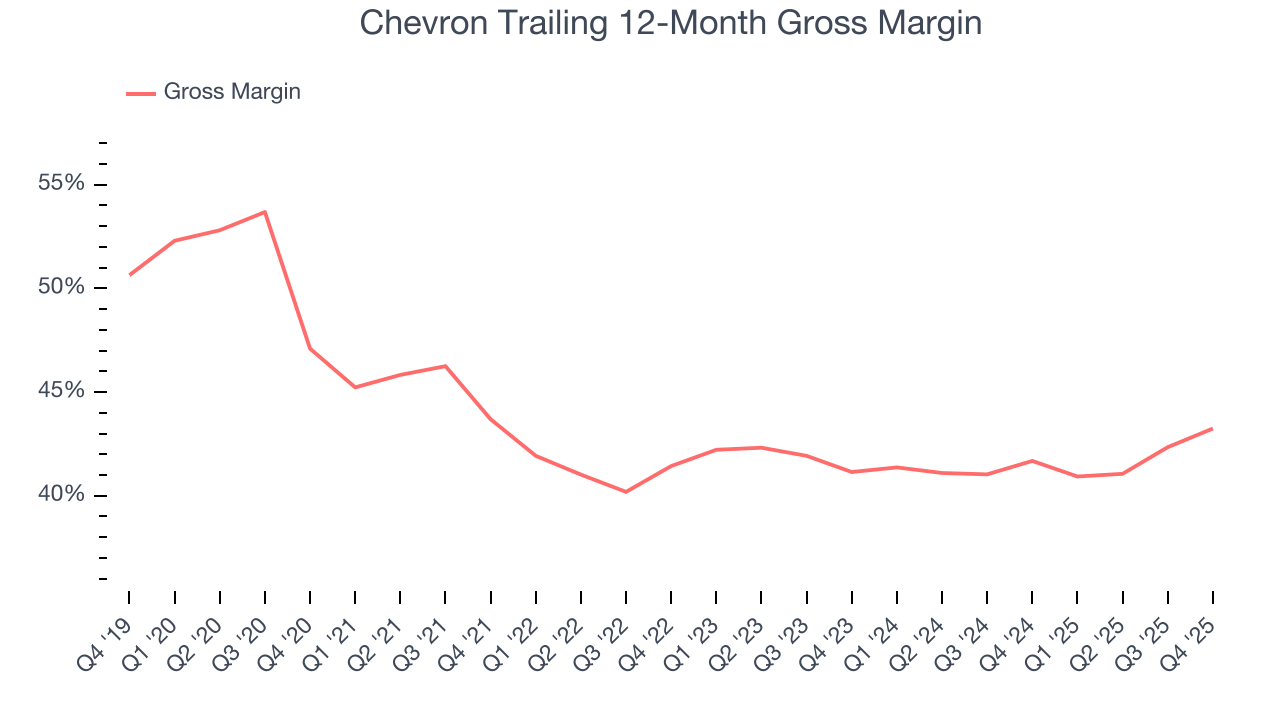
Chevron’s gross profit margin came in at 47.9% this quarter, up 3.8 percentage points year on year.
8. Adjusted EBITDA Margin
Adjusted EBITDA margin strips out accounting distortions tied to depletion and historical drilling spend, providing a clearer view of the cash-generating power of the underlying asset base before financing and reinvestment decisions.
Chevron was profitable over the last five years but held back by its large cost base. Its average EBITDA margin of 24.6% was weak for an upstream and integrated energy business.
Analyzing the trend in its profitability, Chevron’s EBITDA margin decreased by 2.6 percentage points over the last year. This raises questions about the company’s expense base because its revenue growth should have given it leverage on its fixed costs, resulting in better economies of scale and profitability. Chevron’s performance was poor no matter how you look at it - it shows that costs were rising and it couldn’t pass them onto its customers.
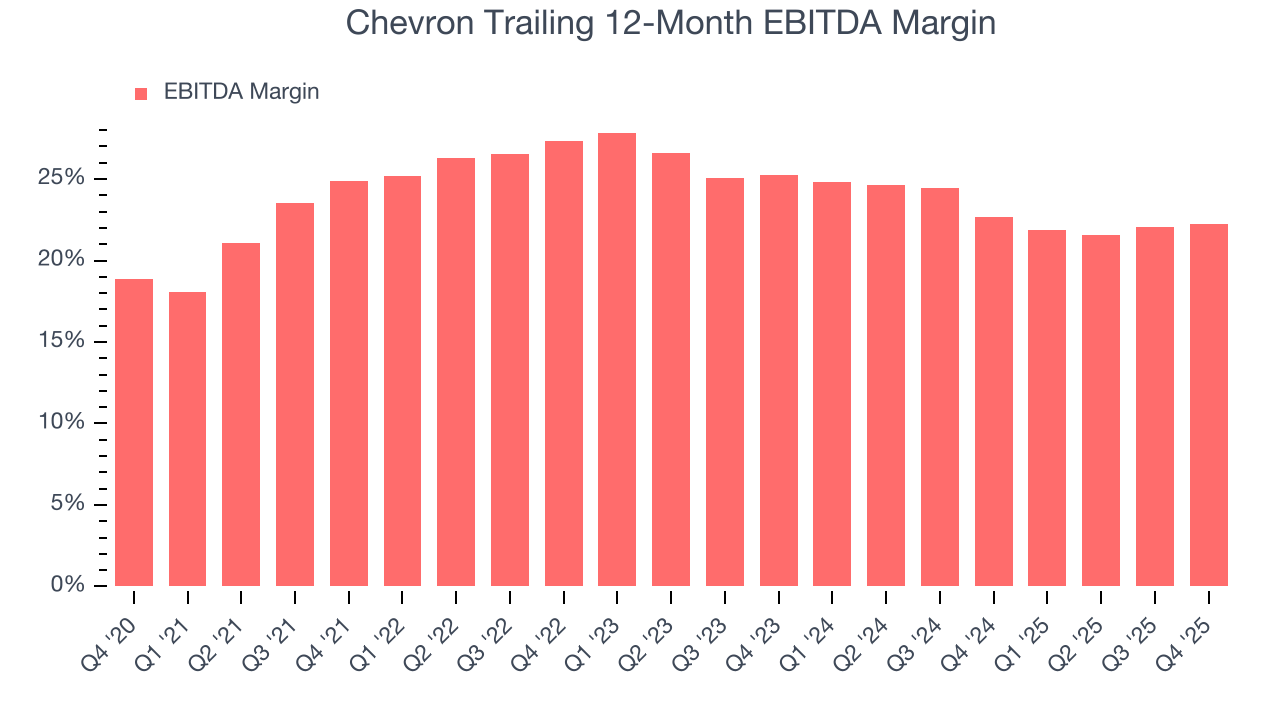
In Q4, Chevron generated an EBITDA margin profit margin of 23.1%, in line with the same quarter last year. This indicates the company’s overall cost structure has been relatively stable. This adjusted EBITDA beat Wall Street’s estimates by 0.8%.
9. Cash Is King
As mentioned above, adjusted EBITDA ignores capital structure and drilling expenditure decisions. These are two huge aspects of an Energy producer, so in order to understand a comprehensive picture of business quality, an investor needs to account for these. Said differently, adjusted EBITDA margins could be solid but free cash flow is abysmal because decline rates of the asset are extreme and the drilling is expensive. Free cash flow tells you about not only the economics of the production that has happened but how much it costs to stay in business as well (further drilling or extraction).
Chevron has shown impressive cash profitability, giving it the option to reinvest or return capital to investors. The company’s free cash flow margin averaged 11% over the last five years, better than the broader energy upstream and integrated energy sector.
Absolute FCF margin levels matter but so does stability of free cash flow. All else equal, we’d prefer a 25.0% average free cash flow margin that is quite steady no matter how commodity prices behave rather than extremely high margins when times are good and negative ones when they’re tough.
Chevron’s ratio of quarterly free cash flow volatility to WTI crude price volatility over the past five years was 3.2 (lower is better), indicating excellent insulation from commodity swings. This stability supports superior capital access in downturns and positions Chevron to act as a consolidator when weaker peers are forced to retrench.
You may be asking why we wait until the free cash flow line to perform this stability analysis versus commodity prices. Why not compare revenue or EBITDA to WTI Crude prices in the case of Chevron? Because what ultimately matters is not how much revenue or profit you earn when prices are high but how much cash you can generate when prices are low. Free cash flow is the superior metric because it includes everything from hedging prowess to growth and maintenance capex to management behavior during good times and bad.
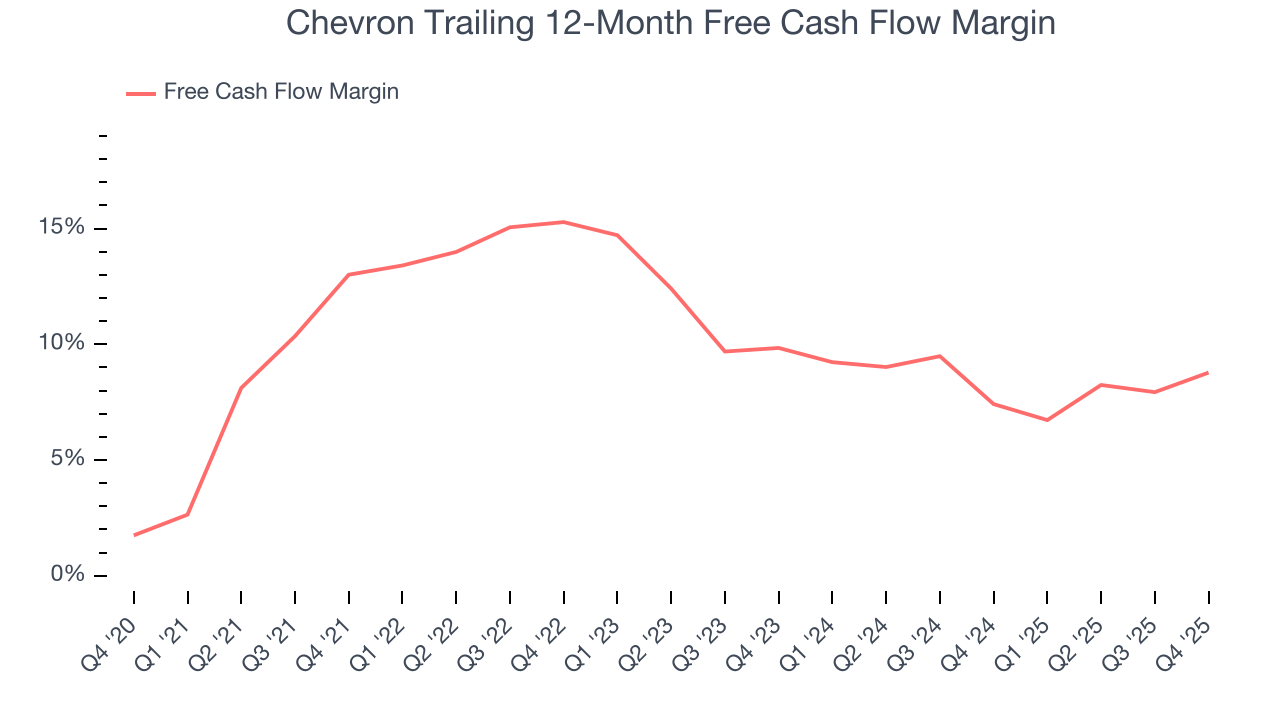
Chevron’s free cash flow clocked in at $5.53 billion in Q4, equivalent to a 11.8% margin. This result was good as its margin was 3.4 percentage points higher than in the same quarter last year. We hope the company can build on this trend.
10. Return on Invested Capital (ROIC)
Free cash flow shows how much money a producer generated, while ROIC shows how efficiently that money was earned. ROIC measures the operating profit produced for each dollar of capital invested, whether from debt or equity. Cash generation measures quantity while ROIC measures the quality of value creation.
We at StockStory like to look at ROIC over a ten-year period because energy investment cycles can involve up to five years of ramping production and another five years of harvesting. A decade view captures buying, extracting, and monetizing rather than just part of that picture. Chevron historically did a mediocre job investing in profitable growth initiatives. Its ten-year average ROIC was 7.4%, somewhat low compared to the best energy upstream and integrated energy companies that consistently pump out 25%+.
We like to invest in businesses with high returns, but the trend in a company’s ROIC is what often surprises the market and moves the stock price. Unfortunately, Chevron’s ROIC has decreased over the last few years. Paired with its already low returns, these declines suggest its profitable growth opportunities are few and far between.
11. Balance Sheet Assessment
Chevron reported $6.3 billion of cash and $40.76 billion of debt on its balance sheet in the most recent quarter. As investors in high-quality companies, we primarily focus on two things: 1) that a company’s debt level isn’t too high and 2) that its interest payments are not excessively burdening the business.
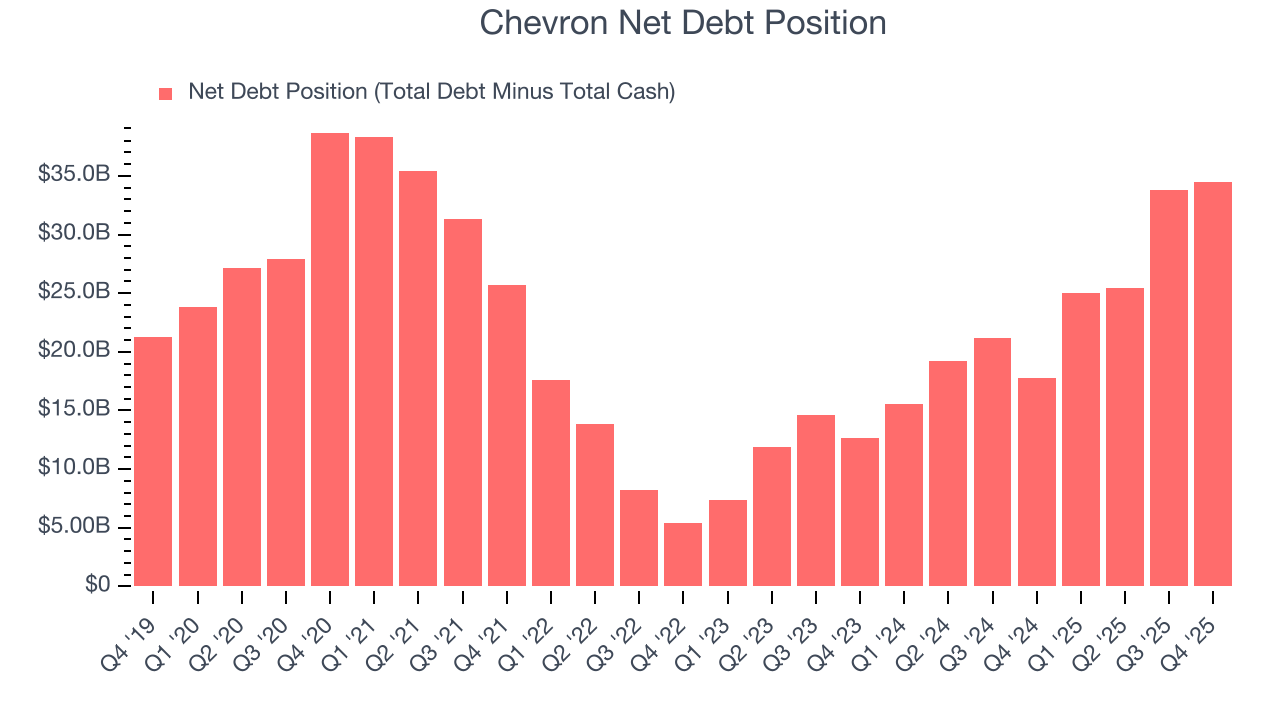
With $42.06 billion of EBITDA over the last 12 months, we view Chevron’s 0.8× net-debt-to-EBITDA ratio as safe. We also see its $1.22 billion of annual interest expenses as appropriate. The company’s profits give it plenty of breathing room, allowing it to continue investing in growth initiatives.
12. Key Takeaways from Chevron’s Q4 Results
We enjoyed seeing Chevron beat analysts’ revenue expectations this quarter. We were also glad its EPS outperformed Wall Street’s estimates. Overall, this print had some key positives. The stock traded up 2% to $190.06 immediately following the results.
13. Is Now The Time To Buy Chevron?
Updated: March 18, 2026 at 1:03 AM EDT
Are you wondering whether to buy Chevron or pass? We urge investors to not only consider the latest earnings results but also longer-term business quality and valuation as well.
Chevron is a fine business. To kick things off, its revenue growth over the last five years was solid for the sector. And while its EBITDA margins reveal bottom-tier profitability compared to other energy upstream and integrated energy companies, its top-tier scale enables operational efficiencies, capital market access, and investment in advanced technologies. On top of that, its free cash flowvolatility compared to commodity price volatility is very low, demonstrating top-tier free cash flow stability.
Chevron’s P/E ratio based on the next 12 months is 24.8x. Looking at the energy upstream and integrated energy space right now, Chevron trades at a compelling valuation. If you believe in the company and its growth potential, now is an opportune time to buy shares.
Wall Street analysts have a consensus one-year price target of $191.83 on the company (compared to the current share price of $197.96).