
Dynatrace (DT)
Dynatrace catches our eye. Despite its slow anticipated growth, its extremely profitable operations give it a high margin of safety.― StockStory Analyst Team


1. News
2. Summary
Why Dynatrace Is Interesting
With its platform processing over 30 trillion pieces of IT performance data daily, Dynatrace (NYSE:DT) provides an AI-powered platform that helps organizations monitor, secure, and optimize their applications and IT infrastructure across cloud environments.
- Software is difficult to replicate at scale and leads to a top-tier gross margin of 81.8%
- Excellent operating margin highlights the strength of its business model, and its rise over the last year was fueled by some leverage on its fixed costs
- On a dimmer note, its operating margin expanded by 2.7 percentage points over the last year as it scaled and became more efficient
Dynatrace is close to becoming a high-quality business. If you believe in the company, the price looks reasonable.




3. Dynatrace (DT) Research Report: Q4 CY2025 Update
Cloud observability platform Dynatrace (NYSE:DT) reported revenue ahead of Wall Street’s expectations in Q4 CY2025, with sales up 18.2% year on year to $515.5 million. Guidance for next quarter’s revenue was better than expected at $520.5 million at the midpoint, 1.2% above analysts’ estimates. Its non-GAAP profit of $0.44 per share was 7.2% above analysts’ consensus estimates.
Dynatrace (DT) Q4 CY2025 Highlights:
- Revenue: $515.5 million vs analyst estimates of $505.9 million (18.2% year-on-year growth, 1.9% beat)
- Adjusted EPS: $0.44 vs analyst estimates of $0.41 (7.2% beat)
- Adjusted Operating Income: $153.4 million vs analyst estimates of $146.2 million (29.8% margin, 4.9% beat)
- Revenue Guidance for Q1 CY2026 is $520.5 million at the midpoint, above analyst estimates of $514.3 million
- Management raised its full-year Adjusted EPS guidance to $1.68 at the midpoint, a 3.1% increase
- Operating Margin: 14.1%, up from 10.9% in the same quarter last year
- Free Cash Flow Margin: 5.3%, similar to the previous quarter
- Annual Recurring Revenue: $1.97 billion (19.7% year-on-year growth, beat)
- Billings: $560.1 million at quarter end, up 26.4% year on year
- Market Capitalization: $10.16 billion
Company Overview
With its platform processing over 30 trillion pieces of IT performance data daily, Dynatrace (NYSE:DT) provides an AI-powered platform that helps organizations monitor, secure, and optimize their applications and IT infrastructure across cloud environments.
The Dynatrace platform serves as both guardian and guide for mission-critical digital systems through its comprehensive suite of solutions. The company's Infrastructure Observability provides visibility into IT infrastructure across public, private, and hybrid cloud environments, while its Application Observability monitors the full technology stack through distributed tracing. Its Security offerings detect vulnerabilities and protect against cyber attacks in real-time.
Dynatrace serves approximately 4,000 customers across diverse industries including banking, government, insurance, retail, and transportation. The platform is particularly valuable to large enterprises managing complex cloud architectures, where traditional monitoring approaches struggle with the scale and frequency of changes in these environments.
The company offers its platform primarily as a Software-as-a-Service (SaaS) solution, though it also provides a Dynatrace Managed option for customers who need to maintain control over their data environment. Revenue comes from subscription licensing, with its newer Dynatrace Platform Subscription model allowing customers to make a minimum annual commitment and then consume various capabilities based on actual usage.
A typical customer might use Dynatrace to automatically detect when a mobile banking application is experiencing slowdowns, identify the root cause within seconds (such as a database query issue), and even automatically implement fixes before most users notice any problems.
4. Cloud Monitoring
Software is eating the world, increasing organizations’ reliance on digital-only solutions. As more workloads and applications move to the cloud, the reliability of the underlying cloud infrastructure becomes ever more critical and ever more complex. To solve this challenge, companies and their engineering teams have turned to a range of cloud monitoring tools that provide them with the visibility to troubleshoot issues in real-time.
Dynatrace competes primarily with Cisco's AppDynamics and Splunk divisions (NASDAQ:CSCO), Datadog (NASDAQ:DDOG), and New Relic (acquired by private equity firms Francisco Partners and TPG in 2023).
5. Revenue Growth
Examining a company’s long-term performance can provide clues about its quality. Any business can put up a good quarter or two, but many enduring ones grow for years. Thankfully, Dynatrace’s 24.1% annualized revenue growth over the last five years was solid. Its growth beat the average software company and shows its offerings resonate with customers, a helpful starting point for our analysis.
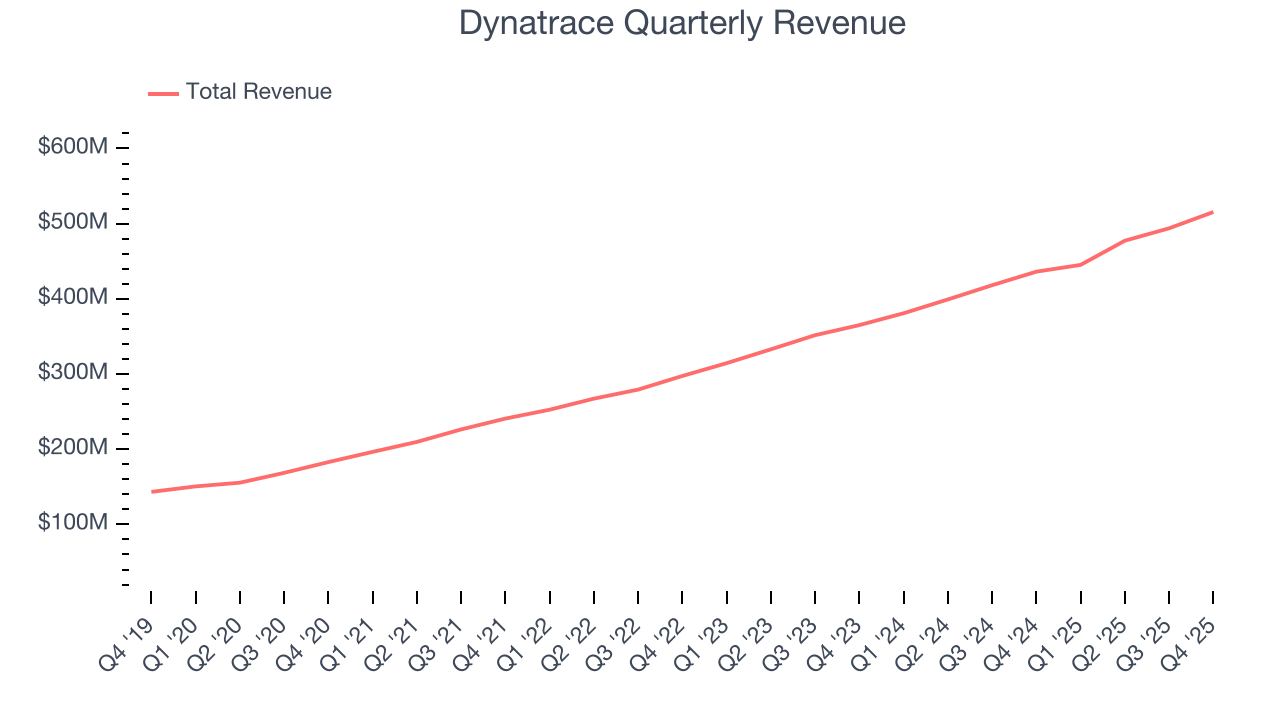
We at StockStory place the most emphasis on long-term growth, but within software, a half-decade historical view may miss recent innovations or disruptive industry trends. Dynatrace’s annualized revenue growth of 19% over the last two years is below its five-year trend, but we still think the results suggest healthy demand. 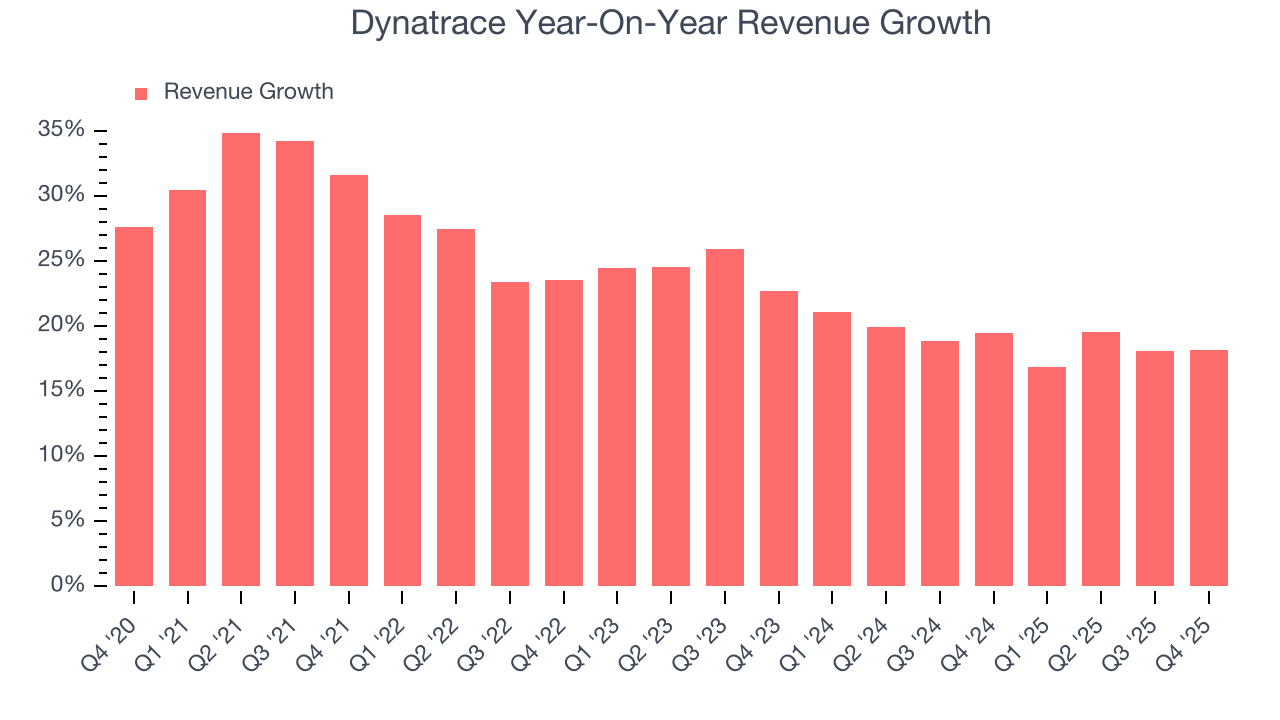
This quarter, Dynatrace reported year-on-year revenue growth of 18.2%, and its $515.5 million of revenue exceeded Wall Street’s estimates by 1.9%. Company management is currently guiding for a 16.9% year-on-year increase in sales next quarter.
Looking further ahead, sell-side analysts expect revenue to grow 14% over the next 12 months, a deceleration versus the last two years. This projection doesn't excite us and implies its products and services will face some demand challenges. At least the company is tracking well in other measures of financial health.
6. Annual Recurring Revenue
While reported revenue for a software company can include low-margin items like implementation fees, annual recurring revenue (ARR) is a sum of the next 12 months of contracted revenue purely from software subscriptions, or the high-margin, predictable revenue streams that make SaaS businesses so valuable.
Dynatrace’s ARR punched in at $1.97 billion in Q4, and over the last four quarters, its growth was solid as it averaged 17.7% year-on-year increases. This performance aligned with its total sales growth, reflecting the company’s ability to maintain strong customer relationships and secure longer-term commitments. Its growth also contributes positively to Dynatrace’s predictability and valuation, as investors typically prefer businesses with recurring revenue. 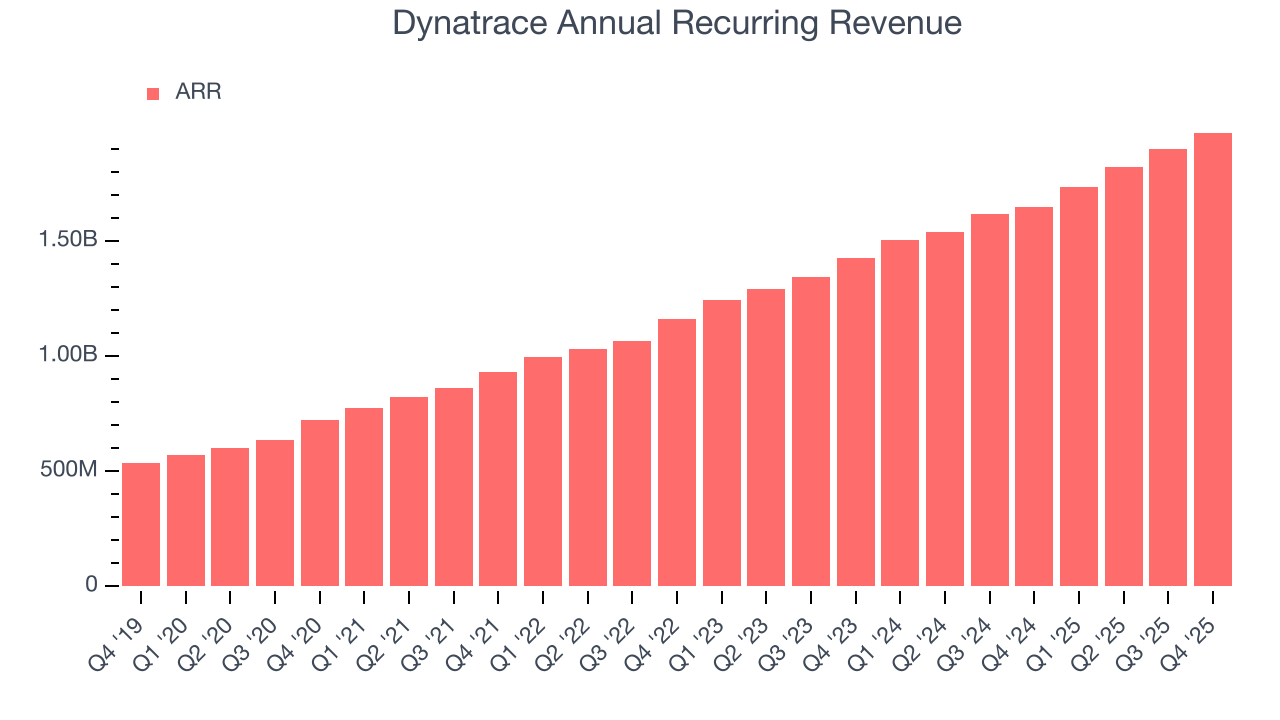
7. Customer Acquisition Efficiency
The customer acquisition cost (CAC) payback period measures the months a company needs to recoup the money spent on acquiring a new customer. This metric helps assess how quickly a business can break even on its sales and marketing investments.
Dynatrace is efficient at acquiring new customers, and its CAC payback period checked in at 36.8 months this quarter. The company’s relatively fast recovery of its customer acquisition costs gives it the option to accelerate growth by increasing its sales and marketing investments. 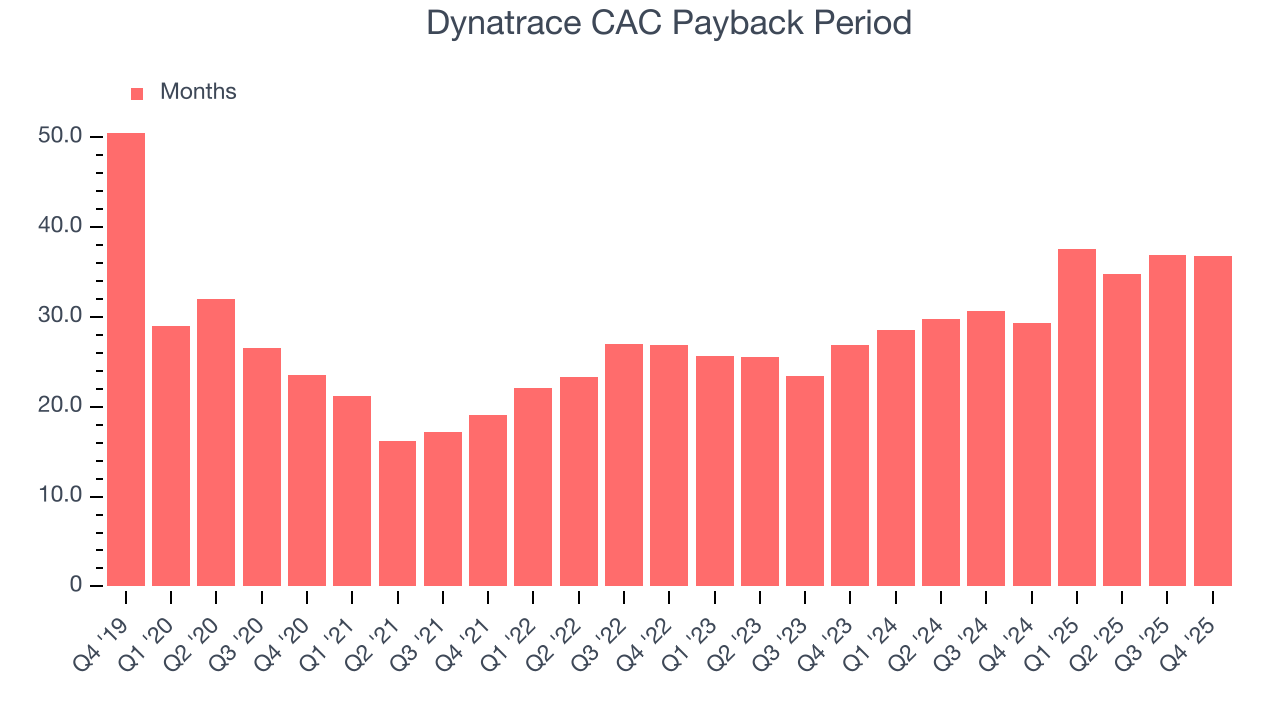
8. Gross Margin & Pricing Power
What makes the software-as-a-service model so attractive is that once the software is developed, it usually doesn’t cost much to provide it as an ongoing service. These minimal costs can include servers, licenses, and certain personnel.
Dynatrace’s robust unit economics are better than the broader software industry, an output of its asset-lite business model and pricing power. They also enable the company to fund large investments in new products and sales during periods of rapid growth to achieve higher profits in the future. As you can see below, it averaged an excellent 81.7% gross margin over the last year. That means Dynatrace only paid its providers $18.30 for every $100 in revenue.
The market not only cares about gross margin levels but also how they change over time because expansion creates firepower for profitability and free cash generation. Dynatrace has seen gross margins decline by 0.8 percentage points over the last 2 year, which is poor compared to software peers.
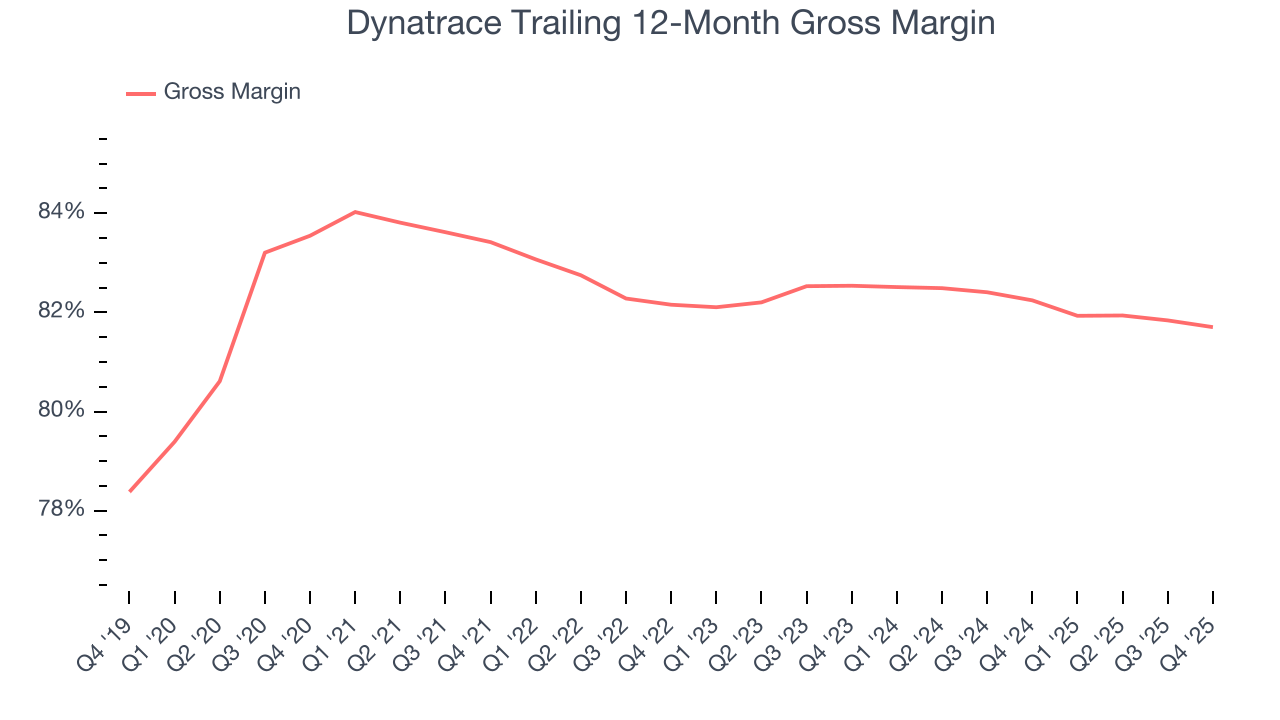
This quarter, Dynatrace’s gross profit margin was 81.4%, in line with the same quarter last year. Zooming out, the company’s full-year margin has remained steady over the past 12 months, suggesting its input costs have been stable and it isn’t under pressure to lower prices.
9. Operating Margin
While many software businesses point investors to their adjusted profits, which exclude stock-based compensation (SBC), we prefer GAAP operating margin because SBC is a legitimate expense used to attract and retain talent. This metric shows how much revenue remains after accounting for all core expenses – everything from the cost of goods sold to sales and R&D.
Dynatrace has been an efficient company over the last year. It was one of the more profitable businesses in the software sector, boasting an average operating margin of 13%. This result isn’t surprising as its high gross margin gives it a favorable starting point.
Analyzing the trend in its profitability, Dynatrace’s operating margin rose by 3.2 percentage points over the last two years, as its sales growth gave it operating leverage.
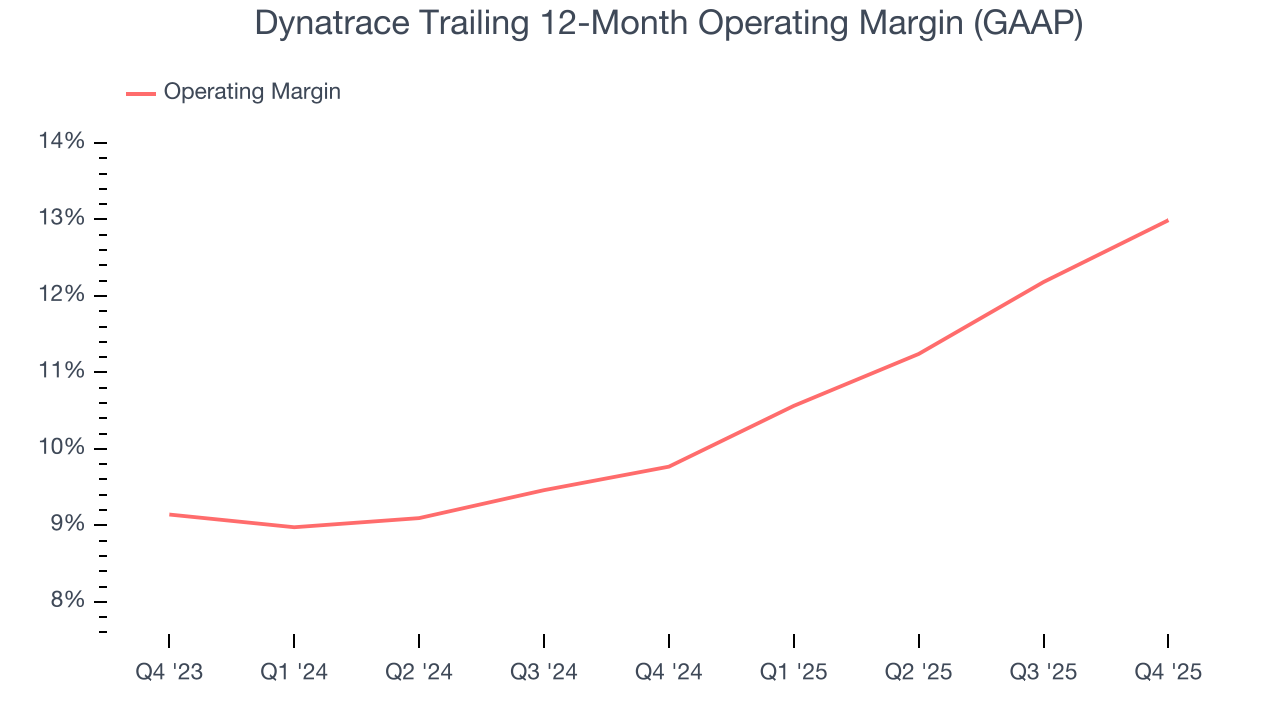
This quarter, Dynatrace generated an operating margin profit margin of 14.1%, up 3.2 percentage points year on year. The increase was encouraging, and because its operating margin rose more than its gross margin, we can infer it was more efficient with expenses such as marketing, R&D, and administrative overhead.
10. Cash Is King
Although earnings are undoubtedly valuable for assessing company performance, we believe cash is king because you can’t use accounting profits to pay the bills.
Dynatrace has shown robust cash profitability, driven by its attractive business model and cost-effective customer acquisition strategy that enable it to invest in new products and services rather than sales and marketing. The company’s free cash flow margin averaged 23.9% over the last year, quite impressive for a software business.
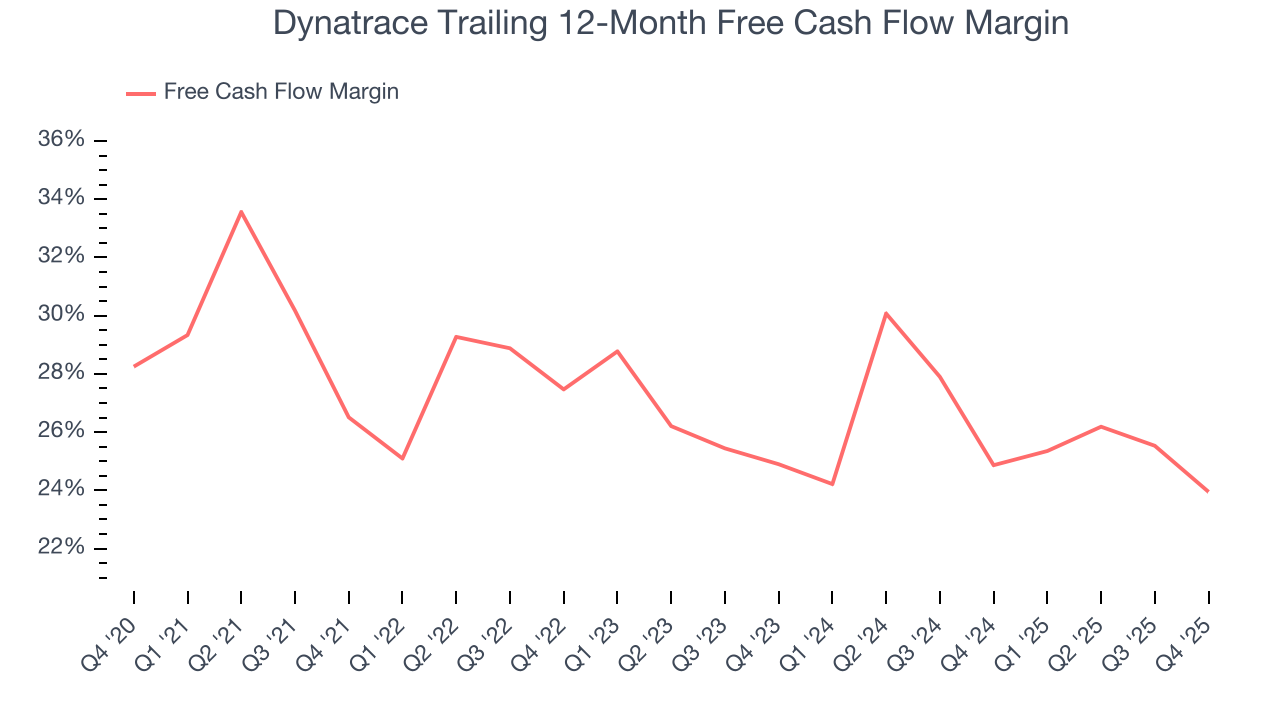
Dynatrace’s free cash flow clocked in at $27.23 million in Q4, equivalent to a 5.3% margin. The company’s cash profitability regressed as it was 3.3 percentage points lower than in the same quarter last year, but we wouldn’t read too much into the short term because investment needs can be seasonal, causing temporary swings. Long-term trends carry greater meaning.
Over the next year, analysts’ consensus estimates show they’re expecting Dynatrace’s free cash flow margin of 23.9% for the last 12 months to remain the same.
11. Key Takeaways from Dynatrace’s Q4 Results
It was great to see Dynatrace’s full-year EPS guidance top analysts’ expectations. We were also glad its EPS guidance for next quarter exceeded Wall Street’s estimates. Overall, we think this was a very solid quarter. The stock traded up 10% to $37.09 immediately following the results.
12. Is Now The Time To Buy Dynatrace?
Updated: February 9, 2026 at 6:49 AM EST
The latest quarterly earnings matters, sure, but we actually think longer-term fundamentals and valuation matter more. Investors should consider all these pieces before deciding whether or not to invest in Dynatrace.
There are some positives when it comes to Dynatrace’s fundamentals. To kick things off, its revenue growth was solid over the last five years. And while its expanding operating margin shows it’s becoming more efficient at building and selling its software, its admirable gross margin indicates excellent unit economics. On top of that, its strong operating margins show it’s a well-run business.
Dynatrace’s price-to-sales ratio based on the next 12 months is 4.6x. When scanning the software space, Dynatrace trades at a fair valuation. For those confident in the business and its management team, this is a good time to invest.
Wall Street analysts have a consensus one-year price target of $57.23 on the company (compared to the current share price of $37.09), implying they see 54.3% upside in buying Dynatrace in the short term.